




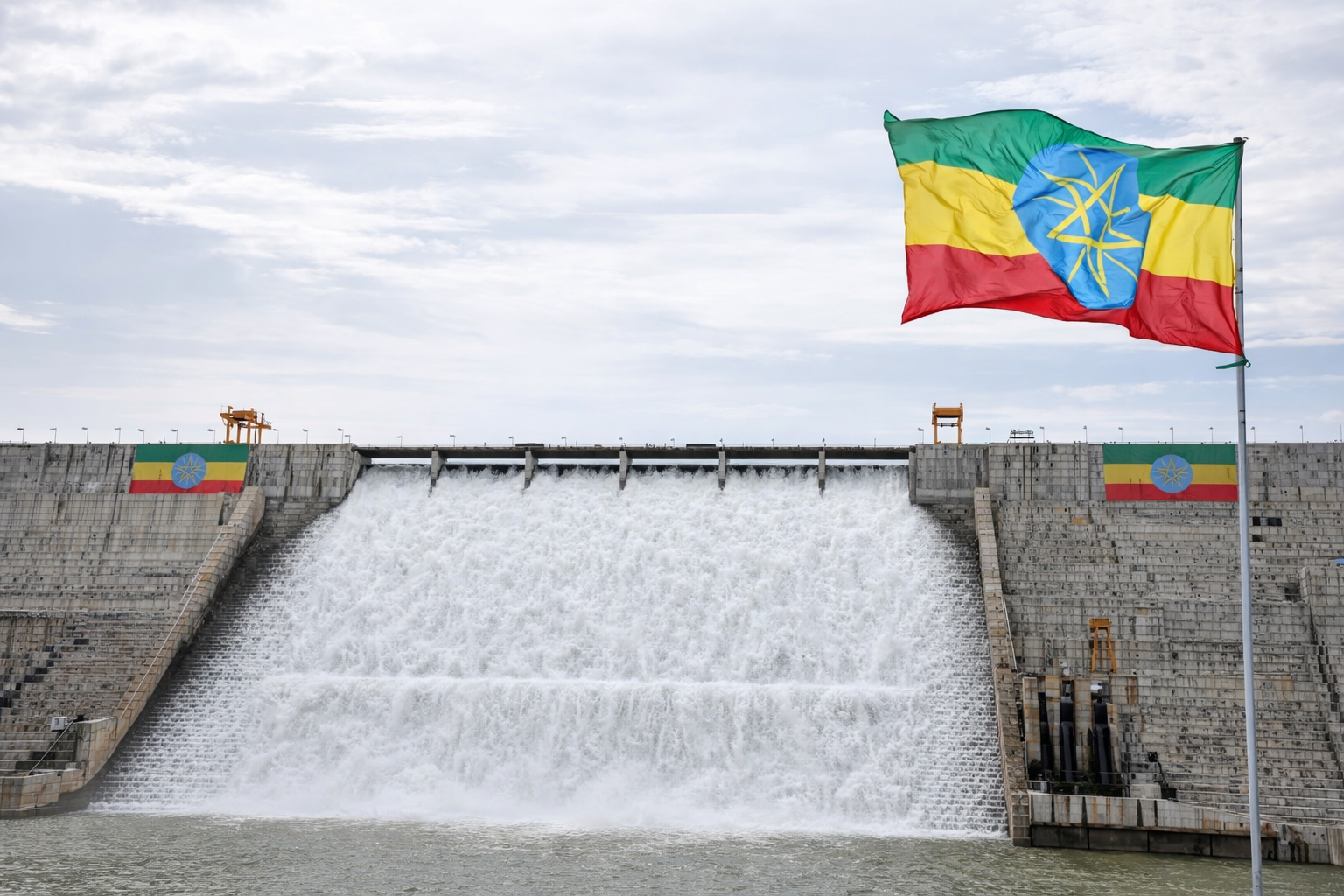
Egypt’s latest warning over the Grand Ethiopian Renaissance Dam once again frames Ethiopia’s actions as unacceptable and unlawful. Yet that argument leaves out the most important part of the story.
Ethiopia is not seeking control over the Nile or attempting to deny water to downstream countries. It is exercising what every sovereign nation expects for itself: the right to use its own natural resources to reduce poverty, generate electricity, and build a stronger economy.
The debate over the GERD is therefore about much more than a dam. It is about whether upstream countries have the same right to development that downstream countries have enjoyed for generations.
The Blue Nile begins in the Ethiopian highlands and contributes approximately 85 percent of the water that eventually reaches Sudan and Egypt. Despite being the primary source of the river, Ethiopia remained one of the least electrified countries in the world for decades. Millions of Ethiopians lived without reliable electricity while the waters originating in their country sustained agriculture, industry, and economic development downstream.
The GERD was conceived to address that historic imbalance by transforming one of Ethiopia’s greatest natural resources into a source of clean energy and economic opportunity.
Much of the rhetoric surrounding the project also overlooks what the GERD actually is. It is a hydroelectric dam, not a large irrigation scheme. The water is used to generate electricity as it passes through turbines before continuing downstream into Sudan and Egypt. Unlike irrigation projects, which permanently consume water through agriculture and evaporation, hydroelectric generation does not remove the river from the basin.
Scientific studies have also suggested that regulating the Blue Nile can reduce destructive flooding in Sudan, decrease sediment accumulation in downstream reservoirs, and improve river management throughout the year. These potential benefits do not eliminate the need for cooperation, but they do challenge the claim that the dam is inherently harmful to downstream countries.
Egypt has repeatedly argued that Ethiopia acted unilaterally and violated international law by filling and operating the dam without a legally binding agreement. Ethiopia, however, has consistently maintained that it has participated in years of negotiations involving Egypt, Sudan, the African Union, and other international partners.
The disagreement has never been over whether cooperation is desirable. It has been over whether cooperation should give downstream countries the ability to effectively veto Ethiopia’s future development. From Ethiopia’s perspective, accepting such an arrangement would place permanent limits on its sovereignty and its ability to meet the needs of a population of more than 120 million people.
Modern international water law does not support the idea that one country has exclusive rights over a shared river simply because it has depended on it for a longer period of time. Instead, it is built around the principles of equitable and reasonable utilization, cooperation, and the obligation to avoid causing significant harm.
Those principles recognize that every riparian state has both rights and responsibilities. They do not require upstream countries to remain underdeveloped in order to preserve historical patterns of resource use downstream.
Egypt also continues to rely on the 1929 and 1959 Nile agreements as the basis for many of its legal arguments. Those treaties divided the Nile waters almost entirely between Egypt and Sudan, but Ethiopia was never invited to participate in either agreement and never accepted their terms.
As a matter of international law, treaties generally do not impose obligations on states that were not parties to them. For Ethiopia, these colonial-era arrangements cannot legitimately determine its rights over waters that originate within its own territory.
Continuing to insist otherwise ignores both the evolution of international water law and the reality that the Nile Basin includes eleven sovereign states, not just two.
None of this means that Egypt’s concerns should be dismissed. Egypt is heavily dependent on the Nile, and its water security is a legitimate national interest. Responsible management of droughts, transparent data sharing, and continued technical cooperation are all essential for maintaining stability throughout the basin.
Recognizing those concerns, however, should not require Ethiopia to indefinitely postpone its own development. One country’s dependence on the river cannot become another country’s permanent poverty sentence.
The debate is also about broader regional change. As Ethiopia expands electricity generation, modernizes its infrastructure, attracts industrial investment, and strengthens its economy, it naturally becomes a more influential regional power.
Some Ethiopians believe this shift is the deeper source of Egypt’s opposition. They argue that Ethiopian development has often been viewed with suspicion whenever it alters the regional balance of power. Whether or not one fully accepts that interpretation, it reflects a widespread belief within Ethiopia that the controversy surrounding the GERD extends beyond technical questions of water management and into the realm of regional geopolitics.
Ultimately, development should never be portrayed as aggression. Building power plants, expanding access to electricity, and reducing poverty are objectives that every nation has the right to pursue.
The GERD was financed largely by Ethiopians themselves through bonds, public contributions, and national sacrifice. For many citizens, it represents far more than a hydroelectric project. It symbolizes self-reliance, national dignity, and the belief that African countries can finance and build transformative infrastructure using their own resources.
The future of the Nile should not be determined by colonial-era agreements that excluded the countries where much of the river originates, nor by political pressure that seeks to preserve historical advantages. It should instead be guided by scientific evidence, mutual respect, and a commitment to equitable development for all riparian states.
The real choice facing the Nile Basin is not between Ethiopia’s development and Egypt’s survival. It is between preserving an outdated framework based on historical privilege and building a future based on cooperation, shared responsibility, and the recognition that every nation along the Nile has an equal right to pursue prosperity.
