




The word genocide was never meant to be casual.
It was created to describe the gravest crime recognized under international law: the deliberate destruction of a people. The legal threshold was intentionally set extraordinarily high because the accusation itself carries enormous consequences. It can shape sanctions, justify intervention, isolate governments diplomatically, inflame ethnic tensions, radicalize political discourse, and permanently alter how nations are remembered in history.
That is why genocide determinations have traditionally belonged to courts, tribunals, and formally mandated international investigations operating under rigorous evidentiary standards.
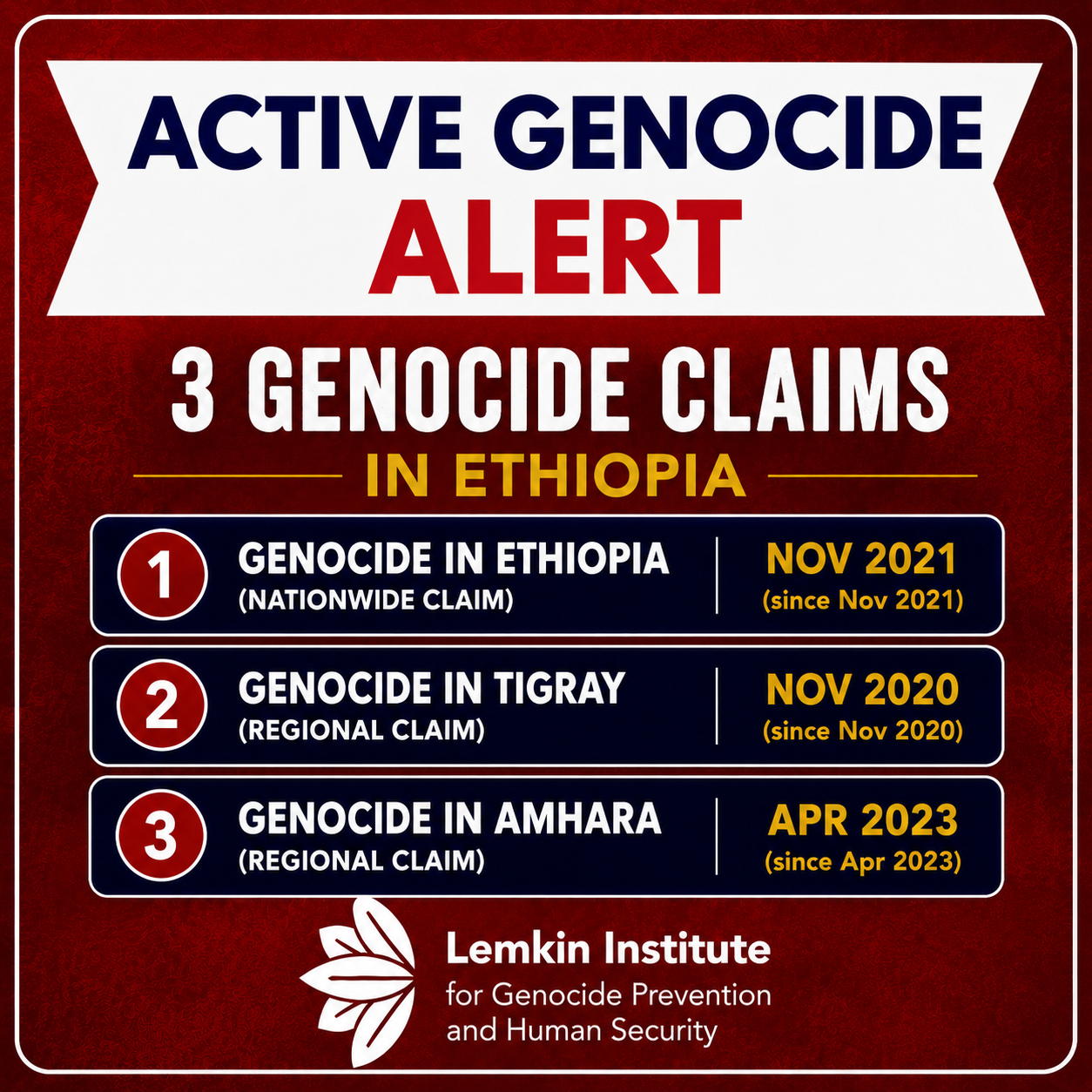
Yet today, in the age of social media activism, a growing number of private advocacy organizations have begun issuing genocide declarations in real time during ongoing conflicts. One of the most visible examples is the Lemkin Institute for Genocide Prevention, a Philadelphia based nonprofit organization that frequently publishes “active genocide alerts” concerning conflicts around the world, including Ethiopia.
The issue raised by critics is not opposition to genocide prevention itself. Genuine atrocity prevention remains essential. The issue is whether activist organizations without formal legal mandate, judicial authority, or large scale investigative infrastructure should present themselves as authoritative voices on genocide.
That distinction matters because advocacy and legal determination are not the same thing.
No International Mandate to Determine Genocide
The Lemkin Institute is not a United Nations body, an international court, or a treaty based investigative mechanism. It possesses no formal legal authority to determine whether genocide has occurred under the United Nations Genocide Convention.
Under international law, genocide requires proof of specific intent to destroy a protected group in whole or in part. Historically, establishing that standard has required years of evidence gathering, forensic review, witness examination, intelligence analysis, and judicial scrutiny.
Yet the Institute frequently publishes categorical genocide language during active conflicts before independent international bodies have reached comparable conclusions.
Critics argue that this increasingly blurs the line between activism and adjudication.
Once genocide language enters public discourse, it shapes international perception immediately regardless of whether the legal standard has actually been met.
The “Lemkin” Name Controversy
The organization has also faced controversy regarding its use of the name of Raphael Lemkin, the scholar who coined the word genocide itself.
Public reporting indicates that members of Lemkin’s family and affiliated advocacy figures challenged the organization’s use of the name and accused it of politicizing Lemkin’s legacy.
The Institute has publicly rejected those criticisms and defended its work.
Regardless of where one stands, the dispute raises a legitimate question: should organizations invoking the moral authority of genocide scholarship themselves be held to exceptionally high standards of neutrality, transparency, and methodological rigor?
Can a Small Donor Funded Organization Conduct Genocide Investigations?
Publicly available nonprofit information raises additional questions about institutional capacity.
According to reporting quoted by the Institute itself, its 2023 annual report listed only $10,300 in revenue. The same Institute response describes the organization as “all volunteer” and states that its executive director works full time as an unpaid volunteer.
ProPublica lists the Lemkin Institute as a Philadelphia nonprofit that became tax exempt in September 2023. It also states that no Form 990 financial data is available for the organization in its database.
This raises a fair and unavoidable institutional question.
Can a small donor funded organization operating with revenue at that scale realistically perform the immense investigative work traditionally associated with genocide determinations?
Formal genocide investigations often require forensic specialists, multilingual legal teams, field researchers, satellite imagery analysis, intelligence review, witness protection, secure evidence preservation, independent corroboration, and long term field access in active war zones.
These are extraordinarily resource intensive processes.
This is not an argument that small organizations cannot advocate for human rights. They absolutely can. But advocacy is different from legal determination.
If an organization lacks the capacity to independently investigate conflict zones at scale, then its statements should be framed as advocacy, concern, or preliminary interpretation rather than authoritative legal conclusions carrying the moral force of courts or international commissions.
Ethiopia and the Expansion of “Genocide” Framing
One of the strongest criticisms directed at the Institute concerns its repeated use of genocide terminology regarding Ethiopia.
The Institute has issued multiple genocide related alerts connected to Ethiopia, including Ethiopia broadly, Tigray, and Amhara. Critics argue that the Institute increasingly appears to treat Ethiopia not as a complex federal state experiencing multiple overlapping insurgencies and political crises, but as a permanently genocidal structure viewed through successive regional narratives.
International law distinguishes between civil war, insurgency, ethnic violence, war crimes, crimes against humanity, and genocide.
These are not interchangeable categories.
The criticism is not that atrocities cannot occur during internal conflicts. They absolutely can. The concern is whether every regional insurgency involving armed militias automatically satisfies the legal threshold for genocide before independent international investigations establish facts.
Critics further argue that the Institute appears particularly focused on fragile or conflict affected states where independent verification is difficult in real time, especially African conflict zones, while comparatively fewer genocide related alerts target powerful Western states in the context of internal security operations.
Ethiopia Fragmented Into Multiple “Genocide” Narratives
Another unusual aspect of the Institute’s Ethiopia coverage is the way Ethiopia appears divided into multiple overlapping genocide frames.
The Institute has separately framed Ethiopia generally, Tigray, and Amhara through genocide related alerts and warnings. In one Ethiopia update, the Institute states that the government created a structure to “exterminate” Amhara identity and describes the ruling party as an “Oromo Prosperity Party regime.”
Critics argue that this cumulative framing creates the impression that every major security crisis inside Ethiopia becomes another genocide narrative attached to the Ethiopian state itself.
That matters because Ethiopia is a federal country with ethnic regions, multiple armed actors, regional insurgencies, and competing political movements. Repeatedly separating conflicts into regional genocide narratives risks reinforcing ethnic fragmentation rather than clarifying legal responsibility.
A fair question therefore arises: does the Institute apply this same layered regional genocide framework to other countries experiencing internal conflict, or is Ethiopia receiving unusually fragmented treatment?
If one country is repeatedly broken into separate genocide narratives tied to ethnicity and regional identity, concerns about selective methodology naturally emerge.
The Question of Fano and Apparent Asymmetry
The issue becomes even more controversial regarding Fano.
In one Ethiopia update, the Institute described Fano linked forces as a “local resistance force” while simultaneously maintaining an active genocide alert against the Ethiopian government.
The Institute also stated that it does not formally endorse Fano. However, critics argue that terminology matters.
Can a report truly appear neutral if an armed insurgent force is described through resistance language while the government is framed primarily through genocide allegations?
An elected government and an armed militia are not identical legal actors under international law. Governments are bound by constitutional obligations, treaty commitments, and international accountability mechanisms in ways irregular armed groups are not.
That distinction does not excuse state abuses. Governments absolutely can commit violations and must be scrutinized. But insurgent groups also require scrutiny.
Critics argue that illegal paramilitary organizations should first be identified and analyzed as such rather than implicitly elevated into moral equivalence with internationally recognized governments.
A credible analysis should identify armed militias as armed militias, examine alleged abuses committed by all sides, and avoid implicitly creating moral equivalence between constitutional state institutions and irregular armed actors lacking democratic or international mandate.
Reliance on AAA and Diaspora Advocacy Networks
Another major concern involves sourcing.
The Institute has acknowledged relying on information from the Amhara Association of America, or AAA, in some Ethiopia related reporting. Critics argue that this matters because AAA is not a neutral international fact finding body. It is an ethnic advocacy organization focused on Amhara interests.
AAA publicly describes itself as an organization dedicated to advancing the political and humanitarian interests of Amhara people. Its X account describes its mission as informing and organizing Amharas in North America. AAA X account.
Public material also connects AAA’s communications director Robel Alemu to Canadian advocacy activity. AAA’s own website states that Robel Alemu submitted a briefing to the Canadian Subcommittee on International Human Rights.
None of that is improper by itself. But critics argue that it raises transparency questions when an organization calling itself the Amhara Association of America appears to operate through a broader North American diaspora network, including Canadian advocacy activity, while providing source material for genocide claims about Ethiopia.
The point is not that diaspora advocacy is illegitimate. Diaspora communities have every right to organize, lobby, fundraise, and speak for communities they believe are under threat.
The issue is methodological.
Advocacy is not the same as neutral investigation.
Critics argue that heavy reliance on partisan advocacy ecosystems creates substantial risk of confirmation bias, selective framing, and amplification of conflict narratives that may not be independently verified.
The Institute itself acknowledged in one update that it “could not independently verify most” incidents referenced in its reporting. That admission alone raises serious methodological questions. Lemkin Institute acknowledgment regarding verification limits.
In active conflicts, social media ecosystems are notoriously difficult to verify. Anyone can claim ethnic affiliation, victim status, eyewitness testimony, or insider knowledge online. Diaspora activism, insurgent propaganda, emotional mobilization, and political narratives often become deeply intertwined.
A genocide accusation should therefore require exceptionally rigorous corroboration rather than reliance on advocacy networks and social media amplification.
What the Abren Analysis Adds
A November 2025 article on Abren directly challenges the Amhara genocide narrative and argues that it omits important context about Ethiopian society, Amhara representation, and the role of armed groups. Author, Rasmus Sonderriis, an Ethiopia based correspondent for media in Chile and Denmark since 2004 has written extensively on various false genocide claims made.
Accordingly, the Amhara are not structurally absent from Ethiopian power. On the contrary they’re represented in the Ethiopian elite “well above” their share of the population and notes that Ethiopia’s First Lady is Amhara. It also says Prime Minister Abiy Ahmed’s government and military are multiethnic and include many Amharas.
Amharic remains dominant in national life, stating that Abiy speaks in parliament in fluent Amharic and that Amharic dominates media and urban life.
These claims do not by themselves disprove abuses against Amhara civilians. But they do challenge the Institute’s sweeping language suggesting that the government seeks to exterminate Amhara identity. If Amharas remain prominent in government, business, the military, culture, language, and urban life, then critics are entitled to ask what research supports the Institute’s claim of a state project to destroy Amhara identity.
This question is especially important because the Institute’s Ethiopia update describes the governing party in heavily ethnic terms. Critics argue that such phrasing resembles diaspora conflict rhetoric more than careful legal analysis.
Abren on Fano and Political Violence
The Abren article also disputes portrayals of Fano as a simple popular defense force.
The author says plainly: “Fano does not represent Amharas.” He also argues that Fano’s main victims include fellow Amharas and says Fano’s chief enemy has been the Amhara regional government.
The article further claims that Fano has attacked or threatened Amhara officials, teachers, businesses, and civilians. It describes Fano as a force that “kills left and right” and says it has sabotaged roads, production facilities, schools, and local economic life.
These are serious allegations and should be treated as one author’s analysis rather than final legal findings. But they are relevant because they directly challenge the framing of Fano as merely a resistance movement.
If the Lemkin Institute uses resistance language for Fano while applying genocide language to the Ethiopian state, critics argue that this creates an appearance of asymmetry.
A human rights organization should be especially careful not to romanticize armed groups, particularly where credible commentators and reporting allege that those groups have committed violence against civilians and political moderates from the very community they claim to defend.
Genocide Narratives as Mobilization Tools
The Abren article also makes a broader argument about genocide narratives in Ethiopia. It compares competing hashtags and describes Amhara genocide rhetoric as one of several ethnic victimhood narratives used in Ethiopian conflict politics.
The author argues that the hashtag “TigrayGenocide” was used to justify the TPLF’s pursuit of power and that “OromoGenocide” became a slogan among OLA supporters. He then characterizes “AmharaGenocide” as another competing propaganda victimology.
This is a contested interpretation. It should not be treated as established fact. But it is directly relevant to the concern that genocide language can become a tool for mobilization.
The word genocide may attract sympathy and international attention. It may help a movement organize donors, media, activists, and foreign policy pressure. But that is precisely why the word must be scrutinized.
When genocide language becomes fused with armed resistance politics, ethnic nationalism, diaspora fundraising, and social media campaigns, the public must ask whether it is being used as a legal category or as a political instrument.
Some analysts and commentators have additionally argued that genocide narratives connected to the Amhara conflict are at times used to mobilize sympathy, legitimacy, and international attention for armed resistance movements. The New Humanitarian on Fano and genocide narratives.
These arguments remain contested and should not be treated as definitive proof of bad faith. However, they reinforce the broader point that genocide allegations require especially rigorous independent verification precisely because such language carries enormous emotional and political power.
The Funding and Advocacy Ecosystem Around Conflict Narratives
Another aspect that deserves scrutiny is the broader fundraising ecosystem surrounding advocacy and conflict narratives connected to Ethiopia.
One of the largest publicly visible fundraising efforts associated with Amhara advocacy networks was the Amhara Emergency Fund, organized through GoFundMe by Wonfel Aid Inc. with participation from AAA and other diaspora organizations. Public campaign data indicated that the fundraiser raised approximately $2.37 million toward a $3 million goal, supported by nearly 8,000 donors. According to the campaign description, the funds were intended for emergency food, shelter, and medical assistance for displaced and injured Amharas.
Wonfel Aid’s own website states that the initiative raised more than $1.8 million primarily through crowdfunding and supported food distribution, shelter assistance, medical services, and volunteer deployment at displacement sites.
Additional Amhara related crowdfunding campaigns on GoFundMe and similar platforms have also raised substantial sums ranging from tens of thousands to hundreds of thousands of dollars, although many were not directly organized by AAA itself.
None of this proves wrongdoing or misuse of funds. Communities affected by conflict often organize humanitarian fundraising campaigns. However, critics argue that when advocacy ecosystems simultaneously mobilize politically, amplify conflict narratives, raise significant funds, engage in social media activism, and contribute sourcing for genocide related claims, the need for independent verification and financial transparency becomes even more important.
Because once humanitarian advocacy, ethnic mobilization, political messaging, and legal sounding atrocity claims become deeply intertwined, the public may struggle to distinguish between humanitarian concern, political activism, ethnic advocacy, conflict propaganda, and independently verified legal determination.
The Geopolitical Dimension
The Ethiopia debate also exists within a broader geopolitical environment.
Reports and public statements over many years have documented Egypt’s strong opposition to Ethiopia’s Grand Ethiopian Renaissance Dam and tensions surrounding Nile politics. In 2013, the BBC reported that Egyptian politicians, apparently unaware they were being broadcast live, discussed aggressive options toward Ethiopia over the dam dispute. According to the report, one politician suggested sending special forces to destroy the dam, another suggested using fighter jets to intimidate Ethiopia, and another proposed supporting rebel groups fighting the government in Addis Ababa.
This does not prove coordination between any advocacy organization and foreign governments. It should not be stated that way without evidence. But critics argue it demonstrates that Ethiopia’s ethnic diversity and insurgent movements have long been viewed by outside actors as potential pressure points to push narratives of conflict.
In that context, repeated genocide framing tied to inciting ethnic and regional fragmentation narratives deserves careful scrutiny because such narratives can unintentionally serve broader geopolitical agendas.
That is precisely why neutrality matters.
A credible genocide assessment should avoid becoming intertwined with ethnic nationalism, insurgent narratives, diaspora mobilization, or geopolitical rivalries. Otherwise, even legitimate human rights concerns risk being viewed through the lens of political struggle rather than impartial legal inquiry.
Advocacy Versus Legal Determination
At the center of this debate lies a deeper problem.
Advocacy organizations exist to persuade, mobilize, and generate public attention. Courts and investigative bodies exist to establish facts through rigorous evidentiary standards.
Those functions are fundamentally different.
When advocacy organizations begin presenting political interpretation as settled legal determination, public trust in genuine atrocity prevention risks eroding.
This concern has been explored for decades by scholars including Noam Chomsky, whose work frequently examined the selective political application of genocide language in international discourse. His book The Politics of Genocide argued that genocide accusations are sometimes shaped as much by media narratives and geopolitical framing as by consistent legal standards.
One does not need to agree with all of Chomsky’s conclusions to recognize the underlying warning: when genocide language becomes politicized, selectively expanded, or casually deployed, the term itself begins losing moral precision.
The Lessons That Should Concern Everyone
The issue extends far beyond one organization or one country.
If clear standards are not maintained, then in the future almost any advocacy network could issue genocide accusations during political unrest, insurgency, or civil conflict.
The word itself could become a mobilizing instrument rather than a carefully established legal conclusion.
That would damage genuine genocide prevention efforts worldwide.
Because while genocide language may mobilize activism and attract international attention, it can also deepen social distrust, inflame ethnic polarization, radicalize political discourse, and weaken confidence in legitimate human rights work.
There is also a deeper social consequence that deserves attention. Once the label genocide enters a political conflict, it often shuts down normal democratic debate. People questioning armed insurgencies, separatist narratives, or activist claims can quickly be portrayed as morally indifferent to mass suffering. Critics of insurgent groups may be reframed as defenders of atrocity. Skeptics asking for evidence may be dismissed as “genocide deniers.”
That is precisely why the term requires extraordinary care. Genocide is not just a legal accusation. It is also a moral terminal claim. Once invoked, it can end nuance, collapse complex realities into absolute moral categories, and make legitimate inquiry socially dangerous. This dynamic may help mobilize activism and international attention, but it can also silence scrutiny, discourage independent investigation, and transform contested political narratives into unquestionable moral doctrine.
The danger is not only false accusation. The danger is that the word itself becomes so politically powerful that it begins replacing investigation rather than following it.
The tragedy is that overuse eventually weakens the very word it seeks to elevate.
When every conflict becomes genocide, the public slowly loses the ability to distinguish between atrocity, insurgency, civil war, ethnic violence, crimes against humanity, and the specific legal horror genocide was originally meant to describe.
That is why scrutiny matters.
Not because genocide prevention is unimportant, but precisely because it is too important to be treated casually.

2 Comments
Good, description of the matters, can Ivtranslate to local languages?
Pingback: The Eritrea Effect: The Political Economy of Ethiopian Suffering - Abren