




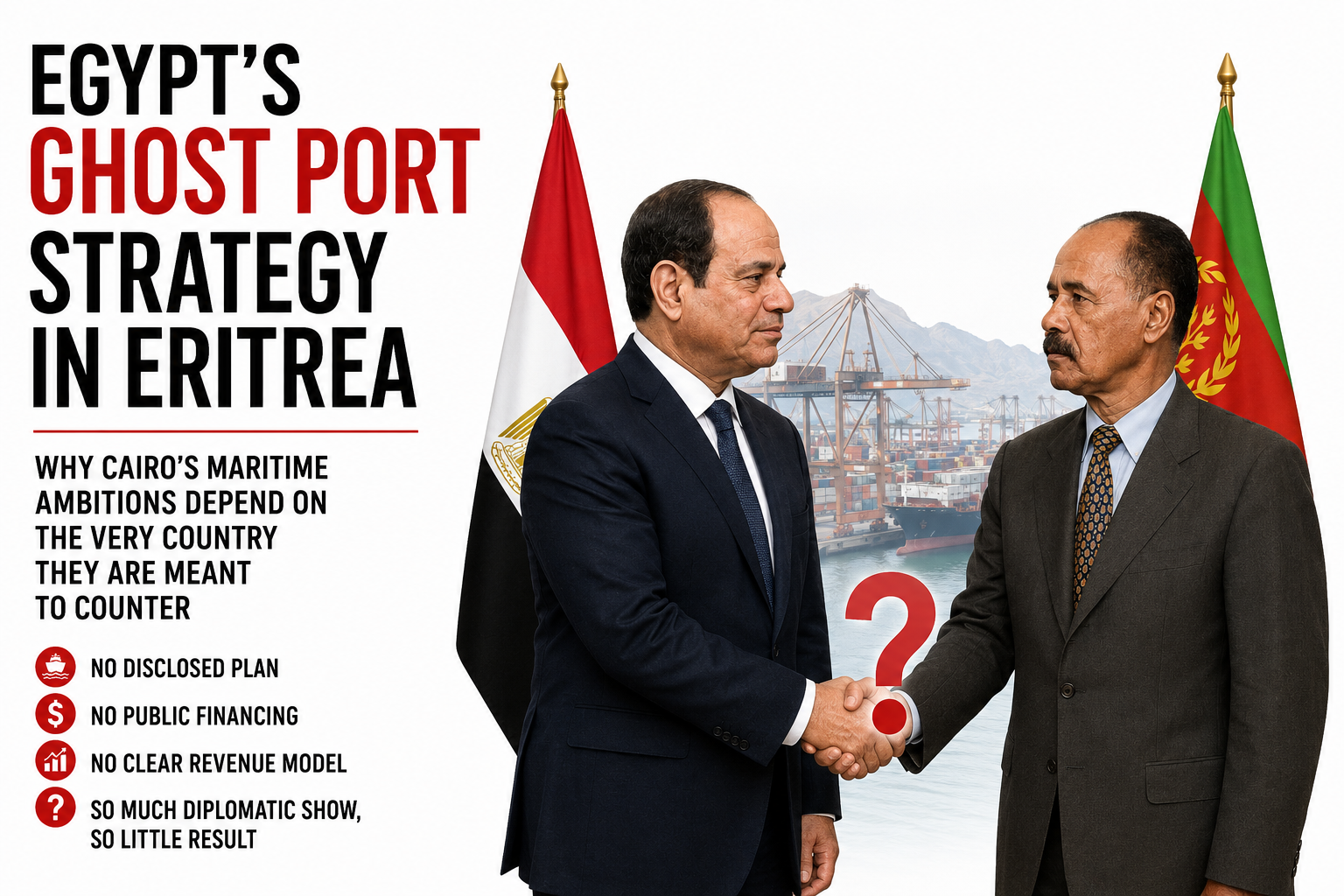
Why Cairo’s Maritime Ambitions Depend on the Very Country They Are Meant to Counter
No disclosed project plan. No public financing package. No credible revenue model.
Yet for more than a decade, Egypt and Eritrea have repeatedly announced new phases of strategic cooperation, maritime coordination, Red Sea partnerships, and regional integration. Senior officials have exchanged visits. Security consultations have expanded. Maritime agreements have been signed. Public statements have emphasized connectivity, development, and shared strategic interests. The political choreography has been highly visible. What remains far less visible is the economic architecture that would transform these ambitions into a viable development strategy.
This gap between rhetoric and economics sits at the center of Egypt’s evolving relationship with Eritrea. Since the groundbreaking of the Grand Ethiopian Renaissance Dam (GERD) in April 2011, Cairo has sought alternative ways to preserve influence in a region undergoing profound geopolitical change. Eritrea increasingly became part of that response. Its strategic location along the Red Sea, its ports at Assab and Massawa, and its complicated relationship with Ethiopia made it an attractive partner for an Egypt increasingly concerned about shifting regional power dynamics.
The problem is that while the political dimensions of the relationship have expanded considerably, the economic foundations remain difficult to identify. After years of agreements, consultations, and strategic declarations, there is still no publicly disclosed financing structure capable of supporting transformative port development in Eritrea. There is no publicly available master plan, no transparent revenue model, no identified investment consortium, and no detailed implementation schedule. What exists instead is a growing body of diplomatic activity accompanied by a remarkable absence of visible economics.
That contradiction raises an uncomfortable question. Is Egypt building a viable maritime strategy in Eritrea, or is it constructing a geopolitical narrative whose economic foundations remain largely invisible?
GERD and the Transformation of Regional Politics
To understand Egypt’s turn toward Eritrea, it is necessary to understand how profoundly GERD altered the political landscape of Northeast Africa.
When Ethiopia launched construction of the dam in 2011, it was undertaking far more than an energy project. GERD became a statement of national ambition, economic sovereignty, and political independence. The project was estimated to cost roughly $5 billion, making it one of the largest infrastructure undertakings in African history. Because international lenders were reluctant to finance a project fiercely opposed by Egypt, Ethiopia turned inward. Domestic bond sales, salary contributions, public fundraising campaigns, and national mobilization efforts became central to financing the dam.
This financing model carried symbolic significance beyond its practical value. GERD became a demonstration that Ethiopia could pursue strategic national objectives despite external opposition. The dam evolved into a powerful symbol of Ethiopian self reliance and development.
Despite years of negotiations, diplomatic pressure, and mediation efforts, Egypt was unable to halt construction. Multiple filling stages were completed, and the project steadily advanced toward full operation. The implications extended far beyond the Nile.
GERD revealed that power in Northeast Africa was increasingly being shaped by economic scale, infrastructure capacity, demographic growth, and energy generation rather than by historical prestige alone. Ethiopia’s population surpassed 120 million people. Its economy became one of Africa’s largest. Its infrastructure ambitions expanded dramatically. Its regional influence grew accordingly.
For Egypt, this transformation created a strategic dilemma. Traditional forms of leverage were proving less effective, while Ethiopia’s economic importance continued to rise. Unable to stop GERD, Cairo began searching for alternative avenues through which it could preserve influence across the Horn of Africa and the Red Sea.
One of those avenues was Eritrea.
Egypt’s Turn Toward Eritrea
From Cairo’s perspective, Eritrea offered several strategic advantages.
Its coastline stretches along one of the world’s most important maritime corridors. The ports of Assab and Massawa sit near shipping routes connecting Europe, Asia, and the Middle East through the Bab el Mandeb Strait. Influence in this region carries significance that extends well beyond Eritrea itself, touching Red Sea security, Gulf politics, Sudan, Yemen, and broader competition for influence across the Horn of Africa.
At the same time, Eritrea’s difficult relationship with Ethiopia created opportunities for strategic convergence. Diplomatic engagement increased. Security consultations expanded. Intelligence cooperation reportedly deepened. Discussions involving Sudan, Red Sea security, regional stability, and Ethiopia became increasingly frequent.
As tensions surrounding GERD intensified, so too did the visibility of Egypt’s relationship with Eritrea.
Official statements portrayed the partnership as an emerging pillar of regional cooperation. Yet beneath the political rhetoric lies a striking contradiction. The political profile of the relationship expanded much faster than its economic substance.
This observation sits at the center of the ADISS analysis titled Egypt and Eritrea: So Much Diplomatic Show Off, So Little Result. The title captures a reality that is difficult to ignore. Egypt and Eritrea have produced years of diplomatic activity, official visits, strategic declarations, and political coordination. Yet measurable economic outcomes remain limited.
Trade remains small. Large scale Egyptian investment in Eritrea is difficult to identify. Transformative joint development projects remain scarce. Economic integration remains weak.
The relationship is active, visible, and politically useful. It is much harder to demonstrate that it has become economically transformative.
This distinction matters because diplomacy and development are not the same thing. Governments can sign agreements and issue joint communiqués without creating meaningful commercial integration. Real economic partnerships generate investment, trade flows, infrastructure, employment, and sustained growth. By those standards, the Egypt Eritrea partnership remains surprisingly shallow.
Security Before Economics
The deeper one examines the relationship, the clearer it becomes that economics are not its primary driver.
The ADISS analysis notes that discussions between Cairo and Asmara consistently revolve around security concerns, Red Sea politics, Sudan, regional stability, and developments involving Ethiopia. Economic modernization plays a far smaller role.
This pattern has persisted for years. Whenever tensions involving Ethiopia increase, Egypt Eritrea engagement tends to become more visible. Meetings multiply. Strategic consultations intensify. Public declarations become more frequent. Yet when geopolitical tensions recede, the relationship rarely generates comparable momentum through commerce, investment, or development projects.
This suggests that the partnership is driven primarily by strategic calculations rather than economic opportunity. For Egypt, Eritrea provides positioning along the Red Sea and a partner that shares concerns regarding Ethiopia’s growing regional influence. For Eritrea, Egypt provides diplomatic support, political coordination, and an additional regional ally.
ADISS goes further by suggesting that regime interests may also shape Eritrea’s external partnerships. From this perspective, the absence of major economic achievements may not represent a failure of the relationship. It may reflect its actual purpose. The partnership may function less as a development alliance than as a mechanism for political coordination, strategic flexibility, and regime security.
If that assessment is correct, then the lack of economic transformation is not an anomaly. It is a feature.
The Maritime Vision and the Missing Economics
The most revealing aspect of Egypt’s maritime engagement with Eritrea is not what has been announced. It is what has not.
Public statements routinely emphasize maritime cooperation, regional connectivity, Red Sea integration, trade facilitation, and port development. In May 2026, Egypt and Eritrea signed a maritime transport cooperation agreement presented as a major step toward strengthening bilateral relations and improving Red Sea connectivity. Egyptian officials described the agreement as evidence of expanding economic cooperation and growing maritime integration.
Yet despite years of diplomatic signaling and maritime rhetoric, fundamental questions remain unanswered.
Neither Egypt nor Eritrea has publicly disclosed the basic financial architecture required for a transformative port development strategy. There is no publicly available master plan explaining how Assab or Massawa would become major commercial hubs. There is no disclosed project budget, no identified engineering consortium, no implementation timetable, no cargo forecast, no transparent revenue model, and no comprehensive explanation of how investments would be financed or how costs would be recovered.
These omissions are significant because ports are not political symbols. They are commercial systems. Transforming a regional port into a competitive maritime hub requires dredging, container terminals, logistics facilities, customs modernization, warehousing, road and rail connectivity, energy infrastructure, digital systems, and long term commercial demand. Such projects routinely cost hundreds of millions or billions of dollars.
Serious infrastructure projects normally begin with financing. Investors want to know who pays. Contractors want to know who builds. Operators want to know how cargo will be generated. Governments want to know how investments will be recovered. In the Egypt Eritrea case, those questions remain largely unanswered.
That raises a simple but unavoidable question: if the maritime vision is real, where is the business plan?
Egypt’s Economic Constraints and the Contradiction of Power Projection
The timing of Egypt’s maritime ambitions in Eritrea deserves closer scrutiny because they emerged during a period of growing economic vulnerability at home. Since GERD’s construction began in 2011, Egypt has experienced repeated currency devaluations, rising inflation, mounting public debt, foreign currency shortages, and increasing dependence on external financing. While Cairo continued to project influence abroad through diplomacy, security partnerships, and regional initiatives, its domestic economic position became increasingly fragile.
Over the past decade, Egypt entered multiple arrangements with the International Monetary Fund in an effort to stabilize the economy and restore investor confidence. These programs involved difficult reforms, including subsidy reductions, exchange rate liberalization, fiscal restructuring, and efforts to address chronic imbalances in public finances. In 2024, Egypt secured an expanded $8 billion IMF package, underscoring the extent of the pressures facing the Egyptian economy. Rather than reflecting economic strength, the agreement highlighted the degree to which Cairo had become dependent on external financing to maintain stability.
The burden of debt has become particularly significant. Debt servicing consumes a growing share of government expenditure, limiting fiscal flexibility and reducing the resources available for new investment. Inflation has repeatedly eroded purchasing power, while foreign currency shortages have disrupted imports and private sector activity. According to Reuters, Egypt has struggled to reduce public debt while maintaining growth, and policymakers continue to face difficult tradeoffs between fiscal consolidation and economic expansion.
These challenges have been compounded by external shocks. Egypt’s dependence on imported food and fuel has exposed it to global price volatility, while instability in the Red Sea has affected one of its most important sources of foreign currency: the Suez Canal. Declining canal revenues have placed additional pressure on state finances at precisely the moment Egypt requires hard currency to service debt, finance imports, and stabilize the Egyptian pound.
This broader economic context matters because it creates a fundamental contradiction. The same government promoting ambitious maritime initiatives abroad is simultaneously confronting significant financial pressures at home. Egypt remains a major regional power with substantial diplomatic and military capabilities, but financing transformative infrastructure projects abroad requires more than geopolitical ambition. It requires capital, commercial planning, and long term investment commitments.
The issue, therefore, is not whether Egypt can pursue security cooperation with Eritrea. The issue is whether it can realistically finance a transformative maritime strategy while simultaneously managing mounting economic challenges domestically.
Assab, Massawa, and the Reality of Port Development
Discussion of Eritrean ports often treats Assab and Massawa as interchangeable assets. In reality, they occupy different positions within Eritrea’s maritime landscape and would require different forms of investment to achieve commercial significance.
Massawa is Eritrea’s principal port and has historically served as the country’s primary maritime gateway. It possesses existing infrastructure, established port facilities, and direct relevance to Eritrea’s domestic economy. Assab, by contrast, occupies a more strategic position near the Bab el Mandeb Strait and has long attracted geopolitical interest because of its location along one of the world’s most important maritime corridors.
For decades, Assab’s significance has often been discussed in strategic rather than commercial terms. Military planners, regional governments, and foreign powers have all recognized its geographic value. Yet strategic value alone does not guarantee commercial viability. A port’s success ultimately depends on cargo throughput, logistics networks, transportation corridors, and market demand.
Transforming either Assab or Massawa into a major regional hub would require substantial investment in dredging, container terminals, customs modernization, warehousing, digital systems, energy infrastructure, and transport connectivity. It would also require long term commitments from shipping companies, logistics firms, and commercial operators. None of these components appear clearly defined in the public record.
This is what makes the absence of financing details so significant. The challenge is not simply building infrastructure. The challenge is building infrastructure that can sustain itself economically over time.
The Trade Problem
The weakness of the maritime vision becomes even clearer when the trade base is examined.
Trade between Egypt and Eritrea remains limited. Egypt exports modest quantities of petroleum products, fertilizers, food items, and consumer goods to Eritrea, while Eritrean exports to Egypt remain negligible. Although trade exists, its scale falls far short of what would normally justify large investments designed to transform regional ports into major commercial gateways.
This point is crucial because ports are not self sustaining assets. Their economic value depends on the movement of goods. Successful ports emerge where large volumes of imports and exports create continuous demand for shipping services, warehousing, customs operations, logistics companies, transportation corridors, financial services, and supporting infrastructure.
Without sufficient cargo volume, even strategically located ports struggle to generate the economic activity necessary to justify major investment.
Political geography and commercial geography are not always the same thing.
Assab and Massawa possess obvious geographic advantages. Their locations along the Red Sea provide access to one of the world’s most important maritime corridors. Yet geography alone does not create commercial viability. Infrastructure follows demand far more often than demand follows infrastructure. Building a port does not automatically create trade. Trade is what gives ports their economic purpose.
This distinction becomes especially important because Eritrea’s domestic economy remains relatively small. Population size, industrial capacity, purchasing power, and export diversification all place limits on the amount of cargo Eritrea can generate independently. Even substantial improvements to port infrastructure would not automatically solve this problem.
The challenge therefore is not whether Eritrea possesses ports. The challenge is whether Eritrea possesses enough commerce to justify transforming those ports into major regional hubs.
The Ethiopia Paradox
At the center of the entire debate sits a reality that neither Egypt nor Eritrea can easily escape.
The only economy in the region capable of generating cargo volumes sufficient to sustain major Eritrean port expansion is Ethiopia.
This is not a political observation. It is an economic one.
Ethiopia’s population exceeds 120 million people. Its industrial sector has expanded significantly over the past two decades. Its demand for imported fuel, machinery, industrial inputs, consumer products, construction materials, and food supplies continues to grow. As a result, Ethiopia generates trade volumes that dwarf those of most neighboring states.
Historically, this demand has flowed overwhelmingly through the Addis Ababa–Djibouti corridor. According to the World Bank, more than 90 percent of Ethiopia’s trade has traditionally moved through Djibouti. The reason is straightforward. Ethiopia’s scale creates the commercial conditions necessary for port infrastructure to thrive.
Large and predictable trade flows attract shipping companies, justify logistics investment, support customs modernization, encourage warehousing development, and create the revenue streams needed to sustain long term infrastructure financing. Eritrea’s domestic economy cannot replicate that scale by itself.
This reality creates a profound paradox.
Much of Egypt’s strategic engagement with Eritrea is interpreted through the lens of balancing Ethiopia’s growing influence following GERD. Yet the commercial viability of large scale Eritrean port development would likely depend on Ethiopian participation. The very country whose regional influence Cairo seeks to offset is also the country whose trade would make the economic model work.
Without Ethiopian cargo, Eritrean ports remain commercially constrained.
With Ethiopian cargo, the ports become more viable, but the strategy becomes dependent on cooperation with the very actor whose rise helped motivate Egypt’s regional recalibration in the first place.
This contradiction lies at the heart of the entire strategy.
Ghost Funding and Strategic Theater
If the economic contradictions surrounding Egypt’s Eritrea strategy raise questions, the absence of visible financing raises even more.
After more than a decade of diplomatic engagement, security coordination, maritime discussions, and strategic declarations, the public record remains remarkably thin on the question that ultimately determines whether transformative infrastructure projects succeed or fail: who is paying for them?
This is where the concept of ghost funding becomes relevant.
In most serious infrastructure initiatives, financing is not an afterthought. It is the centerpiece of the announcement. Governments identify lenders, investors, engineering firms, operating partners, implementation schedules, and projected costs. Development banks disclose their participation. Private consortiums advertise their involvement. Feasibility studies outline expected demand, projected revenues, and timelines for cost recovery.
The Egypt Eritrea case presents a striking contrast.
There are no publicly identified sovereign financing packages capable of transforming Assab or Massawa into major commercial hubs. No major multilateral lending frameworks have been publicly attached to the strategy. No significant international investment consortium has emerged to explain how the proposed developments will be financed, constructed, or operated.
This does not prove that financing does not exist. Governments often negotiate investments privately before public disclosure. Infrastructure planning can proceed behind closed doors.
The problem, however, is that the scale of the rhetoric increasingly exceeds the scale of the publicly available economics.
For years, Egypt and Eritrea have discussed maritime cooperation in language suggesting transformational possibilities. Yet the underlying commercial architecture remains largely absent from public view. The result is a growing gap between political messaging and economic evidence.
That gap helps explain why skepticism has persisted among analysts of the region.
Conclusion
The Egypt Eritrea partnership reflects one of the most important geopolitical shifts in Northeast Africa since the launch of GERD.
As Ethiopia’s influence expanded through population growth, infrastructure development, energy generation, and economic scale, Egypt sought alternative avenues through which to preserve regional leverage. Eritrea became an important component of that strategy because of its location along the Red Sea, its ports, and its complicated relationship with Ethiopia.
From a geopolitical perspective, the logic is understandable. The relationship provides Cairo with an additional foothold in a strategically important region. It allows greater coordination on issues involving the Red Sea, Sudan, and regional security. It strengthens diplomatic ties with a government that occupies territory of significant maritime importance.
Yet geopolitical usefulness should not be confused with economic transformation.
More than a decade after GERD’s launch, the Egypt Eritrea partnership increasingly resembles what ADISS described as “so much diplomatic show, so little result.” Political coordination has expanded. Strategic consultations have multiplied. Security cooperation has deepened. But the economic foundations of the relationship remain difficult to identify.
Trade remains limited. Investment remains difficult to identify at transformative scale. Port development plans remain opaque. Financing structures remain undisclosed. Revenue models remain absent. Implementation frameworks remain unclear.
Most importantly, the commercial viability of Eritrean ports continues to depend heavily on the participation of the very country that sits at the center of the region’s geopolitical tensions.
The only economy capable of generating the scale of cargo necessary to transform Assab and Massawa into major commercial hubs is Ethiopia itself. Without Ethiopian participation, Eritrean ports remain strategically important but commercially constrained. With Ethiopian participation, the ports become more economically viable, but the strategy becomes dependent on cooperation with the same state whose rise helped motivate Egypt’s regional recalibration in the first place.
That paradox exposes the limits of geopolitics when confronted by economics.
Ports cannot operate on diplomatic symbolism alone. They require cargo. Infrastructure cannot be sustained by strategic messaging alone. It requires financing. Commercial hubs cannot be built through declarations alone. They require customers, demand, and revenue.
Until Egypt and Eritrea demonstrate who will finance transformative port projects, how those investments will generate returns, and what economic activity will sustain them over the long term, skepticism will remain justified.
For now, Egypt’s maritime strategy in Eritrea appears caught between geopolitical ambition and economic reality: strategically ambitious, diplomatically useful, but commercially inviable.
