




Three Warnings, One Pattern: ACLED, Africa Intelligence, and Amnesty Expose the New Pressure Campaign Against Ethiopia
Three recent accounts must be read together: ACLED’s warning on Tigray and the Horn of Africa, Africa Intelligence’s reporting on Tsimdo, anti-Abiy front, and Amnesty International’s report on atrocities attributed to OLA militants in Oromia. Each focuses on a different part of Ethiopia’s crisis. Together, they reveal one strategic pattern: Ethiopia is facing not isolated unrest, but a widening campaign of armed destabilization, regional opportunism, and civilian terror.
ACLED provides the geopolitical frame. Its report warns that the TPLF’s effort to reassert Control in Tigray by force, especially around the unresolved “Western Tigray” dispute, could ignite a broader conflict involving TDF, Fano elements, Sudanese actors, Eritrea, and the emerging Ximdo/Tsimdo network. The contested “Western Tigray” could become a regional trigger point. ACLED’s warning places Eritrea directly in the strategic equation, not as a distant observer, but as a state actor whose interests and networks remain entangled with Ethiopia’s internal affairs. (ACLED)
Africa Intelligence adds the political architecture. Its report describes Tsimdo as a growing anti-Abiy front involving Ethiopian rebel groups, including Fano, the Oromo Liberation Army, the TPLF, and others. It also reports that Prime Minister Abiy Ahmed is demanding an end to meetings held by internal opponents on Sudanese soil, while the front expands despite having little in common beyond the shared goal of toppling him. This matters because it shows that Ethiopia’s armed crises are being internationalized through cross-border meeting grounds, Sudan-linked activity, and tactical coalitions among groups that otherwise distrust one another. (Africa Intelligence)
The Patrick Heinisch account sharpens the same point by interpreting Tsimdo as a coalition that began with a rapprochement involving the TPLF and Eritrea before widening into a broader anti-Addis Ababa alignment. Whether one treats that as analysis or political warning, its relevance is clear: Eritrea is not peripheral to the conversation. It is repeatedly named in discussions of emerging opposition coordination, Tigray realignments, and the architecture of pressure against Addis Ababa. (X (formerly Twitter))
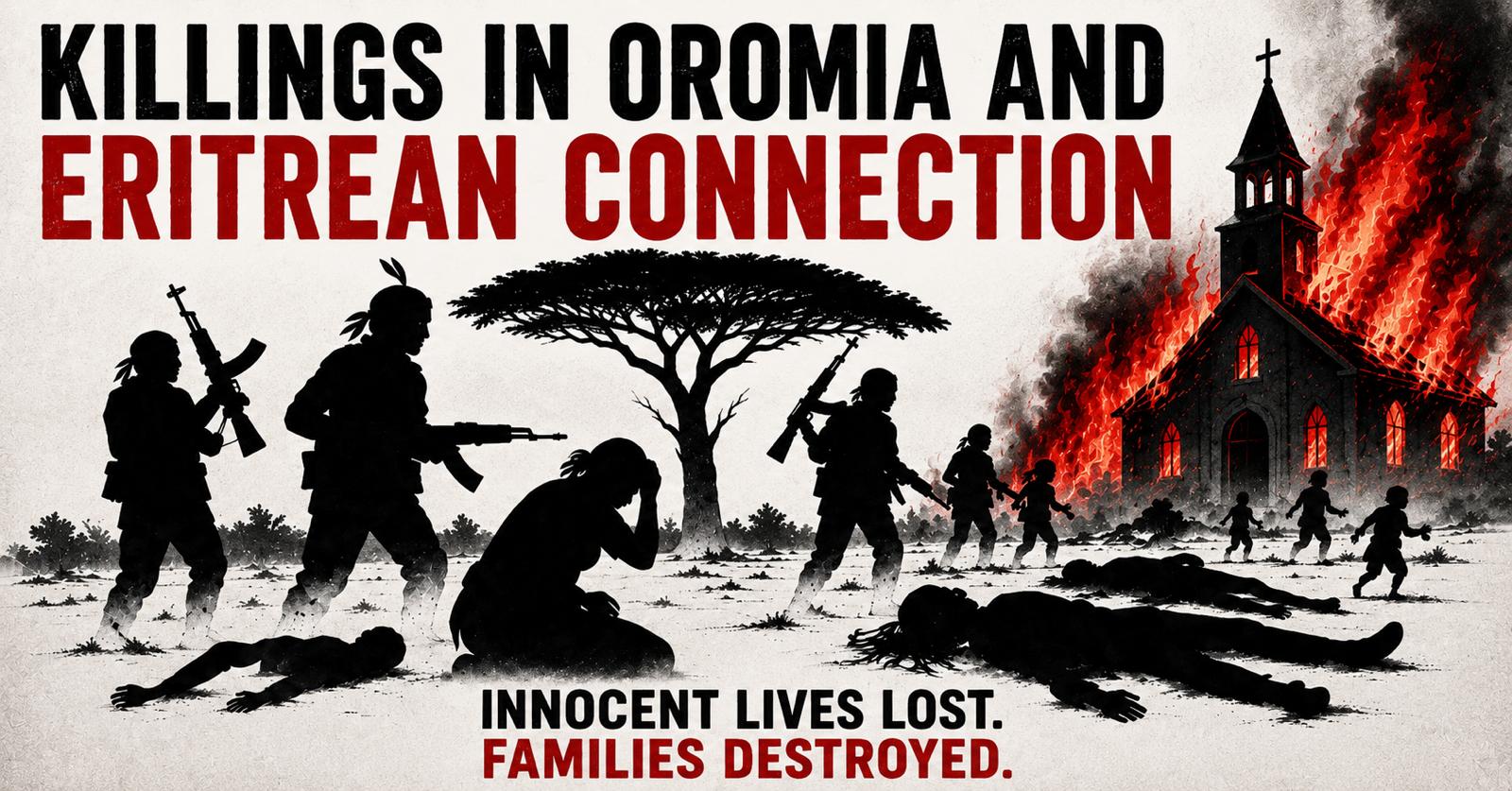
Amnesty International provides the human cost. Its 2026 report on Oromia states that members of the Oromo Liberation Army subjected women and girls to rape, gang rape, sexual slavery, summary killings, destruction of civilian property, and forced displacement in abuses that may amount to war crimes. Amnesty’s investigation focused on Sayo and Anfillo districts in Kellem Wollega and documented ten cases of sexual violence, including five involving both sexual slavery and gang rape. Nine survivors said they were abused by OLA fighters. (Amnesty International)
Taken together, these accounts show the full chain of Ethiopia’s security challenge. ACLED identifies the regional war risk. Africa Intelligence identifies the anti-Abiy coalition structure. Patrick Heinisch highlights the Eritrea-Tigray-Tsimdo dimension. Amnesty documents the civilian terror committed by one of the armed actors inside this wider environment.
This is where Eritrea must be placed clearly in the analysis. President Isaias Afwerki has long operated as a spoiler of peace in the Horn of Africa. He as repeatedly used Ethiopia’s internal political fractures as strategic openings to insert himself. Eritrea has long been accused of hosting, training, arming, or politically supporting violent insurgencies targeting Ethiopia. This practice stretches all the way back to the 1980 when the current regime in Asmara was waging war to breakaway from Addis Ababa. Today, the concern is not only past behavior. The concern is that Eritrea is again using Ethiopian rebels, particularly in Tigray and through cross-border networks in Sudan, to weaken Addis Ababa, block Ethiopia’s economic development.
Ethiopia cannot afford strategic innocence. When ACLED warns of Eritrea’s relevance to the Tigray flashpoint, when Africa Intelligence describes anti-government coordination involving armed actors and Sudanese soil, when analysts point to Tsimdo as an involving hostile platform to Eritrea-linked rapprochements, and when Amnesty documents atrocities by OLA fighters, the Ethiopian state must connect the dots.
Ethiopia’s growing economy, expanding hydropower capacity, infrastructure corridors, cement production, food-security ambitions, Ogaden gas potential, aviation network, military capacity, and Red Sea strategic importance all make it the central power in the Horn. A strong Ethiopia changes the regional balance. That is why destabilizing forces seek to keep it distracted, divided, and internally exhausted. The picture is not of a weak Ethiopia collapsing. It is of a rising Ethiopia being pressured in order to slow it down.
Egypt fears losing leverage over Nile politics. Eritrea fears a stable, prosperous Ethiopia that can dominate the Horn economically, militarily, and diplomatically. Armed factions fear a state strong enough to restore order. Proxy networks fear a government capable of exposing and dismantling them. That is why they are nervous and acting more erratically than ever before.
Ethiopians demand more than negotiations and statements. They demand a state-security doctrine that treats insurgency, foreign sponsorship, cross-border terror coordination, propaganda, financing, and atrocities as interconnected threats. Ethiopia must protect civilians, destroy terrorist networks, expose foreign sponsors, secure its borders, and make clear that no state, militia, rebel front, or intelligence service will be allowed to use Ethiopian blood as currency in a regional power play.
The lesson from all three accounts is direct: Ethiopia’s enemies are trying to organize. Eritrea is in the mix. Sudanese territory is in the mix. OLA violence is in the mix. TPLF realignments are in the mix. Fano factions are in the mix. Tsimdo is the attempted political umbrella. The contested “Western Tigray” is the possible trigger. Oromia is the human-rights emergency. And Ethiopia’s rise is the strategic prize. The Ethiopian state must accept this challenge. The safety, security and prosperity of its people depends on the states ability to outmanuver and overcome the centrifugal forces aiming at collapsing it.
