




Meta Title: Ethiopia’s Quest for Red Sea Access: An Existential Imperative for Regional Stability
Meta Description: Explore why Ethiopia’s pursuit of sovereign maritime access is a survival issue, not expansionism. Analysis of the Djibouti bottleneck, Red Sea militarization, and the El Alamein encirclement strategy.
Focus Keyphrase: Ethiopia Red Sea access
Slug: ethiopia-red-sea-access-existential-imperative
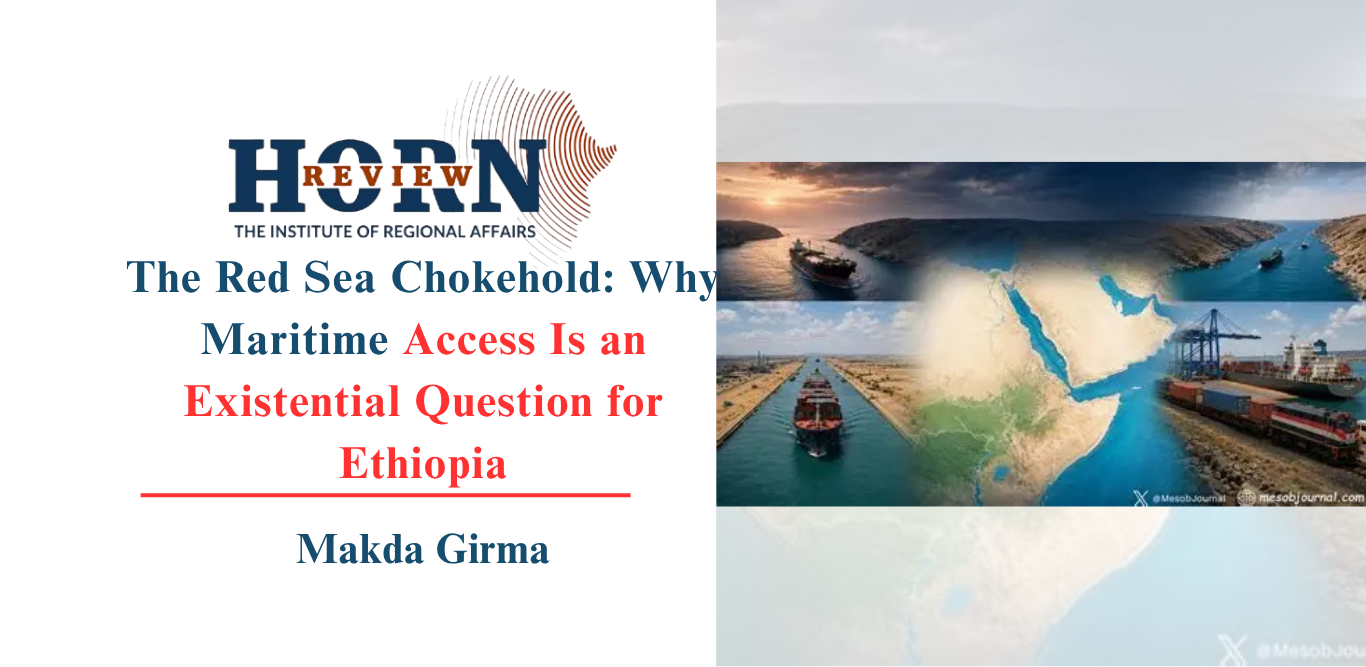
Ethiopia’s Quest for Red Sea Access: An Existential Imperative for Regional Stability
For a landlocked nation, maritime access is rarely a matter of simple commerce; it is an existential variable dictating economic survival, sovereign autonomy, and strategic viability. Nowhere is this geopolitical chokehold more acute than in the volatile dynamic between Ethiopia and Eritrea. As the Red Sea transforms into one of the world’s most militarized maritime corridors, the international community must recognize that Ethiopia’s quest for a seaport has transcended economic aspiration—it is now a non-negotiable requirement for national security and the stability of the entire Horn of Africa.
The World’s Most Populous Landlocked Nation: A Strategic Vulnerability
Ethiopia is the most populous landlocked country in the world, home to over 130 million people, with a significant youth demographic actively seeking employment. According to the International Monetary Fund (IMF), Ethiopia has consistently ranked among the fastest-growing economies in sub-Saharan Africa. This demographic and economic weight, situated merely 60 kilometers from the Red Sea coast, creates a profound structural vulnerability.
Every unit of medicine, fuel, technology, and export revenue depends entirely on the political whims of coastal neighbors. This is not statistical trivia; it is a strategic liability that threatens the livelihood of a nation larger than most European states combined.
The Djibouti Bottleneck: A Single Point of Failure
Currently, Ethiopia relies on Djibouti for approximately 95% of its maritime trade, paying an estimated $1.5 to $2 billion annually in port fees. This “single-door dependency” constitutes an economic chokehold. No sovereign state can safely anchor its future on a single corridor vulnerable to external shocks, political instability, or hostile foreign influence.
Should instability freeze the Port of Djibouti, the Ethiopian economy would face immediate collapse, triggering a humanitarian catastrophe of unprecedented scale. The urgency to diversify is not expansionist—it is a survival instinct akin to a drowning person seeking any available breath.
The Militarization of the Red Sea: Encircling a Giant
The urgency underpinning Ethiopia’s vulnerability has been sharply accelerated by the securitization of the Red Sea. Once an open trade route, the corridor has become an arena for great-power competition, dominated by state coalitions and non-state actors. Global powers increasingly frame the Bab el-Mandeb Strait as a critical national security priority, leading to a dense concentration of foreign military bases.
Djibouti has become the epicenter of this militarization, uniquely hosting overlapping naval facilities for the United States (Camp Lemonnier), China, France, and Japan. Simultaneously, Russia, Saudi Arabia, the UAE, Turkey, and Israel are vying for influence via port logistics and security pacts along the broader Horn coastline. While these bases offer short-term shipping protection, their crowding presence transforms the region into a complex theater of proxy rivalries, brutally doubling down on Ethiopia’s isolation.
The El Alamein Declaration: A Strategy of Encirclement
Beyond great-power competition, Ethiopia faces a deliberate regional containment strategy. The El Alamein Joint Declaration—signed by Egypt, Eritrea, and Somalia—codifies the principle that Red Sea governance belongs exclusively to coastal states. From Addis Ababa’s perspective, this is not routine diplomacy but a deliberate architectural web of alliances designed to permanently deny landlocked Ethiopia a seat at the table.
This encirclement is amplified by Egypt’s forward deployment rhetoric, driven by tensions over the Grand Ethiopian Renaissance Dam (GERD). Cairo appears to be weaponizing Ethiopia’s landlocked status by forging tight military alliances with states bordering Ethiopia. The message is clear: hostile foreign militaries are positioning themselves on Ethiopia’s borders, holding the keys to the maritime gates that feed its population.
The Double Standard of Maritime Sovereignty
A critical question arises regarding the norms of regional security: Why is Ethiopia’s quest to establish a naval presence considered unacceptable when external powers from other continents already maintain bases on the same coastline?
Countries thousands of miles away enjoy strategic access and military infrastructure on the Red Sea, while the region’s largest population and economic engine is expected to remain passive. This double standard fuels the perception that the denial of access is not about sovereignty, but about containment. Ethiopia has consistently expressed a preference for cooperation, advancing frameworks centered on mutual economic integration and shared prosperity (such as the IGAD and African Union agendas). However, legal technicalities cannot serve as sustainable solutions to a matter concerning the survival of 130 million people.
The Path Forward: Diplomacy Over Confrontation
Ethiopia’s determination to secure a reliable maritime corridor—enabling dependable port services and a sovereign naval capability to protect its flag-bearing vessels under international law (UNCLOS)—is a legitimate right to “breathe.” It is the only viable path to a stable, secure Horn of Africa.
The Imperative for Immediate Action:
- IGAD & the African Union must urgently facilitate inclusive regional dialogue, developing a practical framework addressing Ethiopia’s aspirations while safeguarding coastal states’ sovereignty.
- External Actors must be discouraged from fostering hostility and division; their role should be limited to supporting cooperation and regional stability.
- The International Community (UN & Partners) must intensify diplomatic engagement for a negotiated settlement before tensions spiral into a devastating conflict with far-reaching consequences.
Conclusion
Ethiopia’s demand for Red Sea access must be understood as a legitimate strategic, economic, and security concern—not an imperial ambition. A stable Horn of Africa is impossible if its largest engine is kept in a state of permanent anxiety and artificial suffocation. Through timely diplomacy, mutual respect, and political courage, regional leaders can transform a potential casus belli into an engine for shared prosperity and lasting peace. The time to act is now; the cost of inaction is a conflict the region and the wider world can ill afford.
Frequently Asked Questions (FAQ)
Why is Ethiopia landlocked? Ethiopia lost its direct access to the Red Sea following Eritrea’s independence in 1993 after a 30-year war for independence. The 1993 referendum formalized Eritrea’s sovereignty over the coastline, leaving Ethiopia as the most populous landlocked nation globally.
How much does Ethiopia pay Djibouti for port access? Estimates vary, but Ethiopia pays between $1.5 billion and $2 billion annually in port fees and logistics costs to Djibouti, handling over 95% of its import-export volume through the Port of Djibouti.
What is the El Alamein Declaration? Signed in October 2024 by the leaders of Egypt, Eritrea, and Somalia in El Alamein, Egypt, the declaration emphasized respect for sovereignty and territorial integrity. Ethiopia views it as a coordinated effort to exclude it from Red Sea governance frameworks and legitimize a containment strategy.
Does international law guarantee landlocked states sea access? Yes. The United Nations Convention on the Law of the Sea (UNCLOS), Part X, guarantees landlocked states the right of access to and from the sea and freedom of transit through bilateral, subregional, or regional agreements with transit states.
What is the GERD dispute? The Grand Ethiopian Renaissance Dam (GERD) is a massive hydroelectric dam on the Blue Nile. Egypt and Sudan (downstream nations) fear it threatens their water security, while Ethiopia views it as essential for development and electrification. The dispute has spilled over into broader geopolitical alignments in the Horn.
External Authority Links Used in Article
- International Monetary Fund (IMF) – Ethiopia Economic Outlook
- United Nations Convention on the Law of the Sea (UNCLOS) Part X – Right of Access
- World Bank – Landlocked Developing Countries
- African Union – Agenda 2063
- IGAD (Intergovernmental Authority on Development)
- Camp Lemonnier / US AFRICOM
- Bab el-Mandeb Strait Strategic Importance (Britannica)
- Grand Ethiopian Renaissance Dam (GERD) Overview
