




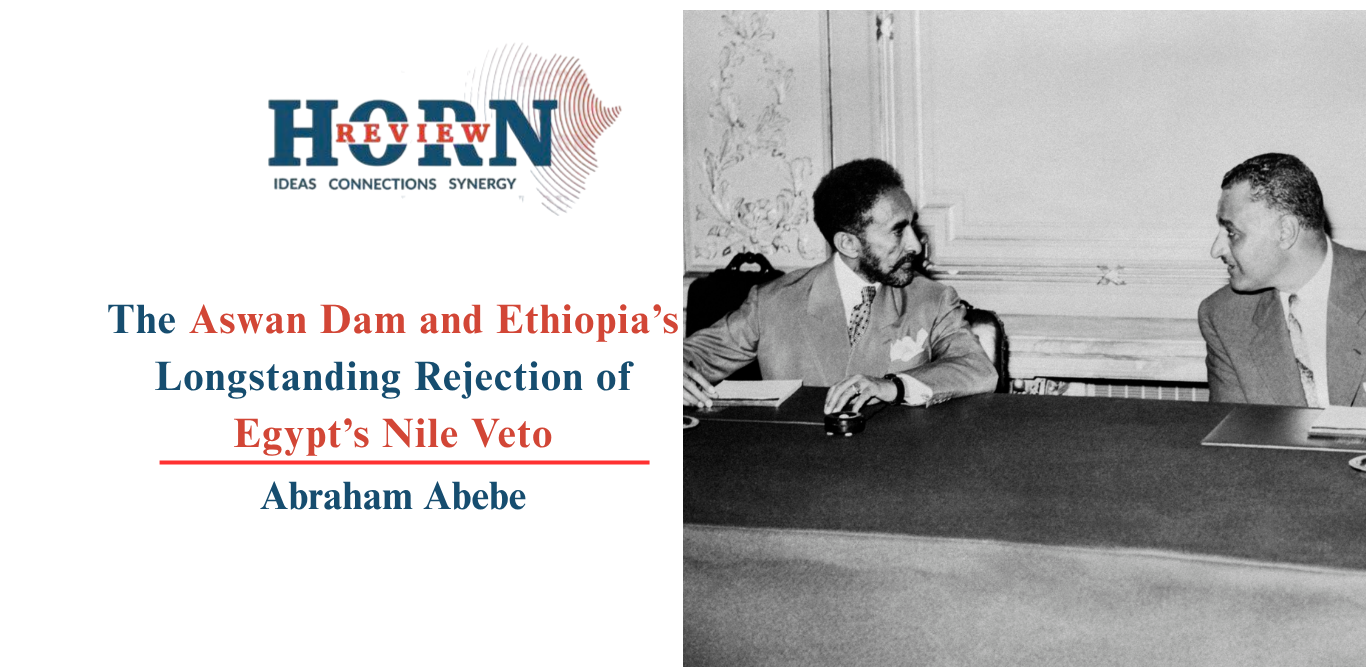
Meta Title: Ethiopia’s Nile Rights: From the 1956 Aswan Objection to GERD & Equitable Utilization
Meta Description: Explore the historical roots of the Nile dispute. How Ethiopia’s 1956 rejection of the Aswan Dam veto foreshadowed the GERD era, the legal basis for equitable water sharing, and why the Cooperative Framework Agreement (CFA) is the path forward.
Focus Keyword: Ethiopia Nile water rights
Slug: ethiopia-nile-water-rights-gerd-history-cfa
Image Alt Text Suggestion: Map of the Nile Basin highlighting the Blue Nile contribution from Ethiopia and the location of the Grand Ethiopian Renaissance Dam (GERD).
Ethiopia’s Nile Water Rights: A 70-Year Struggle for Equitable Utilization
The contest over the Nile River is often framed through the lens of the Grand Ethiopian Renaissance Dam (GERD), yet the legal and diplomatic fault lines were drawn decades before the first stone was laid. To understand the current deadlock, one must look back to May 1956, when Emperor Haile Selassie formally objected to the construction of the Aswan High Dam—not merely as a neighbor, but as the source of the vast majority of the river’s flow.
This historical precedent establishes a consistent Ethiopian position: downstream infrastructure cannot unilaterally dictate the development rights of upstream nations. As the Cooperative Framework Agreement (CFA) enters into force, this principle is finally gaining institutional weight.
The 1956 Telegram: Drawing the Red Line at Aswan
On May 29, 1956, weeks before construction began on the Aswan High Dam, the United States Embassy in Addis Ababa dispatched a classified telegram to Washington (documented in the Foreign Relations of the United States archive). It recorded Emperor Haile Selassie’s unequivocal stance regarding American support for Egypt’s project.
“Believe Ethiopia will not now or in future admit that the Aswan Dam project restricts its future use of Nile Waters.”
This wasn’t a reactionary outburst; it was a calculated diplomatic maneuver. The Embassy warned that bypassing upstream consultation “could seriously undermine U.S.-Ethiopia relations” and recommended collective decision-making rather than treating Aswan as an isolated undertaking.
Key takeaways from the 1956 record:
- Sovereignty over Resources: Ethiopia rejected the premise that Egypt’s development pre-empted Ethiopia’s future use.
- Procedural Equity: The Emperor objected to the lack of meaningful consultation with upstream riparians.
- Precedent Setting: Ethiopia recognized that accepting Aswan without safeguards would legitimize a downstream veto over the Blue Nile.
This telegram, now declassified via the Office of the Historian, remains the clearest articulation of the “upstream objection” that underpins the GERD negotiations today.
The Core Dispute: Development vs. Veto Power
The modern Nile dispute crystallizes a fundamental question of international water law: Does existing infrastructure grant a permanent veto over future upstream development?
Egypt’s position relies heavily on historical rights and acquired rights—concepts rooted in colonial-era agreements (notably the 1929 and 1959 treaties) to which Ethiopia was never a signatory. Ethiopia’s position, consistent since 1956, rests on equitable and reasonable utilization.
The Hydrological Reality
Any legal framework must confront the physical geography of the basin:
- Ethiopia contributes roughly 86% of the Nile’s total annual flow, primarily via the Blue Nile, Sobat, and Atbara rivers originating in the Ethiopian Highlands.
- Egypt contributes effectively 0% of the water (receiving minimal rainfall), relying almost entirely on upstream flow.
As detailed in World Bank assessments of Nile Basin hydrology, this asymmetry makes the downstream veto politically convenient but hydrologically indefensible. A nation contributing the vast majority of the resource cannot be legally subordinate to a nation contributing none.
The Legal Framework: UN Watercourses Convention & The CFA
Moving Beyond Colonial Treaties
The 1997 UN Convention on the Law of the Non-Navigational Uses of International Watercourses provides the governing global standard. It establishes three co-equal pillars:
- Equitable and Reasonable Utilization (Article 5)
- Obligation Not to Cause Significant Harm (Article 7)
- Duty to Cooperate (Articles 8 & 9)
Critically, the Convention does not grant downstream states a veto. The “No Significant Harm” rule is not a freeze on the status quo; it is a due-diligence obligation to mitigate impact, balanced against the right to equitable use.
The Cooperative Framework Agreement (CFA)
After over a decade of negotiation via the Nile Basin Initiative (NBI), the CFA entered into force on October 13, 2024, for ratifying states (Ethiopia, Rwanda, Tanzania, Uganda, Burundi, South Sudan).
The CFA operationalizes the UN Convention for the Nile Basin:
- Article 4: Establishes “Equitable and Reasonable Utilization” as the guiding principle.
- Article 5: Mandates cooperation based on sovereign equality.
- Article 14: Creates a Nile River Basin Commission—a permanent institutional mechanism for joint management, replacing ad-hoc diplomacy.
The CFA effectively nullifies the legal basis for a unilateral Egyptian veto, replacing it with a basin-wide governance structure.
GERD: The Physical Manifestation of a 1956 Promise
The Grand Ethiopian Renaissance Dam is not an aberration; it is the execution of the sovereign right asserted in 1956.
| Aswan High Dam (1960s) | GERD (2020s) |
|---|---|
| Built by downstream state (Egypt) | Built by upstream source state (Ethiopia) |
| Primary purpose: Irrigation & Flood control (Egypt-centric) | Primary purpose: Hydropower (Regional electrification) |
| Filled unilaterally over years; minimal upstream consultation | Filled in stages with declared data sharing; tripartite talks attempted |
| Created Lake Nasser (high evaporation losses) | Creates reservoir in deep gorge (lower evaporation) |
Ethiopia’s determination to fill and operate GERD—even absent a final comprehensive treaty—flows directly from the 1956 logic: waiting for downstream permission is a surrender of sovereignty.
Why “No Harm” Does Not Mean “No Development”
Egypt frequently cites the “No Significant Harm” principle to demand guaranteed flow volumes that effectively replicate the 1959 quota (55.5 BCM). However, international tribunals (e.g., the Gabcíkovo-Nagymaros case at the ICJ) and the UN Watercourses Convention Commentary clarify:
The obligation to prevent significant harm does not entail an obligation to maintain the status quo of water use. It requires states to take all appropriate measures to prevent harm, but where harm is inevitable in the context of equitable utilization, the factors of equitable use (social/economic needs, population dependency, conservation efforts) determine the outcome.
Egypt’s near-total dependence on the Nile is a factor in equitable utilization (Article 6 factors), not a trump card overriding Ethiopia’s right to develop.
The Path Forward: Basin-Wide Cooperation Over Bilateral Veto
The historical record is clear: Unilateralism failed in 1956, and it fails today.
- Egypt must ratify the CFA. It is the only legal instrument offering dispute resolution mechanisms, data sharing protocols, and a permanent commission.
- Operationalize the Nile River Basin Commission. Technical management of filling/drought mitigation belongs in a permanent technical body, not sporadic presidential summits.
- Decouple GERD Operations from Comprehensive Treaty. Interim agreements on drought mitigation (the current sticking point) should be technical, not political preconditions for recognizing the dam’s legitimacy.
- Invest in Basin-Wide Efficiency. Egypt’s water security is better served by modernizing irrigation (saving billions of cubic meters lost to evaporation/inefficiency) and joint watershed management in the Ethiopian Highlands than by blocking upstream dams.
Conclusion: The Nile Belongs to All Riparians
The 1956 telegram was a warning: Ethiopia will not admit that downstream projects restrict its future use. Sixty-eight years later, the GERD stands as proof of that resolve.
The Nile’s future cannot be governed by the ghost of colonial treaties or the inertia of the Aswan High Dam. It must be governed by the Cooperative Framework Agreement, the UN Watercourses Convention, and the hydrological reality that equitable utilization is the only sustainable path for 11 nations and 500 million people.
Egypt’s water security and Ethiopia’s development are not mutually exclusive—they are mutually dependent. The only viable architecture for that interdependence is basin-wide cooperation, not a downstream veto.
Frequently Asked Questions (FAQ Schema)
What was Ethiopia’s position on the Aswan High Dam in 1956? Ethiopia formally objected via a US Embassy telegram, stating it would “not now or in future admit that the Aswan Dam project restricts its future use of Nile Waters,” demanding prior consultation and collective decision-making.
Does the UN Watercourses Convention give Egypt a veto over GERD? No. The Convention establishes Equitable and Reasonable Utilization as the primary principle. The “No Significant Harm” rule is a due-diligence obligation, not a veto right preserving the status quo for downstream users.
What is the Cooperative Framework Agreement (CFA)? The CFA is a basin-wide treaty negotiated through the Nile Basin Initiative. It entered into force in October 2024 for ratifying states, establishing the Nile River Basin Commission and enshrining equitable utilization as the legal standard for the river.
How much Nile water originates in Ethiopia? Approximately 85–86% of the Nile’s total annual flow originates from the Ethiopian Highlands (Blue Nile, Sobat, Atbara), making Ethiopia the primary source state of the basin.
Why is the 1959 Nile Waters Agreement not binding on Ethiopia? Ethiopia was not a signatory to the 1959 Agreement (between Egypt and Sudan). Under the Vienna Convention on the Law of Treaties, treaties do not create obligations for third states without their consent (pacta tertiis nec nocent nec prosunt).
