




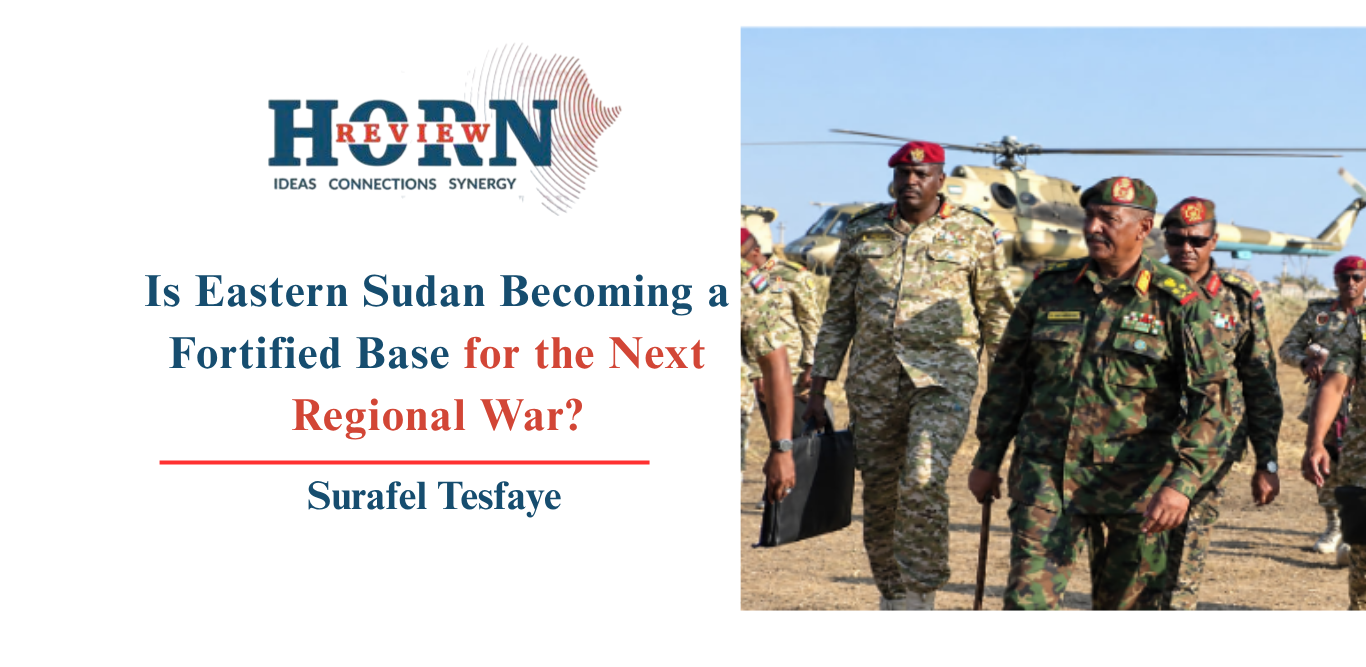
Title: Militarization of Eastern Sudan: How the SAF-Eritrea-Egypt Axis Is Reshaping the Horn of Africa’s Security Architecture
Meta Description: Analysis of Al-Burhan’s Khashm el-Girba visit reveals a deepening military integration of Eritrean-backed proxies into Sudan’s 11th Infantry Division, signaling a coordinated Cairo-Asmara-Khartoum strategy to fortify a strategic buffer zone against Ethiopia.
General Abdel Fattah al-Burhan’s recent inspection of the 11th Infantry Division in Khashm el-Girba, Kassala State, was officially framed as a routine assessment of operational readiness along the Eritrean and Ethiopian borders. However, a closer examination of the forces gathering in this strategic corner of eastern Sudan suggests a far more consequential development: the quiet transformation of the region into a fortified forward operating base for a potential regional conflict that has not yet officially begun.
This buildup centers on the 11th Infantry Division, a conventional Sudanese Armed Forces (SAF) unit with a deep institutional history in Kassala, currently commanded by Major General Adil Sabdarat. While its traditional mandate was straightforward frontier defense, the division is now the epicenter of a structural shift—integrating Eritrean-trained proxy militias into regular SAF command structures, effectively merging Sudan’s domestic survival with the long-term geopolitical interests of Asmara and Cairo.
The Eritrean Pipeline: From Gash-Barka Camps to SAF Ranks
Since the outbreak of Sudan’s civil war in April 2023, Kassala has functioned as the primary logistical terminus for a pipeline running directly through Eritrea. The engine of this pipeline is the network of military training camps in Eritrea’s Gash-Barka region. Long used as sanctuaries for various opposition groups, these facilities have radically evolved into staging grounds for deep structural integration.
Fighters from the Beni Amer, the Beja, and the Eastern Sudan Liberation Forces (ESLF) are being funneled directly into the ranks of the 11th Infantry Division. This is not merely cross-border sheltering; it represents a calculated merging of regional forces that binds the SAF’s immediate military needs to Eritrea’s strategic depth.
The scale of this mobilization is ambitious. A figure of up to fifty thousand recruits has been cited publicly by Mohamed Sayed Ahmed Al-Jakomi, leader of the National Forces Coordination. Al-Jakomi operates as a critical political broker, connecting old-guard intelligence networks to the current military junta under the explicit authorization of Eritrean President Isaias Afwerki. While this number reflects a political target rather than a verified battlefield deployment, the intent is unambiguous: the creation of a massive, irregular force structure legitimized within the regular army.
The Shadow Architects: Salah Gosh, Cairo, and the Weapons Corridor
Much of the logistical architecture enabling this mobilization traces back to a figure long embedded in the region’s shadow intelligence networks: Salah Gosh, former chief of Sudan’s National Intelligence and Security Service (NISS). After years under Egyptian custody in Cairo, Gosh recently relocated his base to Asmara, signaling a deliberate realignment of interests between Egyptian intelligence and the Eritrean presidency.
In Asmara, Gosh has reportedly secured arrangements with President Afwerki to transform Eritrea into a critical transit hub for heavy military hardware bound for the SAF. Intelligence reports indicate this includes anti-aircraft systems, drone components, and electronic jamming equipment. Gosh acts as the primary financier for these new armed factions, utilizing Al-Jakomi as a civilian front to mobilize an Islamist-aligned northern militia framework masked behind ethnic slogans—a structure designed to shield the network from international sanctions.
Gosh’s deep connections to Egyptian intelligence, combined with his physical proximity to the Kassala frontier, demonstrate how Cairo and Asmara are quietly pooling assets to sustain the SAF’s eastern flank.
The El Alamein Declaration: Formalizing the Tripartite Axis
Al-Burhan’s sudden appearance in Khashm el-Girba came on the immediate heels of the El Alamein Joint Declaration—a summit formalizing a deepening tripartite alignment between Khartoum, Asmara, and Cairo (with Mogadishu as a signatory). While the public text avoided explicit mutual defense clauses, the timing of the border inspection exposes the unwritten security architecture shifting beneath the diplomacy.
The SAF is currently fighting brutal, multi-front battles in Darfur and Khartoum. Yet, it is the eastern frontier—hundreds of kilometers from the capital’s frontlines—that now demands the Commander-in-Chief’s personal attention. Unlike Darfur, an isolated internal theater, the eastern flank is the precise geopolitical flashpoint where Sudan’s domestic civil war collides with broader regional ambitions.
By reinforcing this zone, Al-Burhan achieved three overlapping objectives:
- Domestic Reassurance: Signaling the army is securing borders against Rapid Support Forces (RSF) expansion eastward.
- Regional Signaling: Committing to the Cairo-Asmara axis by absorbing their proxy forces into regular command.
- Strategic Deterrence: Warning Addis Ababa that eastern Sudan is no longer a passive borderland, but a heavily fortified forward position backed by a coalition stretching from the Nile to the Red Sea.
Converging Interests: Eritrea’s Buffer, Egypt’s Containment, SAF’s Survival
The militarization of eastern Sudan serves distinct but complementary strategic goals for the three primary actors:
For Eritrea: A Strategic Buffer Zone
President Afwerki has invested heavily in the SAF’s war effort—providing training camps, logistics, and diplomatic cover. The expected return is a buffer zone on Eritrea’s western flank. As theorized by scholars like Robert Jervis, such a zone does not require formal occupation; it manifests as an informal perimeter built on armed proxy networks. If Eritrea and Ethiopia enter direct conflict, forces trained in Gash-Barka and deployed into Kassala would be positioned to pressure Ethiopia’s northern and western frontiers, forcing Addis Ababa to divide its attention. For Asmara, this is strategic insurance: ensuring any future war extends beyond the bilateral border into Sudanese territory.
For Egypt: The Cordon Sanitaire
Cairo’s arrangement serves its long-standing interest in containing Ethiopian influence. The El Alamein Declaration formalized Egypt’s alignment with Khartoum and Asmara. The militarization of eastern Sudan fits a broader strategy of creating a cordon sanitaire around Ethiopia, limiting its Red Sea access and applying multi-front pressure. This highly militarized border zone transforms into the geographic node where the strategic interests of the three parties seamlessly merge: securing a state-backed supply corridor for the SAF, protecting Asmara’s western shield, and providing Cairo a permanent, conflict-enabled lever on Ethiopia’s doorstep.
For the SAF: Denying the RSF and Securing Logistics
Operationally, the arrangement addresses an immediate existential threat. The RSF has probed Sudan’s eastern frontiers, threatening to open a devastating new front. This militarization serves a dual purpose: denying the RSF access to the vital eastern states and safeguarding critical infrastructure—the Khashm el-Girba Dam, tactical airfields, and the highway/rail networks funneling logistics from Port Sudan to the central fronts.
To cement this wall, the junta is actively legalizing irregular factions via legislative decree. By mandating all auxiliary forces fall under the Armed Forces Act, Al-Jakomi has repackaged his proxy network into the officially recognized Sudan Protection Force. This grants independent tribal and Islamist elements legal impunity, state budgets, and heavier weaponry—transforming them from a defensive militia into a core component of an aggressive regional alignment.
The Tri-Border Flashpoint: Implications for Ethiopia
The implications for Ethiopia are immediate and high-stakes. The sensitive tri-border corridor linking Kassala, Gash-Barka, and Western Tigray has quietly become one of the most heavily weaponized zones in the Horn of Africa. Should flashpoints between Asmara and Addis Ababa ignite, or if internal insurgencies in Ethiopia’s northern borderlands intensify, this militarized frontier is primed to activate as a multi-state front.
Ethiopia effectively faces an evolving encirclement axis. The cross-border forces integrated under the 11th Division’s operational umbrella provide this trilateral coalition with a pre-positioned staging ground, granting Egypt, Eritrea, and the SAF the collective capability to launch coordinated operations at Ethiopia’s sovereign gates the moment the regional security architecture fractures.
A Unified Regional System: Three Wars Become One
What renders the current situation intensely volatile is the absolute convergence of three distinct theaters into a unified regional system:
- The civil war in Sudan.
- The deep structural tensions between Ethiopia and Eritrea.
- The expanding internal conflicts within Ethiopia (particularly in Tigray and Amhara).
These are no longer isolated crises. They are irrevocably linked by permeable borders, shared external patrons, and overlapping proxy networks. Eastern Sudan sits at the volatile intersection of all three dynamics. The hyper-militarization of this frontier is far from a mere defensive reaction to the RSF; it constitutes the core operational anchor of a broader strategic realignment—a tectonic shift threatening to tip the entire Horn of Africa into an all-out regional conflagration.
Conclusion: A Signal of Intent, Not a Final Destination
The question of whether eastern Sudan is becoming a fortified base for a future regional war is answered not by diplomatic communiqués, but by the steady accumulation of physical forces: the operational expansion of cross-border training camps, the heavy movement of advanced weapons systems via intelligence channels, and the deliberate coordination of shifting political alignments.
Al-Burhan’s appearance in Khashm el-Girba functioned as an active signal of intent. The proxy forces trained in Eritrea are in the active stages of integration into the SAF command structure. The trilateral alignment formalized at El Alamein is being operationalized on the ground. Should this trajectory persist unchecked, eastern Sudan will solidify into a permanent military stronghold—acting as a forward base not merely for the SAF, but for the broader hostile coalition that systematically sustains it.
For Ethiopia, the lesson is clear: the sensitive tri-border zone has decisively ceased to be a peripheral border security concern. It represents a critical strategic frontier demanding sustained attention and a highly coherent defensive response. The regional security architecture has already fundamentally shifted. The core question now confronting Addis Ababa is how it will adapt to a new geopolitical reality in which its western gates are increasingly hyper-militarized by a coalition of regional actors with deeply shared interests and a demonstrated willingness to coordinate operationally against it.
