




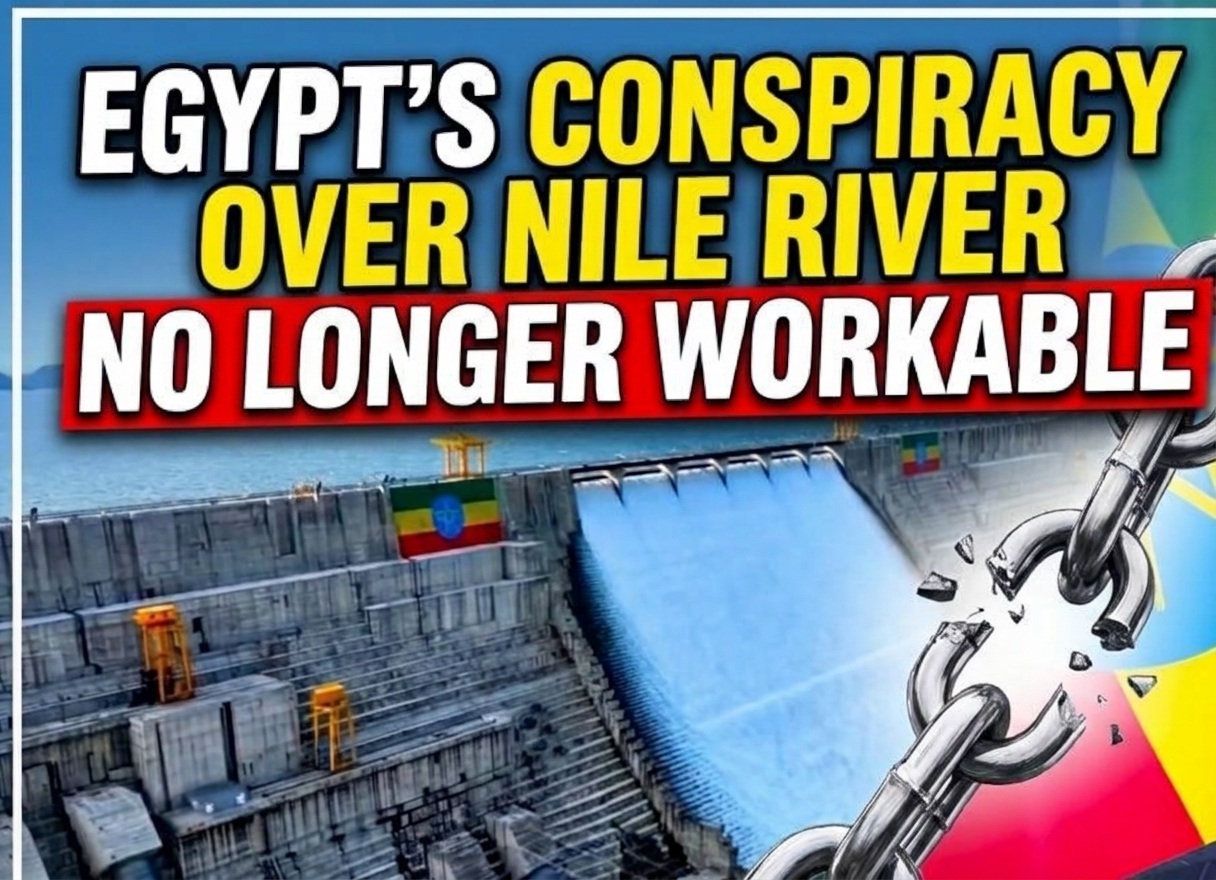
Egypt’s Diplomatic Offensive Over Nile, Red Sea Access Fails as Ethiopia Asserts Sovereign Rights, Minister Declares
Addis Ababa — Ethiopia’s Minister of Water and Energy, Habtamu Itefa, has declared that Egypt’s sustained diplomatic campaign to obstruct Ethiopia’s utilization of the Abay River (Blue Nile) and restrict its access to the Red Sea has effectively collapsed. Speaking to local media, the minister emphasized that Addis Ababa’s current hydro-political strategy—anchored in international law, equitable utilization, and regional cooperation—has rendered Cairo’s traditional hegemonic tactics obsolete.
The remarks signal a significant shift in the Nile Basin geopolitics, highlighting Ethiopia’s growing confidence following the successful completion of the Grand Ethiopian Renaissance Dam (GERD) filling phases and its strategic outreach for maritime access via the Somaliland Memorandum of Understanding (MoU).
Egypt’s “Conspiracy” Strategy: A Historical Context
For decades, Cairo has relied on colonial-era treaties—specifically the 1929 Anglo-Egyptian Treaty and the 1959 Nile Waters Agreement—to claim a “historic right” veto power over upstream projects. Ethiopia, which contributes 86% of the Nile’s water via the Blue Nile, has never recognized these accords.
Minister Habtamu described Cairo’s recent activities as a “conspiracy” involving intense diplomatic lobbying across Africa, the Arab League, and Western capitals to:
- Internationalize the GERD dispute to pressure Ethiopia into a binding agreement favoring Egyptian water security definitions.
- Block international financing for Ethiopian hydro-projects.
- Isolate Ethiopia regionally regarding its quest for a naval base and commercial port access on the Red Sea.
“The conspiracy woven by Egypt against Ethiopia concerning the Abay River and the Red Sea is no longer workable,” Minister Habtamu Itefa stated. “The reality on the ground has changed. Ethiopia is no longer a passive victim of hydro-hegemony but an active architect of regional integration.”
GERD: From Contention to Operational Reality
The centerpiece of this geopolitical friction remains the Grand Ethiopian Renaissance Dam. Located near the Ethiopia-Sudan border, the $4.8 billion project is Africa’s largest hydroelectric power plant, with an installed capacity of 5,150 MW.
Despite years of trilateral negotiations (Ethiopia, Egypt, Sudan) mediated by the African Union (AU), a final legally binding agreement on the dam’s filling and operation remains elusive. However, Ethiopia has unilaterally completed the fourth and final filling phase (as of 2023) and commenced power generation from multiple turbines.
Key Factors Neutralizing Egyptian Pressure on GERD:
- Fait Accompli: The dam is built, filled, and generating power. The physical reality limits Egypt’s leverage to demand a pre-filling agreement.
- AU-Led Process: Ethiopia successfully insisted the African Union lead negotiations, rejecting US/World Bank mediation attempts perceived as biased toward Cairo. This framed the dispute as an African solution to an African problem.
- Sudan’s Shifting Stance: While Khartoum historically aligned with Cairo, Sudan recognizes GERD’s benefits for flood regulation, sediment control, and cheap electricity imports. The ongoing Sudanese civil war has further complicated Cairo’s alliance reliance.
- Scientific Data Sharing: Ethiopia has consistently shared hydrological data, undermining claims that GERD poses an existential threat to downstream water security during average rainfall years.
Read the latest AU Communique on GERD Negotiations
The Red Sea Dimension: Breaking the Landlock
The Minister’s reference to the Red Sea addresses Ethiopia’s most strategic vulnerability: its landlocked status since Eritrea’s independence in 1993. With a population exceeding 120 million and one of Africa’s fastest-growing economies, Ethiopia’s dependence on Djibouti’s ports (handling 95% of trade) is a critical national security bottleneck.
In January 2024, Ethiopia signed a historic MoU with Somaliland, granting Ethiopia 20km of coastal land for a naval base and commercial port (likely near Berbera) in exchange for potential formal recognition of Somaliland’s sovereignty.
Why Egypt Opposes the Somaliland MoU:
- Geopolitical Encirclement: A sovereign Ethiopian naval presence in the Gulf of Aden/Red Sea breaks Egypt’s (and its allies’) ability to potentially blockade Ethiopian trade via the Bab el-Mandeb Strait.
- Somalia Leverage: Egypt has recently strengthened ties with the Federal Government of Somalia (Mogadishu), signing defense pacts and offering troops for the AUSSOM mission, explicitly opposing the Somaliland deal to curry favor with Mogadishu and check Addis Ababa.
Minister Habtamu argued that Egypt’s attempt to weaponize the Somalia-Somaliland dispute to deny Ethiopia sea access has backfired, galvanizing Ethiopian public opinion and forcing the international community to acknowledge the unsustainability of a landlocked nation of 120+ million people.
Review the Ethiopia-Somaliland MoU Text Analysis
Legal Framework: Equitable Utilization vs. Historic Rights
The core of Ethiopia’s winning legal argument rests on the UN 1997 Watercourses Convention and the Nile Basin Cooperative Framework Agreement (CFA/Entebbe Agreement).
| Principle | Egypt/Sudan Position (Historic) | Ethiopia/Upstream Position (Current Law) |
|---|---|---|
| Legal Basis | 1929 & 1959 Bilateral Treaties | UN Watercourses Convention; CFA (Entebbe) |
| Water Allocation | Fixed Quotas (Egypt: 55.5 BCM, Sudan: 18.5 BCM) | Equitable and Reasonable Utilization |
| Upstream Consent | Veto Power for downstream on any project | Notification & Consultation (No Veto) |
| Signatories | Egypt, Sudan only | Ethiopia, Rwanda, Tanzania, Uganda, Kenya, Burundi, South Sudan (Ratified CFA) |
With six upstream nations having ratified the CFA, the legal architecture of the basin has formally shifted away from the colonial treaties Egypt champions. Minister Habtaju highlighted that the “conspiracy” fails because it relies on a legal framework the majority of the basin has abandoned.
Regional Diplomacy: The New Alliances
Ethiopia’s diplomatic counter-offensive has focused on Horn of Africa integration:
- Kenya & Uganda: Strong allies on the CFA and GERD; major trade partners.
- South Sudan: Signed cooperation agreements on water resources and infrastructure.
- Somaliland: The strategic anchor for Red Sea access.
- Eritrea: Despite complex relations, Asmara shares an interest in reducing external (Egyptian/Turkish/UAE) military footprint in the Red Sea.
Conversely, Egypt’s alliance with Somalia (Mogadishu), Eritrea (recently), and Turkey (via defense deals with Somalia) represents a containment ring that Addis Ababa views as the physical manifestation of the “conspiracy.”
Economic Imperatives Driving the Shift
The Minister’s confidence is backed by hard economic data. GERD is not merely a nationalist symbol; it is the engine of Ethiopia’s industrialization.
- Power Export Revenue: Agreements to export power to Kenya, Sudan, Djibouti, and potentially South Sudan create a web of mutual dependency that makes sabotage or political pressure costly for neighbors.
- Industrial Parks: Reliable, cheap electricity (targeting $1 billion/year in export revenue) is essential for the Hawassa, Dire Dawa, and Adama Industrial Parks driving the manufacturing sector.
- Port Diversification: Access to Berbera (Somaliland), Port Sudan, and Lamu (Kenya/LAPSSET corridor) reduces the “Djibouti Risk Premium” on import/export logistics.
World Bank Report: Ethiopia Economic Update – Power Sector Reform
Challenges Remain: The Path Forward
Despite the Minister’s bullish assessment, significant hurdles persist:
- GERD Legal Finalization: Without a signed agreement, drought-year management protocols remain unverified. Climate change-induced volatility (El Niño/La Niña cycles) poses the highest risk of future conflict.
- Somaliland Recognition: The MoU hinges on Ethiopia formally recognizing Somaliland—a move no other UN member state has taken. Domestic Somali politics and AU opposition (upholding Somalia’s territorial integrity) create diplomatic friction.
- Internal Stability: Ethiopia’s internal conflicts (Amhara, Oromia, Tigray post-war recovery) limit the bandwidth and resources for sustained high-level diplomacy.
- External Debt & Forex: The macroeconomic crisis (recent float of the Birr, IMF program) requires stable regional relations to attract FDI and tourism.
Conclusion: A New Hydro-Political Order
Minister Habtamu Itefa’s declaration marks the end of the “Hydro-Hegemony” era on the Nile. Egypt’s ability to unilaterally dictate terms—whether through colonial treaties, UN Security Council resolutions, or proxy pressure in the Red Sea—has been structurally eroded by Ethiopia’s demographic weight, economic trajectory, and infrastructure completion.
The new reality is transactional and legalistic: Ethiopia offers cheap electricity, flood control, and regional trade integration in exchange for recognition of sovereign water rights and maritime access. For Egypt, the only “workable” path forward is negotiating a cooperative framework based on the Entebbe Agreement principles rather than the defunct 1959 Treaty.
As the Nile Basin Initiative (NBI) struggles to reinvent itself as a permanent Nile Basin Commission, the region watches to see if Cairo will join the cooperative framework or remain an outlier defending a status quo that, as Minister Habtamu asserts, “no longer works.”
Related Reading:
