




Meta Title: Egypt-Sudan Alliance Shifts Nile Diplomacy: Drone Allegations, GERD & Regional Security
Meta Description: Analysis of the Cairo 2+2 joint statement linking Sudan’s drone complaints at the UN to the GERD dispute, Ethiopia’s internal conflicts, and the revival of the 1959 Nile Waters Agreement.
Focus Keyword: Egypt-Sudan 2+2 consultations
Slug: egypt-sudan-2+2-consultations-nile-gerd-drone-allegations
Egypt-Sudan 2+2 Consultations Reshape Nile Diplomacy and Regional Security Posture
The joint statement issued in Cairo on November 2 following the third round of Egypt-Sudan 2+2 consultations marks a significant inflection point in the diplomatic architecture of the Nile Basin and the Horn of Africa. By fusing Sudan’s allegations of drone launches from Ethiopian territory with the long-standing legal opposition to the Grand Ethiopian Renaissance Dam (GERD), the communiqué effectively narrows the distinction between downstream water diplomacy and military deterrence.
For Khartoum, the text represents a calculated—albeit fragile—repositioning within the basin. For Addis Ababa, it validates a long-held concern: that regional rivals are exploiting Ethiopia’s domestic instability to construct a posture of strategic encirclement.
The Drone Dossier: Evidence, Inference, and Legal Groundwork
Central to the new dynamic is a detailed complaint filed by Sudan’s Sovereignty Council on November 1 at the UN Security Council and the African Union Peace and Security Council. The dossier, publicized via a dedicated portal, rests on three primary evidentiary pillars:
- Physical Recovery: A flight-control unit retrieved near Damazin.
- Component Forensics: Serial-numbered parts attributed to Turkish-made Bayraktar Akinci drones.
- Attack Logs: A record of 70 attacks involving 187 drones between February and October 2026.
However, a critical gap remains. While serial numbers identify a manufacturer’s customer and supply chain, and wreckage confirms impact sites, the publicly released portions of the report appear to lack ground-station telemetry, full flight-path reconstruction, or a verified chain-of-custody record. Consequently, the attribution of launch points and command authority relies heavily on inference rather than conclusive technical proof.
The Motive Deficit and Strategic Logic
The alleged launch positions sit in close proximity to the GERD—Ethiopia’s most critical strategic asset and a multi-billion-dollar project of existential national importance. Analysts note that a state investing heavily in the dam’s security would arguably gain nothing from drone traffic in the airspace above it, as such activity multiplies risks of accident, misidentification, and retaliation at the very site it seeks to protect.
This absence of a credible motive opens the door to alternative explanations that merit examination before state attribution is finalized:
- Misattributed or manipulated telemetry data.
- Activity by non-state armed actors operating in the volatile Blue Nile borderlands.
- The documents functioning primarily as legal groundwork for a future claim of self-defense under Article 51 of the UN Charter, explaining damage to Sudanese power and fuel infrastructure, and mobilizing diplomatic capital.
The Internal Security Context: Ethiopia’s “Alliance for Survival”
Khartoum’s diplomatic offensive cannot be divorced from the acute security crisis inside Ethiopia. On September 20, the Tigray People’s Liberation Front (TPLF) and six other armed movements—including the Fano militia from Amhara—announced the “Alliance for Survival,” explicitly aiming to remove the federal government.
This internal fragmentation has triggered a cascade of regional diplomatic ruptures:
- October 1: Addis Ababa closed its embassy in Asmara and expelled ten Eritrean diplomats; Eritrea subsequently severed relations.
- Mutual Accusations: Ethiopian officials accuse Asmara of backing the alliance and maintaining troops on Ethiopian soil. Army Chief Field Marshal Birhanu Jula has publicly named Eritrea, Sudan, and Egypt as supporters of the coalition.
- Evidence Parity: In October, the Ethiopian military displayed captured artillery, drones, and communication gear bearing foreign serial codes and shipping labels to foreign attachés. Khartoum rejects the allegation that it arms TPLF-linked fighters. Currently, neither side’s claims regarding external sponsorship have been independently verified, placing both evidentiary records on similar footing.
Strategic Signaling: Bahir Dar, Self-Defense, and the Egyptian Backstop
By explicitly naming Bahir Dar—the logistical hub of the Ethiopian National Defense Force’s northern operations—Khartoum has directed an international spotlight toward Ethiopian air operations. This imposes a reputational and diplomatic cost on Addis Ababa while the federal government fights on multiple fronts.
However, a direct cross-border military escalation sits beyond Sudan’s current capacity. With Bahir Dar approximately 685 km from Khartoum and the Sudanese Armed Forces (SAF) stretched thin by the ongoing civil war, the invocation of “self-defense” functions primarily as strategic signaling.
This signaling is reinforced by Cairo. Egypt’s declared readiness to act under international law and the Egypt-Sudan Joint Defense Agreement projects the same message from a significantly stronger military position. The two capitals appear to be operating a coordinated downstream posture, leveraging Sudan’s frontline position to advance shared strategic objectives.
The Water Track: Reviving the 1959 Agreement
The convergence is most visible on the hydropolitical track, where the revival of the 1959 Nile Waters Agreement reflects the cyclical nature of downstream diplomacy. That bilateral pact allocated the river’s flow exclusively to Egypt (55.5 BCM) and Sudan (18.5 BCM), excluding Ethiopia entirely.
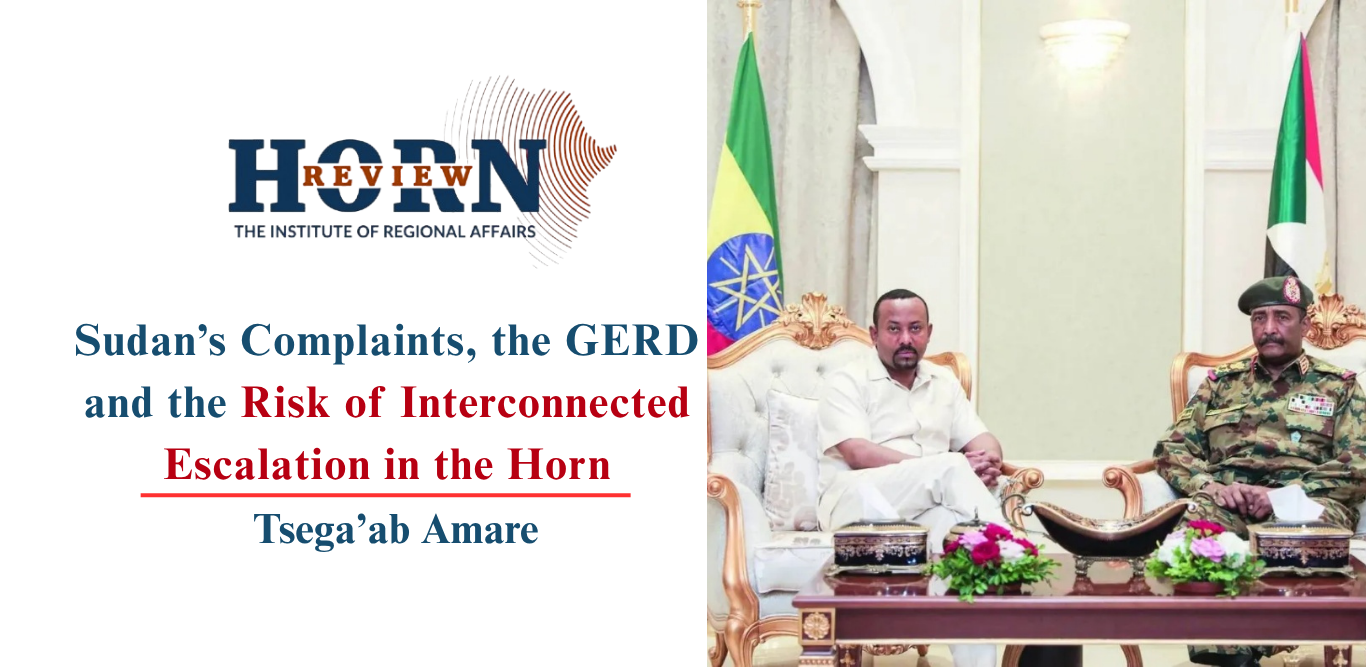
Addis Ababa has consistently rejected the 1959 treaty as a colonial-era arrangement that cannot bind a non-signatory, viewing the GERD as an exercise of sovereign development correcting a historical asymmetry. Sudan’s return to the Egyptian legal position marks a sharp retreat from the pragmatism of January 2023, when then-Sovereignty Council head Abdel Fattah al-Burhan told Prime Minister Abiy Ahmed in Khartoum that the two nations were aligned on the dam—citing benefits like flood regulation, sedimentation control, and cheap electricity.
By October 2025, Burhan was telling President Abdel Fattah el-Sisi that the two states held a unified position. The recent Cairo statement renews that stance. This reversal illustrates how acute domestic insecurity can compel a state to trade long-term economic interests for immediate external military guarantees.
A Path Forward: Decoupling Tracks and Standardizing Proof
De-escalation requires separating the security and water tracks that the Cairo statement deliberately joined, and applying a single, rigorous standard of proof to both.
1. Security Track: An AU-Led Independent Technical Panel
Ethiopia is well-positioned to seize the initiative by issuing a standing invitation to the African Union Commission to appoint an independent technical panel. Operating under a pre-agreed protocol reported to both the UNSC and AUPSC, the panel’s mandate must be reciprocal from day one.
Phase One Mandate:
- Chain of Custody: Establish custody records for the Damazin flight-control unit.
- Supply Chain Audit: Request export and end-user records for serial-numbered components from the manufacturer (Baykar) and licensing state (Turkey).
- Telemetry Reconstruction: Reconstruct launch signatures using datalink, ground-station, and radar records.
Phase Two Mandate:
- Reciprocal Field Verification: Utilize the African Union Border Programme (AUBP) and the Ethiopia-Sudan Border Commission machinery.
- Scope: Cover sites named by Sudan (launch points) AND areas/supply routes identified by Ethiopia where hostile armed groups are allegedly equipped (with Eritrean coordination).
2. Water Track: Return to the 2015 Declaration of Principles
The water dispute belongs in the AU-led trilateral framework anchored in the 2015 Declaration of Principles (DoP), signed by all three capitals in Khartoum.
- Mutual Benefit: Sudan stands to gain significantly from GERD operations—flood regulation, reduced sedimentation at Roseires and Sennar dams, and affordable electricity.
- Confidence Building: A real-time data-sharing protocol on reservoir operations during the flood season would restore those tangible benefits, giving Khartoum concrete equities to weigh against Cairo’s legal maximalism.
- Strategic Reality: Sudan’s return to the 1959 Agreement serves Egypt’s interests more than Khartoum’s. Cairo has found in a weakened Khartoum a useful instrument to lend a riparian voice to its opposition to the dam, applying pressure Egypt cannot openly apply itself.
3. The Political Precondition: Ending Proxy Warfare
Ending external support for armed movements seeking regime change—or at minimum submitting these mutual allegations to neutral scrutiny—is a precondition for any durable settlement. Without this insulation, the fragilities of Sudan and Ethiopia will continue to act as communicating vessels: escalation on one side feeding instability on the other. The ultimate cost will be borne by civilians in Blue Nile, Khartoum, and along Ethiopia’s northern front.
Frequently Asked Questions (FAQ)
What was the main outcome of the Egypt-Sudan 2+2 consultations in Cairo? The joint statement merged Sudan’s drone allegations against Ethiopia with a renewed rejection of the Grand Ethiopian Renaissance Dam (GERD), invoking the Egypt-Sudan Joint Defense Agreement to blur the lines between water diplomacy and military deterrence.
What evidence has Sudan presented regarding the drone attacks? Sudan filed a complaint at the UNSC and AU PSC citing a recovered flight-control unit near Damazin, serial-numbered components linked to Turkish Bayraktar Akinci drones, and a log of 70 attacks (187 drones) between February and October. However, the public report lacks ground-station telemetry and full flight-path reconstruction.
Why is the 1959 Nile Waters Agreement controversial? The agreement allocated the entire Nile flow to Egypt and Sudan, excluding Ethiopia. Addis Ababa rejects it as a colonial-era relic that cannot bind a non-signatory, while Cairo and Khartoum (currently) view it as the binding legal baseline.
How does Ethiopia’s internal conflict affect the Nile dispute? The formation of the “Alliance for Survival” (TPLF, Fano, etc.) and the diplomatic rupture with Eritrea have led Ethiopian officials to accuse Egypt, Sudan, and Eritrea of proxy warfare. This insecurity drives Sudan toward Egypt for security guarantees, prompting a hardening of Khartoum’s stance on the GERD.
What is the proposed solution for the drone allegations? An African Union-appointed independent technical panel with a reciprocal mandate: investigating Sudan’s drone claims and Ethiopia’s allegations that Sudan arms TPLF-linked fighters, verified through supply-chain audits and field inspections via the AU Border Programme.
