




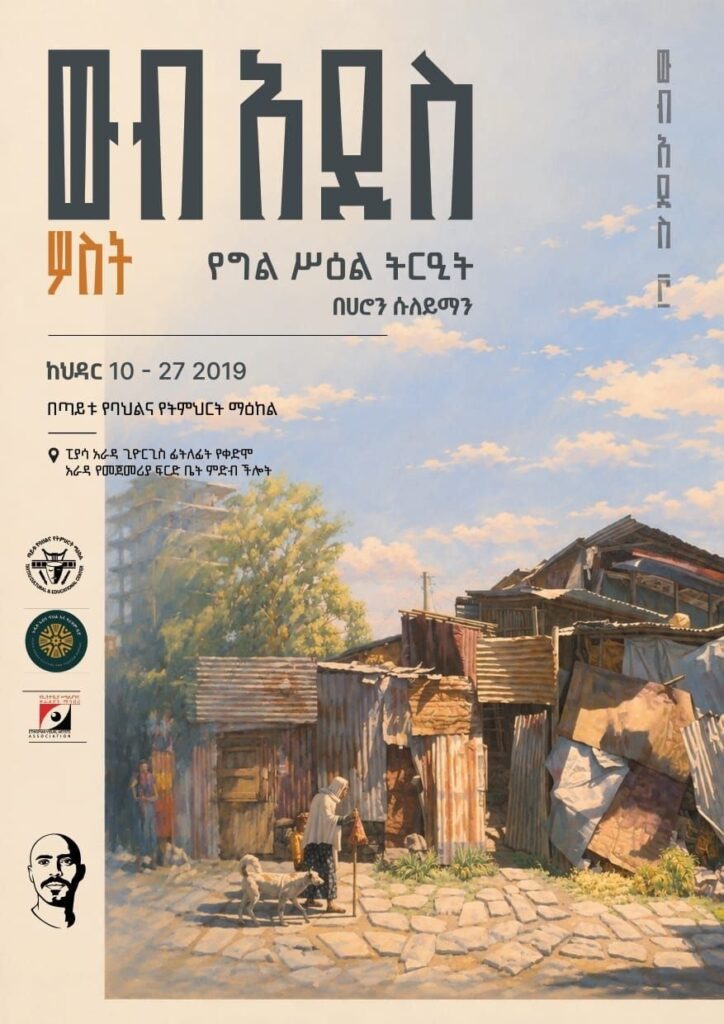
Meta Title: Haron Suleiman’s “Wub Addis III”: Preserving Addis Ababa’s Vanishing Heritage Through Art
Meta Description: Explore Ethiopian artist Haron Suleiman’s final “Wub Addis” exhibition at the Taitu Cultural Center. Discover 49 paintings documenting historic neighborhoods, traditional architecture, and the race to preserve Addis Ababa’s cultural memory amid rapid modernization.
Focus Keyphrase: Haron Suleiman Wub Addis III
Slug: haron-suleiman-wub-addis-iii-addis-ababa-heritage
Haron Suleiman’s “Wub Addis III”: A Visual Archive of Addis Ababa’s Disappearing Soul
Addis Ababa, Ethiopia – As cranes reshape the skyline of Ethiopia’s capital, artist Haron Suleiman is wielding a brush against erasure. His latest solo exhibition, “Wub Addis III” (Beautiful Addis III), currently on view at the historic Taitu Cultural and Educational Center, serves as a poignant visual archive of the neighborhoods, architecture, and everyday spaces that defined generations of residents.
Running through December 6, 2026, this final chapter of a near 14-year trilogy presents 49 paintings—39 oils and acrylics alongside 10 watercolours—documenting an urban landscape vanishing under the weight of rapid modernization.
The Trilogy: Mapping a City’s Heartbeat
The “Wub Addis” project (Amharic for “Beautiful Addis”) is not merely a collection of cityscapes; it is a structured anthropological study conducted through pigment and canvas. Suleiman, born and raised in the capital, structures the trilogy around three distinct pillars of urban life:
1. Wub Addis I: Midday at the Market (The Economic Pulse)
The inaugural edition immersed viewers in the chaotic vitality of Addis Ababa’s informal marketplaces, locally known as gulits. Suleiman captured small-scale traders laboring under the midday sun, framing the informal economy not as clutter, but as the city’s beating heart.
2. Wub Addis II: Doorstep (The Commercial Fabric)
The second installment zoomed in on the neighbourhood shops and micro-enterprises lining residential streets. From vibrant fruit displays to cluttered merchandise spilling onto sidewalks, Suleiman elevated these “doorstep” economies as essential features of the city’s visual and social culture.
3. Wub Addis III: The Residential Soul (The Domestic Memory)
The finale turns inward, focusing on older residential neighbourhoods and traditional houses—specifically locations tethered to the artist’s own childhood. This edition carries the heaviest emotional weight; several structures depicted on canvas have already been demolished or radically altered, existing now only within these frames.
Artist Insight: “Documenting these places through painting was an effort to preserve their stories and memories for future generations. Even ordinary structures—ageing houses, traditional shops, familiar corners—carry historical and emotional value that should not be overlooked.” — Haron Suleiman
The Making of a Masterpiece: Process, Patience, and Perseverance
The exhibition represents a staggering investment of time and personal resources. Suleiman’s hyper-realistic style demands a rigorous, almost journalistic methodology:
- Research & Fieldwork: Each painting begins with extensive site visits, photographic studies, and historical research—approx. one month per piece.
- Execution: Large-scale realistic works require 3 to 4 months of studio time; smaller pieces take 2 to 3 weeks.
- Independent Financing: For nearly 14 years, Suleiman self-funded the trilogy, covering transport, studio rent, and premium art materials without initial institutional backing—a testament to the project’s personal urgency.
Did You Know? The Taitu Cultural and Educational Center, hosting the exhibition, is itself a heritage site. Named after Empress Taitu Betul, founder of Addis Ababa, the center sits near the historic Menelik II Palace complex, grounding the show in the very history it depicts. Learn more about Empress Taitu’s legacy →
Art in the Age of AI: A Humanist Manifesto
Beyond urban preservation, “Wub Addis III” sparks a critical dialogue on the future of artistic practice. In an era where Generative AI tools (like Midjourney, DALL-E, and Stable Diffusion) can render cityscapes in seconds, Suleiman issues a measured warning.
While acknowledging AI’s utility for reference or ideation, he argues that overreliance erodes the foundational craft:
- Observation: The discipline of seeing light, texture, and atmosphere firsthand.
- Drawing & Colour Study: The muscle memory connecting hand, eye, and pigment.
- Independent Style: The unique visual fingerprint forged through thousands of hours of failure and correction.
“Human experience, emotion, empathy, and originality remain central to meaningful artistic expression,” Suleiman asserts. “An artist’s understanding of society gives a painting significance beyond its visual appearance.” This positions the exhibition as a performance of humanity—each brushstroke a rebuttal to algorithmic synthesis. Read UNESCO’s stance on AI and cultural diversity →
Public Reception & Institutional Support
The resonance is immediate. Suleiman estimates 300–400 daily visitors flocked to the Taitu Center shortly after the November opening, signaling a deep public hunger for cultural reflection. The artist credits the Addis Ababa Culture, Arts, and Tourism Bureau for crucial logistical support in realizing the second and third editions, marking a growing municipal recognition of contemporary art as heritage infrastructure.
Why “Wub Addis III” Matters Now
Addis Ababa is one of Africa’s fastest-growing cities. The World Bank projects its population could double by 2035, driving aggressive densification that often prioritizes high-rise concrete over the low-rise, courtyard-centric Addis Ababa house typology.
Suleiman’s work functions as “Counter-Mapping”—a strategy used by indigenous and marginalized communities globally to reclaim narrative control over space. By painting the ordinary, he argues the ordinary is sacred.
Key Takeaways for Visitors & Scholars:
- Visual Archive: 49 paintings now serve as primary source documents for architects, historians, and urban planners studying the vernacular architecture of Addis Ababa.
- Cultural Policy Case Study: The 14-year self-funded model highlights the funding gaps for long-form documentary art in the Global South.
- Human vs. Machine: A timely case study for art curriculums on maintaining craft integrity amid AI disruption.
Plan Your Visit
| Detail | Information |
|---|---|
| Exhibition | Wub Addis III (Final Installment) |
| Artist | Haron Suleiman |
| Venue | Taitu Cultural and Educational Center |
| Location | Kirkos Sub-city, Near Menelik II Square / Arat Kilo, Addis Ababa |
| Dates | Open Now – December 6, 2026 |
| Works on View | 49 Total (39 Oil/Acrylic, 10 Watercolour) |
| Supported By | Addis Ababa Culture, Arts & Tourism Bureau |
Frequently Asked Questions (FAQ)
What does “Wub Addis” mean? “Wub Addis” translates from Amharic as “Beautiful Addis.” It is the title of Haron Suleiman’s three-part solo exhibition series documenting the cultural landscape of Addis Ababa.
Where is the Taitu Cultural and Educational Center located? It is located in the Kirkos Sub-city area of Addis Ababa, near the historic Arat Kilo and Menelik II Square landmarks.
How long did the “Wub Addis” project take? The trilogy spanned nearly 14 years (approx. 2012–2026), from initial concept to the closing of the third exhibition.
Are the paintings for sale? Inquiries regarding acquisitions should be directed to the Taitu Cultural Center administration or the artist’s official channels, as specific sales policies vary by exhibition.
How does this exhibition relate to AI art? The artist uses the platform to advocate for traditional artistic skills (observation, drawing, emotional empathy) arguing they provide a “significance beyond visual appearance” that AI generation currently lacks.
Final Reflection
“Wub Addis III” does not romanticize decay; it documents dignity. In the peeling paint of a courtyard gate, the shadow play on a corrugated iron roof, or the geometry of a gulit stall, Suleiman proves that heritage lives not only in monuments, but in the patina of daily life.
As the exhibition closes its doors on December 6, 2026, the paintings will disperse, but the archive remains—a permanent “Beautiful Addis” built not from concrete, but from memory, pigment, and the stubborn, slow magic of the human hand.
Related Reading:
- The Evolution of Addis Ababa’s Urban Planning (World Bank Report)
- Vernacular Architecture of Ethiopia (Journal of African Architecture)
- UNESCO Creative Cities Network: Addis Ababa
Image Optimization Note for Webmaster:
- Featured Image:
IMG_20261122_210317_002.jpg-> Alt Text: “Haron Suleiman standing beside a large oil painting from Wub Addis III depicting a traditional Addis Ababa neighborhood street at the Taitu Cultural Center.” - Gallery Images: Ensure all 7 gallery images have unique Alt Texts describing the specific architectural element shown (e.g., “Watercolour of a traditional Addis Ababa house with wooden balconies,” “Oil painting of a neighborhood fruit shop doorstep in Merkato area”).
- Schema Markup: Implement
ExhibitionEventandVisualArtworkSchema.org markup for rich snippets.
