




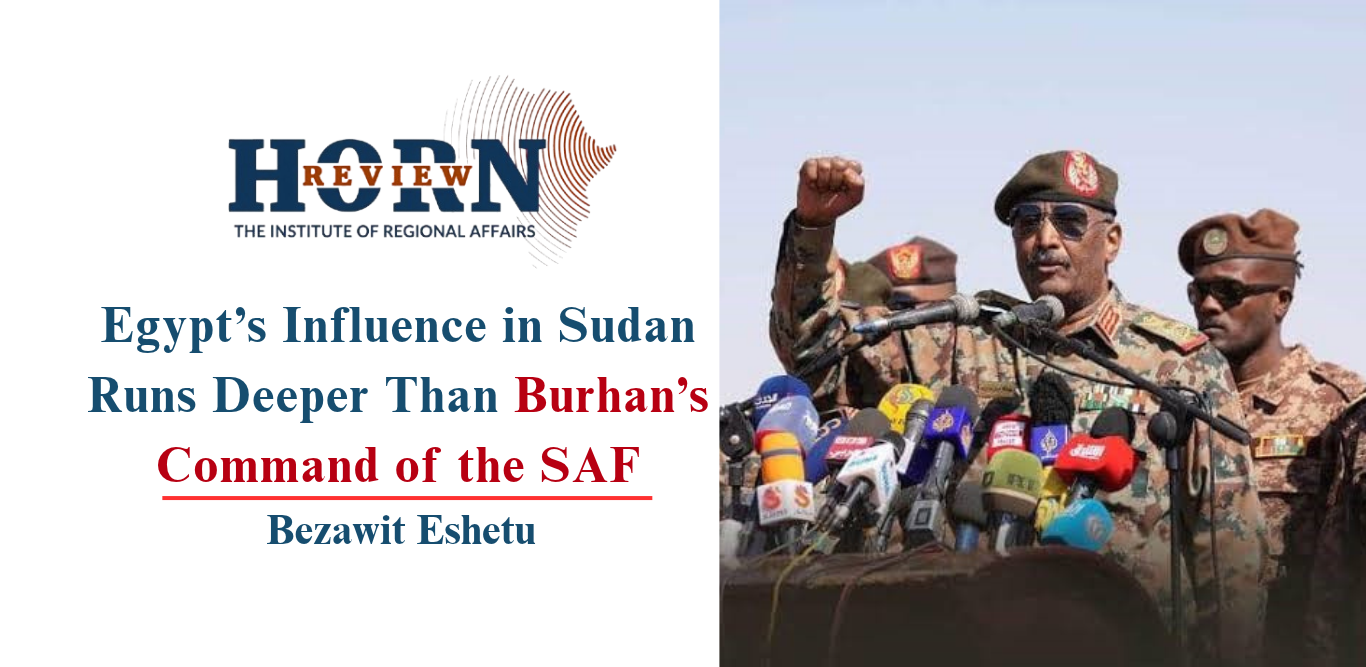
Title: Beyond Burhan: The Deep Institutional Roots of Egypt’s Strategy in Sudan
Meta Description: Egypt’s Sudan policy runs deeper than support for General Burhan. Explore the historical, military, economic, and social institutional ties binding Cairo to the SAF and the riverine elite networks shaping Khartoum’s power structure.
Egypt’s relationship with Sudan is frequently reduced in international commentary to a single variable: Cairo’s backing for General Abdel Fattah al-Burhan since the war erupted in April 2023. This interpretation mistakes the most visible interlocutor for the architecture of influence itself. In reality, Egyptian engagement spans the Sudanese Armed Forces (SAF) command, military intelligence, defense production, commercial networks, and political constituencies surrounding the state.
Burhan occupies a central node in this architecture, but the relationship was built through institutions, personnel, and strategic interests that predate his leadership—and are structured to outlast it. Understanding this durability requires examining the social composition of the Sudanese state itself, particularly the networks that have historically monopolized its political, administrative, and military establishment.
The Riverine Core: Social Foundations of the Sudanese State
Since independence in 1956, political and administrative authority in Sudan has been disproportionately concentrated among networks associated with the Nile Valley north of Khartoum. Specifically, the Ja’aliyyin, Shaigiya, and Danagla lineages have formed the backbone of the central establishment.
This “riverine core” has shaped the SAF’s institutional identity in a critical way: while the army’s broader ranks are socially diverse, recruiting from communities across the country, its senior officer corps has historically reflected this narrow northern demographic. This distinction between a diverse rank-and-file and a centralized command structure defines the SAF’s conception of the state it serves.
Unequal access to education, administrative employment, and military training consolidated these networks within the central establishment. Conversely, peripheral communities in Darfur, Kordofan, and the East often encountered state authority primarily through coercive administration and military campaigns rather than developmental governance.
Historical Roots: From Turco-Egyptian Conquest to Condominium
This hierarchy is not accidental; it is the product of nearly two centuries of state formation.
- The Turco-Egyptian Conquest (1820): Incorporated Sudan into a Nile-centered imperial administration, establishing Khartoum as the primary military and political hub.
- British Condominium Rule: Reorganized coercive institutions, notably establishing the Sudan Defense Force (SDF) in 1925 following the withdrawal of Egyptian forces.
- Uneven Development: The development of military recruitment, training pipelines, and access to state institutions remained geographically uneven, reinforcing the divide between the central military establishment in Khartoum and locally recruited forces in the periphery.
The Sudanese Armed Forces (SAF) inherited this legacy, evolving as the principal military institution of the central state with an organizational identity tightly bound to the preservation of that specific state architecture.
The Parallel Track: Rise of the Rapid Support Forces (RSF)
While the SAF anchored the center, the state relied on a parallel model of coercion for the margins. The Rapid Support Forces (RSF) emerged from government-backed militia mobilization during the Darfur conflict (early 2000s), formalized as a separate force in 2013 under the National Intelligence and Security Service (NISS).
The RSF developed distinct recruitment networks in Darfur and Kordofan, an independent command structure, and autonomous commercial resources (particularly gold mining). Gradually, it acquired the organizational capacity to challenge the SAF’s military primacy.
The current confrontation, therefore, reflects a structural crisis: a state architecture that concentrated authority in Khartoum while outsourcing peripheral control to armed formations that eventually became a rival center of power.
Egypt’s Strategic Calculus: Why the SAF?
Cairo’s preference for the SAF is not merely personal; it is structural. Sudan shares a 1,276 km border with Egypt, sits at the crossroads of the Nile Valley, the Sahel, and the Horn of Africa, and is the indispensable partner in Nile diplomacy—specifically regarding the Grand Ethiopian Renaissance Dam (GERD).
Former British Ambassador to Sudan, Dame Rosalind Marsden, has emphasized Egypt’s “strong preference for the Sudanese army,” highlighting the close military links and Cairo’s interest in retaining Khartoum as an ally in GERD negotiations.
For Egypt, the conventional army offers:
- An identifiable counterpart for border coordination and security agreements.
- An institutional partner for regional diplomacy.
- Continuity in Sudan’s negotiating position on Nile water security.
Institutional Military Ties: Decades of Interoperability
The military relationship possesses an institutional history extending far beyond the current leadership.
- 1976 Joint Defense Agreement: Formalized a security partnership rooted in the 1950s and 60s.
- March 2021 Military Cooperation Agreement: Signed by Egyptian Chief of Staff Lt. Gen. Mohamed Farid and Sudanese counterpart Lt. Gen. Mohamed Othman al-Hussein, covering training, joint exercises, and security coordination.
- “Nile Eagles” Exercises: Regular joint drills (air operations, maritime training) that build procedural familiarity and personal networks across the officer corps.
These exchanges generate institutional familiarity—networks of trust and standard operating procedures—that are less dependent on the political fortunes of any single leader. Egypt engages the SAF as an institution: the senior command, professional military education pipelines, and bilateral committees.
Beyond the Barracks: Religious, Social, and Economic Networks
Egypt’s influence operates through channels deeper than the General Staff.
Religious and Sufi Diplomacy
During the 1950s, Egypt’s Free Officers government cultivated Sudese Sufi networks through Al-Azhar Al-Sharif and religious diplomacy to preserve influence over the Nile Valley. These networks provided channels of political influence bypassing formal state institutions—a template that endures today.
Defense Industrial Integration
The relationship is anchored in the military-industrial complex.
- November 2020 MoU: Egypt’s National Organization for Military Production (NOMP) and Sudan’s Military Industry Corporation (MIC) signed a memorandum on manufacturing cooperation.
- April 2021 Talks: Sudanese Defense Industries System General Manager Merghani Edris met Egypt’s Minister of State for Military Production, Mohamed Ahmed Morsi, to expand industrial ties.
This links the two countries’ defense production establishments, creating a material basis for cooperation immune to diplomatic fluctuations.
Commercial Networks of the Military Economy
Bilateral engagement extends into the commercial ecosystems surrounding the military establishments.
- GreenZone: A company linked to Sudan’s military-industrial establishment, involved in reported agricultural trade/export arrangements.
- Multiple Directions: Another military-linked enterprise alleged to maintain connections with Egyptian intelligence structures.
These ties indicate that institutional relationships operate through the commercial networks through which Sudan’s military establishment accumulates and manages economic resources, providing additional resilience to the bilateral bond.
Political Engagement: Broadening the Constituency
Cairo’s strategy encompasses political and armed constituencies capable of shaping the post-conflict order.
In February 2023, Cairo hosted a meeting of Sudanese political and armed groups rejecting the December 2022 Framework Agreement. Participants included Democratic Bloc figures:
- Gibril Ibrahim (Justice and Equality Movement / Finance Minister)
- Minni Arko Minnawi (Sudan Liberation Movement / Darfur Governor)
- Al-Hadi Idris (Sudan Liberation Movement – Transitional Council)
- Mohamed al-Amin Terik (Beja Congress)
This initiative provided a platform for forces contesting the civilian-led transition, signaling Cairo’s intent to maintain leverage across Sudan’s fragmented political landscape—engaging armed movements, regional networks, and Islamist-leaning blocs alongside the SAF command.
Navigating Internal SAF Fragmentation
The SAF is not a monolith. Egypt’s deep contacts position it to navigate internal divisions:
- Islamist Networks: Supporters of the former National Congress Party (NCP) retain significant influence within the officer corps and over Burhan.
- Professional/Institutional Officers: Career soldiers focused on corporate military interests.
- Military-Commercial Elites: Actors connected to the vast military economy developed under Omar al-Bashir.
Egypt’s longstanding ties to the senior command, Military Intelligence, and defense-industrial leadership allow it to engage multiple nodes of this fragmented power structure simultaneously.
Precedent: Institutional Ties Survive Political Ruptures
History confirms that deep institutional ties do not guarantee political alignment.
- 1990s Crisis: Bashir’s Islamist orientation, ties to Iran, and the 1995 assassination attempt on Hosni Mubarak in Addis Ababa (allegedly backed by Khartoum) drove a deep wedge between Cairo and Khartoum. The Hala’ib Triangle dispute added territorial tension.
- 1999 Rapprochement: Relations improved only after Bashir marginalized Hassan al-Turabi and sought to reduce regional isolation.
This cycle—convergence, confrontation, recalibration—demonstrates that Egypt’s relationship is with the Sudanese state structure and its military institution, not merely the incumbent leader.
The Post-2019 Trajectory: Continuity Amid Chaos
Following Bashir’s ouster in 2019, Cairo pivoted to the Transitional Military Council (TMC) and the emerging military leadership. The GERD dispute intensified this focus. The March 2021 defense agreement, subsequent Nile Eagles exercises, Egypt’s measured response to the October 2021 coup, and the February 2023 political initiative all reflect a consistent strategy: maintain relations with the institutions and constituencies shaping Sudan’s transition.
Burhan’s prominence as Cairo’s interlocutor is a function of his position within the SAF command structure, not the origin of the relationship.
Conclusion: An Architecture Built to Endure
Egypt’s position in Sudan is consequently deeper than its association with General Burhan. Its links with the SAF extend through:
- Senior Command & Succession Lines: Generations of officers trained in Egyptian academies.
- Military Intelligence: Deep operational coordination.
- Defense Industrial Base: Joint production and procurement pipelines.
- Commercial & Religious Networks: Parallel influence channels.
A change in SAF leadership would alter Cairo’s immediate counterpart, but it would not erase the institutional connective tissue developed over seven decades. Egypt has bet on the durability of the Sudanese state’s central military architecture—a bet placed on history, sociology, and structural interest, not on a single general.
Key Takeaways for Policy Watchers
| Dimension | Mechanism | Resilience Factor |
|---|---|---|
| Military | Joint Defense Agreements, Nile Eagles Exercises, Officer Training | Professional socialization; procedural interoperability. |
| Industrial | NOMP-MIC MoU, Joint Manufacturing | Sunk costs; supply chain integration. |
| Commercial | Military-linked firms (GreenZone, Multi. Directions) | Patronage networks; revenue dependence. |
| Political | Engagement with Armed Movements (JEM, SLM) & Democratic Bloc | Hedging; access to peripheral power brokers. |
| Social/Religious | Al-Azhar links, Sufi Order diplomacy | Cultural legitimacy; soft power depth. |
Further Reading & Sources:
- RVI Sudan Handbook: Historical Administrative Structures
- CFR Global Conflict Tracker: Power Struggle in Sudan
- UK Parliament Oral Evidence: Dame Rosalind Marsden on Egypt/SAF/GERD
- NYT Archives: 1976 Egypt-Sudan Joint Defense Accord
- SIS Egypt: Egypt-Sudan Military Production MoU (2020)
- Journal of Eastern African Studies: Military-Commercial Networks
- Al Jazeera: History of Egypt-Sudan Tensions (Hala’ib, 1995)
