




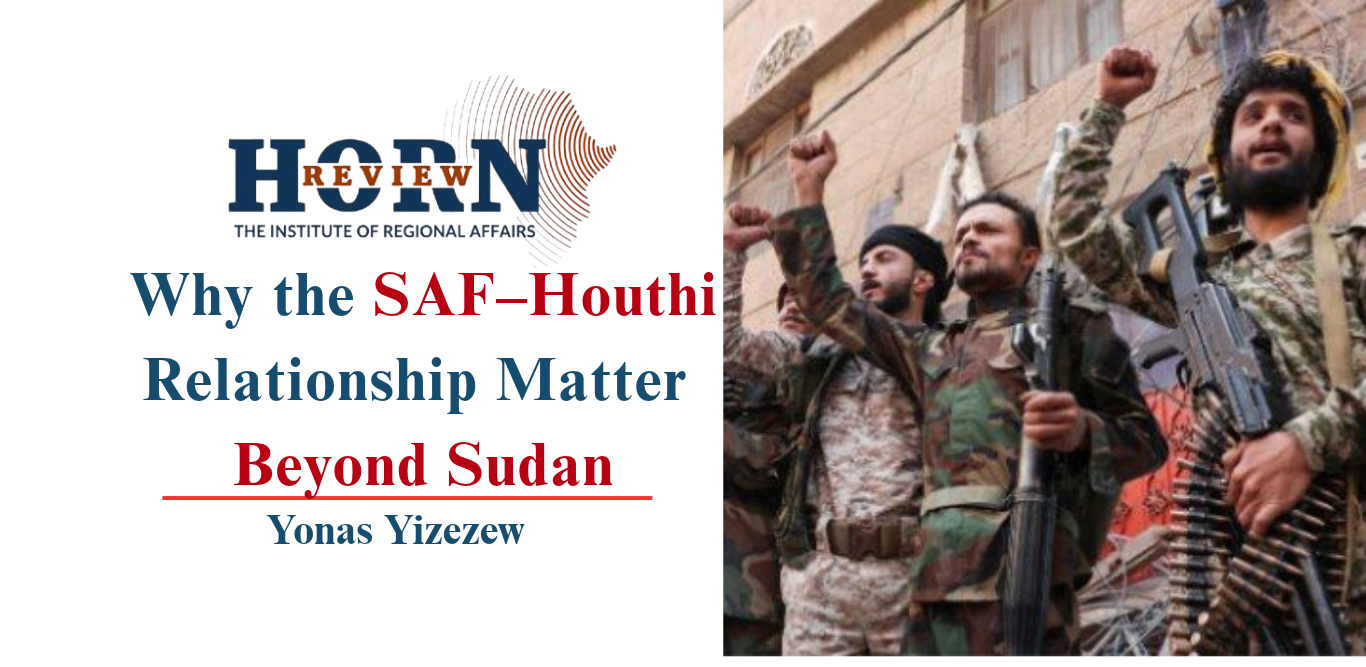
Meta Title: Houthi Expansion in Africa: The Red Sea Corridor, Sudan’s SAF & Iran’s Growing Influence
Meta Description: Explore The Century Foundation’s report on the Houthis’ evolving role as a regional hub in Africa. Analyzing links with Sudan’s SAF, al-Shabaab, Eritrea, and Iran’s supply chains across the Red Sea.
Focus Keyword: Houthi expansion in Africa
Slug: houthi-expansion-africa-red-sea-corridor-sudan-iran
Houthi Expansion in Africa: How the Red Sea Corridor Is Reshaping Regional Security
The Houthis (Ansar Allah) have transcended their origins as a localized Yemeni insurgency to become a pivotal regional intermediary connecting the Red Sea, the Horn of Africa, and the Sahel. A detailed report by The Century Foundation (TCF) maps this transformation, revealing a sprawling network of weapons transfers, logistical corridors, and political alliances centered on Sudan, Somalia, and Eritrea—all operating under the strategic umbrella of Iranian influence.
This evolution marks a critical shift: the Houthis are no longer merely a spoke for Iranian power projection but a hub facilitating military cooperation across multiple conflict theaters.
The Sudanese Pivot: SAF, Port Sudan, and the Iranian Supply Line
The outbreak of Sudan’s civil war in April 2023 between the Sudanese Armed Forces (SAF) and the Rapid Support Forces (RSF) created a vacuum that Iran and the Houthis moved swiftly to fill.
Why Sudan Became Strategic
- SAF Vulnerabilities: The SAF lacked aerial surveillance, drone capabilities, and modern munitions.
- Iran’s Return: Tehran seized the opportunity to restore influence lost after Khartoum severed ties in 2016, supplying Mohajer-6 drones, radar systems, and ammunition.
- Houthi Logistics: The Houthis leveraged their Red Sea maritime access to act as the physical conduit for these transfers.
Port Sudan: The Operational Nexus
Port Sudan—the SAF’s wartime administrative capital—sits directly opposite Yemen across the Red Sea. Its geographic proximity to the Bab el-Mandeb Strait (recently consolidated under Houthi control) makes it the ideal node for maritime smuggling.
- TCF Evidence: The report documents at least three Houthi-facilitated shipments of small arms and light weapons to the SAF from mid-2024 onward.
- Sanctioned Intermediaries: Key figures like Mirghani Idris Suleiman, chief of the Defence Industries System (under EU and US sanctions), sit at the intersection of procurement and Islamist networks facilitating this flow.
External Context: The US State Department designated the Sudanese Muslim Brotherhood a Foreign Terrorist Organization in March 2026, citing its recruitment of 20,000+ fighters for the SAF, many trained by Iran’s IRGC.
The Islamist Anchor: Ideology as Infrastructure
The SAF-Houthi-Iran axis is not purely transactional; it is cemented by shared Islamist ideology within Sudan’s military establishment.
- Deep State Networks: Since Omar al-Bashir’s ouster, the Sudanese Islamic Movement retains deep influence over intelligence, military command, and volunteer brigades (e.g., al-Baraa ibn Malik Brigade).
- Historical Ties: These networks maintained relations with Tehran during the Bashir era, providing a political foundation for current military cooperation.
- Internal Friction: This alignment creates a strategic contradiction for General Abdel Fattah al-Burhan. He seeks legitimacy from Saudi Arabia, Egypt, and the US—all adversaries of the Iranian axis—while his wartime survival depends on Islamist factions sympathetic to Iran.
The Saudi Dilemma
Riyadh supports the SAF against the RSF but leads the coalition fighting the Houthis in Yemen.
- Flashpoint: Reports indicate Riyadh requested Sudanese troops for deployment against the Houthis. Internal SAF resistance (reportedly leading to Burhan’s refusal) exposes the fragility of the Saudi-Sudanese alliance.
- US Concern: Senior Advisor Massad Boulos explicitly flagged the SAF’s importation of Iranian weapons and ties to radical Islamists as primary concerns for the Trump administration (Darfur24 Report).
The Southern Flank: Houthi–al-Shabaab Cooperation
Despite stark ideological differences—Zaidi Shia vs. Salafi-Jihadi—the Houthis and al-Shabaab in Somalia have found pragmatic convergence.
| Actor | Need | Houthi Offer |
|---|---|---|
| Al-Shabaab | Counter-drone warfare; advanced IED tech; anti-armor capabilities. | Drone warfare expertise; weapon modification; asymmetric tactics honed against Saudi/US defenses. |
| Houthis | Strategic depth; access to Somali coastline; expansion of Iranian logistics. | Territorial access; shared enemy (US/Western naval presence); expansion of the “Resistance Axis” brand. |
The Sahel Connection: Al-Shabaab’s growing links to Jama’at Nusrat al-Islam wal-Muslimin (JNIM) and Islamic State Sahel Province (ISSP) extend this arc of instability from Mogadishu to Mali. The Houthis now possess technology (anti-ship ballistic missiles, long-range UAVs) capable of threatening sophisticated air defenses—a capability that could eventually filter down this terror corridor.
The Northern Lock: Eritrea’s Reopening Corridor
Eritrea provides the final geographic link completing a continuous African Red Sea littoral under Iranian/Houthi influence.
Shifting Alignments in Asmara
- Historical Precedent: Late 2000s IRGC use of Eritrean territory for Houthi training.
- Hiatus: Suspended when Asmara joined the Saudi-led coalition (2015).
- Reactivation: Driven by:
- Eritrea-Iran Rapprochement: Diplomatic normalization.
- Pro-SAF Stance: Asmara supports Burhan in Sudan.
- Ethiopia Tensions: Deteriorating relations with Addis Ababa push Eritrea toward alternative security partners.
The Continuous Coastal Continuum
The TCF report identifies an intermittent but resilient logistics chain:
Northeastern Somalia (Al-Shabaab zones) → Djibouti (proximity) → Eritrea (Assab/Massawa) → Sudan (Port Sudan)
This corridor allows for:
- Personnel Movement: Fighters, trainers, IRGC advisors.
- Weapons Transit: Drones, missiles, small arms, components.
- Technical Exchange: Drone assembly, electronic warfare, maritime targeting.
Strategic Implications: A Self-Defeating Strategy for Sudan?
The report argues the SAF’s current trajectory is strategically incoherent:
- Confrontation with Ethiopia: Aligning with Cairo’s rivalry against Addis Ababa isolates Khartoum regionally.
- Dependency Trap: Reliance on Iranian hardware and Islamist militias locks Sudan into an axis opposed by its wealthy Gulf neighbors and the West.
- Ecosystem of Instability: By integrating into the Houthi hub, Sudan’s civil war becomes inextricably linked to Red Sea shipping security, Somali counter-terrorism, and Sahel stabilization.
Key Takeaways for Policymakers
- The “Hub” Model: Counter-terrorism and counter-proliferation strategies targeting the Houthis only in Yemen will fail. The network is now trans-regional.
- Sanctions Enforcement: Targeting sanctioned individuals like Mirghani Idris Suleiman and the Defence Industries System is critical to disrupting the procurement pipeline.
- Diplomatic Leverage: The SAF’s reliance on Saudi/US support vs. Iranian/Islamist battlefield necessity is a pressure point. Forcing a choice may degrade the Houthi corridor.
- Eritrea Watch: Monitoring the reactivation of Assab and Massawa ports for Iranian/Houthi logistics is an early-warning indicator for Red Sea escalation.
Frequently Asked Questions (FAQ)
Are the Houthis officially part of the Iranian military? No. They are a non-state armed group (Ansar Allah) aligned with Iran’s “Axis of Resistance.” Iran provides funding, advanced weaponry (UAVs, missiles), and IRGC training, but the Houthis maintain independent command structures and local Yemeni political objectives.
Why would al-Shabaab (Sunni extremists) work with the Houthis (Zaidi Shia)? Pragmatism over theology. Al-Shabaab needs advanced drone/counter-drone tech to fight AU/US forces. The Houthis need African coastal access and seek to expand their utility to Iran by linking the “Resistance Axis” to East African militants.
Is the Sudanese government (SAF) an Iranian proxy? The SAF is a national army fighting a civil war. However, key factions within it (Islamist networks, Military Industry) act as willing partners for Iranian/Houthi logistics in exchange for battlefield survival. This creates a “state capture” risk where national policy is dictated by factional alliances.
What is the Bab el-Mandeb Strait’s role? It is the chokepoint connecting the Red Sea to the Gulf of Aden. Houthi control of the Yemeni coast (and advances toward the strait) allows them to threaten global shipping and secure the maritime highway linking Yemen to Port Sudan and Eritrea.
How does this affect US/EU policy in the Horn? It complicates stabilization efforts in Somalia (ATMIS/AUSSOM transition), Sudan (ceasefire talks), and Red Sea security (Operation Prosperity Guardian). Policies must now treat these as a single interconnected theater, not discrete country files.
Further Reading & Sources
- Primary Source: The Century Foundation Report: The Houthis in Africa (PDF)
- Houthi Red Sea Advances: BBC News: Houthi advance to Bab el-Mandeb
- Saudi-Houthi Tensions: The Arab Weekly: New phase after energy attacks
- Saudi Request for Sudanese Troops: Imarabic: Riyadh seeks soldiers in Sudan
- US Designation of Sudanese Muslim Brotherhood: State Department Release
- EU Sanctions Tracker (Mirghani Idris Suleiman): EU Sanctions List
- US Sanctions on SAF Procurement: State Department Sanctions Notice
- Massad Boulos Comments: Darfur24: US Adviser on Iran-trained fighters
