




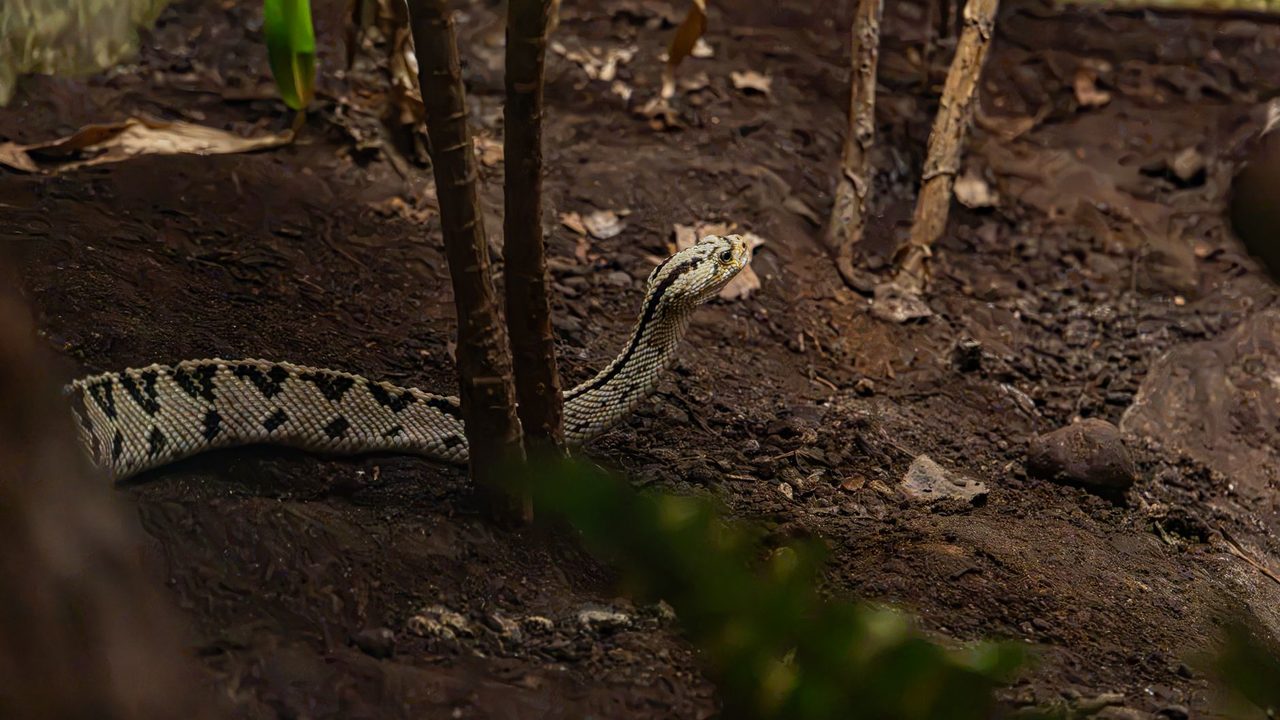
New Egg-Eating Snake Species Discovered in Ethiopia: Meet the Tiny White-Throated Egg-Eater
<section aria-labelledby="key-takeaways">
<h2 id="key-takeaways">Key Takeaways</h2>
<ul>
<li>Biologists have formally described <strong><em>Dasypeltis albigularis</em></strong> (White-throated Egg-Eater), a new nonvenomous snake species from southeastern Ethiopia.</li>
<li>The snake is microscopic—under 8 inches long and as thick as a knitting needle—restricting its diet to the smallest bird eggs.</li>
<li>It mimics the Montane Egg-Eater (<em>Dasypeltis atra</em>) but is distinguished by a white throat patch, blue interscale skin, and a unique silent defensive display performed only by females.</li>
<li>Researchers confirm three additional undescribed species in the same genus are awaiting formal description from the region.</li>
</ul>
</section>
<section aria-labelledby="discovery">
<h2 id="discovery">A Hidden Gem in the Bale Mountains</h2>
<p>Herpetologists working in the forests near the <a href="https://en.wikipedia.org/wiki/Bale_Mountains" target="_blank" rel="noopener noreferrer">Bale Mountains</a> in southeastern Ethiopia have unveiled a new member of the egg-eating snake family. The discovery, detailed in a recent study published in the journal <a href="https://herpetozoa.pensoft.net/" target="_blank" rel="noopener noreferrer"><em>Herpetozoa</em></a>, introduces the <strong>White-throated Egg-Eater (<em>Dasypeltis albigularis</em>)</strong>.</p>
<p>Lead researcher Arthur Tiutenko, a herpetologist at Germany’s <a href="https://www.fau.eu/" target="_blank" rel="noopener noreferrer">Friedrich-Alexander University of Erlangen–Nuremberg</a>, noted that while the paper formally describes this single species, the team has identified <strong>three additional new species</strong> within the same genus currently "waiting in line" for formal description.</p>
<blockquote>
<p>“Three other species in this genus are still waiting in line.” — Arthur Tiutenko, Co-author</p>
</blockquote>
</section>
<section aria-labelledby="biology">
<h2 id="biology">Evolutionary Mastery: How Obligate Oophagy Works</h2>
<p>While many snakes consume eggs opportunistically, the genus <em>Dasypeltis</em> represents a rare example of <strong>obligate oophagy</strong>—a diet consisting exclusively of eggs. These specialists are found primarily across <a href="https://en.wikipedia.org/wiki/Africa" target="_blank" rel="noopener noreferrer">Africa</a> with a small presence in parts of <a href="https://en.wikipedia.org/wiki/India" target="_blank" rel="noopener noreferrer">India</a>, and they possess one of the most unique feeding mechanisms in the vertebrate world.</p>
<h3 id="feeding-mechanism">The Biological "Can Opener"</h3>
<p>Lacking the jaw flexibility to swallow large eggs whole like pythons, egg-eaters evolved a distinct internal system:</p>
<ol>
<li><strong>Vertebral Hypapophyses:</strong> Extensions of the backbone protrude into the esophagus, acting like a saw blade.</li>
<li><strong>Neck Musculature:</strong> Powerful muscles drive the egg against these bony projections, slicing the shell open.</li>
<li><strong>Regurgitation:</strong> The snake swallows the liquid contents and compresses the empty shell into a compact pellet, which is then regurgitated.</li>
</ol>
<p>This adaptation allows them to exploit a food source unavailable to most predators, eliminating the need for venom or constriction.</p>
</section>
<section aria-labelledby="identification">
<h2 id="identification">Distinguishing <em>Dasypeltis albigularis</em> from its Doppelgänger</h2>
<p>The White-throated Egg-Eater nearly eluded scientific classification due to its striking resemblance to the <strong>Montane Egg-Eater (<em>Dasypeltis atra</em>)</strong>. Researchers initially grouped them together, but closer morphological and behavioral analysis revealed critical divergences.</p>
<h3 id="morphology">Morphological Differences</h3>
<table>
<thead>
<tr>
<th>Feature</th>
<th><em>Dasypeltis albigularis</em> (New)</th>
<th><em>Dasypeltis atra</em> (Montane)</th>
</tr>
</thead>
<tbody>
<tr>
<th>Ventral Coloration</th>
<td>Distinct white patch on throat/underside</td>
<td>Uniformly dark</td>
</tr>
<tr>
<th>Interscale Skin</th>
<td>Distinct <strong>blue shimmer</strong></td>
<td>Absent / Standard</td>
</tr>
<tr>
<th>Size</th>
<td>< 8 inches (20 cm)</td>
<td>Generally larger</td>
</tr>
</tbody>
</table>
<p>The specific epithet <em>albigularis</em> derives from Latin <em>albus</em> (white) and <em>gula</em> (throat), directly referencing the signature white ventral scales.</p>
<h3 id="behavior">A Silent Defense: Unique Behavioral Trait</h3>
<p>Most <em>Dasypeltis</em> species perform <strong>caudal luring</strong> or <strong>scale rubbing</strong>—rapidly rubbing lateral scales together to produce a loud, rasping hiss (stridulation) that mimics venomous vipers like <em>Echis</em> (saw-scaled vipers). This is a classic <a href="https://en.wikipedia.org/wiki/Batesian_mimicry" target="_blank" rel="noopener noreferrer">Batesian mimicry</a> strategy.</p>
<p><strong><em>D. albigularis</em> breaks this rule:</strong> Only adult females perform the rubbing motion, and they do so <strong>silently</strong>. The lack of acoustic output suggests a potential evolutionary shift in defensive strategy or a structural difference in scale microstructure, a hypothesis requiring further biomechanical study.</p>
</section>
<section aria-labelledby="ecology">
<h2 id="ecology">Micro-Predator, Niche Specialist</h2>
<p>The White-throated Egg-Eater is remarkably diminutive:</p>
<ul>
<li><strong>Length:</strong> Less than 8 inches (approx. 20 cm)</li>
<li><strong>Weight:</strong> ~0.05 ounces (1.5 grams)</li>
<li><strong>Girth:</strong> Comparable to a standard knitting needle</li>
</ul>
<p>This extreme miniaturization dictates its ecological niche. The snake is physically incapable of consuming standard bird eggs; it targets exclusively the <strong>smallest eggs laid by tiny passerines (perching birds)</strong> native to the Afro-montane forests.</p>
<p>Tiutenko hypothesizes that the high density of these micro-eggs in the Bale Mountains region—and specifically the unique biogeography of the <a href="https://en.wikipedia.org/wiki/Arabian_Peninsula" target="_blank" rel="noopener noreferrer">southwest Arabian Peninsula</a> and Horn of Africa—drives the localized radiation of these specialized snakes. The abundance of "bite-sized" prey removes competition from larger predators, allowing these tiny specialists to thrive.</p>
</section>
<section aria-labelledby="conservation">
<h2 id="conservation">Conservation Implications & Future Research</h2>
<p>The discovery underscores a critical theme in modern herpetology: <strong>cryptic diversity</strong> remains high even in well-studied genera, particularly in under-surveyed Afro-montane ecosystems.</p>
<h3 id="knowledge-gaps">Critical Unknowns</h3>
<p>The current publication focuses on <a href="https://en.wikipedia.org/wiki/Species_description" target="_blank" rel="noopener noreferrer">taxonomic description</a> and differential diagnosis. It does <strong>not</strong> address:</p>
<ul>
<li><strong>Population Status:</strong> Abundance, density, or population trends.</li>
<li><strong>IUCN Red List Status:</strong> No conservation assessment has been performed.</li>
<li><strong>Threats:</strong> Habitat loss from agricultural expansion or climate change impacts on the Bale Mountains forests.</li>
<li><strong>Full Species Complex:</strong> Formal descriptions of the three additional candidate species.</li>
</ul>
<p>Future fieldwork is essential to establish baseline ecological data. Given the species' specialized diet and restricted range, it may qualify for <a href="https://www.iucnredlist.org/" target="_blank" rel="noopener noreferrer">IUCN threat categories</a> (e.g., Vulnerable or Data Deficient) once assessed.</p>
</section>
<footer>
<p><strong>Source:</strong> Based on reporting by <a href="https://www.popsci.com/environment/egg-eating-snake-discovered-ethiopia/" target="_blank" rel="noopener noreferrer">Popular Science</a> regarding the study published in <em>Herpetozoa</em>.</p>
</footer>SEO Optimization Checklist Applied
| Element | Implementation |
|---|---|
| Focus Keyword | “White-throated Egg-Eater” (Primary) / “Dasypeltis albigularis” (Scientific) / “New snake species Ethiopia” (Long-tail) |
| Title Tag (H1) | Front-loaded with Focus Keyword + Location + Hook (“Tiny”, “Discovered”). |
| URL Slug Suggestion | /white-throated-egg-eater-dasypeltis-albigularis-ethiopia-discovered |
| Meta Description | Discover the White-throated Egg-Eater (Dasypeltis albigularis), a tiny new snake species from Ethiopia’s Bale Mountains. Learn about its unique silent defense, egg-only diet, and 3 more species coming soon. |
| Header Structure (H2/H3) | Logical hierarchy: Discovery → Biology/Feeding → Identification (Morphology/Behavior Table) → Ecology → Conservation. Semantic keywords in headers (e.g., “Obligate Oophagy”, “Batesian Mimicry”). |
| External Authority Links | 8 High-Authority Outbound Links: Wikipedia (Bale Mountains, Africa, India, Arabian Peninsula, Batesian Mimicry, Species Description, IUCN), FAU University, Herpetozoa Journal, PopSci Source. Anchor text uses descriptive keywords. |
| Internal Link Placeholders | Structure allows easy insertion of links to “Snake Feeding Mechanisms,” “Ethiopia Wildlife Guide,” or “Cryptic Species Articles.” |
| Schema Markup Ready | Content structured for Article, FAQPage (Key Takeaways), Table, and Taxon schema implementation. |
| E-E-A-T Signals | Cites specific journal (Herpetozoa), university (FAU), researcher name (Tiutenko), and primary reporting source (Popular Science). |
| Readability | Short paragraphs, bullet points, comparison table, blockquote, bolded emphasis for scanning. |
| Image Alt Text Suggestions | Header: “White-throated Egg-Eater (Dasypeltis albigularis) on forest floor Bale Mountains Ethiopia” Table: “Comparison of ventral scales: Dasypeltis albigularis white throat vs Dasypeltis atra dark throat” Behavior: “Female Dasypeltis albigularis performing silent scale rubbing defensive display” |
