





The trajectory of Ethiopia under Prime Minister Abiy Ahmed deserves to be examined not simply through the narrow prism of individual political controversies, but through the broader questions of state resilience, national power and strategic relevance.
Since 2018, Ethiopia has confronted an extraordinary accumulation of political, economic, security and diplomatic pressures while simultaneously attempting to transform one of Africa’s largest and most consequential states. What makes the Ethiopian case particularly significant is not the absence of contradictions, but the state’s continued capacity to function, and in some areas even thrive under extraordinary pressure. Its economy has continued to expand, national institutions have continued to operate, and Ethiopia’s strategic relevance has, rather than diminished, become increasingly difficult for the international community to ignore.
The economic figures are among the clearest indicators of this resilience. Ethiopia is now a country of approximately 135 million people and one of Africa’s largest economies when measured by purchasing power parity. The World Bank recorded real GDP growth of 7.6 percent in 2024, while growth accelerated to approximately 9.2 percent in fiscal year 2024/25. The IMF has projected growth of around 9.2 percent for 2025/26.
These rates place Ethiopia as the fastest-growing large economy in Africa and, by some measures, internationally. Inflation, meanwhile, has fallen substantially from its peak in recent years, reaching approximately 13.2 percent in 2025. Such performance is particularly significant because it has occurred alongside major macroeconomic reforms and within an exceptionally complicated political and security environment.
The important point is not to suggest that Ethiopia is Africa’s richest or most developed economy. The more consequential observation is that the Ethiopian economy has demonstrated a considerable capacity for expansion despite the scale of the pressures confronting the country.
Ethiopia’s development story is therefore better understood through the concept of resilience: the capacity of a state to absorb shocks, reorganize institutions and continue accumulating productive capacity rather than allowing crisis to become permanent economic decline.
The same principle can be seen in infrastructure and technological development. The Grand Ethiopian Renaissance Dam has transformed Ethiopia’s strategic position in the energy sector, while the expansion of electricity generation, industrial parks, roads, aviation, telecommunications and digital financial services has broadened the material foundations of national power.
The rapid expansion of digital finance is particularly revealing. Telebirr, introduced by Ethio Telecom, has grown to approximately 60 million registered customers, illustrating how technological infrastructure can rapidly transform economic participation in a country where conventional financial penetration remains comparatively limited.
These developments should be understood within the larger architecture of national power. A country’s strength cannot be measured solely by GDP or the size of its armed forces. A more useful framework considers the combined capacity of the state across diplomacy, information, military capability, economic strength, financial institutions, intelligence and law enforcement—the instruments commonly captured by the DIMEFIL framework.
What Ethiopia has demonstrated during the Abiy period is an effort to develop several of these instruments simultaneously. The military dimension is particularly important. Ethiopia possesses one of the largest and historically significant military establishments in sub-Saharan Africa. Its armed forces have accumulated decades of operational experience, while the Ethiopian Air Force has developed into one of the continent’s significant air capabilities. The significance of this institution was publicly demonstrated in January 2026, when Ethiopia marked the 90th anniversary of its Air Force in Bishoftu.
Christopher Landau, the U.S. Deputy Secretary of State, and General Dagvin Anderson, commander of U.S. Africa Command, travelled to Ethiopia and participated in the Black Lion Air Show marking the anniversary. They appeared alongside Field Marshal Berhanu Jula, Chief of General Staff of the Ethiopian National Defense Force, and General Yilma Merdassa, Commander of the Ethiopian Air Force.
U.S. military documentation described the event as a celebration of 90 years of the Ethiopian Air Force and emphasized shared priorities and interests between American and Ethiopian leadership. The Ethiopian Air Force was established in the 1930s, and American aviator Colonel John C. Robinson, the Tuskegee Airman known as the “Brown Condor,” played a foundational role in Ethiopian aviation. Ninety years later, American and Ethiopian military leaders stood together in Bishoftu to celebrate the institution’s history while discussing contemporary security cooperation. The symbolism is difficult to overlook. A relationship that began during the formative years of Ethiopian aviation had, nine decades later, become part of a renewed strategic dialogue between the two countries.
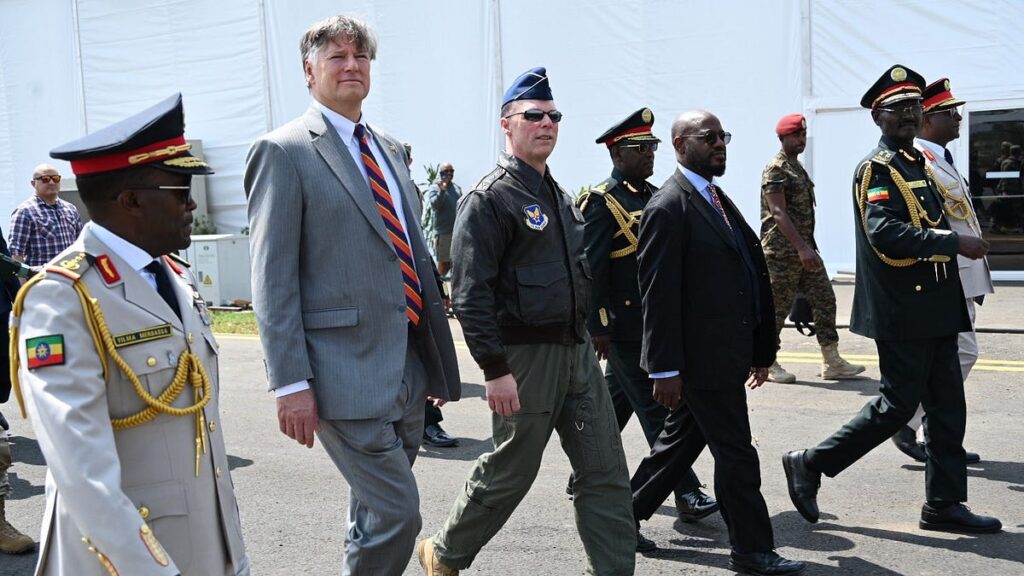
The participation of the U.S. Africa Command commander is particularly significant from a strategic perspective. It is one thing for diplomats to visit Addis Ababa; it is another for the commander of the United States military command responsible for Africa to participate publicly in an Ethiopian military event alongside the country’s senior defense leadership.
This does not mean Washington agrees with every Ethiopian policy, nor should it be interpreted as an unconditional political endorsement. It does, however, demonstrate that Ethiopia possesses security capabilities and geopolitical relevance that Washington considers worthy of sustained engagement.
The significance became clearer through the broader military engagement surrounding the visit. Ethiopian and American officials have discussed cooperation in logistics, communications, professional military engagement and regional security. Ethiopia subsequently hosted an Africa-wide logistics and communications symposium involving representatives from roughly 40 African countries.
A state does not become a continental convening center through rhetoric alone. It does so because other states recognize that its geography, infrastructure, institutions and political position make engagement worthwhile.
The most recent development provides an even stronger indication that the relationship is moving beyond symbolism. On August 19 and 20, 2026, a high-level Ethiopian Defense Force delegation led by Major General Teshome Gemechu, Director General of Foreign Relations and Military Cooperation at Ethiopia’s Ministry of Defense, travelled to the United States for bilateral consultations at the Pentagon with senior American defense officials.
The consultations were co-led by Major General Teshome Gemechu and Brian J. Ellis, the U.S. Deputy Assistant Secretary of Defense for African Affairs. At the conclusion of the discussions, Ethiopia and the United States agreed to establish a framework for comprehensive strategic cooperation in defense and security.
According to Ethiopia’s Ministry of Foreign Affairs, the two countries agreed to expand institutional cooperation and strengthen strategic coordination between their defense institutions. The framework is intended to protect national interests and mutual benefits, strengthen mutual trust, and contribute to peace, security and stability in the Horn of Africa and the wider region.
Major General Teshome Gemechu and Brian J. Ellis also affirmed their commitment to implementing the agreed frameworks and advancing the bilateral defense relationship toward a more future-oriented strategic partnership.
Sustained institutional cooperation requires compatible interests, professional channels, strategic trust and confidence in the partner’s capacity. The Pentagon consultations therefore provide another indication that Ethiopia is being treated not simply as a country requiring assistance, but as a state with which the United States seeks to build a structured security relationship.
Participation of senior U.S diplomats and military figures at Ethiopia’s 90th-anniversary Air Force celebrations is perhaps the most telling sign of renewed U.S-Ethiopia ties. General Anderson subsequently engaged Ethiopian defense leadership in wider African security discussions. Ethiopia hosted a major continental military logistics and communications forum. Then, in August, a senior Ethiopian defense delegation led by Major General Teshome Gemechu travelled to the Pentagon and negotiated a framework for comprehensive strategic defense and security cooperation. Viewed collectively, these events suggest a gradual reconstruction of strategic confidence between Addis Ababa and Washington.
Ethiopia’s relationship with Washington passed through a period of serious tension during the Tigray conflict. The subsequent return to senior-level military engagement and a stated framework for comprehensive strategic cooperation illustrates how international relationships can ultimately be reshaped by changing strategic interests and demonstrated state capacity. Ethiopia has placed its institutional capabilities, geopolitical position and security relevance back on the strategic table. Washington appears increasingly willing to engage with those assets.
The Pentagon meeting is particularly relevant to the broader concept of national power. Ethiopia’s strategic weight does not derive from military capability alone. It derives from the combination of population, economic expansion, geographic proximity to the Red Sea and Middle East, diplomatic weight, military and security capabilities, aviation infrastructure, energy potential and an increasingly diversified set of international relationships. The ability to translate those assets into concrete international partnerships is itself an instrument of national power.
Ethiopia is not necessarily entering the relationship as a passive recipient of an externally designed security agenda. The stated principles of national interests, mutual benefit and mutual trust suggest an effort by Addis Ababa to protect its strategic autonomy while simultaneously expanding cooperation with Washington. That distinction is central to understanding contemporary Ethiopian diplomacy. The objective is not isolation from major powers, but engagement with them from a position of greater institutional confidence.
Abiy Ahmed entered government during a period of profound political transition. Whatever one’s interpretation of individual policies, his administration has consistently sought to present Ethiopia as a state capable of exercising strategic autonomy rather than depending upon external actors to determine its political future. That orientation was tested most dramatically during the Tigray conflict.
When the war began in November 2020, the Ethiopian state faced an existential security challenge. The conflict developed into a major national crisis, and by late 2021 the government faced an armed advance toward the capital.
At that point, Abiy’s decision to go to the front and appear alongside Ethiopian forces became an important symbol of political leadership. The significance was not simply personal bravery. It communicated that the political leadership would remain physically associated with the institutions responsible for defending the state rather than attempting to manage the crisis exclusively from the capital.
Strong leadership does not mean that one individual personally controls every instrument of state power. Rather, it means the political center can coordinate military, diplomatic, economic, intelligence, administrative and technological institutions around a strategic direction.
Ethiopia’s continued functioning through an exceptionally turbulent period suggests that its state capacity is considerably deeper than some external assessments have assumed. This also helps explain the discrepancy between Ethiopia’s actual trajectory and some of the more pessimistic narratives that have circulated internationally.
There are genuine challenges in Ethiopia, and serious analysis should not deny them. But there is an equally serious analytical problem when Ethiopia’s difficulties are detached from historical context, demographic scale and the magnitude of the shocks the country has absorbed.
A nation of more than 130 million people emerging from conflict, transforming its economic system, expanding infrastructure and maintaining rapid GDP growth cannot reasonably be assessed through isolated indicators alone.
Ethiopia remains a developing country with substantial poverty and inequality. But portraying Ethiopia simply as an undifferentiated landscape of deprivation obscures the scale of structural change taking place across the country.
Roads, electricity access, telecommunications, aviation, urban construction, industrial production, digital payments, agricultural commercialization and energy generation have all expanded substantially over the past two decades.
The relevant question for serious analysis is not whether poverty exists—it plainly does—but whether the direction of socioeconomic change is compatible with sustained development.
On that question, Ethiopia’s record is considerably more substantial than simplified external narratives sometimes suggest.
Ethiopia’s strategic transformation should also be viewed over a longer historical horizon.
The country has survived imperial collapse, revolution, civil war, famine, regime change, border war and repeated international pressure. A defining characteristic of the Ethiopian state has historically been its ability to preserve political identity and institutional continuity under extreme pressure.
The Abiy period represents a new chapter in that longer tradition: an attempt to convert demographic weight, geography, infrastructure, economic growth, military capacity and diplomatic centrality into a modern conception of national power.
Addis Ababa is the headquarters of the African Union, giving Ethiopia an institutional role that few African countries can replicate. Its location places it at the intersection of the Horn of Africa, the Nile Basin, the Red Sea and the wider East African security system.
Its population provides demographic weight, while its aviation infrastructure and diplomatic institutions reinforce Addis Ababa’s role as a continental capital. Ethiopia’s geography therefore does not merely define its vulnerabilities. It also enhances its strategic value. This is why the evolution of the U.S.–Ethiopian relationship should be understood as a strategic recalculation rather than simply a diplomatic improvement.
Ethiopia has demonstrated that it can offer strategic depth in a region where security, trade, logistics, migration, terrorism, maritime access and great-power competition increasingly intersect. The United States, meanwhile, has an interest in maintaining relationships with capable states that can contribute to regional stability and security.
The central lesson is that national strength is not demonstrated by the absence of problems. It is demonstrated by the ability to confront problems without surrendering the strategic direction of the state.
Its political institutions face challenges. Its economy remains vulnerable. Poverty remains widespread. Conflict and instability continue to threaten parts of the country. The government’s policies remain contested domestically and internationally. None of these realities should be minimized but neither should they obscure a broader strategic reality. Ethiopia is not adequately described as a failed or collapsing state. Nor is it necessary to pretend that every policy pursued under Abiy Ahmed has been successful.
A more historically and strategically defensible conclusion is that Ethiopia has demonstrated considerable resilience, maintained one of the stronger growth trajectories among Africa’s large economies, expanded important instruments of national power and retained a geopolitical position that major international actors increasingly recognize.
The presence of Christopher Landau and General Dagvin Anderson at the Ethiopian Air Force’s 90th-anniversary celebrations in Bishoftu, followed months later by Pentagon consultations led by Major General Teshome Gemechu, is therefore more than a sequence of diplomatic photographs. It represents something larger: the recognition by a major global power that Ethiopia remains an important military, diplomatic and strategic actor in Africa.
Ninety years after the establishment of the Ethiopian Air Force, senior American and Ethiopian leaders stood together to celebrate its history and discuss shared strategic interests. In August 2026, Ethiopian defense leadership then travelled to the Pentagon to establish a new framework for comprehensive strategic cooperation.
The broader story of Ethiopia under Abiy Ahmed is therefore not that of a country without challenges. It is the story of a state whose capacity to absorb those challenges has, at several critical moments, exceeded the expectations of those who predicted its collapse.
The next stage of Ethiopia’s national development will depend on whether this resilience can be converted into durable institutions, sustained economic modernization and an increasingly sophisticated exercise of national power.
If that transformation succeeds, the historical significance of the present period will not simply be that Ethiopia survived one of the most difficult periods in its modern history. It will be that Ethiopia emerged from it as a more consequential regional power.
