




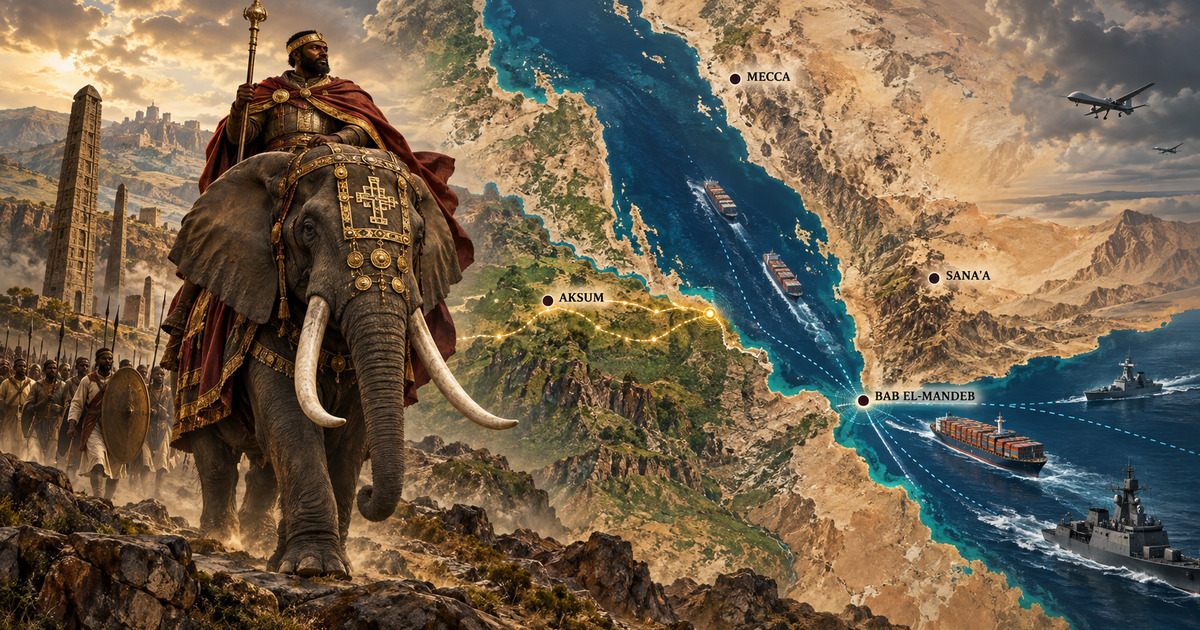
Those propaganda images you saw in Saudi Arabia recently—Houthi (Ansar Allah) leaders riding an elephant toward Mecca—are not invented from nothing. They borrow a narrative framework that has circulated for more than fourteen centuries, and that framework begins with Ethiopia’s Aksumite Empire. Propaganda’s greatest trick is to find symbols already buried deep in collective memory—including religious memory—and reactivate them for a new conflict. Abraha’s elephant is one such symbol.
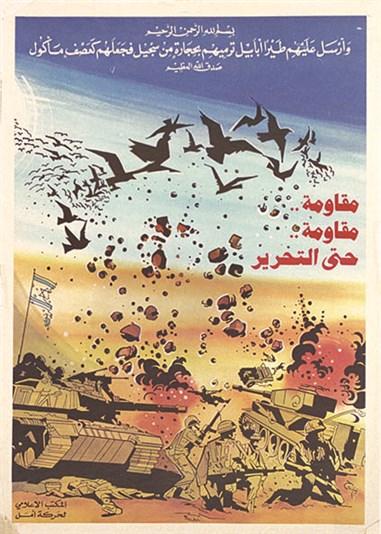
According to Islamic tradition, Abraha of Aksum marched from Yemen toward Mecca with an army that included war elephants, intending to destroy the Kaaba. As the army approached, God sent flocks of birds—described in the Quran as tayran ababil—that pelted the invading force with stones of baked clay, leaving it “like chewed-up straw.” The account, preserved in the Quran’s short but powerful “Chapter of the Elephant,” transformed Abraha’s expedition into an enduring parable: the mighty elephant represents arrogant worldly power, while the small birds represent unexpected divine intervention against an apparently invincible aggressor.
Whether understood as literal history, sacred memory, or a narrative reshaped over centuries, the story supplied the political imagination of the region with an extraordinarily durable set of symbols: the elephant, the holy sanctuary, the Axumite invader, the falling stones, and the miraculous destruction of overwhelming force.
The Elephant, Resurrected
In September 2026, the Saudi-led coalition accused the Houthis of launching drones “targeting Mecca,” calling it a “red line” provocation against Islam’s holiest site. The Houthis immediately denied the allegation, calling it an “ugly lie” and a “disgusting fabrication.” Almost simultaneously, visual content appeared on social media depicting Houthi leaders as elephant-riding invaders marching toward Mecca.
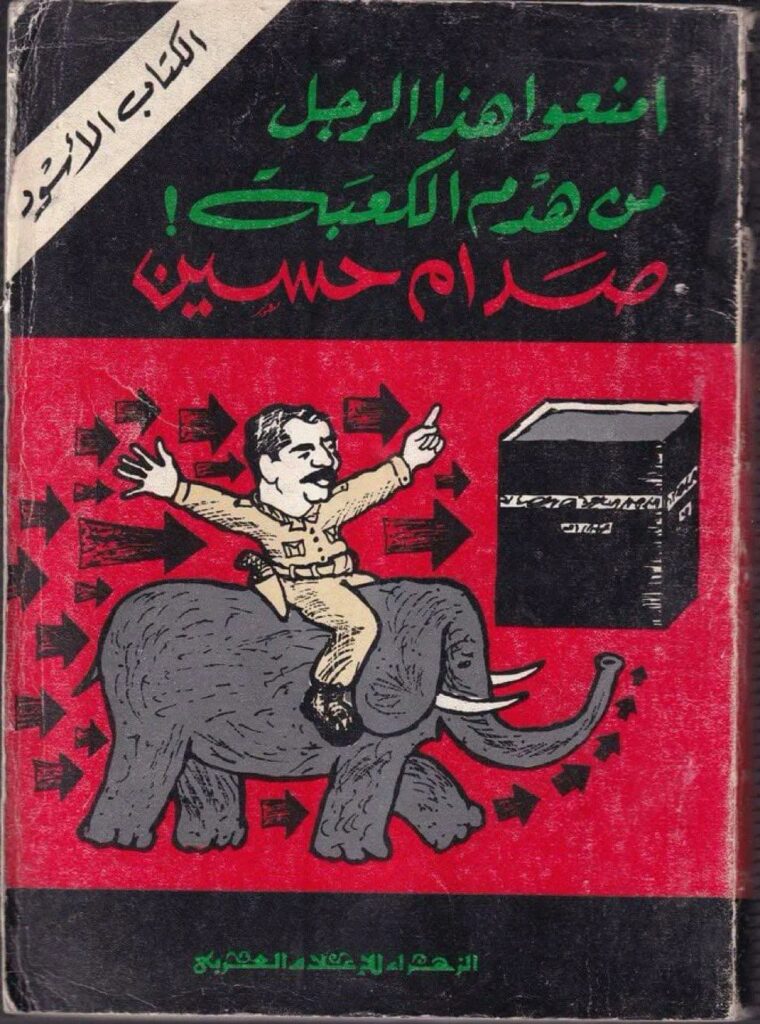
The message was unmistakable: the -Houthis were being cast as the new army of Abraha. This playbook is not new. During the 1990 Gulf War, Iraq’s Saddam Hussein was accused of “desecrating the holy sites” of Mecca and Medina. The United States had to expend considerable effort publicly denying the allegation, even inviting Muslim journalists to visit the holy sites to dispel the rumor.
Further back, during the 1982 Lebanon War, the Amal Movement published a poster directly invoking the Quran’s “Chapter of the Elephant.” It depicted Israeli tanks as modern elephants destined to be destroyed by Ababil birds raining stones upon them—just as Abraha’s army was destroyed in Islamic tradition.
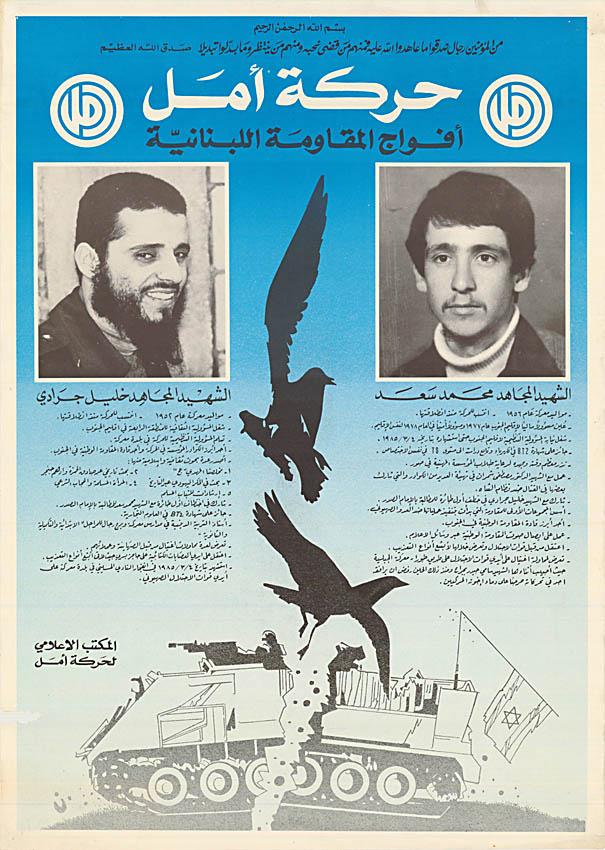
The same symbols have been requisitioned by different camps, generation after generation, to mobilize populations, terrify opponents, sanctify political causes, and justify tribal rage and violence.
Aksum: The Red Sea’s True First Empire
To understand why Abraha could become a propaganda symbol spanning more than a millennium, we must first understand where he came from.
The Aksumite Empire is one of the most underrated powers of the ancient world. At its height in the second and third centuries CE, it controlled trade arteries extending from the Mediterranean to the Indian Ocean through its Red Sea port of Adulis. The Persians regarded Aksum as one of the world’s four great civilizations, alongside Rome, Persia, and China. Aksumite commercial networks reached as far as Ceylon, modern-day Sri Lanka, while the empire served as an important intermediary in the trade between Rome, Persia, Arabia, Africa, and India. In the fourth century, Aksum also became one of the earliest Christian states in the world.
Aksum’s military interventions in South Arabia, in what is now Yemen, were not isolated adventures. From at least the second century onward, Aksum conquered and ruled parts of South Arabia, treating the two shores of the Red Sea as a single strategic theater. The logic of this trans-sea empire was clear: control the Bab el-Mandeb Strait, and you control the throat of East-West trade.
In the sixth century, Abraha emerged from this imperial tradition. A general of Aksumite extraction, he likely arrived in Yemen as part of the Aksumite military intervention around 525 CE. He later rebelled against Aksum’s appointed administration and established himself as Yemen’s ruler, probably during the early-to-mid 530s. Contemporary South Arabian inscriptions securely document his rule from the late 540s until at least 558 or 559 CE, although he may have remained in power sometime into the 560s.
The precise date of Abraha’s expedition toward Mecca remains disputed. Islamic tradition places it in the “Year of the Elephant,” conventionally associated with the birth of the Prophet Muhammad around 570 CE. The surviving contemporary inscriptions, however, document Abraha’s major campaigns in Arabia during the 550s and do not securely identify an attack on Mecca. It is therefore plausible that the expedition remembered in later tradition occurred earlier—before Muhammad’s birth—although the available evidence does not permit a definitive date.
The great cathedral Abraha built in Yemen’s Sana’a, known in Arabic tradition as al-Qullays, was intended to elevate Sana’a as an important religious and commercial center, potentially challenging Mecca’s position as a major pilgrimage destination on the Arabian Peninsula. His march toward Mecca—whatever its actual scale or precise date—can therefore be understood historically as part of a wider Aksumite effort to bring both shores of the Red Sea into a single political, commercial, and religious order.
Later accounts disagree sharply over what provoked the conflict. The Ethiopian version of the story depicts Arabian chieftains as the instigators, accusing them of desecrating Abraha’s cathedral in Sana’a. The Geʽez text describes the desecration of ቤተ፡ክርስቲያን፡ዘአብርሃ— “the Church of Abraha.” In the competing narratives, each side portrays the other as the aggressor and itself as the defender of a violated sacred space.
That contest over memory would prove almost as enduring as the military confrontation itself.
Bab el-Mandeb: The Same Throat, a Different Era
Today, the Bab el-Mandeb Strait is once again a global focal point—not because of elephants, but because of Houthi missiles and drones.
In September 2026, Houthi forces captured the Red Sea port city of Mocha and continued advancing toward Bab el-Mandeb and the surrounding islands. The number of vessels transiting the waterway reportedly plummeted from an average of 33 per day to single digits—an 88 percent decline. Roughly 12 percent of global trade and 10 percent of maritime shipping ordinarily pass through this narrow waterway. With the route under threat, large numbers of ships have been forced to sail around the Cape of Good Hope, adding weeks to voyages and driving shipping and insurance costs sharply higher.
Meanwhile, Ethiopia—Aksum’s historical successor—is seeking to return to the Red Sea in a very different way. The landlocked nation of more than 120 million people lost direct access to the coast when Eritrea gained independence in 1993. Prime Minister Abiy Ahmed has publicly described Red Sea access as a “matter of survival,” while reiterating at BRICS summits that Ethiopia intends to urgently pursue maritime access.
Israel has publicly voiced support for Ethiopia’s maritime ambitions, alarming Egypt, whose officials insist that the “exclusive rights” of Red Sea littoral states cannot be challenged.
The strategic logic operating on both shores of the Red Sea remains strikingly similar to that of fifteen centuries ago: whoever controls Bab el-Mandeb controls the artery connecting Europe, Arabia, Africa, and Asia. Aksum ruled Yemen across the sea partly to secure this passage. Today, the Houthis control much of Yemen’s western coast, Ethiopia’s current leader, Abiy Ahmed is unambiguous about his ambition to return to the Red Sea. In his speeches he frequently refers his country’s history on the Red Sea. “From the River to the Sea” has become a rallying call among his supporters. River means to the Nile of course.
The actors, weapons, alliances, and political systems have changed. The inherent geographic logic has not. It cannot.
The Immortality of Stories
Abraha’s elephant has survived for more than a thousand years because it offers a nearly perfect narrative template: an alien and arrogant invader, armed with overwhelming force, advances upon a holy site—only to be destroyed by divine power.
This template can be requisitioned by almost any side to “Abraha-ize” its opponent: to cast an adversary as a sacrilegious foreign aggressor marching against the sacred, the innocent, and the divinely protected.
When Saudi Arabia accuses the Houthis of targeting Mecca, it activates this historical and religious memory. When the Houthis deny the accusation, they are contesting the same narrative space. And when Ethiopia’s Red Sea ambitions receive support from Israel while being viewed with suspicion by Egypt, they too become entangled in an older geopolitical anxiety: should a power from the Horn of Africa once again project influence across the Red Sea?
Story never dies. It simply waits for the next convenient historical moment, changes its tools and sets out again.
Abraha’s elephants became tanks, and the tanks became drones, but the structure of the story has not changed. The Red Sea remains the place where empires, nations, religions, and rival historical memories collide—and where it is often decided whose story will be told, usually after a great war.
