




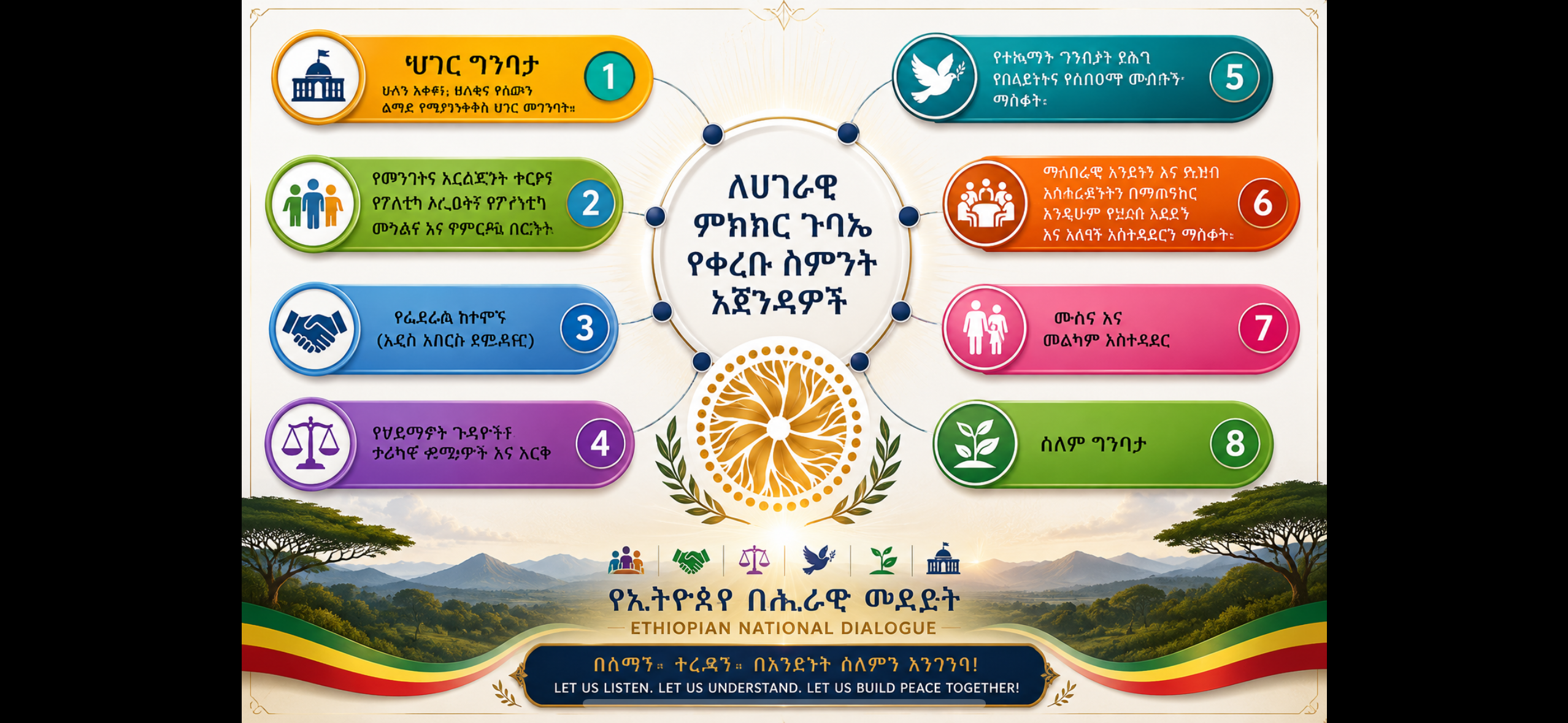
Ethiopia’s National Dialogue is more than another political initiative. It is perhaps the country’s most important opportunity in decades to ensure that Ethiopia’s future is shaped by the voices of its citizens rather than by competing narratives about them. At its core, the dialogue is about restoring Ethiopian agency—allowing ordinary Ethiopians, not the loudest commentators or the most influential advocacy campaigns, to define the nation’s path forward.
In recent years, Ethiopia has experienced not only armed conflict and political upheaval but also an unprecedented battle over information. Traditional media, social media platforms, advocacy organizations, foreign policy actors, and anonymous online networks have all competed to shape both domestic and international perceptions of Ethiopia. In such an environment, distinguishing genuine public opinion from strategically amplified narratives has become increasingly difficult.
This challenge extends far beyond Ethiopia. Around the world, modern conflicts are increasingly fought on two fronts: the battlefield and the information space. Public opinion has become a strategic objective. Narratives are repeated, amplified, and circulated until they often acquire the appearance of accepted truth before they have been fully tested against the lived experiences of ordinary people.
The war in northern Ethiopia demonstrated how contested the information environment can become. Throughout the conflict, competing accounts sought to influence international media coverage, diplomatic engagement, legal initiatives, and humanitarian responses. Various observers and analysts raised concerns that organized information campaigns were playing an increasingly significant role in shaping global perceptions of the conflict. While many of these claims remain debated, the broader lesson is a reminder that information itself is an instrument of conflict.
Against this backdrop, Ethiopia’s National Dialogue assumes exceptional significance.
Unlike television debates, newspaper columns, or social media campaigns, the National Dialogue seeks to hear directly from Ethiopians representing different regions, communities, generations, political beliefs, and religious backgrounds. It asks a simple yet profound question: What do Ethiopians themselves want?
The answer cannot be measured by hashtags, online engagement, or the volume of political rhetoric. It must emerge from citizens speaking honestly about their aspirations, grievances, concerns, and hopes for their country’s future.
If conducted with credibility, inclusiveness, and transparency, the National Dialogue has the potential to distinguish authentic public opinion from manufactured or amplified narratives. It can reveal where prevailing narratives accurately reflect the views of Ethiopians—and where they do not. More importantly, it can provide policymakers, civil society, and the international community with a clearer understanding of the priorities that genuinely matter to the Ethiopian people.
This distinction carries profound implications for peace.
Conflicts often endure because competing actors become convinced that they alone represent the people’s will. Yet when citizens are given a genuine opportunity to speak directly, a more nuanced reality often emerges. Despite Ethiopia’s ethnic, religious, political, and regional diversity, many citizens share remarkably similar aspirations. They seek peace, security, justice, accountable institutions, economic opportunity, and a country where political disagreements are resolved through dialogue rather than violence.
The National Dialogue also offers an opportunity to reduce the polarization that has become deeply entrenched in Ethiopian public discourse. By exposing participants to perspectives from fellow Ethiopians across the country, the process can help challenge misconceptions, reduce mistrust, and reinforce an essential democratic principle: compromise is not surrender but a necessary foundation for nation-building.
No national dialogue can eliminate every disagreement or erase every historical grievance. Ethiopia’s diversity guarantees that different perspectives will continue to exist. But diversity of opinion should never be mistaken for permanent division. Stable democracies are not built by eliminating disagreement; they are built by creating institutions capable of managing disagreement peacefully.
Perhaps the dialogue’s greatest contribution will be restoring Ethiopian ownership of Ethiopia’s future.
For too long, external actors, advocacy groups, political movements, and competing interests have often claimed to define Ethiopia’s challenges or prescribe its solutions. A successful National Dialogue returns that responsibility to where it belongs—with the Ethiopian people themselves. It affirms that the country’s future should be determined by those who live its realities, not merely by those who observe or comment from afar.
This is not simply a matter of national pride. It is a prerequisite for sustainable peace. Peace built upon distorted perceptions or externally driven narratives is inherently fragile. Peace grounded in the authentic aspirations and participation of citizens is far more durable because it reflects public legitimacy rather than political convenience.
The National Dialogue should therefore be judged not by the volume of attention it receives but by the quality of listening it produces. Its success will depend on whether it creates genuine space for citizens to speak freely, whether every community feels represented, and whether the outcomes reflect the collective voice of the nation rather than the preferences of a few powerful interests and elite bargainers.
If Ethiopia succeeds in elevating the authentic voice of its people above the noise of competing narratives, the National Dialogue will achieve far more than political consultation. It will strengthen public trust, reinforce national ownership of Ethiopia’s future, and demonstrate that lasting peace cannot be manufactured through slogans or imposed through competing narratives.
It must be built by listening.
At this pivotal moment in Ethiopia’s history, that may be the country’s greatest opportunity—and its greatest responsibility.
