




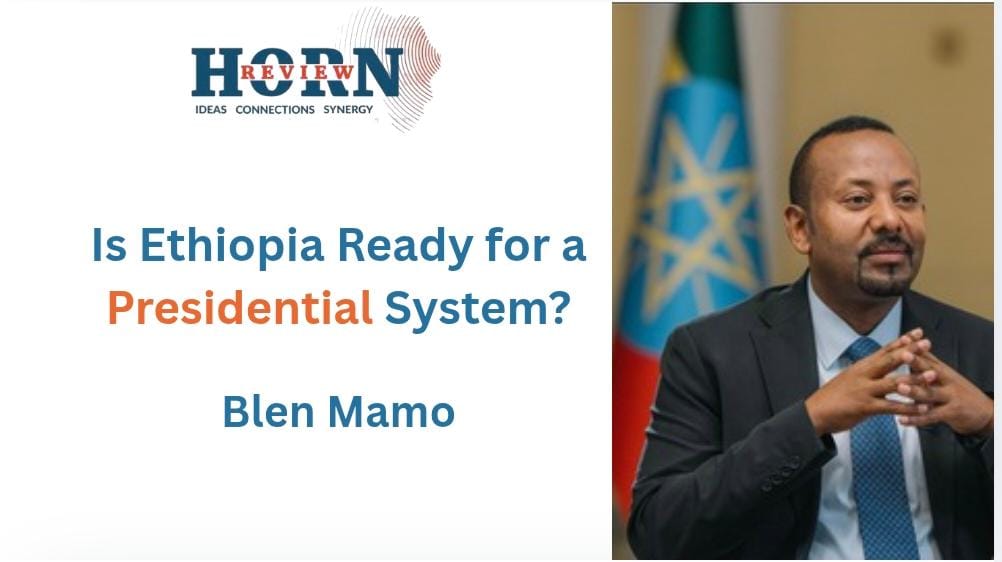
Ethiopia’s Constitutional Crossroads: The Case for a Presidential Transition
For nearly a century, Ethiopia’s political history has been defined by a recurring, unresolved question: where does legitimate political authority reside? From the imperial constitutions of 1931 and 1955 to the revolutionary socialist experiment of the Derg and the ethnic federalism of the 1995 Constitution, every constitutional order has emerged from a crisis of sovereignty. Today, as the National Dialogue process concludes, the country stands at another inflection point. The debate over adopting a presidential system is not merely a technical adjustment of governance mechanics; it is a profound attempt to answer the enduring crisis of national executive legitimacy.
The Historical Architecture of Ethiopian Sovereignty
To understand the current debate, one must trace the lineage of Ethiopian statehood. Each regime has answered the “legitimacy question” differently:
- The Imperial Order (1931, 1955): Anchored sovereignty in the Crown, attempting to graft modern institutional vocabulary onto ancient monarchical authority without displacing imperial supremacy.
- The Revolutionary Order (1974–1991): Repudiated the monarchy, substituting revolutionary legitimacy and a highly centralized socialist state (the Derg), later codified in the failed 1987 Constitution.
- The Federal Democratic Republic (1995–Present): Shifted the locus of sovereignty to the “Nations, Nationalities, and Peoples,” institutionalizing ethnic federalism and a parliamentary system where the Prime Minister derives authority from legislative confidence.
The 1995 settlement was a deliberate reaction against centralized tyranny. By dispersing power through federalism and making the executive accountable to parliament, the constitution sought to manage Ethiopia’s profound plurality. Yet, three decades later, the political settlement designed to stabilize the state has become the primary object of contestation.
The Legitimacy Deficit in the Parliamentary Model
Plurality vs. National Mandate
The central dilemma exposed since 1995 is structural: a state can possess extensive mechanisms for recognizing diversity while simultaneously failing to generate a persuasive form of national political legitimacy. Under the current parliamentary system, the Prime Minister’s authority is derivative—contingent on parliamentary arithmetic and the internal cohesion of a ruling coalition (formerly the EPRDF, later the Prosperity Party).
This creates a specific vulnerability: national executive authority is mediated through a dominant parliamentary organization rather than the electorate directly. When coalition logic fractures—as seen in the lead-up to 2018—the national executive loses its functional mandate even before losing an election.
The 2018 Rupture and the Exhaustion of the Post-1991 Settlement
The accession of Abiy Ahmed in 2018 signaled the visible rupture of the post-1991 architecture. The EPRDF’s internal equilibrium collapsed under mass mobilization in Oromia and Amhara and intra-coalition disagreements. Abiy’s dismantling of the EPRDF coalition structure marked the exhaustion of a mediation model that had governed for 27 years. The current premiership occupies an interregnum: the old settlement is exhausted, but the new institutional arrangement remains unborn.
Why Presidentialism? Reframing the Debate
Critics rightly point to the dangers of presidentialism in Africa and Ethiopia’s own history. The African experience is littered with examples where presidential offices converted electoral mandates into executive predominance, hollowing out legislatures and courts. Ethiopia’s imperial and Derg histories amplify fears of concentrated authority.
However, rejecting presidentialism solely because institutions are currently weak mistakes symptoms for causes. Institutions are not just prerequisites for development; they are products of political development. No Ethiopian constitutional settlement emerged from “institutional perfection.” The argument for a presidential system is not an argument for a stronger executive, but for a different source of legitimacy.
The Mechanism: Direct Election as Coalition Builder
A directly elected president creates a mandate that is neither derivative of parliamentary math nor reducible to a ruling party’s organizational dominance. Properly designed, the presidency forces political actors to construct constituencies larger than their regional or communal bases. It compels plurality to negotiate a common political horizon.
The design is decisive. A simple majoritarian “winner-takes-all” model in a country where political identity maps onto territory and ethnicity would intensify centrifugal pressures. Losing the presidency would be experienced as the exclusion of an entire community from the state.
Designing a “Coalition-Forming” Presidency
For presidentialism to strengthen rather than threaten Ethiopian federalism, the office must be conceived as a mechanism of coalition formation before it is an instrument of executive power. Essential institutional safeguards include:
- Two-Round Electoral System: Ensuring the winner secures an absolute majority, forcing runoff coalition-building across regional lines.
- Geographical Distribution Thresholds: Requiring candidates to win minimum percentages in a majority of regions/states (similar to Nigeria’s presidential requirements) to prevent purely regional capture.
- Robust Federal Guarantees: Constitutionally entrenched regional autonomy that cannot be unilaterally overridden by the center.
- Institutional Checks: An empowered legislature with veto override powers, an independent judiciary with constitutional review, and autonomous oversight bodies (Electoral Board, Human Rights Commission, Anti-Corruption Commission).
The objective is not to manufacture a homogeneous “Ethiopian identity” but to create incentives where national authority cannot be secured through the permanent mobilization of particularistic identities alone.
The Abiy Factor: Constitutional Reform vs. Constitutional Capture
The prospect of this transition occurring under Prime Minister Abiy Ahmed introduces a critical tension. The legitimacy of the reform hinges on a single distinction: Is this a mechanism to entrench the incumbent, or a framework to bind successors?
The Test of Political Maturity
If the reform expands the powers of the current officeholder without simultaneous, prior constraints, it reproduces the “oldest pathology of Ethiopian political development: the identification of the state with the political actor who temporarily commands it.”
Conversely, if Abiy’s tenure becomes the occasion to define, limit, and institutionalize presidential powers before they are fully exercised, it marks the separation of political office from personal authority. The ultimate proof of constitutional seriousness is not whether the incumbent can win a presidential election, but whether he accepts a system where:
- His successor could defeat him.
- Parliament can constrain him.
- Courts can overrule him.
- His term ends without endangering the political order.
This converts the political capital of an incumbent moment into the institutional capital of a post-incumbent republic.
Public Sentiment and the National Dialogue Mandate
The completed National Dialogue has surfaced a clear public consensus: Ethiopians strongly value democracy but express deep dissatisfaction with current accountability mechanisms. Crucially, the demand is not for less federalism, but for a federal system that delivers credible accountability. A presidential system—designed around direct mandate and institutional vulnerability—offers one structural response to this demand.
The Path Forward: Deliberate Evolution Over Revolutionary Rupture
Ethiopia faces a choice between deliberate institutional evolution and another cycle where transformation arrives only after breakdown. The transition must be:
- Slow enough for institutional learning and bureaucratic adaptation.
- Deliberate enough to protect the federal architecture and regional autonomy.
- Constitutional enough to ensure rules are written before political stakes peak.
The Real Test
The test of presidentialism is not whether it solves Ethiopia’s crises overnight. The test is one of political maturity:
Can Ethiopia change the architecture of executive power without reproducing the political habits that made institutional change dangerous? Can it create an office powerful enough to govern, legitimate enough to represent the national electorate, and constrained enough to remain subordinate to the Constitution?
If the answer is yes, the presidency becomes not a prize for a man or a party, but a permanent institution belonging to the Ethiopian Republic itself. The journey has begun; the challenge is building the foundations without rushing the endpoint.
Frequently Asked Questions (FAQ)
- What is the main difference between Ethiopia’s current system and a presidential system?
- Currently, Ethiopia uses a parliamentary system where the Prime Minister (Head of Government) is elected by and accountable to Parliament. The President is a ceremonial Head of State. A presidential system would establish a directly elected President serving as both Head of State and Head of Government, with a fixed term independent of legislative confidence votes.
- Why is direct election argued to improve legitimacy in Ethiopia?
- Proponents argue a direct national mandate forces candidates to build cross-regional, cross-ethnic coalitions, creating a legitimacy rooted in the broader citizenry rather than parliamentary party dynamics or regional power-brokering.
- What are the risks of presidentialism for Ethiopian federalism?
- Without strict design (runoff elections, regional vote thresholds, strong checks and balances), a presidential system could centralize power, encourage “winner-takes-all” ethnic mobilization, and undermine the autonomy of regional states guaranteed by the current constitution.
- How does the National Dialogue relate to constitutional reform?
- The National Dialogue Commission was mandated to build consensus on fundamental national issues, including the form of government, electoral systems, and federal-regional relations. Its outcomes are expected to inform the constitutional amendment process.
