




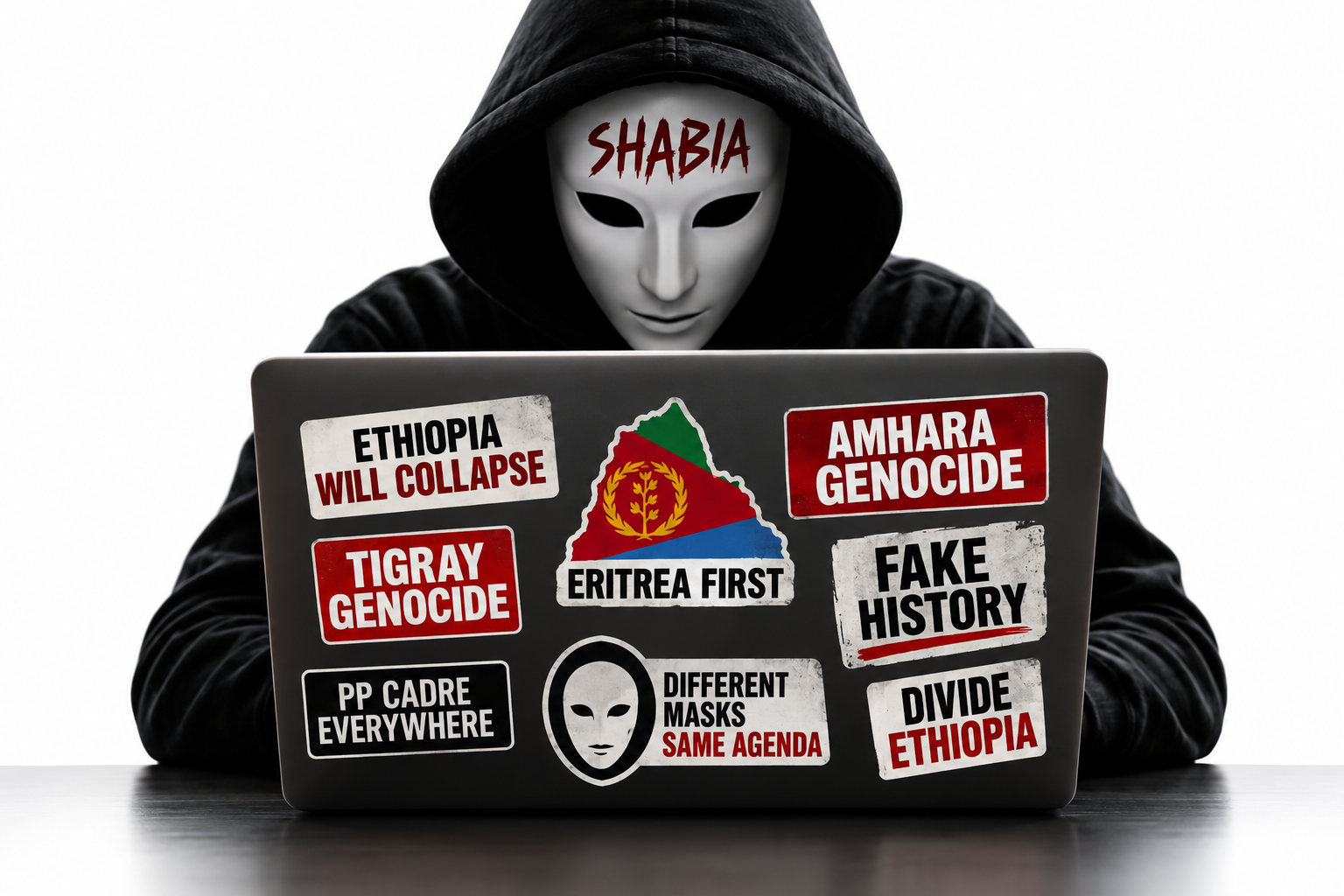
For years, hardline Shabia supporters have behaved as though Ethiopians would never compare the rhetoric of one political era with another. Now people are comparing notes, and the pattern is becoming obvious. The Ethiopian leader changes, the ethnicity accused of controlling the country changes, and the community selected as the victim changes, but the destination remains remarkably consistent: deepen mistrust between Ethiopians, amplify every crisis, encourage grievance politics, weaken confidence in the state and present fragmentation as inevitable.
The ethnic formula is particularly revealing. Under Haile Selassie and Mengistu, Amhara domination could be blamed for Ethiopia’s problems. Under Meles, the rhetoric shifted toward Tigrayans and insults such as “Agame.” Under Hailemariam Desalegn came another ethnic vocabulary, including “bariya.” Under Abiy, “Oromuma” became the fashionable explanation. These were very different governments, yet there is always a supposedly privileged ethnicity controlling Ethiopia and another community being told that it is the victim.
Once you recognize the formula, the playbook becomes easier to spot:
- Rotate the Villain. Tie the current leadership’s ethnicity to privilege, conspiracy and state capture, then identify another community as its victim.
- Weaponize Grievances. Turn genuine complaints about discrimination, violence or government failures into narratives of ethnic persecution, revenge and impossible coexistence.
- Switch the Victim. Shift sympathy from Tigrayan to Amhara victimhood, or elsewhere, as the political battlefield changes.
- Back the Insurgency. Whoever is fighting the Ethiopian state can become a heroic resistance movement, regardless of yesterday’s position toward that group.
- Inflame and Recruit. Sharpen ethnic tensions into fears of persecution or genocide, then present armed mobilization as the only protection.
- Exploit Atrocities. Turn civilian deaths into political ammunition before responsibility is reliably established.
- Predict and Celebrate Collapse. Treat every war, economic problem, protest or diplomatic dispute as proof that Ethiopia is finished, while welcoming instability as confirmation.
- Rewrite History. Reduce Ethiopia to a supposedly 150 year old invention, circulate questionable maps and erase evidence that complicates the preferred story.
- Redefine Colonialism. Condemn Ethiopian expansion as uniquely illegitimate while granting Italian colonialism generous language about modernization and infrastructure.
- Doxx and Expose. Circulate private names, workplaces, photographs, relatives and other identifying information to make critics vulnerable or intimidated.
- Dogpile and Silence. Direct hostile audiences toward critics, overwhelm them with replies, encourage reporting and pressure them into blocking, self censorship or withdrawal.
- Smear and Discredit. Replace arguments with labels such as “PP cadre,” government agent, extremist or propagandist, attacking critics instead of answering their evidence.
- Provoke and Screenshot. Bait angry responses, capture the worst reaction and present it as evidence of what an entire population believes.
- Flood the Narrative. Repeat the same slogans, maps, accusations, recycled images and collapse predictions until repetition resembles corroboration.
- Borrow an Identity. Use Ethiopian or Amhara personas, Menelik portraits, Ethiopian colors, patriotic biographies and Amharic to make a message appear locally authentic.
- Take It Offline. Carry confrontational politics into diaspora demonstrations, including protests involving visiting Ethiopian officials, where political opposition can cross into personalized harassment and intimidation.
- Mobilize Through the Diaspora. Treat diaspora communities not simply as supporters but as political infrastructure capable of organizing demonstrations, amplifying campaigns and applying pressure abroad.
- Stay Obsessed With Ethiopia. More than three decades after independence, parts of hardline Shabia politics still appear unable to construct an identity in which Ethiopia is not the central obsession.
This is also why the harassment question cannot be reduced to a collection of overexcited people arguing on X. United Nations reporting on Eritrea has described a much broader system of transnational repression involving surveillance, intimidation, harassment, threats and smear campaigns against critics abroad, and has raised concerns about government supporters and structures associated with Eritrean diplomatic representations in diaspora mobilization. When the same political ecosystem appears around demonstrations, targeted online campaigns and intimidation of critics, the role of officials and diplomatic networks deserves scrutiny rather than automatic dismissal as spontaneous diaspora activism.
More specific allegations go further, including claims that embassy connected figures direct supporters toward particular critics or effectively identify individuals for concentrated attention. If the practice described by critics as giving supporters “hot names” can be established through messages, recordings, testimony or other primary evidence, it belongs near the center of this story because it would transform what looks like online mob behavior into something much more organized. The important question would no longer be why dozens of accounts suddenly descend on the same person, but who pointed them there.
There is also a larger geopolitical allegation that deserves the same scrutiny: that Egyptian strategic interests in weakening Ethiopia overlap with Eritrea’s ruling system, hostile media networks and Ethiopian armed movements. The Nile dispute gives Egypt an obvious strategic interest in Ethiopian affairs, while specific claims of financing, operational coordination, or insurgents deliberately killing civilians and manipulating attribution should be established through documents, financial evidence and incident specific investigation. If the evidence exists, publish it, identify the intermediaries and follow the money.
What makes the playbook recognizable is repetition. The leader, alleged master ethnicity, chosen victim, favored insurgency, humanitarian slogan, historical argument and sometimes even the online persona change, but the destination remains the same: make Ethiopians distrust one another, magnify every fracture, undermine confidence in coexistence and wait for Ethiopia to break itself apart.
Repetition eventually ruins a trick. Ethiopians are comparing notes now, and once the pattern appears across governments, wars, ethnic causes, diaspora networks and supposedly spontaneous online campaigns, it becomes much harder to pretend nobody can see who is standing behind the curtain.
