




Focus Keyphrase: Horn of Africa Geopolitical Realignment
Meta Title: Horn of Africa Realignment: Why Djibouti Skipped the Cairo Summit for EU Security Ties
Meta Description: Analysis of Djibouti’s strategic absence from the Egypt-Eritrea-Somalia trilateral. Explore how the EUNAVFOR ASPIDES agreement and Ethiopian economic leverage are reshaping Red Sea security architecture.
Horn of Africa Realignment: Why Djibouti Skipped the Cairo Summit for EU Security Ties
A recent trilateral diplomatic engagement in Cairo bringing together Egypt, Eritrea, and Somalia—facilitated in part by shuttle diplomacy involving US Ambassador Massad Boulos—has illuminated a stark fracture in Horn of Africa geopolitics. The conspicuous absence of Djibouti from this Egypt-led process is far more than a routine diplomatic oversight; it signals a profound strategic divergence rooted in Djibouti’s recalibration toward a formalized security partnership with the European Union (EU).
This pivot creates a complex new landscape of challenges and opportunities for regional actors, particularly Ethiopia, which now finds itself uniquely positioned to leverage its own EU ties to advance long-standing maritime ambitions.
The Cairo Axis: A New Regional Coalition?
The Cairo meeting, building on prior talks between Eritrean and Egyptian foreign ministers, underscores a desire by Asmara, Cairo, and Mogadishu to construct a counterbalancing framework in the Red Sea. For Eritrea, historically wary of external military presences along its coastline, the deepening military footprint of rivals and extra-regional powers has accelerated a search for new security guarantees. Egypt, seeking to project influence southward, and Somalia, navigating its own stabilization path, found common cause in Asmara.
Yet, the missing chair at the table—Djibouti’s—tells a competing story. Rather than joining a nascent “Cairo Axis,” Djibouti has doubled down on a separate, legally binding security architecture centered on Brussels.
Anchored to Brussels: The EUNAVFOR ASPIDES Factor
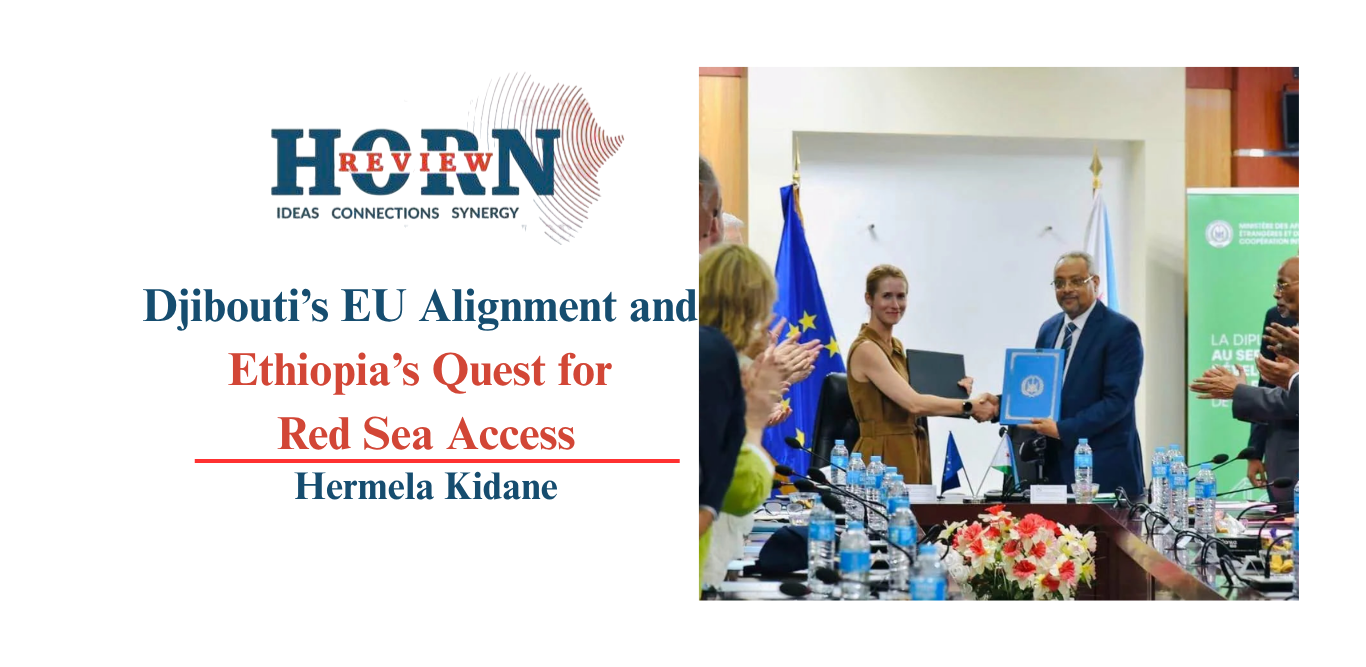
The primary driver of Djibouti’s non-participation is the Status of Forces Agreement (SOFA) signed with the European Union on July 16, 2026, concerning Operation EUNAVFOR ASPIDES. This agreement grants the EU sustained logistical and operational access to Djiboutian facilities, effectively anchoring European naval power at the strategic Bab el-Mandeb strait.
Operational Success and Strategic Depth
According to EU High Representative Kaja Kallas, effective maritime security requires reliable shore-based partners. In roughly 29 months, ASPIDES has demonstrated tangible results:
- Escorted over 670 merchant vessels.
- Assisted in the rescue of 128 seafarers.
- Responded to multiple asymmetric threats in the Gulf of Aden and Red Sea.
This operational tempo reinforces the EU’s role as a primary guarantor of freedom of navigation through a critical global chokepoint. For Djibouti, the SOFA provides a predictable, multilateral security umbrella backed by major European economies.
Eritrea’s Encirclement Anxiety
This deepening EU-Djibouti partnership has not gone unnoticed in Asmara. Eritrea has long viewed the concentration of foreign military bases in Djibouti—hosting US, French, Japanese, and now formalized EU assets—as a strategic encirclement. This perception was a key catalyst pushing Eritrea toward Cairo, seeking a counterweight arrangement with Egypt and Somalia that explicitly excludes the Djibouti-Brussels axis.
The Economic Tether: Ethiopia’s 90% Leverage
Beyond security alignments, Djibouti’s calculus is heavily constrained by economic reality. Analysis indicates Djibouti derives an estimated 90% of its port-related revenue from Ethiopian transit and logistics. This structural dependency creates a powerful incentive for caution.
Any diplomatic alignment perceived as antagonistic to Addis Ababa—such as joining an Egypt-Eritrea-Somalia bloc that Ethiopia views with deep suspicion—carries existential economic risk. Ethiopia has actively pursued port diversification strategies (including agreements with Somaliland, Sudan, and Kenya). Djibouti’s absence from Cairo, therefore, reflects a deliberate hedging posture: prioritizing stability in its vital economic relationship with Ethiopia while remaining anchored to the EU on security matters.
Ethiopia’s Strategic Opening: From Isolation to Integration
Djibouti’s isolation from the Cairo axis paradoxically opens a significant window for Ethiopia. As a major non-NATO ally with established ties to the European Union, Ethiopia is well-positioned to engage proactively in Red Sea security structures.
Bridging the Land-Sea Gap for ASPIDES
The EU’s ASPIDES operation, while effective at sea, benefits immensely from deeper land-based situational awareness and regional integration. Ethiopia—as the region’s largest economy, primary user of Djibouti’s ports, and a continental power with a reconstituted naval capability—offers precisely this depth.
Ethiopia’s naval assets, currently developing at the inland facility in Bishoftu, could transition toward meaningful coastal engagement through structured cooperation with ASPIDES. By negotiating complementary arrangements, Ethiopia could integrate its assets into broader patrols or escort missions, advancing its blue-water aspirations under a legitimate, multilateral framework. This aligns directly with the EU’s stated interest in burden-sharing for freedom of navigation.
Leveraging the European Peace Facility (EPF)
The recent European Peace Facility (EPF) support package—approximately $10 million to equip and train the Djiboutian Navy—will strengthen Djibouti’s role as a maritime security provider. However, a capable Djiboutian navy requires a stable, prosperous hinterland to maximize effectiveness.
Ethiopia can position itself as the indispensable partner: Ethiopia gains reliable, diversified Red Sea access; Djibouti diversifies its security and revenue base beyond volatile commercial port fees. Negotiations for enhanced naval and logistical cooperation—potentially including dedicated access or joint facilities—should be framed as mutual reinforcement, shifting the relationship from purely transactional to strategically symbiotic.
The Dumeira Dimension: Quiet Statecraft and Historical Claims
The Dumeira Island dispute, subject to periodic Djiboutian-Eritrean friction, presents a parallel avenue for Ethiopian statecraft. Historical Ethiopian interests in this feature predate certain post-colonial delineations. While sovereignty claims require meticulous legal and diplomatic handling, a well-documented review of Ethiopia’s position could form part of a broader maritime strategy.
Pursuing this through quiet diplomacy and multilateral forums—rather than unilateral assertion—would complement the security and economic tracks, signaling Addis Ababa’s commitment to a rules-based regional order while asserting its historical equities.
Lessons for Horn of Africa Statecraft
The current configuration offers three clear lessons for regional geopolitics:
- Economic Interdependence Trumps Fleeting Coalitions: Djibouti’s reliance on Ethiopian trade revenue outweighed the diplomatic allure of the Cairo summit.
- Extra-Regional Partnerships Reshape Local Alignments: The EU-Djibouti SOFA effectively created a security bloc that forced Eritrea into a counter-coalition with Egypt and Somalia.
- No Unified Coastal Front Exists: The notion of a monolithic “Red Sea littoral” opposing Ethiopian maritime access is dismantled. The coast is fragmented into competing security architectures (EU-Djibouti vs. Egypt-Eritrea-Somalia).
Conclusion: Multi-Track Diplomacy as the Path Forward
For Ethiopia, the divergence between the Cairo Axis and the Djibouti-EU partnership is not a crisis, but an opportunity. It highlights the value of patient, multi-track diplomacy combining:
- Bilateral negotiations with Djibouti to deepen port and logistics integration.
- Multilateral security cooperation with the EU/ASPIDES to legitimize naval development.
- Prudent assertion of historical positions (e.g., Dumeira) through legal channels.
By leveraging its EU partnership, transforming economic leverage into strategic depth with Djibouti, and methodically advancing its maritime doctrine, Ethiopia can convert a moment of regional divergence into a durable foundation for Red Sea access. The result would not only address Ethiopia’s long-standing quest for maritime outlets but also contribute to a more stable, balanced, and rules-based regional security order.
Disclaimer: This analysis is based on open-source diplomatic reporting and official press releases. It does not constitute official government policy.
