




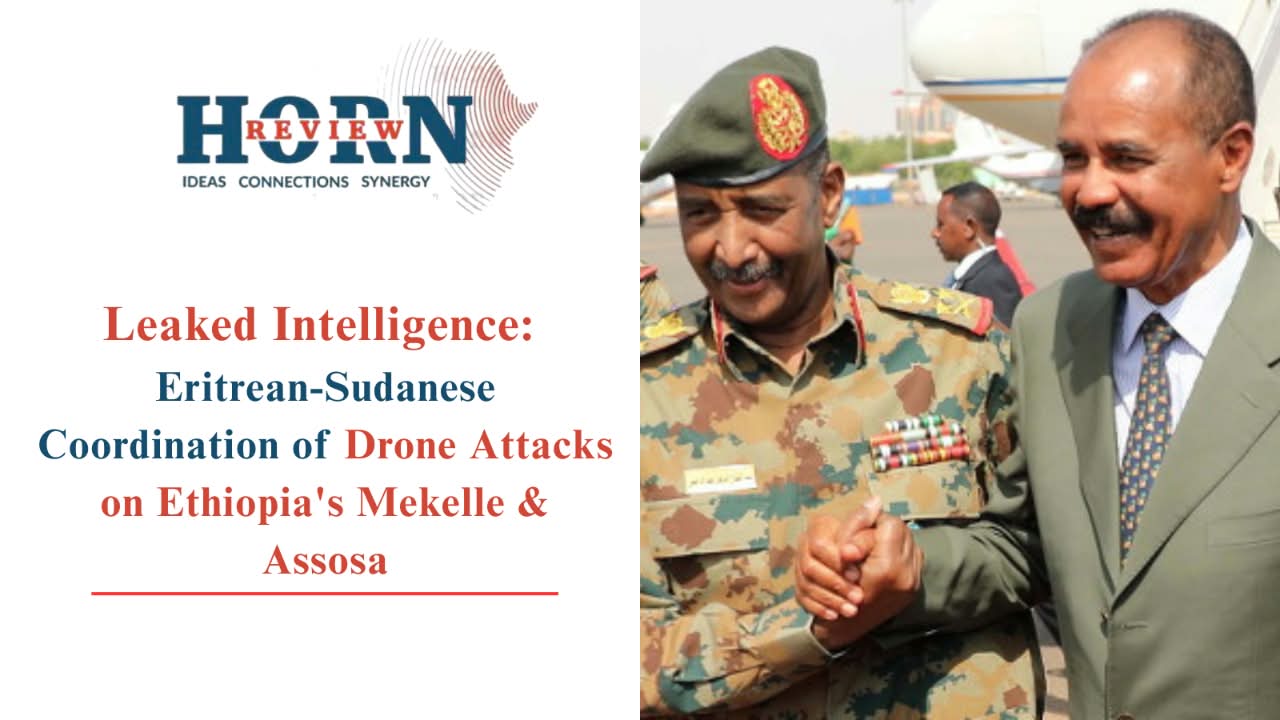
Leaked Intelligence Reveals Eritrea-Sudan Drone Plot Against Ethiopia as Regional Axis Hardens
Leaked intelligence pointing to alleged military coordination between Eritrea and Sudan’s military leadership under General Abdel Fattah al-Burhan has raised alarm over a potential coordinated drone campaign targeting the Ethiopian cities of Mekelle and Asosa. The reported plan, which allegedly relies on Ethiopian armed opposition groups hosted in both nations to facilitate ground operations, signals a dangerous escalation from proxy warfare to direct strikes on civilian population centers.
Intelligence Details: From Proxy War to Direct Aerial Strikes
According to the leaked reports, high-level discussions have taken place between Asmara and Port Sudan regarding preparations for aerial attacks. The alleged mechanism involves leveraging Ethiopian armed opposition movements—sheltered and sustained within Eritrean and Sudanese territories—to provide logistical guidance and ground facilitation for the strikes.
Targeting Civilian Infrastructure: A Legal and Strategic Threshold
The reported selection of Mekelle (capital of Tigray region) and Asosa (capital of Benishangul-Gumuz region) as targets is particularly significant. Unlike military installations on contested borders, these are major urban hubs. Deliberate targeting of civilians and civilian infrastructure constitutes a violation of International Humanitarian Law (IHL) and the UN Charter, potentially classifying such actions as war crimes. This moves the confrontation beyond the “plausible deniability” of proxy support into the realm of direct state-on-state aggression.
Eritrea’s Dual Track: Sovereignty Rhetoric vs. Expansionist Action
The allegations cannot be separated from the trajectory of Eritrean policy under President Isaias Afwerki over the past four years. Asmara has constructed an aggressive diplomatic narrative claiming Ethiopia’s quest for secure and diversified access to the Red Sea threatens Eritrean sovereignty.
The Contradiction of Asmara’s Posture
- Hosting Armed Opposition: Eritrea has a decades-long record of hosting, arming, and facilitating Ethiopian armed groups dedicated to overthrowing the federal government in Addis Ababa.
- Territorial Incursions: In late September 2026, Eritrean forces reportedly pushed over 60 kilometres into Ethiopian territory, a move Addis Ababa views as an invasion rather than border management.
- Victim Narrative: Despite initiating hostilities and hosting proxy forces, Asmara portrays itself as the victim of Ethiopian expansionism, using “sovereignty” rhetoric to legitimize a confrontational military posture.
This pattern suggests the sovereignty argument is a strategic narrative tool designed to justify pre-emptive destabilization of its larger neighbor.
Sudan’s Pivot: SAF’s Hostility Despite Ethiopian Restraint
Sudan’s trajectory under the Sudanese Armed Forces (SAF) presents a parallel concern. Despite Ethiopia’s consistent advocacy for a negotiated settlement to Sudan’s civil war, humanitarian solidarity, continued electricity exports, and declared neutrality between SAF and the Rapid Support Forces (RSF), General al-Burhan’s leadership has adopted increasingly hostile rhetoric.
Ethiopia’s Peace Efforts Met with Accusations
Prime Minister Abiy Ahmed was the first world leader to visit Port Sudan after SAF’s displacement from Khartoum, offering explicit support for a civilian-led transition. This outreach was rebuffed. Instead, SAF has constructed an elaborate narrative accusing Addis Ababa of backing the RSF—allegations Ethiopia categorically rejects.
While Ethiopia has legitimate security concerns regarding armed movements on its western border and the implications of Sudan’s fragmentation, it has maintained strict declared neutrality. The persistence of SAF’s accusations suggests they function less as genuine security grievances and more as instruments of diplomatic pressure.
The UN Security Council Showdown: Article 51 Invoked
The diplomatic rupture formalized on October 30, 2026, when Sudan submitted Letter S/2026/872 to the UN Security Council invoking Article 51 of the UN Charter (the right to individual or collective self-defense). Khartoum accused Ethiopia of facilitating drone attacks on Sudanese soil and supporting the RSF.
Ethiopia’s Rebuttal: Document S/2026/892
In its formal response dated November 6 (S/2026/892), Ethiopia rejected the claims as “unfounded.” Addis Ababa countered with its own dossier alleging:
- SAF cross-border military violations into Ethiopia.
- SAF logistical support, weapons transfers, and sanctuary for Ethiopian armed opposition groups (specifically citing TPLF-linked formations).
- Direct coordination between SAF and forces seeking to undermine the Ethiopian federal government.
Legal Analysis: Article 51 requires an “armed attack” to trigger self-defense. Invoking it absent a verified Ethiopian attack—while simultaneously supporting anti-Ethiopian militias—raises serious questions about the legitimacy of Sudan’s legal justification and suggests a strategy to internationalize the bilateral dispute.
The Emerging Regional Axis: Cairo, Asmara, and Port Sudan
These bilateral tensions are crystallizing into a multilateral alignment. Two high-profile summits cemented this convergence:
- October 4, El Alamein (Quadrilateral): Egypt’s President Abdel Fattah al-Sisi, Eritrea’s Isaias Afwerki, Sudan’s al-Burhan, and Somalia’s Hassan Sheikh Mohamud.
- November 21, Aswan (Trilateral): Foreign Ministers of Egypt, Eritrea, and Sudan.
Converging Strategic Interests
This axis unites three distinct but overlapping grievances against Addis Ababa:
| Actor | Core Grievance / Interest |
|---|---|
| Egypt | Existential concern over the Grand Ethiopian Renaissance Dam (GERD) and Nile water security; desire to limit Ethiopian hydro-hegemony. |
| Eritrea | Opposition to Ethiopian Red Sea access; regime survival via external threat narrative; historical animosity toward TPLF/federal structure. |
| Sudan (SAF) | Allegations of Ethiopian support for RSF; border disputes (Al-Fashaga); domestic legitimacy through external diversion. |
The timing of the alleged Eritrean-Sudanese drone coordination—surfacing days after the Aswan ministerial—strongly suggests political coordination is translating into operational security cooperation, utilizing proxy networks as force multipliers.
Implications: A Region on the Brink

What emerges is a troubling picture where Ethiopia’s internal security challenges—particularly in Tigray, Amhara, and Benishangul-Gumuz—are being weaponized by neighbors whose strategic calculations now align. An attack on Mekelle or Asosa would not be a border skirmish; it would be an act of war against a sovereign UN member state.
Risks of Miscalculation
- Wider Conflagration: Direct strikes could trigger a broader interstate war drawing in Eritrea, Sudan, and potentially Egypt, destabilizing the entire Horn of Africa.
- Red Sea Disruption: Escalation threatens global shipping lanes already strained by Houthi attacks and great power naval presence.
- Proxy Fragmentation: Empowering Ethiopian opposition groups with state-level air support risks fragmenting Ethiopia, creating a Somalia-style stateless zone on the Red Sea.
Conclusion: Restraint Is Not Weakness
Ethiopia has consistently signaled its preference for peaceful coexistence, neighborly dialogue, and negotiated dispute resolution—regarding the Nile, the Red Sea, and border management. However, the convergence of leaked attack plans, UN Article 51 invocations, and a hardening Cairo-Asmara-Port Sudan axis suggests the region is approaching a critical inflection point.
Addis Ababa’s restraint should not be mistaken for an absence of capability or resolve. The consequences of converting regional rivalries into direct kinetic aggression against Ethiopia would be catastrophic—not merely for the protagonists, but for the stability of the Red Sea corridor and the broader African security architecture. The window for diplomatic de-escalation is narrowing; the choice between a managed dialogue and a descent into chaos now rests squarely with the leadership in Asmara, Port Sudan, and Cairo.
