




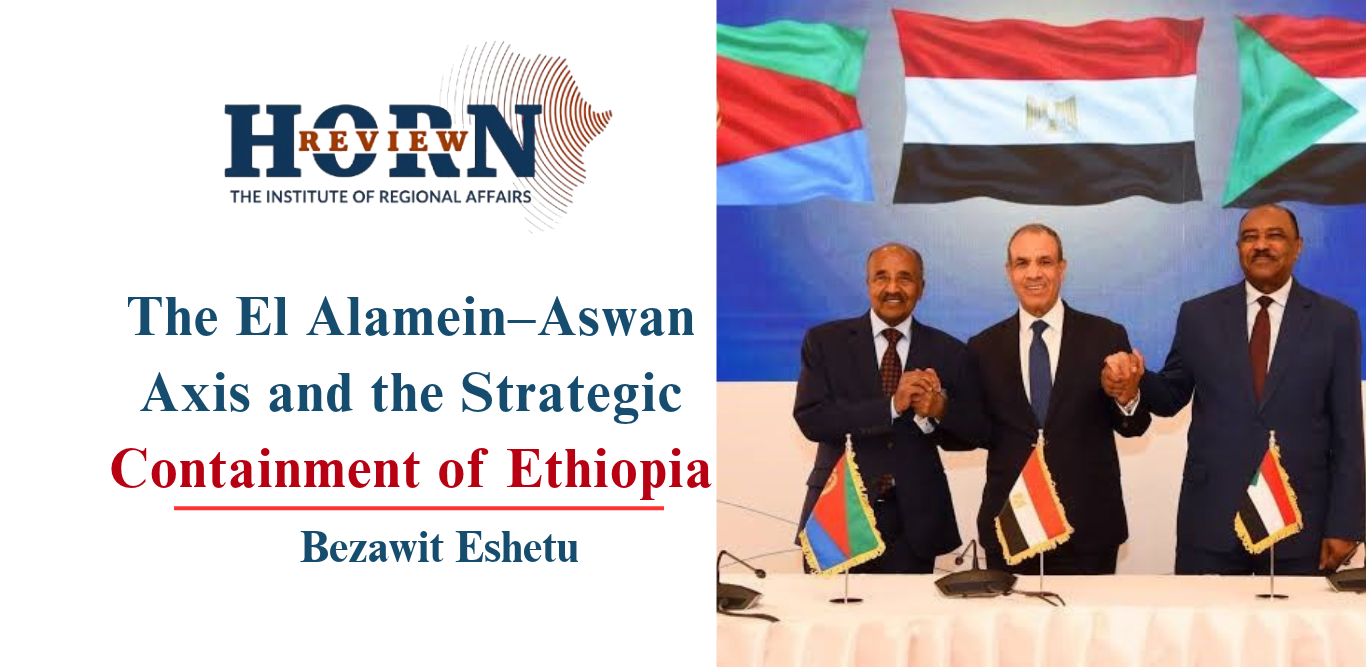
A distinct geopolitical bloc is hardening along the western rim of the Red Sea. The November 21 trilateral meeting in Aswan between the foreign ministers of Egypt, Sudan, and Eritrea—held on the sidelines of the Aswan Forum for Sustainable Peace and Development—signaled more than routine diplomatic coordination. It confirmed the emergence of a sustained alignment involving Cairo, Khartoum, Asmara, and Mogadishu, forged to manage a cluster of interconnected disputes involving Nile water security, Red Sea governance, Sudan’s internal conflict, and Somalia’s territorial integrity.
The El Alamein Framework: A Four-Pillar Declaration
The political architecture for this axis was laid on October 4, 2024, when Egyptian President Abdel Fattah el-Sisi hosted Sudan’s Abdel Fattah al-Burhan, Eritrea’s Isaias Afwerki, and Somalia’s Hassan Sheikh Mohamud in El Alamein. Their joint declaration established a common framework resting on four pillars:
- Sovereignty & Non-Interference: Rejection of parallel authorities in Sudan; explicit opposition to recognition of or support for Somaliland.
- Red Sea Governance: Assertion that security and governance belong exclusively to littoral states.
- Transboundary Waters: Demand for prior notification, consultation, and consensus on Nile issues; rejection of unilateral measures affecting downstream states.
- Institutional Follow-up: Establishment of a mechanism to sustain consultation beyond the summit.
This declaration provided the diplomatic vocabulary for subsequent engagements, allowing the quartet to project a unified stance into regional forums.
Catalyst: The Ethiopia-Eritrea Rupture and Abiy’s Maritime Imperative
The timing of the El Alamein summit was deliberate. Just three days prior, on October 1, Ethiopia closed its embassy in Asmara and expelled ten Eritrean diplomats, accusing Asmara of threatening its national security amid renewed fighting in Tigray. As Eritrea pivoted toward Cairo and Khartoum, Prime Minister Abiy Ahmed addressed parliament on October 5, reiterating Ethiopia’s determination to secure a maritime outlet based on a “give and take” principle.
This divergence defines the core tension: Ethiopia views reliable sea access as an existential economic and strategic necessity, while the emerging coastal framework reserves governance rights for littoral states, effectively setting the political preconditions for any future access negotiation.
Operationalizing the Axis: The Cairo 2+2 Mechanism (November 2)
The third round of the Egypt-Sudan 2+2 consultation (Foreign and Irrigation Ministers) in Cairo translated broad principles into specific bilateral commitments. The joint statement addressed three critical theaters simultaneously:
1. Red Sea Security: Defining the “Littoral Club”
Cairo and Khartoum reaffirmed the exclusive responsibility of coastal states for Red Sea governance. They explicitly rejected maritime access for non-littoral countries where it compromises coastal sovereignty, territorial integrity, or port security, and opposed attempts to militarize the waterway. By incorporating these positions into a formal mechanism, Egypt and Sudan created a coordinated diplomatic front to advance their interests in a waterway bordered by seven states (Egypt, Eritrea, Sudan, Saudi Arabia, Yemen, Jordan, Israel), plus the strategically vital Gulf of Aden (Somalia/Djibouti) and the Bab el-Mandeb chokepoint (Djibouti/Yemen).
2. The GERD & Nile Waters: Indivisible Security & The 1959 Baseline
The two governments described their water security as indivisible, anchoring their position in the 1959 Nile Waters Agreement—a bilateral treaty Ethiopia never signed. They characterized Ethiopia’s filling and operation of the Grand Ethiopian Renaissance Dam (GERD) as unilateral and contrary to international law, demanding a binding framework based on “no significant harm” and prior consensus. Crucially, they insisted the dispute remain a trilateral (Egypt, Sudan, Ethiopia) matter, rejecting Addis Ababa’s push to broaden negotiations to the wider Nile Basin Initiative.
3. Sudan’s War: The SAF as Institutional Anchor
Egypt explicitly identified the Sudanese Armed Forces (SAF) as central to Sudan’s national security and, by extension, Egypt’s water security. Invoking the 1976 Joint Defense Agreement and a 2021 military cooperation pact, Cairo declared readiness to take measures under international law to protect Sudan’s territorial integrity. This moves beyond diplomatic endorsement into a consequential security partnership, linking Cairo’s Nile policy directly to the survival of the military-led state structure in Khartoum.
The Red Sea Flashpoint: Littoral Sovereignty vs. Landlocked Rights
The alignment carries its most immediate implications for Ethiopia at sea. The El Alamein and Aswan declarations advance the principle that Red Sea governance belongs exclusively to the seven littoral states. However, Article 125 of UNCLOS (UN Convention on the Law of the Sea) recognizes the right of landlocked states to access and transit the sea, stipulating terms be agreed upon with transit states while preserving the latter’s sovereignty.
This legal tension sharpens when examining Ethiopia’s practical alternatives to Djibouti (its current 95% transit route):
- Eritrea (Assab, Massawa): Directly controlled by Asmara, now in deep adversarial alignment with Cairo/Khartoum against Addis Ababa.
- Sudan (Port Sudan): Controlled by the SAF, Egypt’s primary military partner in the region.
- Somaliland (Berbera): Administered by Hargeisa’s de facto authorities, but claimed by Mogadishu—a quartet member now backed by Cairo against recognition.
Egypt’s coordination with Eritrea, Sudan, and Mogadishu gives Cairo a veto-position in the political conversations surrounding every major alternative corridor available to Addis Ababa.
Commercial vs. Military Access: Cairo’s Red Line
Egyptian Foreign Minister Badr Abdelatty has drawn a sharp distinction: commercial access (accepted if negotiated bilaterally) vs. military access for non-littoral states (deemed unacceptable). This distinction allows Cairo to frame any future Ethiopian naval presence, logistical facility, or security role in the Red Sea as “militarization,” triggering objections based on coastal sovereignty and port security. The November 2 joint statement gives this framing collective diplomatic weight.
Principle vs. Practice: Consistency Gaps in the Alignment
The sovereignty principles advanced at El Alamein invite scrutiny when measured against the recent conduct of the signatories:
Egypt in Libya
Cairo has maintained a strategic relationship with Khalifa Haftar’s eastern-based forces in Libya, operating alongside a rival authority in Tripoli. While Egypt later reopened its embassy in Tripoli (November 2024), its engagement with non-state military actors in a fragmented neighbor illustrates that its interpretation of “national institutions” and “non-interference” is filtered through immediate border security and ideological priorities.
Eritrea and Somaliland (2019)
In March 2019, Eritrean Foreign Minister Osman Saleh and Presidential Adviser Yemane Gebreab visited Hargeisa to initiate diplomatic engagement with Somaliland. While stopping short of formal recognition, this demonstrated Asmara’s willingness to engage the very entity the El Alamein declaration now explicitly rejects. The shift underscores how sovereignty positions evolve with regional circumstance—specifically, Asmara’s deepening rupture with Addis Ababa and alignment with Mogadishu.
The “Tsimdo Initiative” and the Non-Interference Paradox
Perhaps the sharpest friction point involves the Tsimdo Initiative (launched 2025), a framework coordinating Eritrean, Sudanese, and Ethiopian opposition networks (including Amhara nationalist groups). A high-profile gathering in Port Sudan, May 2026, brought these actors together under the auspices of governments currently championing “non-interference” and “respect for national institutions” at El Alamein.
This creates a dual-track reality: a formal diplomatic track invoking sovereignty to limit Ethiopia’s external options (Red Sea, GERD), and a security track engaging Ethiopian internal opposition to pressure Addis Ababa domestically. The convergence raises the strategic cost of Ethiopia’s choices across multiple arenas simultaneously.
Strategic Compression: The Logic of the Axis
Seen together, the El Alamein, Cairo, and Aswan meetings reveal a process of strategic compression:
- Egypt contributes diplomatic coordination and the Nile/GERD agenda.
- Sudan (SAF) provides a downstream Nile partner, a Red Sea coastline (Port Sudan), and a territorial depth for Egyptian security.
- Eritrea brings a direct security rivalry with Ethiopia and connections to opposition networks.
- Somalia gains regional backing for its unity claim over Somaliland, linking the Berbera corridor to the broader axis.
Their interests are distinct but mutually reinforcing. The axis links the Red Sea question to the GERD, Sudan’s war, and Ethiopia’s internal security environment. Its influence lies not in legal authority, but in raising the diplomatic and strategic costs of Ethiopia’s maneuverability.
Diplomatic Weight vs. Legal Authority: The Limits of Declarations
It is critical to distinguish political coordination from legal determination. The declarations issued by this quartet express collective political preferences; they do not:
- Establish an exclusive regional mandate over the Red Sea, displacing the rights of other littoral states (Saudi Arabia, Yemen, Jordan, Israel, Djibouti) or the international navigation regime.
- Negate the legal basis for Ethiopia’s pursuit of maritime access under UNCLOS Article 125.
- Resolve the GERD dispute, which remains subject to African Union mediation and the principles of equitable and reasonable utilization under international water law.
The emerging alignment is a formidable diplomatic facts on the ground. It shapes the political environment in which Ethiopia must negotiate its access, its water rights, and its security. But the final settlement of these disputes will ultimately require negotiations that include Addis Ababa, grounded in the treaty frameworks and customary international law that the current declarations invoke selectively.
