




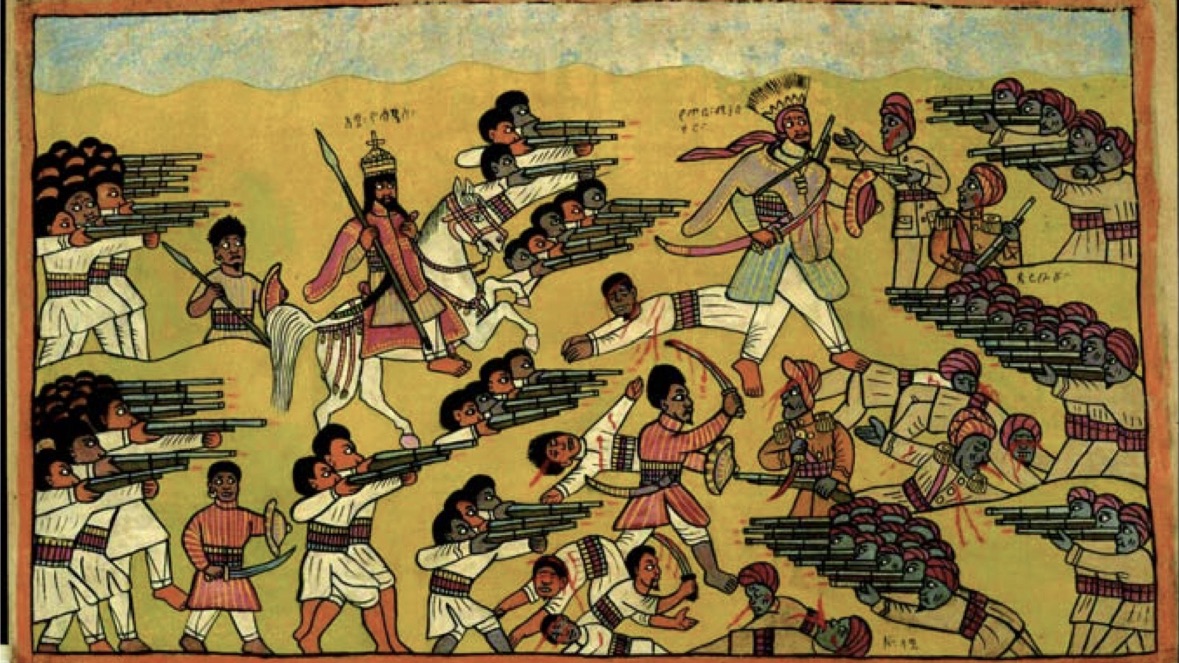
How Yohannes IV turned an invasion into a decisive Ethiopian victory, November 1875
On 16 November 1875, an Egyptian expedition that had advanced into the northern Ethiopian highlands met a catastrophe near Gundet, above the Mareb River. Its commander, the Danish officer Søren Adolph Arendrup, was killed; much of his force was destroyed; and rifles and artillery intended to enforce Cairo’s demands passed into Ethiopian hands. The encounter lasted only hours, but its consequences reached far beyond the valley. The Cambridge History of Africa places the battle within a struggle for the frontier, the Red Sea approaches, and the authority of Emperor Yohannes IV.
Gundet was not simply a triumph of spears over modern guns. It was a victory of concentration over dispersal, local knowledge over misplaced confidence, and political determination over an expedition whose commanders had underestimated the country they entered. It also exposed the gulf between imperial proclamations and military reality.
An empire pushing inland
Khedive Ismail’s Egypt sought a larger role along the Nile and Red Sea. Its expansion was part of a nineteenth-century contest in which ports, caravan routes, customs revenues, and strategic uplands mattered as much as prestige. Egyptian control at Massawa and advances around Bogos and Keren sharpened the conflict with Ethiopian rulers whose authority and claims extended toward the northern plateau. A September 1875 American consular dispatch records the Egyptian occupation of Bogos and the growing tension in Hamasen, although its portrayal of Ethiopian intentions reflects the reporting and assumptions of its author.
The frontier was neither empty nor politically simple. Local rulers and communities had their own loyalties, rivalries, and calculations. As historian Richard Reid emphasizes in his study of the Mareb borderlands, power in Hamasen, Serae, and adjacent regions was contested and negotiated, not merely imposed from distant capitals. This complexity helps explain why a marching army could appear to make progress while losing its grasp of the political and geographical ground beneath it.
For Yohannes IV, who had become emperor in 1872, the incursion threatened more than a boundary line. It challenged his authority in a kingdom already marked by regional divisions. He could not count on every powerful noble to answer his summons, yet he could not allow a foreign army to dictate terms in the highlands. The stakes were therefore both territorial and dynastic.
Arendrup’s mission and the unanswered ultimatum
Arendrup landed at Massawa in September 1875 and led a force equipped with Remington breech-loading rifles, artillery, and rockets. Contemporary and later accounts disagree about the expedition’s precise size, partly because they count different detachments. The UNESCO General History of Africa describes an initial force of roughly 2,500, while Czeslaw Jesman’s study of the Egyptian invasion uses a larger estimate. Whatever the exact figure, the force was small for the political objectives assigned to it and dangerously divided across difficult country.
The column included Egyptian and Sudanese soldiers as well as foreign officers and advisers. Count Zichy, Arakel Bey, and several European and American officers appear in accounts of the campaign. Their presence reflected Ismail’s determination to build an army using imported expertise and modern equipment. Yet technology could not compensate for uncertain intelligence, stretched communications, and divided command.
Arendrup informed Yohannes that Egypt sought to settle the frontier and obtain redress, while warning of further advance if its terms were refused. The wording and interpretation of the message differ among narrators; Jesman discusses the letter and its political setting. Yohannes did not concede. Rather than immediately meeting the invaders in open battle, his forces withdrew and prepared to fight on more favorable ground.
The emperor gathers his army
Yohannes mobilized in late October as the Egyptians pushed inland. The Cambridge accountdates the call to arms to 23 October and describes the Ethiopian main force crossing the Mareb immediately before the battle. Estimates of Ethiopian strength vary widely, from tens of thousands to considerably larger totals; none should be presented as an exact headcount. What matters operationally is that Yohannes was able to assemble a force vastly larger than the separated Egyptian detachments at the point of contact.
This achievement was political as well as military. Men came with regional commanders, local knowledge, and mixed weapons. Some prominent southern rulers did not join the campaign. Nevertheless, the emperor assembled a coalition capable of maneuvering in the highlands and attacking at a chosen moment. In Haggai Erlich’s account of Ras Alula, the young Alula emerges as an important figure in the operations, though later fame should not obscure the emperor’s overall command or the contributions of other leaders and fighters.
A retreat across familiar terrain was not necessarily a sign of weakness. It could draw the invaders away from secure supply lines, oblige them to guard scattered posts, and expose their movements. Egypt’s own subsequent explanation acknowledged that its soldiers were too few and too widely separated. That admission is preserved in the official Egyptian report sent to Washington by the American vice-consul in Cairo.
The trap above the Mareb
In the days before the decisive clash, Ethiopian units probed the Egyptian advance. Arendrup’s officers faced uncertain reports of scouts, skirmishes, and movement in the valley. The high ground around Gundet was particularly dangerous to a force that depended on keeping its companies mutually supporting. General William Loring, who later served with Egypt’s next expedition, described the terrain and the errors of the campaign in A Confederate Soldier in Egypt. His account is valuable but retrospective: he was not an eyewitness to Gundet.
On the night of 15–16 November, Yohannes’s main army crossed the Mareb. The Egyptians had moved into positions from which steep slopes and narrow approaches limited their ability to exploit rifles and guns. Ethiopian fighters occupied the surrounding ground. When the attack came, the Egyptian force faced pressure from several directions, and retreat became difficult. The Cambridge History describes a battle of only a few hours; the Egyptian government’s later narrative gives a longer and more heroic account of resistance. The difference is a reminder that the surviving sources were written for different audiences.
Modern firearms were formidable, but they were not magic. A rifle could reach farther than a spear, yet effective fire required visibility, ammunition, order, and space. Artillery needed suitable positions and fields of fire. When soldiers were surprised, divided, or forced into close combat on broken ground, those advantages narrowed. The Ethiopian assault succeeded not because firepower was irrelevant, but because the commanders and fighters on the heights prevented Egypt from using it decisively.
Defeat, losses, and captured weapons
Arendrup and Arakel Bey died in the fighting. The Egyptian official account also recounts Lieutenant Colonel Rustem Bey continuing to command after a head wound before being struck again. It praises the bravery of the soldiers, and that part of the record deserves attention. The disaster was not proof that Egyptian and Sudanese rank-and-file troops lacked courage. It was a failure of the campaign that placed them in an untenable position.
Casualty figures remain disputed. Egypt’s published account admitted 770 infantry deaths while claiming 15,000 Ethiopian losses, a figure that does not accord with the later scholarly accounts consulted here. The Cambridge History of Africa reports roughly 1,800 Egyptian dead, while Jesman gives about 2,000. The precise totals cannot be established from these conflicting reports. A careful account should describe the Egyptian force as largely destroyed rather than pretend to a false precision.
The Ethiopians captured substantial stocks of modern weapons. Estimates again vary: the UNESCO history cites 2,500 rifles and 14 artillery pieces; the Cambridge History speaks of about 2,000 rifles and cannon. The difference does not diminish the strategic result. Captured weapons strengthened Yohannes’s forces and helped shift the military balance in subsequent encounters.
Not all Egyptians were killed. A remaining detachment withdrew toward the coast after disabling guns it could not transport. The official Egyptian dispatch records an Ethiopian demand for surrender that offered the defenders the choice of withdrawing or remaining in place. The original article’s fuller account of safe conduct is associated with Loring’s later narrative; the exact terms should be read against the separate sources rather than conflated.
Two governments, two stories
Cairo’s explanation of the defeat was a revealing mixture of acknowledgment and denial. It conceded that Arendrup’s troops had been separated and outnumbered, but asserted enormous Ethiopian casualties and promised vengeance. Its closing declaration—“But our brave soldiers shall be avenged!”—appears in the document preserved by the U.S. State Department. The statement was not merely rhetoric: Egypt prepared another, much larger expedition.
The documentary record also shows how imperfectly news traveled. Consular dispatches reported movements, rumors, and official claims with varying degrees of certainty. The September 1875 report from Cairo even misidentified Arendrup’s nationality. Such errors caution against treating a contemporary dispatch as automatically authoritative. A historical reconstruction must compare witnesses, distinguish what they observed from what they heard, and note where sources contradict one another.
Gura: the second test
Ismail sent a larger force under Ratib Pasha, with William Loring as chief of staff and Prince Hassan among its senior figures. In March 1876, Yohannes’s forces defeated the Egyptians again at Gura. The Cambridge History places the second expedition at about 15,000 men, though other histories give different figures. This second defeat demonstrated that Gundet was not simply an isolated mishap in a single valley.
The consequences were substantial but should not be overstated. Egypt’s costly ventures contributed to wider fiscal and political pressures on Ismail; they were not the sole cause of his removal in 1879. For Ethiopia, the victories strengthened Yohannes’s standing and gave new prominence to Alula. Yet victory did not dissolve internal rivalries, settle every border question, or eliminate foreign interest in the Red Sea corridor.
One additional episode shows how broad the 1875 campaign had become. A separate Egyptian advance from the direction of Tajura met disaster among the Afar, with the death of Werner Munzinger. The UNESCO history records this operation alongside Gundet. It underscores the fact that Egypt was pursuing several approaches to the region at once, multiplying the demands on its commanders and resources.
The lesson of Gundet—and its limits
Gundet belongs to Ethiopian history as a decisive defense of sovereignty. Its enduring lesson, however, is not that another war is inevitable or desirable. It is that political ambition unsupported by a realistic understanding of terrain, local society, logistics, and the opposing army can turn superior equipment into abandoned trophies. Yohannes’s success depended on disciplined timing, coalition-building, and the ability to make an adversary fight under unfavorable conditions.
The history also invites care in drawing modern parallels. In April 2021, Egyptian President Abdel Fattah el-Sisi warned that “all options are open” amid negotiations over the Grand Ethiopian Renaissance Dam, as reported by Al Jazeera. The language recalls earlier confrontations over Nile waters and regional influence, but a nineteenth-century invasion and a twenty-first-century dispute over a hydroelectric dam are not the same event. Their legal, diplomatic, environmental, and human circumstances differ sharply.
The responsible comparison is therefore about choices, not predictions. Threats can harden positions; negotiated arrangements can address real concerns without treating war as a test of national honor. The Egyptians and Sudanese who died at Gundet, like the Ethiopians who fell defending their land, paid the cost of decisions made above them. Remembering their lives alongside the victory makes the story more serious, not less patriotic.
The Mareb still runs through a landscape whose history refuses simple slogans. At Gundet, Yohannes IV showed what a threatened state could achieve when it understood its ground and united enough of its people to defend it. The stronger conclusion, a century and a half later, is that sovereignty deserves respect, historical claims require evidence, and peace is worth more than another valley filled with the dead.
Sources and further reading
Bahru Zewde, A History of Modern Ethiopia, 1855–1991
Haggai Erlich, Ras Alula and the Scramble for Africa
The Cambridge History of Africa, volume 5 (Egypt–Ethiopia conflict)
UNESCO, General History of Africa, volume VI
Czeslaw Jesman, “Egyptian Invasion of Ethiopia” (1959)
William Wing Loring, A Confederate Soldier in Egypt (1884)
William McE. Dye, Moslem Egypt and Christian Abyssinia (1880)
U.S. Foreign Relations, 1876, Egyptian official account
U.S. Foreign Relations, September 1875 consular report
