




Eritrea celebrates Italy’s colonial architecture, erases monuments to African resistance and keeps generations of its youth in military service. More than 30 years after independence “liberation” became a permanent state of war.
Eritrea has a peculiar way of remembering its past. The European colonizer gets credit for building the country. The African neighbor gets blamed for holding it back. Italy is celebrated for its roads, railways, architecture and cafés. Ethiopia, despite centuries of shared civilization and its own contributions to Eritrea’s development, is remembered overwhelmingly as the enemy.
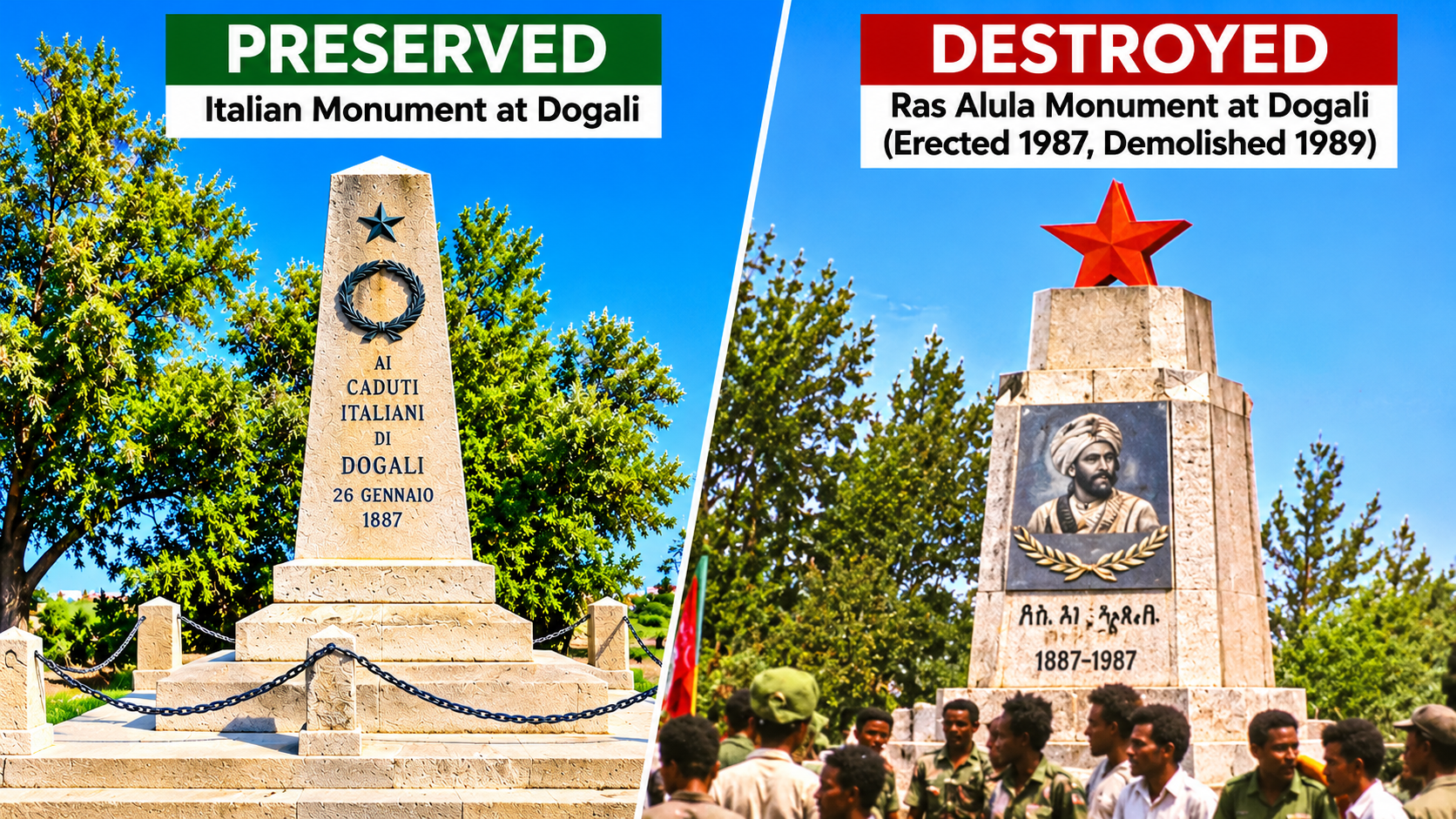
At Dogali, the contradiction is carved into the landscape. A monument honoring Ras Alula, the African commander who defeated Italian invaders in 1887, was destroyed. Yet a memorial to the defeated Italian soldiers survived. The African victor was erased. The European invader was memorialized. And that is only the beginning of Eritrea’s colonial paradox.
The Colonizer Gets the Credit
Walk through Asmara and Italy’s legacy is impossible to miss. Art Deco buildings, Italian-era cafés, railways and colonial architecture have become central to the capital’s international image. There is much worth preserving. But the nostalgia comes with an uncomfortable question: Why is infrastructure built under a racially segregated colonial regime celebrated as modernity, while Ethiopia’s developmental contributions are so often dismissed?
From 1952 to 1991, Ethiopia’s administration brought repression, political conflict and eventually devastating war. The dismantling of Eritrea’s federal autonomy in 1962 was a defining injustice. But those decades also saw public institutions, educational expansion, infrastructure investment and economic integration. None of that excuses Ethiopian repression. It does mean the historical record is more complicated than a simple story of foreign domination.
Italy built under colonial rule and receives admiration. Ethiopia governed through a deeply contested political relationship and receives condemnation. Why is one legacy allowed complexity while the other is reduced to oppression?
Dogali: The Monument That Says It All
In January 1887, Ethiopian forces commanded by Ras Alula defeated an advancing Italian military column at Dogali. It was a significant African victory against European colonial expansion. But Italy turned its defeat into a story of national martyrdom.
As Elias Wondimu explains in his essay The Dogali Paradox, Part II: The Battle for Memory in Rome, Asmara, and Addis Ababa, Rome repurposed an ancient Egyptian obelisk to honor the fallen Italian troops. At Dogali itself, an Italian memorial portrayed the defeated colonial soldiers as victims of treachery. Think about that. European troops advancing into African territory became the victims. The Africans resisting them became the aggressors.
A century later, Ethiopia’s Derg government erected a monument honoring Ras Alula’s victory, complete with a red star identifying it with the regime’s ideology. When Eritrean liberation forces captured the area in 1989, the monument was destroyed. Wondimu cites historian Hagai Erlich’s account of EPLF commander Petros Solomon expressing satisfaction at its destruction. By 1996, historian Paul Henze reportedly found no trace of the structure. The Italian memorial, meanwhile, remained.
To be fair, the destroyed monument also represented the Derg, a government against which Eritreans had fought a brutal liberation war. Its removal cannot automatically be interpreted as affection for Italian colonialism. But the symbolism remains extraordinary. A monument to African resistance disappeared. A monument to European invasion survived. What does that say about the politics of historical memory?
The Eritrean Who Stood Up to Mussolini
There is another chapter in this story that complicates the official divide between Eritrean and Ethiopian identity. His name was Zerai Deres.
After Fascist Italy invaded Ethiopia in 1935, Mussolini’s regime seized the Lion of Judah statue from Addis Ababa and transported it to Rome. The statue was placed beneath the Dogali Obelisk, turning an Ethiopian symbol of sovereignty into a trophy of Italian conquest. In June 1938, Zerai, an Eritrean, confronted that humiliation.
Historical accounts describe him kneeling before the statue and then resisting Italian authorities with a sword while expressing loyalty to Ethiopia’s emperor. He was wounded, detained and eventually confined to a psychiatric institution, where he died in 1945. An Eritrean stood against Italian fascism in defense of Ethiopian sovereignty.
That history does not fit neatly into a narrative that treats Eritrea and Ethiopia as eternally separate, hostile civilizations. Their modern political conflict is real. But so is their shared past. Before the modern border became a political dividing line, Africans from both sides could see European imperialism as a common enemy. Zerai Deres understood something that later nationalist narratives sometimes obscure: resistance to colonialism did not always respect the boundaries colonialism itself had created.
Eritrea Fought Ethiopia, Not Italy, for Independence
Here is another historical irony. Italian colonial rule ended in 1941, when British and Allied forces defeated Italy in East Africa. Eritrea’s eventual independence did not come from a successful liberation war that expelled the Italian colonial government. Its defining armed struggle was against Ethiopia.
The United Nations-backed federation of 1952 was progressively dismantled, and Ethiopia formally annexed Eritrea in 1962. The liberation war continued until Eritrean forces achieved military victory in 1991, followed by internationally recognized independence in 1993. Eritreans had legitimate grievances against Ethiopian rule and an undeniable right to determine their political future.
But political independence does not erase historical connections. The peoples of Eritrea and Ethiopia shared religious traditions, languages, commercial networks and political histories long before Italy proclaimed its colony in 1890. Their histories were intertwined, even if their political futures ultimately diverged. Italy imposed a colonial boundary. Eritrean nationalism transformed that boundary into a sovereign state. That achievement deserves recognition. But must national identity require treating older African connections as historical liabilities?
Even the Colonial Name Stayed
Across Africa, independence often came with a new name. The Gold Coast became Ghana. Bechuanaland became Botswana. Nyasaland became Malawi. Northern Rhodesia became Zambia. Upper Volta became Burkina Faso. Eritrea kept the name introduced by Italy in 1890.
There is nothing inherently illegitimate about that choice. Many independent African states retained colonial-era names, and Eritreans gave theirs a new political meaning through their struggle. But the contrast is worth examining. The colonial name became central to national identity, while historical associations with Ethiopia became politically sensitive. The European label survived. The African connection became suspect.
The question is not whether Eritrea should change its name. It is whether a confident nation should have to distance itself from parts of its own African history to defend its independence.
African by Geography, Distant by Politics
Eritrea is unquestionably African. Its history, cultures, languages and geography are deeply rooted in the Horn of Africa. Yet its government has repeatedly distanced itself from regional institutions, including its reported withdrawal from IGAD in December 2025. At the same time, Asmara has cultivated strategic relationships with Gulf and Arab states.
Those relationships are not inherently problematic. The Red Sea has connected African and Arabian societies for centuries through trade, migration, religion and diplomacy. But why does regional cooperation with neighboring African countries so frequently become a casualty of political confrontation? Why does the country’s international image so often foreground Italian colonial architecture rather than the full depth of its indigenous African civilizations?
Eritrea does not need to choose between its African identity and its Red Sea connections. It can embrace both. But a national identity built around perpetual suspicion of its closest neighbors risks turning geography into a strategic disadvantage rather than an opportunity.
From Liberation Movement to Permanent Garrison State
The greatest contradiction, however, is not found in a monument, a colonial name or an old railway. It is found in the lives of Eritrea’s young people.
More than three decades after independence, Eritrea remains one of the world’s most heavily militarized societies. Indefinite national service has consumed years of young citizens’ lives. Political freedoms remain severely restricted. Economic opportunities are limited. Large numbers of Eritreans have fled abroad.
The country won sovereignty, but many of its citizens still struggle to exercise meaningful control over their own futures. The liberation movement promised freedom from domination. Instead, the state has made permanent military readiness a defining feature of national life.
National defense is a legitimate responsibility. Eritrea has faced genuine security threats, including a devastating border war with Ethiopia. But there is a difference between maintaining an army and organizing an entire society around military mobilization. A country cannot remain on a permanent war footing without eventually sacrificing the civilian future it claims to defend.
A Country That Produces Soldiers Instead of Opportunity
Eritrea occupies one of the most strategically important positions on the Red Sea. Its coastline, ports, agricultural potential and proximity to major trading routes could support a far more ambitious economic future. Its young people could be building technology companies, expanding universities, developing manufacturing industries, modernizing agriculture and turning Massawa and Assab into engines of regional commerce.
Instead, too many face prolonged military service, uncertain civilian prospects or exile. Eritrea has also become entangled in military struggles beyond its own borders. Its territory has hosted foreign military operations, including the United Arab Emirates’ use of facilities at Assab during the Yemen war. Eritrean forces also participated in the conflict in Ethiopia’s Tigray region.
These examples raise a troubling question about national priorities. Is Eritrea building a prosperous civilian society, or has military relevance become its principal contribution to regional politics?
A nation should not measure its importance by how many soldiers it can mobilize, how many foreign military operations it can accommodate or how frequently its forces enter regional conflicts. It should measure progress by how many young people can graduate, work, innovate, raise families and build secure lives without being trapped indefinitely in military obligations. Soldiers can defend a nation. They cannot substitute for its future.
The Past Cannot Be a Permanent Excuse
Eritrea’s history contains genuine suffering, extraordinary sacrifice and a hard-won achievement of national sovereignty. None of that should be minimized. Nor should Ethiopia’s repression, the dismantling of the federation or the destruction caused by decades of war be forgotten. But history should illuminate the present, not excuse every failure of government.
Dogali illustrates how selective memory can reshape a nation’s understanding of itself. Italy turned a military defeat into a monument to European sacrifice. Ethiopia celebrated Ras Alula as an African hero. Eritrea’s liberation forces destroyed the Derg-era monument while the Italian memorial survived.
The dispute was never simply about stone. It was about which past could be remembered and which past had become politically inconvenient. A confident Eritrea should be able to acknowledge Italian colonial abuses, Ethiopian developmental contributions, shared African resistance and the failures of successive governments without feeling that its sovereignty is threatened.
A nation should not have to erase its history to justify its existence. Nor should historical grievances become a permanent substitute for a vision of the future.
Independence for What?
Italy gave Eritrea its modern colonial name. Eritreans sacrificed enormously to win their independence. But more than 30 years later, what has that independence delivered to the generation expected to inherit the country?
Eritrea increasingly resembles a permanent garrison state, a country where preparing for war appears to have displaced preparing for prosperity. Its territory has accommodated foreign military operations. Its armed forces have fought across borders. Its young people have spent years in compulsory service, while many others have risked dangerous journeys into exile.
It is as though the country has been assigned a single permanent mission: train soldiers, accommodate foreign military interests, prepare for the next confrontation and send another generation into uniform. Where are the great universities, the expanding industries, the thriving businesses and the opportunities that would persuade young Eritreans to build their futures at home rather than seek them abroad? Where is the national ambition beyond military survival?
Eritrea has a proud history, a strategically valuable coastline and a population capable of far more than endless mobilization. Yet a government that treats military readiness as its highest achievement risks reducing an entire nation to a barracks. The tragedy is not that Eritrea has an army. It is that the country increasingly appears to exist for its army.
Its youth deserve to become engineers, entrepreneurs, scientists, teachers and builders of a prosperous society, not simply recruits for the next war. Its sovereignty should be the foundation for opportunity, not a justification for permanent sacrifice. A nation cannot claim to have fulfilled the promise of liberation when its young people see more hope in escaping the country than in building it.
Italy gave Eritrea its colonial identity. Eritreans won its independence. But its rulers have yet to demonstrate that independence can deliver a future beyond military service, regional confrontation and exile. Eritrea won the right to govern itself. The question now is whether its people will ever be allowed to live for something other than defending it.
