




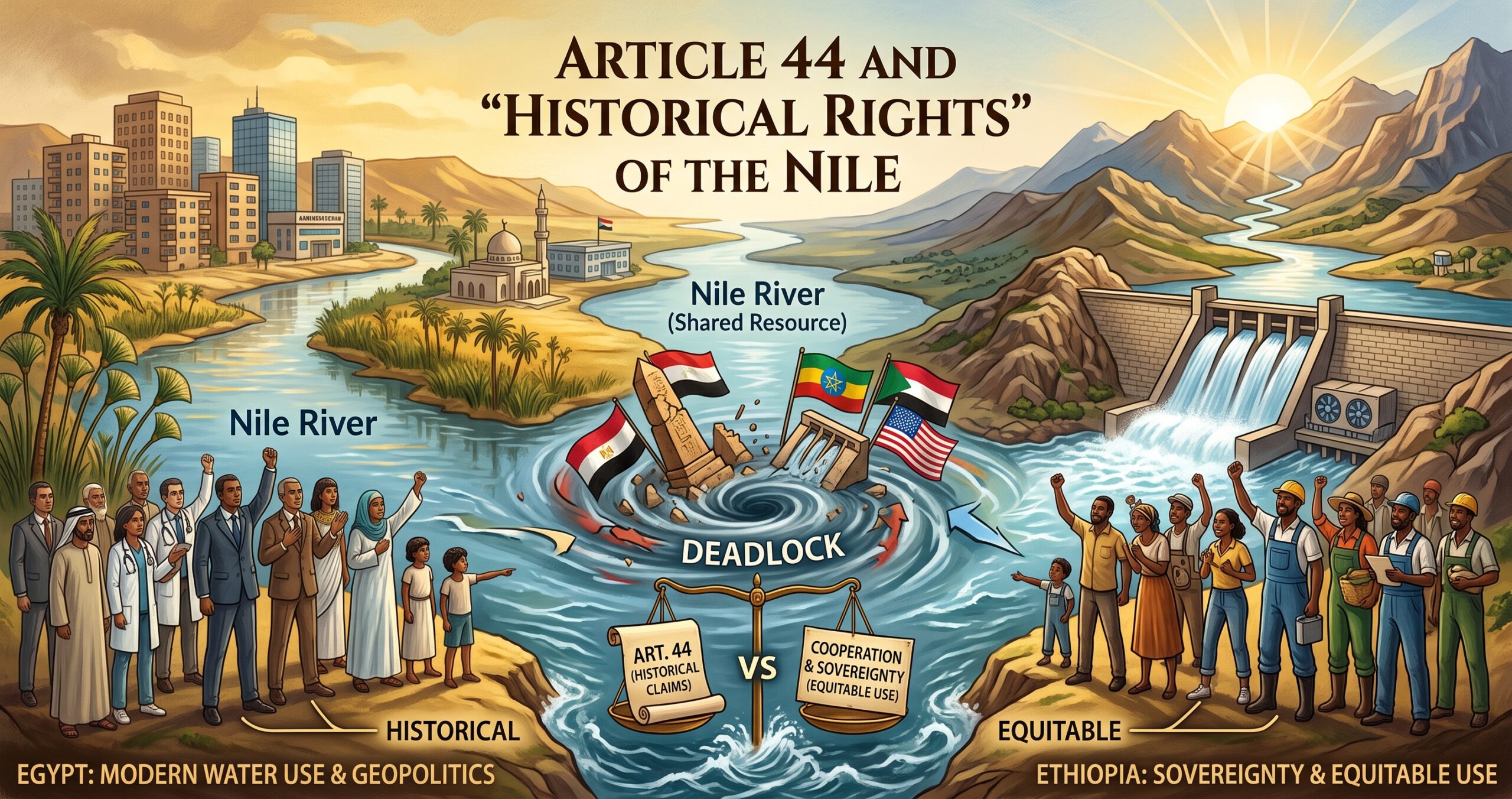
Egypt’s relationship with the Nile is ancient and profound. No serious observer can dispute that Egypt has legitimate interests in the river that tens of millions of Egyptians depend. But legitimate national interests are not the same thing as exclusive historical ownership. That distinction is increasingly important as the Nile Basin confronts the realities of population growth, development, climate pressure, and competing demands among sovereign states.
Egypt’s constitutional language deserves scrutiny in that context. Article 44 of Egypt’s Constitution states that “the State shall protect the Nile River and preserve Egypt’s historical rights related to it.” The provision is understandable from an Egyptian national security perspective, but the phrase “historical rights” can become problematic when interpreted as establishing a superior entitlement over a transboundary river shared by multiple sovereign nations. A constitution can articulate a country’s national interests; it cannot, by itself, convert those interests into universally accepted rights over resources beyond its sovereignty. This is the mindset in which most Egyptian politicians are deeply immersed and creates a deadlock on any negotiations, the belief, almost unquestioned, that Egypt possesses ‘historical rights” over the Nile. That narrative treats a shared river as an inherited Egyptian entitlement rather than a resource governed by the rights and interests of all Nile basin countries.
The broader constitutional symbolism surrounding Egypt and the Nile also matters. Egypt is frequently described through the famous phrase that it is “the gift of the Nile and the gift of Egyptians to humanity.” As a statement of national identity and civilization, that sentiment is understandable. But when such language becomes intertwined with political arguments about the Nile, it can reinforce the perception among some Egyptians that the river is fundamentally an Egyptian inheritance rather than a shared resource. The central question, therefore, is not whether Egypt has rights concerning the Nile. It unquestionably does. The question is whether Egypt’s rights should be understood as fundamentally different from, or superior to, those of the upstream countries.
Ethiopia as a source of the largest share of the Abbay River, which turns to be the Blue Nile the moment it leaves Ethiopian boundary and its Grand Ethiopian Renaissance Dam (GERD) that is built at the heart of this debate and the prospects of other dams that are going to be built for development should not be a reason for claiming a binding agreement from the downstream country that has no share on producing that water. Ethiopia’s contribution to the Nile system at roughly 84 percent, depending on the measurement and hydrological definition used has not historically framed its position by claiming an exclusive constitutional right to “protect” the Abbay as though downstream countries were merely beneficiaries of an Ethiopian inheritance.
Ethiopia’s argument is fundamentally simple and straightforward. It is about sovereignty, development and equitable use. Its position is that being an upstream country should not condemn it to permanent underdevelopment while downstream countries claim “historic privileges” over water originating largely within Ethiopian territory.
That principle should not be controversial as the Nile is not sole property of Egypt, Ethiopia or any other single state. It is a river system that requires cooperation among all basin countries. Egypt’s security concerns deserve recognition, but so do Ethiopia’s development needs and the interests of Sudan and the other Nile Basin states.
This is precisely why the language of “historical rights” requires careful examination. History matters, but history cannot freeze a river basin in the political circumstances of another era. Population, technology, economic needs, environmental conditions and international law have changed. A sustainable Nile framework must reflect those realities.
The danger is that constitutional language can become political doctrine. When citizens repeatedly hear that Egypt possesses “historical rights” to the Nile, the phrase can gradually be understood not as one country’s legitimate interest but as a permanent entitlement superior to the interests of upstream nations. That perception makes compromise harder. The word “Historical Rights” is precisely the sticking point that the Egyptian politicians have a struggled to confront as it is deeply embedded conception of the Nile as an inherited national entitlement reinforced by the constitutional language and generation of political rhetoric.
It also helps explain why every new Nile dispute can become an international diplomatic campaign.
The United States, China, Italy and other outside powers may have legitimate diplomatic or economic interests in the region. But the Nile cannot be resolved by accumulating foreign endorsements for one country’s preferred narrative. External powers can facilitate dialogue; they cannot manufacture sovereignty, erase upstream rights or permanently settle a dispute between trans-boundary river sharing states.
Egypt therefore faces a choice. It can continue internationalizing the dispute and appealing to outside powers to validate its interpretation of “historical rights,” or it can help build a genuinely basin-wide framework based on equitable and reasonable utilization, no significant harm, transparency, cooperation and respect for the sovereignty of all Nile Basin states.
Reconsidering the constitutional and political language surrounding the Nile would not mean abandoning Egypt’s interests. On the contrary, it could strengthen Egypt’s long-term security by replacing a zero-sum conception of the river with a cooperative one.
The Nile is indeed central to Egypt’s civilization. But that does not make it an Egyptian inheritance.
A river can be the lifeblood of one nation without being the property of that nation which requires the upstream countries to sign a binding agreement. The future of the Nile will not be secured by historical claims written into constitutions or repeated in diplomatic corridors. It will be secured when every country along the river accepts the same fundamental principle: the Nile belongs to no single nation, and its future must be negotiated among equals.
References
- Constitutional Decree: Constitution of the Arab Republic of Egypt, 2014, Article 44 (stipulating state duties regarding the Nile River and historical rights).
- International Frameworks: United Nations, Convention on the Law of the Non-Navigational Uses of International Watercourses, Adopted by the General Assembly on May 21, 1997 (Articles 5 and 7 on Equitable and Reasonable Utilization and No Significant Harm).
- Hydro-Political Analysis: Salman, M. A. Salman, The Grand Ethiopian Renaissance Dam: The Road to the Declaration of Principles and the Khartoum Agreement, Water International, Vol. 41, No. 4, 2016.
- Treaty History: Agreements relating to the use of the waters of the River Nile: 1929 Anglo-Egyptian Exchange of Notes and the 1959 Agreement for the Full Utilization of the Nile Waters between Egypt and Sudan.
