




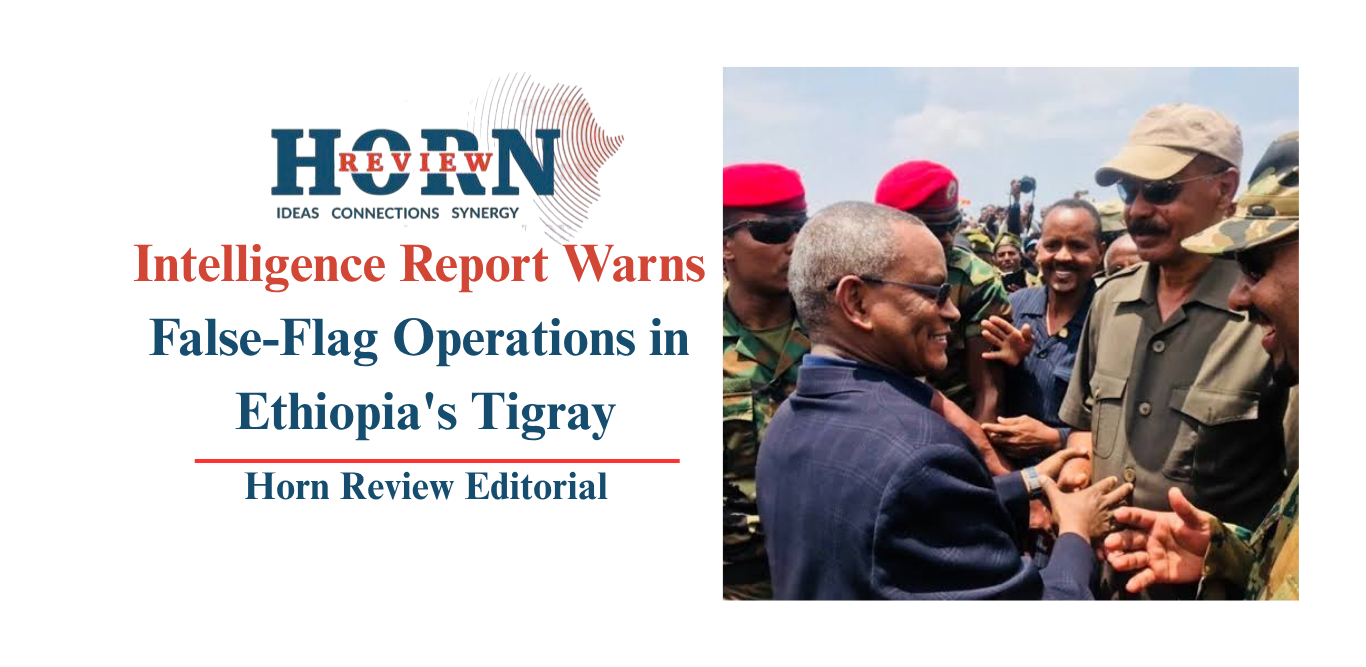
Meta Title: Intelligence Report: TPLF-Eritrea Coordination, False-Flag Risks & Military Buildup in Northern Ethiopia
Meta Description: Leaked intelligence details alleged TPLF-PFDJ meetings in Zalambessa, plans for false-flag attacks on civilians/EFFORT assets, “Hawzen 2” narrative manipulation, and major troop mobilizations in Tigray.
Focus Keyword: Northern Ethiopia security crisis
Slug: northern-ethiopia-security-crisis-tplf-eritrea-intelligence-report
Intelligence Report Warns of Coordinated Destabilization Campaign in Northern Ethiopia
A leaked intelligence assessment has exposed a rapidly deteriorating security environment in northern Ethiopia, describing a convergence of political coordination, military positioning, and information operations allegedly orchestrated by the Tigray People’s Liberation Front (TPLF) and the Eritrean regime. The report warns that instability is being deliberately instrumentalized not merely as physical disruption, but as a strategic tool to shape public perception, manipulate attribution of responsibility, and undermine confidence in Ethiopia’s Federal Government.
Alleged TPLF-PFDJ Strategic Alignment in Zalambessa
According to the report, senior military and political figures from the TPLF and Eritrea’s People’s Front for Democracy and Justice (PFDJ) convened on August 3, 2026, in the border town of Zalambessa. The location carries heavy historical weight, serving as a primary flashpoint during the 1998–2000 Eritrean–Ethiopian War.
The intelligence suggests this meeting was not an isolated event but a continuation of unauthorized “official” relations maintained over the past two years. In the volatile geopolitical landscape of the Horn of Africa, where domestic conflicts frequently intersect with regional rivalries, such coordination between former battlefield adversaries signals a significant shift in the regional balance of power.
Key Figures Identified in Covert Engagements
The report names specific TPLF operatives allegedly driving this coordination:
- Fetlework Gebregziabher (Monjerno)
- Wedi Imbeytey
- Wedi Medhin
- Kinfe Dagnew
Discussions reportedly centered on restoring political influence, fostering public hostility toward the Federal Government, and generating conditions for a broad-based popular uprising against federal authority.
False-Flag Operations: Violence as Narrative Warfare
Central to the intelligence allegations is a strategy blending kinetic action with information warfare. The report details plans for coordinated explosive attacks across multiple locations in Tigray, designed to be subsequently blamed on the Federal Government.
Primary Target Categories
| Target Type | Specific Examples | Strategic Intent |
|---|---|---|
| Economic & Industrial | EFFORT-affiliated entities | Undermine employment, economic recovery, and socioeconomic resilience; erode public confidence. |
| Civilian & Public Spaces | Markets, transport hubs, hospitals, churches, mosques, community centers | Maximize civilian casualties and trauma to generate visceral public anger. |
The “False-Flag” Mechanism
The report characterizes this as a classic false-flag operation: TPLF employs violence not solely for territorial gain, but as a mechanism to redistribute blame. By controlling the interpretation of events immediately following an attack, the actors hope to decisively alter political outcomes among local Tigrayans, national audiences, and international observers.
Analyst Note: In modern conflict environments, the ability to define responsibility following an incident has become as strategically significant as the incident itself. Political legitimacy and international perception are increasingly shaped by narratives rather than material realities alone.
Digital Influence Operations & Historical Trauma Exploitation
Parallel to kinetic plans, the report describes a sophisticated information operation leveraging social media networks and digital platforms.
Pre-Emptive Narrative Setting
Selected activists and online influencers were allegedly engaged to disseminate messaging pre-warning communities that the Federal Government would “deliberately target civilians.” This primes the information space to accept the false attribution immediately after a planned attack occurs.
The “Hawzen Number Two” Scenario
Perhaps the most psychologically potent allegation is the intent to recreate a “Hawzen number two” scenario. This references the 1988 Hawzen airstrike by the Derg regime—a historical trauma carrying profound emotional significance in Tigrayan collective memory.
The report warns that this historical wound is being deliberately echoed to mobilize sentiment and assign blame to the current Federal Government. While collective memory serves legitimate purposes of accountability, the intelligence suggests a cynical manipulation of past suffering to justify present political objectives.
The “Tsimdo Alliance” Paradox
The report highlights a stark contradiction: Intelligence attributes 76% of atrocities against Tigrayan civilians during the 2020–2022 war to Eritrean soldiers and 18% to Fano militias. Yet, these same actors now form the core of the “Tsimdo alliance”—a bloc reportedly affiliated with the Sudanese Armed Forces (SAF) and backed by Egypt.
The implication is clear: violence and instability are rationalized as strategic tools within a broader contest for power, regardless of previous perpetration, placing civilian populations at risk of becoming instruments in competing political strategies.
Military Posture: Troop Concentrations & Operational Readiness
Beyond political and informational dimensions, the report documents concrete military developments indicating heightened operational readiness.
TPLF Militia Deployments & Fortifications
Troop concentration and fortification efforts are reportedly underway across strategic corridors:
- Raya Bala
- Zobel direction
- Waja Tumuga
- Merewa direction
- Korem line
Heavy Mechanized Deployment
The deployment of mechanized heavy weaponry associated with the 43rd Army around Chercher and Bala is cited as a primary indicator of preparation for sustained military engagement.
Operational Security (OPSEC) Measures
Communication restrictions have been imposed on deployed personnel, including the collection or limitation of mobile phones. This standard operational security practice aims to prevent information leakage and maintain command integrity ahead of potential kinetic operations.
Cross-Border Dimension: “Army 70” in Sudan
The regional complexity is deepened by the presence of TPLF-affiliated forces based in Sudan, commonly referred to as “Army 70.” Recent mobilization of these forces introduces a cross-border dynamic that could rapidly influence internal Ethiopian developments, reminiscent of proxy dynamics seen in other Horn of Africa conflicts.
Humanitarian Impact: Civilian Displacement & Anxiety
The cumulative effect of these developments is already manifesting in civilian behavior, serving as an early warning indicator of humanitarian stress.
- Transportation Collapse: Declining public transport services between Alamata, Kobo, Korem, and Mehoni reflect growing uncertainty.
- Pre-Emptive Displacement: Residents in Alamata and surrounding areas are relocating toward Korem, Mehoni, and Maichew in anticipation of conflict.
- Early Warning: Such movements are widely recognized by UNHCR and OCHA as precursors to large-scale displacement crises.
Strategic Implications for Federal Authority & Regional Stability
The intelligence assessment frames the situation as a multifaceted test of Ethiopia’s institutional resilience. The Federal Government faces a dual challenge: neutralizing immediate security threats while preserving constitutional order and public trust.
Required Response Pillars
- Military Readiness: Deterrence and defense against multi-axis threats (local militia, mechanized units, cross-border elements).
- Credible Strategic Communication: Rapid, verifiable attribution capabilities to counter false-flag narratives in real-time.
- Diplomatic Engagement: Addressing the external dimensions (Eritrea, Sudan, Egypt) driving the “Tsimdo alliance” coordination.
- Civilian Protection & Stabilization: Immediate humanitarian preparedness for anticipated displacement flows in Southern and Eastern Tigray zones.
Conclusion: Narrative Credibility as National Security
In a region marked by deep historical trauma and contested narratives, the report concludes that the credibility of government communication is now a critical determinant of stability. The capacity to counter misinformation and maintain public trust is inextricably linked to physical security.
The situation in northern Ethiopia represents a broader test: whether political disputes can be managed within institutional frameworks, or whether the region will once again descend into cycles of violence fueled by competing narratives and external manipulation.
Related Entities & Contextual References
- Belligerents: Tigray People’s Liberation Front (TPLF) | People’s Front for Democracy and Justice (PFDJ) | Fano (militia)
- Geography: Zalambessa | Raya Azebo | Korem | Alamata
- Historical Context: 1988 Hawzen Massacre | Eritrean–Ethiopian War | Tigray War (2020–2022)
- Economic Entities: EFFORT (Endowment Fund for the Rehabilitation of Tigray)
- Regional Bodies: African Union | IGAD | UN OCHA Ethiopia
Schema Markup (JSON-LD) for SEO: json
