




For more than a century, Ethiopia and the United States have maintained one of Africa’s most important diplomatic relationships. The partnership has been built around security cooperation, development, humanitarian assistance, economic engagement, and a shared interest in peace and stability in the Horn of Africa.
Like many long-standing relationships, however, it has faced difficult moments. The Ogaden War, from 1976 to 1977, in which the U.S ceased the sale of arms to Ethiopia in favor of Somalia. This was a classic as of Cold War geopolitics. More recently the conflict in northern Ethiopia that began in November 2020 created one of the most serious challenges in modern Ethiopia–United States relations.
The Ethiopian government described the conflict as a constitutional law enforcement operation following the attack on the Ethiopian National Defense Force’s Northern Command by the Tigray People’s Liberation Front (TPLF). The government argued that restoring federal authority and protecting national institutions were necessary to preserve Ethiopia’s constitutional order.
The United States approached the conflict from a different perspective, raising concerns about humanitarian conditions, civilian suffering, alleged violations of international humanitarian law, and the involvement of Eritrean forces. These differences led to diplomatic tensions between Addis Ababa and Washington.
Despite these disagreements, the strategic importance of Ethiopia never disappeared. Ethiopia remains Africa’s second-most populous nation, the host of the African Union headquarters, and a central player in regional peace and security. For the United States, Ethiopia remains an essential partner in the Horn of Africa. For Ethiopia, maintaining constructive relations with Washington remains important for investment, technology, diplomacy, and economic development. Despite the difficulties of the 2020-22 war between the TPLF and the Federal government, diplomatic relations continued and evolved.
A Turning Point After Pretoria
The signing of the Pretoria Cessation of Hostilities Agreement in November 2022 marked an important turning point.
The agreement created an opportunity for peace, reconstruction, and renewed international engagement. As the peace process progressed, Ethiopia and the United States gradually began rebuilding communication channels.
Although differences over the conflict remain part of the historical record, both countries recognized that continued engagement was necessary to address shared challenges. The relationship began shifting from confrontation toward practical cooperation.
Diplomacy Returns to the Highest Level
One of the clearest signs of improving relations has been the return of high-level diplomatic engagement.
Ethiopian Foreign Minister Gedion Timothewos has been central to efforts to strengthen communication with Washington. His discussions with senior U.S. officials, including Secretary of State Marco Rubio, focused on strengthening bilateral relations, regional peace, economic cooperation, and security issues.
The engagement between Ethiopian and American diplomatic leaders demonstrated that both sides were rebuilding structured channels for cooperation after a period of tension.
The visit of U.S. Deputy Secretary of State Christopher Landau to Addis Ababa further highlighted renewed American engagement with Ethiopia. His discussions with Ethiopian officials focused on strengthening bilateral relations, regional stability, and areas of mutual interest.
The involvement of senior U.S. diplomatic officials showed that Washington continues to view Ethiopia as a strategically important country. It also demonstrated that both governments are willing to engage directly and address differences through dialogue.
Renewed Security Partnership
The security relationship between Ethiopia and the United States has also entered a new phase.
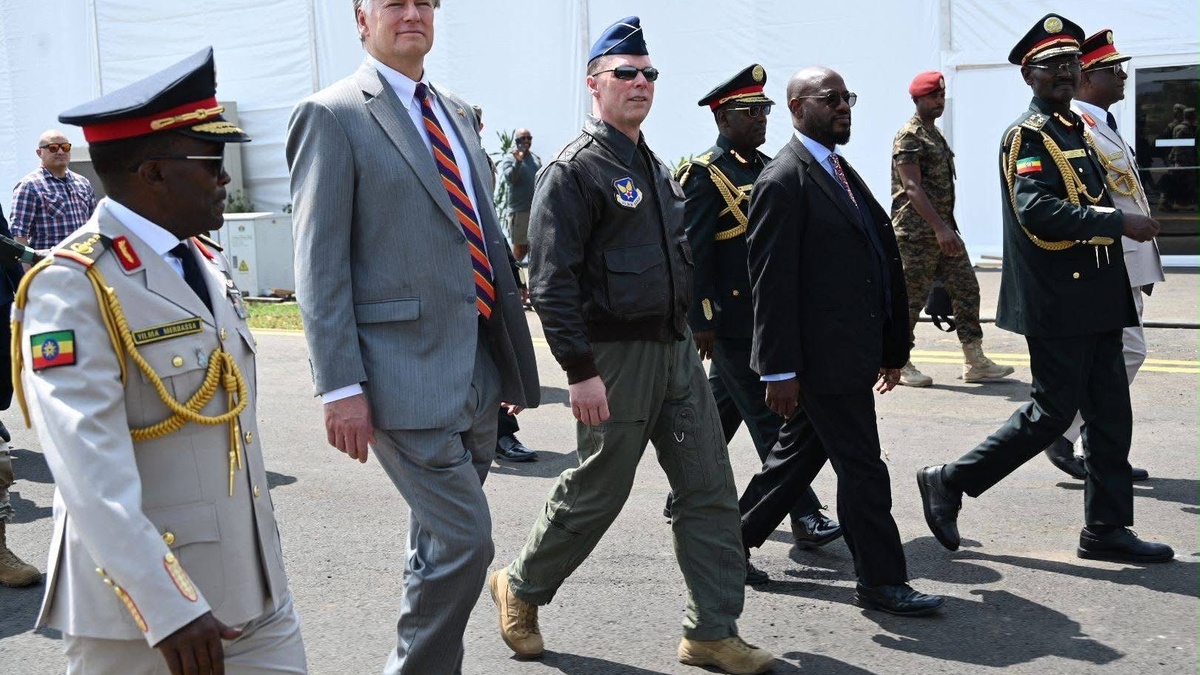
The engagement of senior U.S. defense officials, including AFRICOM Commander General Dagvin Anderson, reflected renewed cooperation between American and Ethiopian security institutions. Discussions focused on regional security, military cooperation, and strengthening professional relationships between the two countries.
The participation of U.S. representatives in the Ethiopian Air Force’s 90th Anniversary celebrations carried important symbolism. It demonstrated recognition of Ethiopia’s military and aviation institutions and showed a willingness to rebuild trust through professional engagement.
Another major development was the African Logistics and Communications Symposium held in Addis Ababa, jointly organized by the Ethiopian National Defense Force (ENDF) and U.S. Africa Command (AFRICOM).
The conference brought together senior military leaders, generals, and defense representatives from across Africa to discuss logistics, communications, technology, readiness, and strengthening African security capabilities.
The participation of military leaders from many African countries showed that the event was not simply a bilateral Ethiopia–United States meeting. It was a continental platform focused on improving cooperation among African security institutions.
Hosting such a high-level conference in Addis Ababa reinforced Ethiopia’s role as an important center for African security discussions.
Energy Cooperation and the Grand Ethiopian Renaissance Dam
The renewed relationship between Ethiopia and the United States is also expanding beyond diplomacy and security into energy and development.
Recent discussions between Ethiopian electricity officials and a U.S. government delegation led by Deputy Assistant Secretary Mark Traunter Mitchell focused on cooperation in the energy sector, including the reliable transmission of electricity generated from the Grand Ethiopian Renaissance Dam (GERD) and modernization of Ethiopia’s power infrastructure.
The discussions addressed important areas such as upgrading the national electricity grid, expanding smart meters, accelerating digital transformation, improving distribution systems, and creating investment opportunities in the energy sector.
For Ethiopia, the GERD represents more than a hydropower project. It is considered a foundation for industrial development, economic growth, and expanded access to electricity.
However, maximizing the benefits of the dam requires modern transmission and distribution systems capable of delivering reliable power to homes, businesses, and industries.
The cooperation discussions between Ethiopian and American officials demonstrate that the relationship is increasingly moving toward practical development projects that support clean energy, infrastructure modernization, and economic transformation.
Technology and Artificial Intelligence:- Building the Partnership of the Future
The renewed Ethiopia–United States engagement is also expanding into one of the most important fields of the modern era; artificial intelligence and digital technology.
A U.S. government delegation led by Mark Mitchell, Deputy Assistant Secretary for Middle East and Africa Affairs, visited the Ethiopian Artificial Intelligence Institute to explore opportunities for cooperation in artificial intelligence, research, innovation, and technology development.
During the visit, the leadership of the Ethiopian Artificial Intelligence Institute presented the country’s progress in AI research and development, including work in natural language processing, robotics, and the application of artificial intelligence to Ethiopia’s indigenous languages.
Ethiopia has been developing AI systems designed to help machines understand local languages, creating opportunities for applications in education, public services, communication, and economic development. The institute has also focused on supporting technology startups and creating an environment where young innovators can develop new solutions.
The U.S. delegation welcomed Ethiopia’s progress and recognized the potential for collaboration in areas such as artificial intelligence, robotics, digital innovation, and technology entrepreneurship.
This emerging area of cooperation reflects a broader transformation in Ethiopia–United States relations. Beyond traditional areas such as security and development assistance, the partnership is increasingly focusing on innovation, knowledge exchange, and preparing both countries for the opportunities and challenges of the digital age.
Cooperation in artificial intelligence could create new opportunities for research partnerships, startup development, digital skills training, and technology-driven economic growth, particularly for Ethiopia’s young and rapidly growing population.
Beyond Security:- A Broader Strategic Partnership
The Ethiopia–United States relationship extends beyond defense and energy.
The United States remains an important partner in Ethiopia through humanitarian assistance, health programs, education, and economic engagement. Ethiopia, with its large population, strategic location, and growing economy, remains an important market and investment opportunity.
For Washington, Ethiopia’s stability matters because developments in the Horn of Africa influence regional security, trade routes, migration, and international peace efforts.
For Addis Ababa, cooperation with the United States provides opportunities for investment, technology transfer, diplomatic engagement, and access to one of the world’s largest economies.
The relationship is increasingly becoming broader; diplomacy, security, energy, technology, and economic cooperation are all becoming interconnected parts of the partnership.
A New Chapter Ahead
The challenges of the past few years cannot simply be forgotten. The Tigray conflict remains one of the most difficult chapters in Ethiopia’s modern history, and different sides continue to interpret those events differently.
However, international relationships are not defined only by moments of disagreement. They are also defined by the ability to rebuild communication and cooperation when shared interests are recognized.
The recent pattern is clear:- senior diplomatic visits, renewed defense cooperation, AFRICOM engagement, African security partnerships, and energy cooperation around the GERD all point toward a renewed Ethiopia–United States partnership.
The future of the relationship will depend on continued dialogue, mutual respect, and cooperation based on shared interests.
The lesson from recent years is that even a partnership tested by crisis can recover. Ethiopia and the United States are now working to write a new chapter one focused not only on the disagreements of the past, but on the opportunities ahead: peace, development, energy, investment, and stability in the Horn of Africa.

1 Comment
Pingback: Ethiopia’s Strategic Resilience, Leadership, National Power and the Re-emergence - Abren