




Ethiopia Receives Russian Su-35 Jets, S-400 Deal Signed Amid Tigray, Amhara Conflicts
Meta Description: Ethiopia confirms delivery of 12 Su-35 fighter jets and an agreement for S-400 air defense systems from Russia. PM Abiy Ahmed announced the military hardware upgrade at the Russia-Africa Summit in Moscow as fighting continues in Tigray and Amhara regions.
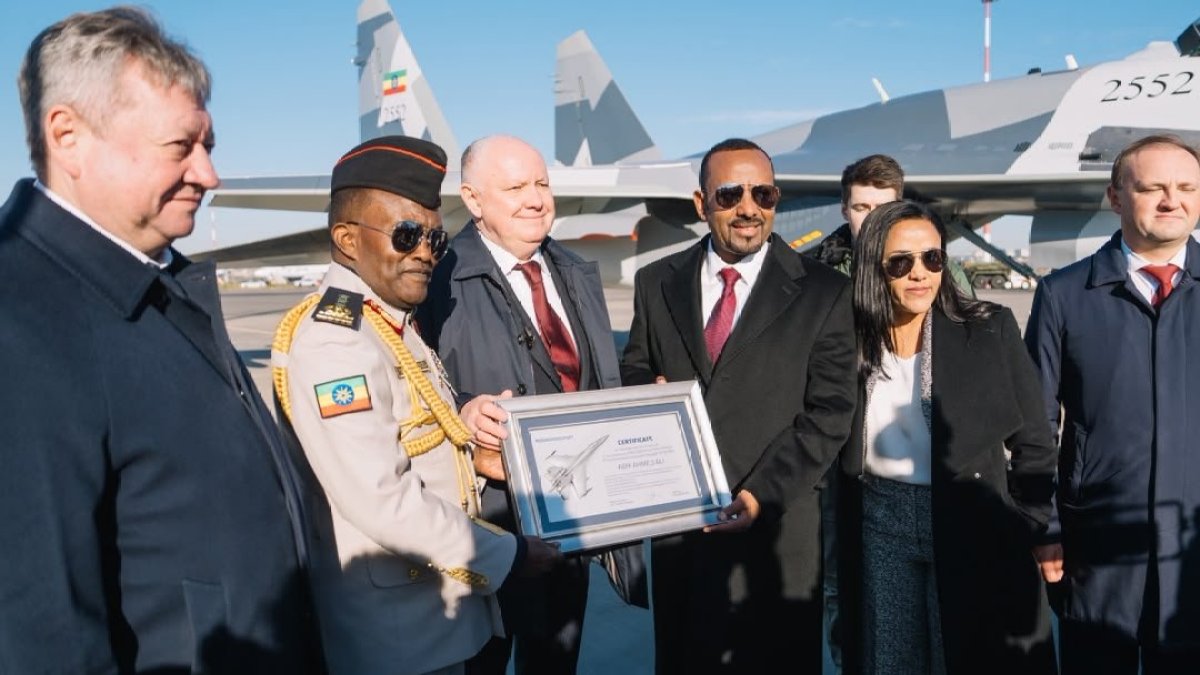
Ethiopia has taken delivery of 12 Russian-made Sukhoi Su-35 “Flanker-E” multirole fighter jets and finalized an agreement to acquire four S-400 Triumf air defense missile batteries, Prime Minister Abiy Ahmed announced Wednesday. The declaration came during the Russia-Africa Summit in Moscow, signaling a deepening strategic military partnership between Addis Ababa and the Kremlin as Ethiopia contends with simultaneous internal conflicts in the northern Tigray and Amhara regions.
Su-35 Delivery Accelerated, S-400 Timeline Pending
In a post on X (formerly Twitter) from the summit venue, Prime Minister Abiy confirmed the advanced 4.5-generation Su-35S jets arrived a year ahead of schedule under an existing procurement contract. He credited Russian President Vladimir Putin for expediting the transfer.
“The new equipment will strengthen Ethiopia’s ability to preemptively deter aggression,” Abiy stated, adding in a subsequent post that the aircraft are “newly deployed” and tasked with defending Ethiopian airspace.
While the fighter jets are reportedly operational, the Prime Minister did not specify a delivery timeline for the S-400 surface-to-air missile (SAM) systems. The S-400, NATO reporting name SA-21 Growler, is one of the world’s most advanced long-range air defense platforms, capable of engaging aircraft, cruise missiles, and ballistic missiles at ranges up to 400 km. The acquisition would place Ethiopia among a select group of nations operating the system, alongside Turkey, India, and China.
Russia-Africa Summit: Security Diplomacy in Focus
The announcement highlights the centerpiece of the second Russia-Africa Summit, where Moscow is leveraging military-technical cooperation to expand geopolitical influence across the continent amidst Western sanctions related to the war in Ukraine.
According to the Stockholm International Peace Research Institute (SIPRI), Russia accounted for 15% of major arms imports to Africa between 2021 and 2025, maintaining its position as the continent’s third-largest arms supplier. The summit agenda, attended by numerous African heads of state, prioritizes trade, investment, and security cooperation frameworks designed to bypass Western financial systems.
Deepening Ethiopia-Russia Defense Ties
Wednesday’s revelation is the culmination of years of accelerating defense collaboration:
- July 2021: Addis Ababa and Moscow signed a foundational Military Cooperation Agreement focusing on training, technology transfer, and joint exercises.
- January 2026: Janes defense weekly reported Ethiopia publicly displayed newly acquired Yak-130 advanced jet trainers during the Ethiopian Air Force’s 90th-anniversary celebrations, confirming the integration of Russian pilot training pipelines.
- Current: The Su-35 and S-400 deals represent a qualitative leap from trainers to frontline air superiority and strategic air defense assets.
Operational Context: Two-Front War Drives Modernization
The hardware arrival coincides with a critical juncture in Ethiopia’s internal security landscape. The Ethiopian National Defense Force (ENDF) is currently engaged in high-intensity combat on two distinct fronts:
1. Renewed Tigray Conflict
Fighting reignited in Tigray following the collapse of the November 2022 Pretoria Peace Agreement (mediated by the African Union). Key developments include:
- October 4, 2026: Federal troops and allied forces entered the regional capital, Mekelle, after Tigray People’s Liberation Front (TPLF) fighters withdrew.
- Territorial Losses: The TPLF has ceded further ground as government forces advance into secondary towns.
- Governance Vacuum: Addis Ababa installed a six-month caretaker administration, though a TPLF commander recently urged continued resistance via televised broadcast.
- Human Cost: Researchers at Ghent University estimate the 2020–2022 phase of the conflict killed approximately 500,000 civilians; the current escalation risks exacerbating the humanitarian crisis.
2. Amhara Region Insurgency
Concurrently, federal forces are battling Fano, a decentralized Amhara militia movement opposing federal authority since 2023. The group controls significant rural territory and has demonstrated the ability to contest major urban centers, stretching ENDF logistics and manpower.
Strategic Implications of Su-35 / S-400 Integration
The introduction of the Su-35—equipped with the N035 Irbis-E radar and thrust-vectoring engines for supermaneuverability—provides the Ethiopian Air Force (ETAF) with a significant qualitative edge over any regional non-state actor and parity with neighboring air forces.
The S-400 batteries, once delivered, would create a layered Anti-Access/Area Denial (A2/AD) bubble over critical infrastructure (Addis Ababa, GERD dam, airbases). However, integration challenges remain:
- Training & Maintenance: Transitioning from legacy Soviet-era fleets (Su-27, MiG-23) and diverse Western platforms to the Su-35/S-400 ecosystem requires intensive Russian technical support.
- Interoperability: Integrating Russian Identification Friend or Foe (IFF) systems and data links with existing Ethiopian command-and-control architecture.
- CAATSA Risk: While the Countering America’s Adversaries Through Sanctions Act (CAATSA) targets significant transactions with Russia’s defense sector, Ethiopia—unlike NATO member Turkey—faces a different calculus regarding US security assistance leverage.
What Comes Next
As the Russia-Africa Summit concludes, observers will monitor:
- S-400 Delivery Schedule: Satellite imagery of Ethiopian airbases (e.g., Bishoftu/Harar Meda) for S-400 transporter-erector-launcher (TEL) deployment.
- Operational Debut: Whether Su-35s are utilized for Close Air Support (CAS) or interdiction missions in Tigray/Amhara.
- Diplomatic Fallout: Reactions from Washington, Brussels, and the African Union regarding the militarization of internal conflicts via external great-power patronage.
The deals cement Russia’s role as Ethiopia’s primary strategic arms partner, fundamentally altering the Horn of Africa’s military balance while the federal government seeks a decisive military solution to its fracturing internal cohesion.
Related Reading
- SIPRI Trends in International Arms Transfers 2025 Report
- African Union Peace and Security Council Communique on Tigray
- Russia-Africa Summit 2026 Official Portal
Keywords: Ethiopia Su-35 delivery, Russia S-400 Ethiopia, Abiy Ahmed Moscow summit, Russia-Africa Summit 2026, Tigray conflict 2026, Amhara Fano insurgency, Ethiopia Russia military cooperation, CAATSA sanctions Ethiopia.
