




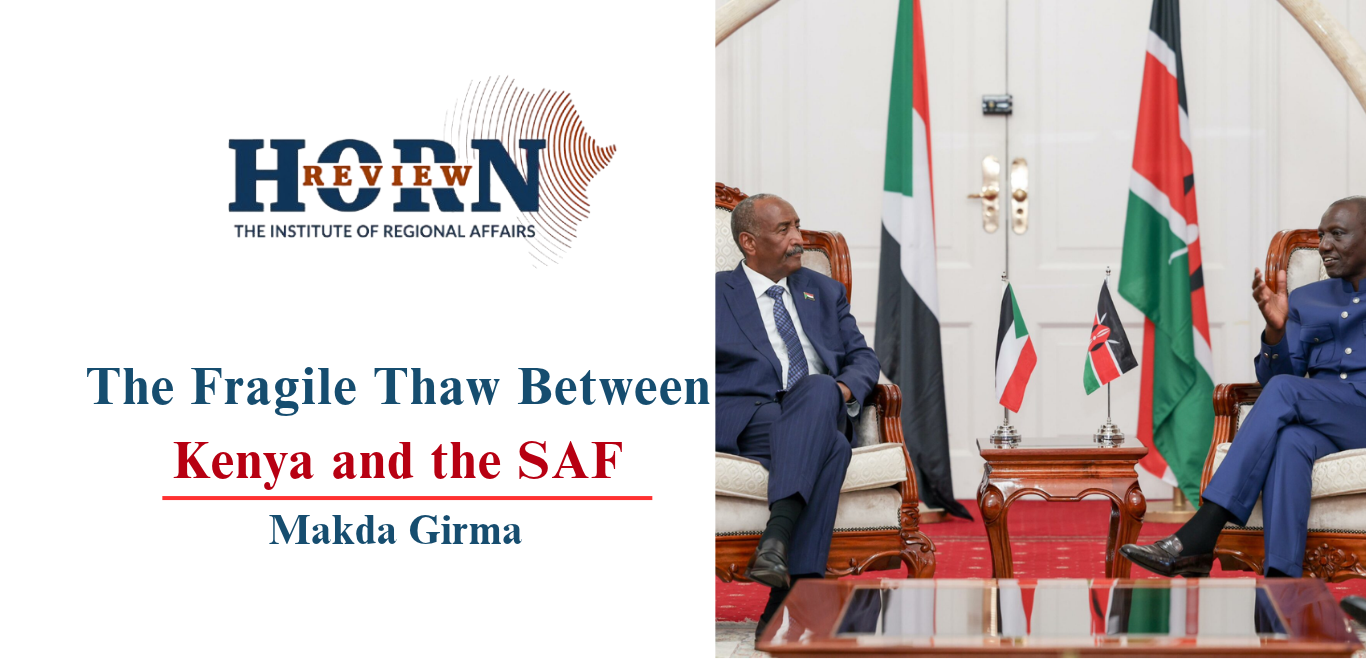
Kenya–Sudan Relations Thaw as SAF Lifts Tea Ban, But RSF Dispute Remains Unresolved
After more than a year of frozen ties, Kenya and Sudan’s Armed Forces (SAF)-aligned government have resumed diplomatic engagement, marked by Khartoum’s decision in November 2026 to lift a 20-month ban on Kenyan tea imports. The move reopens a vital commercial corridor worth approximately $70 million annually, yet the core political fracture—Nairobi’s engagement with the rival Rapid Support Forces (RSF)—remains unsettled, casting doubt on the durability of the rapprochement.
Intelligence-Led Diplomacy Breaks the Deadlock
The breakthrough followed months of high-level, behind-the-scenes maneuvering. Momentum gathered in October 2026 during the COMESA summit in Harare, where President William Ruto met Sudanese Prime Minister Kamil Idris to discuss trade restoration. However, the critical channel proved unconventional: Kenya’s National Intelligence Service (NIS) Director General Noordin Haji traveled to Sudan to meet SAF Commander Abdel Fattah al-Burhan directly.
This intelligence-led diplomacy acknowledged that a dispute rooted in security alignments could not be resolved solely through commercial talks. By opening a direct line to al-Burhan, Nairobi addressed SAF’s core security concerns away from public scrutiny. On November 8, 2026, Sudan formalized the reopening via Ministerial Order No. 25 of 2026, lifting the import ban. The specifics of Haji’s assurances to al-Burhan—particularly regarding future engagement with the RSF—remain undisclosed.
Economic Necessity Drove Khartoum’s Calculus
While politics triggered the ban, economics forced its removal. By August 2026, Sudanese officials signaled willingness to negotiate if Kenya used formal diplomatic channels. The restrictions had inflicted mutual damage:
- Kenyan Exporters: Lost access to a peak-year market worth $70 million; 207 containers were left stranded at the Port of Mombasa.
- Sudanese Importers: Over 50 companies were forced to source Kenyan tea indirectly via the UAE and China at inflated prices.
A Targeted, Limited Reopening
Crucially, Ministerial Order No. 25 addressed Kenyan tea specifically, leaving restrictions on other Kenyan products intact. This selectivity allowed the SAF to relieve domestic price pressures and appease local traders without conceding political ground on the RSF issue.
Timeline: From Transition Partners to Diplomatic Rupture
The current friction sits atop years of deteriorating trust, evolving from cooperation to confrontation.
2022–2023: Failed Mediation Bid
Kenya initially backed Sudan’s transition, with Ruto endorsing the December 2022 Political Framework Agreement. When war erupted in April 2023, Nairobi sought a lead mediation role via the IGAD Quartet. The SAF rejected Kenya’s leadership in June 2023, accusing Nairobi of bias toward the RSF. A brief thaw saw al-Burhan visit Nairobi in November 2023, where both leaders agreed on a ceasefire and political dialogue—an understanding that proved fragile.
2024: The Hemedti Factor
Relations soured again in January 2024 when Ruto hosted RSF leader Mohamed Hamdan “Hemedti” Dagalo. Khartoum recalled Ambassador Kamal Gubara in protest. Though Gubara returned in May 2024, the precedent was set: SAF viewed high-profile RSF hosting as legitimization of its rival.
February 2025: The Breaking Point
A tentative reset in January 2025—where Foreign Minister Ali Youssif reportedly secured assurances Nairobi would not recognize an RSF government—collapsed weeks later. Kenya hosted RSF allies for the signing of the Sudan Founding Charter on February 22, 2025, outlining a parallel administration. The SAF condemned the move as sovereignty violation, recalled its ambassador on February 20, and imposed trade restrictions the following month. Nairobi argued hosting talks ≠ recognition; Khartoum saw broken promises.
The Gulf Dimension: UAE Influence and Kenyan Commercial Ties
The bilateral dispute is refracting through a wider regional proxy struggle. The SAF repeatedly accuses the United Arab Emirates (UAE) of backing the RSF—allegations Abu Dhabi denies—while Saudi Arabia engages the SAF-led diplomatic tracks. Kenya’s deepening commercial and investment ties with the UAE have consequently drawn scrutiny in Khartoum.
While Kenya’s Gulf partnerships are economic in nature, the SAF’s narrative linking Abu Dhabi to the RSF places Nairobi’s diplomacy under a microscope. This dynamic illustrates how Sudan’s war has weaponized ordinary bilateral relationships, forcing regional actors to navigate a minefield of competing accusations.
Nairobi’s Balancing Act: Humanitarian Access vs. Political Legitimacy
Despite SAF protests, Kenya has not severed channels with the RSF. In April 2026, UN Envoy Pekka Haavisto met Hemedti in Kenya to discuss de-escalation. In September, British and Japanese officials engaged RSF-affiliated figures in Nairobi on humanitarian access.
The SAF protested these engagements, arguing they risk legitimizing the RSF’s parallel governance structures. Western envoys countered that talks were strictly humanitarian. This exposes the core doctrinal clash: Kenya views engagement as a operational necessity for peace and aid access; the SAF views political engagement as an existential threat to state sovereignty.
Implications for IGAD and AU Mediation
The dispute has already paralyzed regional diplomacy. The SAF’s 2023 rejection of Kenya’s IGAD leadership complicated bloc-wide mediation. While restored trade and the Ruto–al-Burhan channel (via Haji) may ease technical cooperation, trade normalization does not equal mediation acceptance. IGAD and the African Union still face the structural dilemma of engaging two warring parties without appearing to endorse competing claims to state authority.
Outlook: A Familiar Pattern of Fragile Truces
History suggests caution. Similar thaws in November 2023 and January 2025 collapsed once Nairobi’s RSF engagement resumed. The current arrangement is distinct only in its mechanism: direct intelligence-to-military dialogue produced a concrete economic deliverable without a public political concession.
The durability of this peace depends on a difficult equilibrium: Can the SAF tolerate Kenya’s “pragmatic” RSF contacts if they remain strictly humanitarian? Can Kenya resist pressure to host political events that legitimize the RSF? Until the war in Sudan concludes or a unified government emerges, the “tea truce” remains a tactical pause in a strategic standoff.
Further Reading: Kenyan tea traders eye rebound after Sudan lifts ban (The East African) | Sudan lifts ban on Kenyan tea imports (The Star) | Sudan Tribune Coverage
