




Ximdo, armed alliances and the contradictions behind the Washington protest
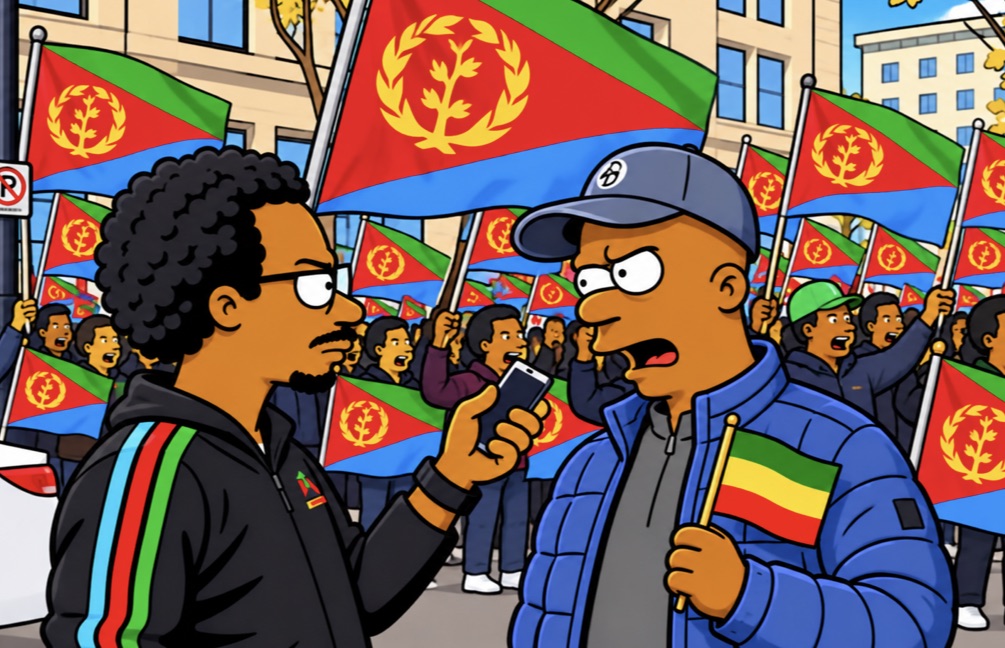
On November 16, 2026, Eritrean government supporters and Ethiopian opposition figures gathered in Washington demanding freedom for Oromo, Amhara and Tigrayan communities.
The irony was unmistakable. Supporters of a government that has never held national elections were demanding political freedom in a neighboring country.
The protest was announced in advance and subsequently publicized by Eritrea’s Ministry of Information.
Among the participants were Ethiopian opposition figures whose cooperation with Shaebia raises questions about their political alliances and priorities.
The jailer preaching freedom
Eritrea has never held a national election. Its constitution remains unimplemented. Independent political opposition is prohibited, while indefinite national service has kept generations under military control.
Human Rights Watch documented this system of coercion. The government has also faced international condemnation over coercive collection of its diaspora tax, including through United Nations Security Council Resolution 2023.
Yet supporters of this same political establishment stood in Washington demanding freedom for Ethiopians.
Freedom for Oromo. Freedom for Amhara. Freedom for Tigray.
But what about freedom for Eritreans? Elections? Independent newspapers? An end to indefinite military service?
The contrast damning
Ximdo: New names, same political machinery?
The trail from Ximdo to ትብብር and the Alliance for Survival is central to understanding the Washington demonstration.
Ximdo did not emerge in a political vacuum. The German Institute for International and Security Affairs documented Eritrea’s role in launching Tsimdo Selam and cultivating relations with TPLF figures.
EritreaNEXT.org publicly identifies the initiative’s representatives and international communications structure. Its disclosures provide evidence of organized political outreach, although they do not independently establish direct operational control by Shaebia.
The political vocabulary then shifted: Ximdo, ትብብር, meaning cooperation, and the Alliance for Survival.
The September 2026 founding proclamation brought together TPLF, OLA, the Amhara Fano National Movement and other Ethiopian opposition organizations in a coalition associated with the Tsimdo framework.
The significance is not merely the resemblance between three names. It is the recurring political relationships, overlapping organizations and continued pursuit of an alliance against Ethiopia’s federal government.
A new name is not evidence of a new political project.
The essential question is whether the underlying strategy changed or only its presentation. That question becomes more consequential when coalition members face allegations involving civilian killings, forced recruitment and foreign military assistance.
A new banner cannot erase an organization’s documented conduct. Nor does a change in terminology resolve questions about leadership, funding or military coordination.
The names changed. The political connections remained. The accountability questions followed them.
OLA and the Shirka killings
The timing of the Washington protest coincided with a consequential statement from OLA.
On November 16, OLA acknowledged that its fighters had carried out a deadly operation in Shirka, Oromia.
Reporting on OLA’s statement described its acknowledgment of the attack and civilian deaths, alongside its dispute with the Ethiopian Human Rights Commission.
The commission attributed 41 deaths in Shirka to OLA. Church authorities reported approximately 60 deaths across Shirka and neighboring Merti.
The contrast is stark: demonstrators were demanding protection for Ethiopian civilians while an organization within the broader opposition alliance acknowledged an operation that killed civilians.
Accountability cannot depend on whether the perpetrators belong to one’s own political coalition.
AFNM, TPLF and the Eritrean connection
AFNM’s participation in the Alliance for Survival adds another dimension to the controversy.
ACLED’s analysis of regional conflict dynamics discussed allegations of Eritrean training and support for Fano formations. Allegations concerning attacks on Amhara civilians also require investigation and clear attribution to the organizations responsible.
TPLF’s reported rapprochement with Eritrea is equally consequential. Former battlefield enemies have developed political contacts amid escalating tensions with Ethiopia’s federal government.
In October, Reuters reported Ethiopian accusations of Eritrean military involvement around Zalambessa. Allegations concerning Eritrean commanders, military positions and incursions remain disputed.
Meanwhile, Human Rights Watch documented forced recruitment in Tigray, including children as young as 15.
Allegations that Tigrayan youths were recruited or sent to fight in Sudan also warrant investigation. Claims that fighters were systematically sold to Sudan’s Armed Forces have not been independently established.
The conduct of these organizations is directly relevant to the political credibility of the alliance.
Egypt’s interest and the media coverage
The Washington protest received limited attention from major international news organizations, but Egypt’s Daily News Egypt, through DNE Africa, published a detailed report highlighting demands that Prime Minister Abiy Ahmed face the International Criminal Court. Ethiopian media also covered the event.
The Egyptian coverage is noteworthy because of the accusations surrounding Cairo’s relationship with Ethiopia’s armed opposition.
In September, Ethiopian military chief Field Marshal Birhanu Jula accused Egypt and Sudan of supporting an armed alliance, allegedly using Eritrea as an intermediary. Ethiopia subsequently accused Egypt of supplying weapons and logistical assistance to Tigrayan rebels.
Egypt and Eritrea have denied interference, and these allegations have not been independently established.
The wider context includes Egypt’s longstanding dispute with Ethiopia over the Grand Ethiopian Renaissance Dam and escalating tensions between Ethiopia and Eritrea.
An Egyptian newspaper’s reporting does not establish Egyptian sponsorship of the protest. Nevertheless, the relationship between regional rivalries, armed alliances and international political mobilization warrants scrutiny.
Who financed the Washington demonstration, and what connections exist between its organizers and the armed coalition?
Those questions remain unanswered.
November 16: History’s irony
The demonstration coincided with the anniversary of Ethiopia’s victory over Egyptian forces at the Battle of Gundet in 1875.
Under Emperor Yohannes IV, Ethiopian forces defeated an Egyptian expedition in territory now belonging to Eritrea. The campaign is documented in UNESCO’s General History of Africa.
Freedom cannot be selective
The Washington demonstration brought together diaspora participants, Eritrean government supporters and representatives of Ethiopian opposition movements. The organizers’ advisory called for peace, accountability and an end to foreign interference.
Ironically the demonstrators were holding up the brutal dictator’s Isaias Afewerki’s photograph from 1980.
The principles demanded by the protesters require scrutiny of Eritrea’s restrictions on political freedom, OLA’s acknowledged operation in Shirka, allegations involving AFNM and Eritrean assistance, and documented forced recruitment in Tigray.
The Alliance for Survival’s formation brought together organizations with different histories and, in some cases, longstanding hostilities. Their political cooperation raises questions about how responsibility for abuses and foreign relationships will be addressed.
Ximdo. ትብብር. Alliance for Survival.
Changing political names does not answer questions about organizational continuity, civilian harm or accountability.
The demands made in Washington deserve to be examined alongside the documented conduct of the governments and armed organizations associated with the demonstration. Freedom and civilian protection are principles that must apply beyond political alliances.
