




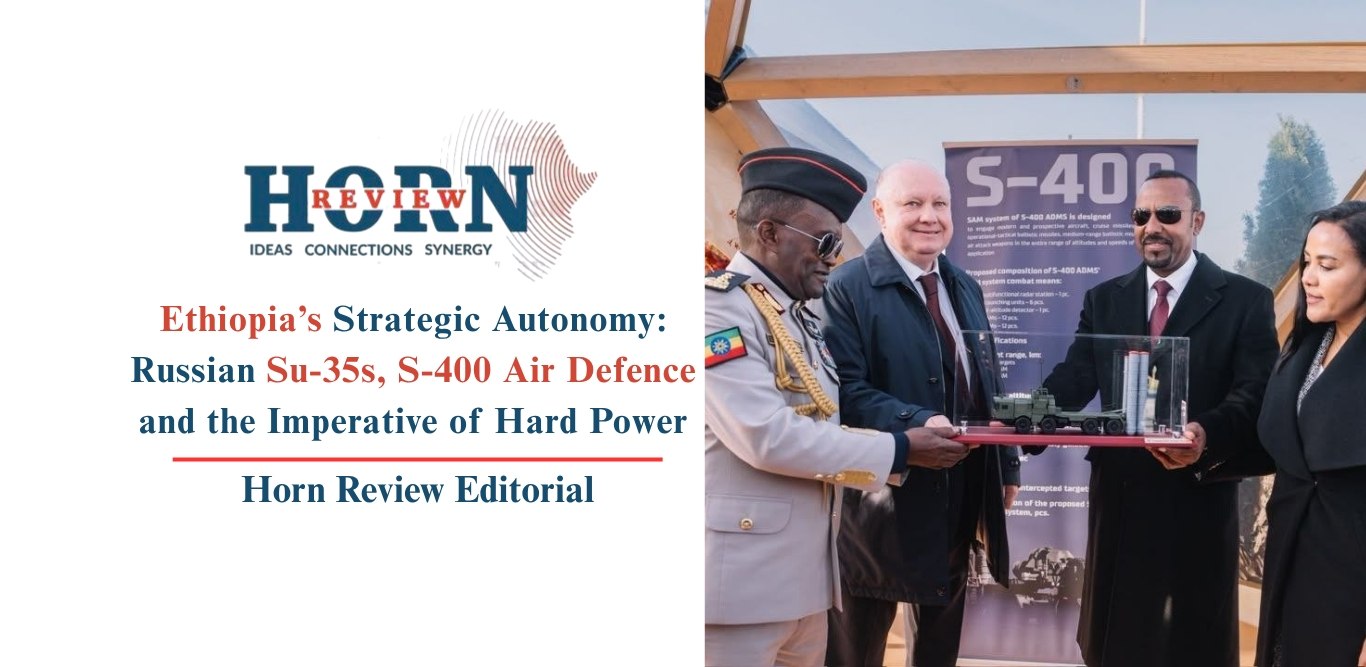
Ethiopia’s Su-35 and S-400 Acquisition: A Strategic Pivot in Horn of Africa Military Modernization
Meta Description: Ethiopia accelerates defense modernization with Russian Su-35 fighter jets and planned S-400 air defense systems. Analysis of Addis Ababa’s pursuit of strategic autonomy, military diversification, and domestic industrial development.
Ethiopia has taken a decisive step in reshaping the military balance of the Horn of Africa, formally confirming the acquisition of advanced Russian Su-35 “Flanker-E” multi-role fighter aircraft and announcing plans to procure the S-400 “Triumf” long-range air defense system. The announcement, made by Prime Minister Abiy Ahmed during a visit to Moscow on October 28, signals a profound shift in Addis Ababa’s defense posture—moving decisively toward strategic autonomy through high-end capability acquisition and domestic industrialization.
Su-35 Delivery Confirmed: Capabilities and Timeline
According to the Prime Minister’s office, the first batch of Sukhoi Su-35s arrived a year ahead of schedule, a timeline PM Abiy credited to the direct support of Russian President Vladimir Putin. Russia’s state arms exporter, Rosoboronexport, subsequently confirmed to Reuters that the initial delivery comprised two Su-35 units out of a total order of 12 aircraft.
The Su-35 (NATO reporting name: Flanker-E) represents a generational leap for the Ethiopian Air Force (EtAF). As a 4++ generation, supermaneuverable multi-role fighter, it introduces capabilities previously absent from the Ethiopian inventory:
- Thrust-Vectoring Engines: The AL-41F1S (117S) engines with 3D thrust vectoring grant exceptional agility and supermaneuverability, critical for within-visual-range (WVR) dogfighting.
- AESA Radar: The Irbis-E Passive Electronically Scanned Array (PESA) radar—functionally akin to AESA in tracking performance—offers detection ranges exceeding 350–400 km for large aerial targets and robust ground-mapping modes.
- Electronic Warfare Suite: The Khibiny EW system provides advanced self-protection against radar-guided missiles.
- Payload & Range: With 12 hardpoints and a maximum takeoff weight of 34,500 kg, the platform carries a vast array of Russian air-to-air (R-77, R-73, R-27) and air-to-surface munitions (Kh-31, Kh-59, guided bombs), extending Ethiopia’s strike reach deep into the Red Sea and across regional theaters.
This acquisition replaces and supplements aging fleets of Su-27SK and MiG-23 aircraft, instantly establishing the EtAF as the operator of the most advanced fighter jet in the Horn of Africa region.
The S-400 “Triumf”: Securing the Air Domain
Complementing the offensive reach of the Su-35, the planned procurement of four batteries of the S-400 Triumf surface-to-air missile (SAM) system addresses a critical vulnerability: integrated air defense.
If finalized, the S-400 deployment would provide Ethiopia with a tiered air defense architecture capable of engaging:
- Strategic bombers, fighters, and cruise missiles at ranges up to 400 km (using the 40N6E missile).
- Ballistic missiles (terminal phase interception) at ranges up to 60 km (using the 48N6DM / 9M96E2 missiles).
- Low-observable (stealth) targets and AWACS/ISR platforms at extended standoff distances.
The system’s multi-function radar (91N6E / 92N2E Grave Stone) and autonomous command vehicles allow for rapid deployment and network-centric integration with the Su-35 fleet, creating a potent Anti-Access/Area Denial (A2/AD) bubble over critical national infrastructure, the Grand Ethiopian Renaissance Dam (GERD), and the capital, Addis Ababa.
Strategic Autonomy: The Doctrinal Framework
Since 2018, “Strategic Autonomy” has evolved from a political slogan into the central pillar of Ethiopia’s state-building project. As analyzed by regional experts, this doctrine links political sovereignty directly to economic self-reliance, technological sovereignty, and the capacity for independent military action.
The Su-35/S-400 procurement translates this doctrine into hard power. In a region characterized by proxy competition, maritime disputes (Red Sea access), and transnational security threats, the ability to deny airspace to adversaries and project precision power without reliance on external security guarantors is the ultimate expression of sovereignty. It shifts Ethiopia’s deterrence posture from reliance on diplomatic assurances to credible military denial.
Diversification of Strategic Partnerships
The Russian deal is a calculated move in defense partnership diversification. For decades, Ethiopia’s air force relied heavily on Ukrainian (MiG-23/Su-25 upgrades), Israeli (avionics/upgrades), and Western (C-130, trainers) support channels—many of which became unreliable due to sanctions, human rights conditionality, or shifting geopolitical alignments.
By deepening ties with Moscow, Addis Ababa accesses:
- Non-Western Supply Chains: Procurement channels less susceptible to Western legislative oversight (e.g., US Leahy Laws, EU export criteria).
- Technology Transfer Potential: Historical precedent exists for licensed assembly and MRO (Maintenance, Repair, Overhaul) offsets with Russian OEMs (e.g., the Bishoftu/Debre Zeit aviation industry complex).
- Diplomatic Leverage: Alignment with the BRICS+ bloc (Ethiopia joined January 2024) reinforces a multipolar foreign policy.
This aligns with the “Strategic Autonomy” framework where external partnerships serve national priorities without determining them.
The Domestic Industrial Base: SkyWin and Homicho
Crucially, foreign procurement is not viewed as a substitute for domestic capacity but as a bridge. Ethiopia is simultaneously investing heavily in its Defense Industrial Base (DIB) to reduce long-term dependencies.
Key institutions driving this effort include:
- SkyWin Aeronautics Industries: A state-owned enterprise focused on UAV design/manufacturing, aircraft MRO, and component fabrication. SkyWin has already fielded indigenous drones (e.g., the Tsehay, Zagel series) used effectively in recent conflicts. The Su-35 arrival creates a demand signal for high-end MRO capabilities—jet engine overhaul, avionics repair, and composite structures—that SkyWin is positioned to absorb over time.
- Homicho Ammunition Engineering Complex: Part of the Metals and Engineering Corporation (METEC) ecosystem, Homicho focuses on ammunition production, pyrotechnics, and propellant manufacturing. Securing the supply chain for artillery, mortar, and small-caliber rounds—and eventually air-to-air/air-to-ground missile components—is essential for sustained combat operations.
These institutions operate at different technological maturity levels than 4++ gen fighter integration, but they form the foundational ecosystem—skilled labor, metallurgy, quality control, systems engineering—required for eventual licensed production or deep-level maintenance of advanced Russian platforms.
Regional Implications and the Balance of Power
The introduction of the Su-35/S-400 complex alters the regional calculus significantly:
| Capability | Previous Regional Standard | New Ethiopian Capability | Strategic Effect |
|---|---|---|---|
| Air Superiority | Su-27SK (Eritrea), F-16 (regional partners), MiG-29 (Sudan) | Su-35 (AESA/PESA, TVC, BVR dominance) | Decisive qualitative edge in BVR (Beyond Visual Range) combat; forces neighbors to invest in 5th-gen or advanced SAMs to parity. |
| Air Defense | Short/Medium range (Buk-M1, Pantsir, legacy S-125/SA-2/SA-3) | S-400 (400km range, ABM capability) | Denial of adversary air operations over Ethiopian depth; complicates strike planning for any regional actor. |
| Maritime Projection | Limited (Su-25, helicopter) | Su-35 + Anti-Ship Missiles (Kh-31A/35U) | Credible threat to naval assets in Southern Red Sea / Bab el-Mandeb; supports Red Sea access ambitions. |
This modernization occurs as Ethiopia seeks commercial and naval access to the Red Sea (via the MoU with Somaliland and broader diplomatic pushes), requiring a credible maritime air power component to secure Sea Lines of Communication (SLOCs).
Challenges: Sustainability, Training, and Integration
Despite the strategic logic, significant hurdles remain:
- Logistics & Spares: Russian supply chains face strain from the Ukraine conflict and Western sanctions (CAATSA risks for third parties, though Ethiopia is not a US treaty ally). Ensuring a 15–20 year spares pipeline for AL-41F1S engines and Irbis-E radar modules is critical.
- Human Capital: Transitioning pilots and ground crews from Su-27/MiG-23 platforms to the Su-35’s glass cockpit, HOTAS controls, and complex sensor fusion requires intensive conversion training, likely conducted in Russia (Lipetsk/Kubinka) or via Russian Mobile Training Teams (MTTs) in Ethiopia.
- C4ISTAR Integration: The Su-35 and S-400 must be networked into a modern Command, Control, Communications, Computers, Intelligence, Surveillance, Target Acquisition, and Reconnaissance (C4ISTAR) architecture. Ethiopia needs robust datalinks, AWACS/GCI (Ground Controlled Intercept) radars, and secure comms to exploit the platforms’ full potential.
- CAATSA Considerations: While the Countering America’s Adversaries Through Sanctions Act (CAATSA) targets “significant transactions” with Russian defense sectors, enforcement against non-NATO African nations has been inconsistent. However, it complicates potential future US security assistance (IMET, FMF) or access to US-origin spares for the C-130 fleet.
Conclusion: Sovereignty as Material Capability
Ethiopia’s acquisition of the Su-35 and pursuit of the S-400 represents more than a shopping list; it is the materialization of sovereignty. By combining high-end foreign procurement (immediate capability injection) with domestic industrial development (long-term self-reliance via SkyWin and Homicho), Addis Ababa is executing a “whole-of-nation” approach to defense modernization.
In the volatile geopolitics of the Horn of Africa and the Red Sea, this move establishes Ethiopia as the dominant conventional military power in the immediate region, capable of independent action and credible deterrence. The success of this strategy will ultimately depend not on the arrival ceremony in Bishoftu, but on the sustained ability to generate sorties, maintain availability rates above 60%, and integrate these assets into a coherent joint warfighting doctrine.
Related Reading:
- Sukhoi Su-35 Technical Specifications & Operational History
- S-400 Triumf System Analysis: Capabilities and Export Variants
- Ethiopia’s BRICS Membership: Geopolitical Implications for the Horn
- SkyWin Aeronautics Industries: Official Portal
- CAATSA Sanctions Risks for African Defense Procurement
Keywords: Ethiopia Su-35, Ethiopia S-400, Ethiopian Air Force modernization, Abiy Ahmed Moscow visit, Strategic Autonomy Ethiopia, Horn of Africa military balance, SkyWin Aeronautics, Rosoboronexport delivery, Russian fighter jets Africa, Air defense systems Ethiopia.
