




Meta Title: Ethiopia Opens $50M National Precious Metals Refinery: A New Regional Gold Hub?
Meta Description: Ethiopia inaugurates its first National Precious Metals Refinery in Addis Ababa with 600+ tonne capacity. Explore the $50M joint venture, record $5.6B gold exports, and the strategy to become Africa’s next bullion hub.
Focus Keyword: Ethiopia National Precious Metals Refinery
Slug: ethiopia-national-precious-metals-refinery-addis-ababa-gold-hub
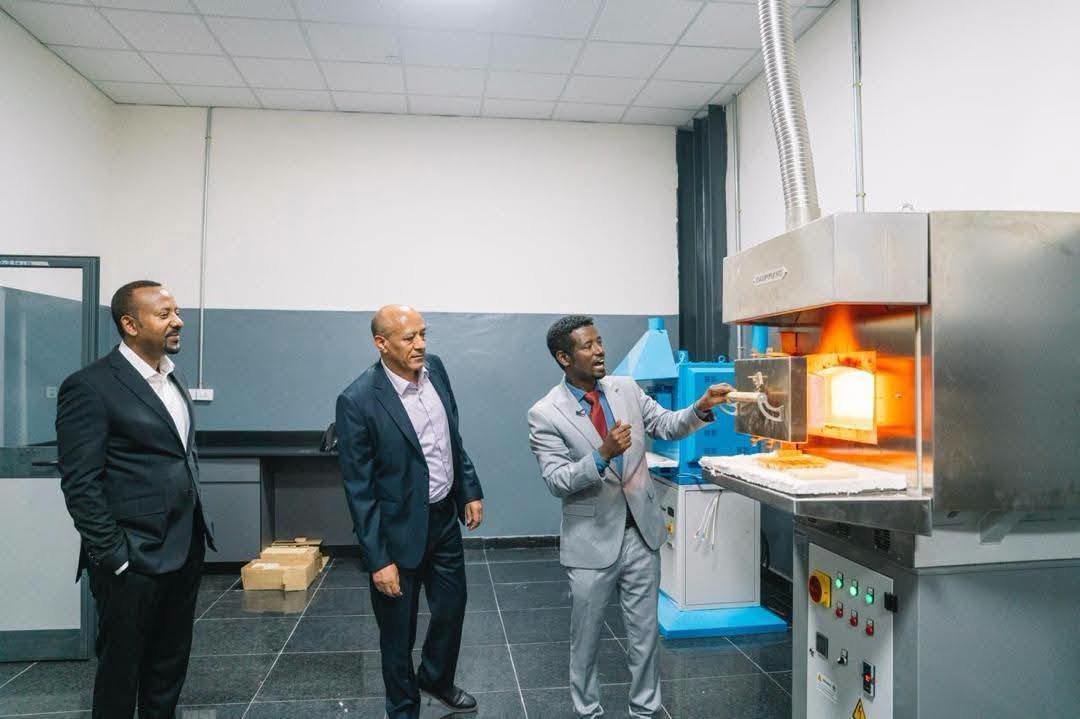
Ethiopia has officially entered the league of nations with sovereign gold refining capacity. On October 10, Prime Minister Abiy Ahmed inaugurated the Ethiopia National Precious Metals Refinery at the Bole Lemi Special Economic Zone in Addis Ababa. The facility represents a strategic pivot for an economy where gold has rapidly become the single largest source of foreign exchange, accounting for roughly half of all merchandise export earnings.
Built on a joint venture model where state-owned Ethiopian Investment Holdings (EIH) retains a 51% controlling stake and Dubai-based Sam Precious Metals holds 49%, the $50 million plant is engineered to process over 600 tonnes of precious metals annually. This capacity dwarfs Ethiopia’s current domestic production of roughly 44 tonnes (2025/26 fiscal year), signaling a clear ambition: to position Addis Ababa as a regional gold refining hub serving the wider African continent.
A $50 Million Bet on Value Addition
The refinery’s launch marks the culmination of a policy drive to capture more value from the mineral sector domestically. For decades, Ethiopian gold—much of it from artisanal and small-scale mining (ASM)—was exported in doré form (semi-pure alloy) to be refined in Switzerland, the UAE, or South Africa.
Key Spec: The facility produces London Bullion Market Association (LBMA) standard cast and minted gold and silver bars in varying purities, alongside assaying and certification services.
By processing domestically, Ethiopia retains revenues from refining fees, certification, logistics, and the recovery of by-products like silver and platinum group metals (PGMs) often lost in unrefined exports. The government argues this moves the country up the value chain from a mere primary commodity exporter to a service provider in the global bullion supply chain.
External Context: World Gold Council data on African gold production trends highlights that Africa produces roughly 20% of global mine supply, yet refining capacity remains concentrated outside the continent.
The Capacity Gap: Why 600 Tonnes Matters
The most striking commercial feature of the project is the mismatch between capacity and current supply.
| Metric | Figure (2025/26 FY) |
|---|---|
| Refinery Design Capacity | > 600 tonnes/year (Total Precious Metals) |
| Ethiopia Gold Production | ~ 44 tonnes |
| Capacity Utilization (Domestic Only) | ~ 7% |
This gap is not an oversight; it is the business model. Prime Minister Abiy Ahmed explicitly invited neighbouring countries and regional miners to utilize Addis Ababa for refining, certification, and sale.
The logic is compelling: Landlocked African producers (e.g., South Sudan, DRC, Tanzania, Sudan) currently ship doré bars to Dubai or Europe. A competitive refinery in Addis Ababa—connected via Ethiopian Airlines’ vast cargo network—offers lower freight costs, faster settlement, and “African-sourced, African-refined” provenance.
The Gold Boom: Prices, Reform, and Formalization
The refinery opens against the backdrop of an extraordinary surge in recorded gold exports.
- Export Earnings: $5.5B – $5.65B (2025/26 FY).
- Share of Merchandise Exports: ~50% (Total exports > $11B).
- YoY Growth (H1 2025/26 vs H1 2024/25): Volumes ↑ ~30%, Prices ↑ ~45%.
The Reform Catalyst
This surge is not purely geological. It follows the July 2024 Foreign Exchange Reform orchestrated by the National Bank of Ethiopia (NBE) with IMF support.
- Market-Based FX Rates: Eliminated the overvalued official rate that fueled the parallel market.
- Targeted Premiums: The NBE shifted from compensating for FX distortions to paying a moderate, transparent premium above international spot prices (e.g., LBMA PM Fix) to incentivize formal channel sales.
- Phased Liberalization: The IMF noted in 2026 that the NBE plans to phase out premiums entirely, opening purchasing to private sector banks and traders.
Result: Artisanal miners—who dominate supply—found legal channels suddenly more attractive than smuggling routes. The refinery now provides the physical infrastructure to match these financial incentives.
External Reference: IMF Ethiopia Staff Report 2026 on FX Reform & Gold Purchasing details the transition to market-based premiums.
Ownership Strategy: State Capital Meets Private Expertise
The 51/49 Joint Venture structure via Ethiopian Investment Holdings (EIH) reflects the government’s broader “state capitalism” playbook—using a sovereign wealth fund vehicle to manage commercial assets rather than ministerial bureaucracies.
- EIH (51%): Ensures strategic alignment with national policy (foreign exchange retention, job creation, data sovereignty) and captures equity upside.
- Sam Precious Metals (49%): Provides technical operability, LBMA good delivery list navigation, responsible sourcing protocols, and relationships with global bullion banks.
This mirrors successful models like Rand Refinery (South Africa) or Emirates Gold (UAE), where sovereign backing meets merchant agility.
The Trust Deficit: From “Plant” to “Hub”
Physical capacity is the easiest hurdle. The harder challenge—acknowledged implicitly by the government—is commercial credibility.
Miners and traders evaluating Addis Ababa vs. Dubai (DMCC/Al Etihad), Switzerland (Valcambi, PAMP, Argor-Heraeus), or South Africa (Rand Refinery) will benchmark:
- Assay Accuracy & Consistency: Independent verification against LBMA Good Delivery List standards.
- Responsible Sourcing & Chain of Custody: OECD Due Diligence Guidance compliance is non-negotiable for Western banks and jewelers. Conflict-free certification (e.g., RJC – Responsible Jewellery Council) must be established at the Bole Lemi facility specifically—Sam Precious Metals’ Dubai accreditations do not automatically transfer.
- Settlement Speed & Currency Convertibility: Can a Tanzanian miner sell doré in Addis and repatriate USD/EUR within 48 hours?
- Customs & Logistics: Seamless transit regimes for cross-border doré shipments (Bonded warehouse status at Bole Lemi SEZ is critical here).
- Security & Insurance: “All risks” coverage for high-value transit and vaulting.
Reality Check: The refinery starts with zero throughput track record. Accreditation takes 12–24 months of consistent, audited production. Until then, bars stamped “Addis Ababa” may trade at a discount to “Zurich” or “Dubai” bars.
Macroeconomic Stakes: Gold as FX Anchor
With foreign exchange reserves historically thin, gold is now a monetary policy variable, not just a mining statistic.
- Formalization = FX Visibility: Every ounce refined domestically and exported legally generates hard currency entering the NBE’s reserves or the interbank market.
- Price Risk: A 20% drop in the global gold price (XAU/USD) would slash export earnings by ~$1B annually—a fiscal shock.
- Supply Volatility: ASM production is erratic (seasonal, weather-dependent, security-sensitive).
The refinery mitigates processing risk but not market risk. Its success requires the NBE to maintain competitive purchasing terms relative to regional informal networks (which still pay a premium for zero paperwork).
The Roadmap: Metrics That Will Define Success (2025–2028)
| KPI | Target / Watchpoint |
|---|---|
| Annual Throughput | Ramp from <50t (Year 1) → 200t+ (Year 3) |
| Third-Party / Regional Share | > 50% of throughput by Year 3 |
| LBMA / RJC Accreditation | Application Year 1; Good Delivery List entry Year 2–3 |
| Domestic Value Retention | Refining fees + Silver/PGM recovery + Logistics revenue |
| Artisanal Formalization Rate | % of estimated ASM production entering legal chain |
Downstream Multipliers: If throughput hits critical mass (~200t+), expect clustering: bullion banking desks (Commercial Bank of Ethiopia, private banks), jewellery manufacturing zones (leather/gemstone synergy), precious metals ETFs, and vaulting/logistics firms.
FAQ: Ethiopia’s National Precious Metals Refinery
How much did Ethiopia’s new gold refinery cost?
The initial investment is approximately US$50 million.
Who owns the refinery?
It is a Joint Venture: Ethiopian Investment Holdings (EIH) owns 51%; Sam Precious Metals (Dubai) owns 49%.
Where is it located?
Bole Lemi Special Economic Zone, Addis Ababa—leveraging SEZ customs incentives and proximity to Bole International Airport cargo hub.
What is the processing capacity?
> 600 tonnes/year of total precious metals (Gold, Silver, PGMs). Note: This is not gold-only capacity.
How much gold does Ethiopia produce?
~44 tonnes in the 2025/26 Fiscal Year (Ministry of Mines data), predominantly Artisanal & Small-Scale Mining (ASM).
How much did Ethiopia earn from gold exports recently?
US$5.5B – $5.65B in the 2025/26 FY, representing ~50% of total merchandise exports.
Why build a refinery 13x larger than domestic production?
To capture regional market share. The facility targets doré supply from East/Central Africa (South Sudan, DRC, Tanzania, Sudan, Eritrea) currently refined in Dubai, Europe, or India.
Did the 2024 FX Reform stop gold premiums?
No. The NBE moved to market-based FX rates but retained a moderate premium over LBMA spot prices to incentivize formal sales. The IMF confirms a plan to phase this premium out gradually as private sector purchasing scales up.
Will this stop gold smuggling?
Not automatically. It strengthens the formal option (better price, faster pay, local refining). Smuggling persists where informal networks offer better net prices (tax evasion, zero compliance costs, instant cash). Enforcement + competitive pricing + financial inclusion for miners are all required.
Is Addis Ababa already a regional gold hub?
Not yet. It has the hardware (plant). It now needs the software (LBMA accreditation, OECD/RJC certification, deep liquidity pool, trusted settlement, regional logistics corridors).
Bottom Line
Ethiopia has built the infrastructure of a regional gold hub. Whether it becomes one depends entirely on throughput execution.
The next 24 months will answer the only question that matters: Can Addis Ababa offer a better “Mine-to-Market” proposition—speed, cost, trust, and settlement—than Dubai or Zurich for an African miner?
If the answer becomes “Yes,” the Ethiopia National Precious Metals Refinery transitions from a sovereign prestige project into a genuine pillar of the Horn of Africa’s financial architecture.
