




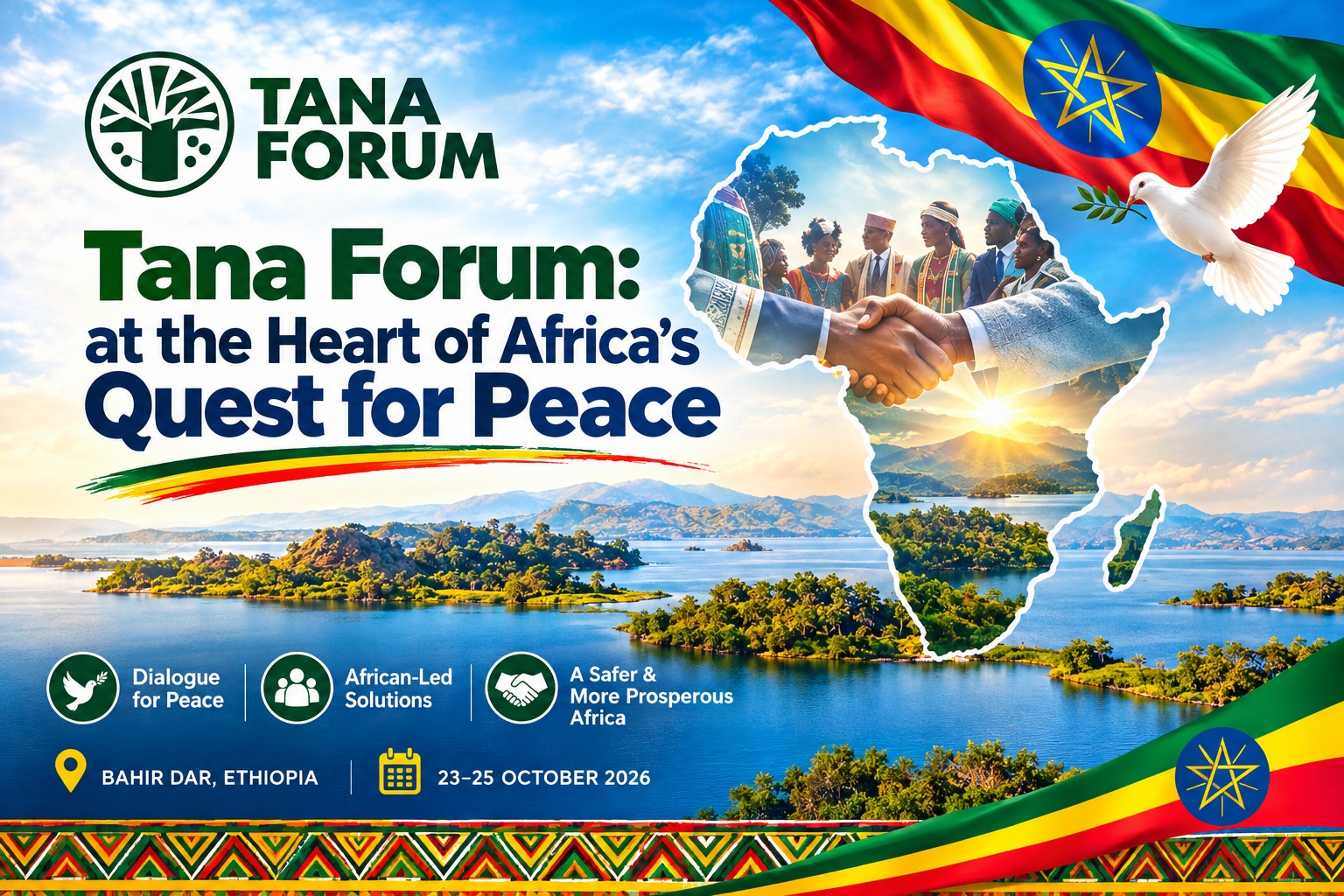
Meta Title: Tana High-Level Forum 2026: Pathways to Peace, Economic Sovereignty & Geopolitics in Africa
Meta Description: Explore the 12th Tana Forum in Bahir Dar (Oct 23–25). Discover how African-led solutions, economic sovereignty, and regional cooperation shape the continent’s security future.
Focus Keyphrase: Tana High-Level Forum 2026
Slug: tana-high-level-forum-2026-africa-peace-security
Tana High-Level Forum 2026: Charting African Pathways to Peace and Economic Sovereignty
As Africa confronts a convergence of persistent conflicts, shifting geopolitical rivalries, and structural economic vulnerabilities, the continent is turning inward for answers. From October 23–25, 2026, Ethiopia will host the 12th Tana High-Level Forum on Security in Africa in the historic lakeside city of Bahir Dar.
Convening under the theme “Pathways to Peace in Africa: Economic Sovereignty and Geopolitical Transformation,” this premier gathering brings together heads of state, policymakers, security architects, and leading researchers. Their mission: to move beyond crisis management and forge the political, economic, and institutional foundations for lasting continental stability.
Why the Tana Forum Matters: An African Platform for African Solutions
Since its inception in 2012, the Tana Forum has evolved into the continent’s most distinctive “track 1.5” dialogue platform—bridging official diplomacy with academic rigor and civil society insight. Unlike standard summitry, Tana prioritizes candid, informal exchange over scripted communiqués.
The central question driving the 2026 edition remains urgent: How can Africa transition from managing recurring crises to building sustainable peace?
The Case for African Ownership
Conflicts across the continent rarely stem from a single cause. They fester at the intersection of political exclusion, weak institutions, resource competition, economic inequality, and unresolved historical grievances. The fallout is devastating: displaced populations, shattered trade routes, evaporated investment, and diverted development budgets.
Addressing these drivers requires more than military hardware or humanitarian aid. It demands:
- Preventive diplomacy over reactive intervention.
- Inclusive political processes that legitimize the state.
- Accountable institutions capable of delivering justice.
- Economic opportunities that anchor youth and communities in the national project.
African nations and Regional Economic Communities (RECs) possess the contextual intelligence—historical, cultural, and political—that external actors often lack. Strengthening this endogenous capacity for mediation and peacebuilding is the forum’s core premise. However, African ownership does not imply isolation. Effective international partnerships remain vital, provided they amplify—rather than displace—African agency and priorities.
Ethiopia’s Strategic Diplomacy: Hosting the Continent’s Conversation
Ethiopia’s role as host is both symbolic and strategic. As the seat of the African Union (AU) Headquarters in Addis Ababa, the country is the physical nerve center of continental diplomacy. Hosting the Tana Forum in Bahir Dar—a city steeped in history and gateway to the Blue Nile—extends this diplomatic footprint beyond the capital, grounding high-level debate in the lived geography of the continent.
From Convening to Impact
For Ethiopia, the forum is an opportunity to:
- Advance dialogue on the structural security challenges of the Horn of Africa.
- Reinforce its commitment to continental conflict prevention architecture.
- Bridge the gap between policy research and operational practice.
Yet, as the forum’s history suggests, the true measure of success lies not in the communiqué, but in the translation of ideas into implemented policy. Ethiopia’s diplomatic dividend will depend on sustained engagement that connects Bahir Dar’s discussions to the AU’s Peace and Security Council (PSC), the IGAD early warning mechanisms, and national reform agendas.
The Horn of Africa: Why Regional Cooperation Is Non-Negotiable
The Horn of Africa epitomizes the indivisibility of security. Political tensions, terrorism, climate shocks, and economic fragility ignore borders. Insecurity in one state triggers displacement flows, disrupts transit corridors (like the Djibouti-Addis Ababa railway), and scares off regional FDI.
From Zero-Sum to Positive-Sum
Disputes over shared resources—most notably Nile waters and Red Sea access—have historically strained relations. The Tana Forum provides a rare space to reframe these as shared opportunities:
- Cross-border trade integration via the AfCFTA.
- Energy pooling (e.g., Ethiopia’s hydro-exports to neighbors).
- Joint resource governance frameworks for water and pasture.
In a region crowded by great power competition—from Gulf states to global powers vying for port access and naval footholds—coherent regional positions are a strategic necessity. Sustained dialogue through platforms like Tana builds the trust capital required to manage disagreements before they escalate.
Economic Sovereignty: The Overlooked Pillar of African Security
The 2026 theme places Economic Sovereignty at the heart of the peace agenda—a critical, often neglected linkage.
The Vulnerability Trap
Many African economies remain trapped in commodity dependence, external debt distress, limited industrial bases, and exposure to volatile global markets. These structural weaknesses:
- Constrain fiscal space for security sector reform and social protection.
- Limit policy autonomy when global powers compete for critical minerals, ports, and infrastructure.
- Create governance vacuums where illicit economies and armed groups thrive.
Redefining Sovereignty for the 21st Century
Economic sovereignty is not autarky. It is the capacity to make genuine choices over development trajectories. The forum will explore five levers:
| Lever | Strategic Implication for Peace |
|---|---|
| Domestic Resource Mobilization | Reduces aid dependency; funds legitimate state services. |
| Industrial Policy & Value Addition | Creates youth employment; reduces recruitment pools for militias. |
| Regional Market Integration (AfCFTA) | Builds interdependence; raises opportunity cost of conflict. |
| Strategic Partnership Negotiation | Ensures FDI aligns with national development plans (e.g., UN SDGs/Agenda 2063). |
| Institutional Capacity | Enables transparent contract negotiation; curbs corruption-fueled grievance. |
For the Horn, deeper economic interdependence—shared power grids, harmonized customs, joint infrastructure—creates powerful constituencies for peace. When neighbors profit from each other’s stability, the calculus of conflict fundamentally shifts.
From Dialogue to Measurable Action: Closing the Implementation Gap
Africa is not short of declarations. The AU’s Agenda 2063, the African Peace and Security Architecture (APSA), and countless summit resolutions articulate the “what.” The persistent deficit is the “how.”
Operationalizing Tana’s Outcomes
For the 12th Forum to transcend “talk shop” critiques, participants must focus on implementation architecture:
1. Institutionalizing Early Warning & Early Action
Strengthening the Continental Early Warning System (CEWS) requires not just data collection, but political triggers that mandate PSC action. Research institutions present at Tana must feed rigorous, localized conflict analysis directly into these mechanisms.
2. Evidence-Based Peacebuilding
Policies must be informed by granular, community-level data—not just capital-city elite assessments. Integrating local peace committees, women’s networks, and youth groups into national architectures ensures relevance and legitimacy.
3. Continuity & Accountability Mechanisms
Tana recommendations need institutional homes—assigned to specific AU departments, RECs, or national ministries with clear timelines and KPIs. A “Tana Tracker” mechanism could publicly monitor progress on key resolutions year-over-year.
Conclusion: The Bahir Dar Imperative
Africa’s pursuit of peace is inseparable from its quest for developmental sovereignty and strategic autonomy in a multipolar world. The 12th Tana High-Level Forum arrives at a pivotal inflection point.
For Ethiopia, hosting is a reaffirmation of its Pan-African mandate. For the continent, Bahir Dar offers a crucible to test whether “African Solutions” can evolve from a slogan into a systemic, resourced, and accountable practice.
The enduring legacy of Tana 2026 will not be measured by the eloquence of speeches, but by whether the pathways debated on the shores of Lake Tana lead to:
- Stronger institutions that prevent violence.
- Deeper regional integration that makes war uneconomic.
- Economies that offer dignity and opportunity to every African citizen.
The dialogue in Bahir Dar is the starting line. The race is implementation.
Frequently Asked Questions (FAQ)
What is the Tana High-Level Forum on Security in Africa?
Established in 2012, the Tana Forum is an annual, informal gathering of African leaders, scholars, and security experts hosted by Ethiopia. It serves as a “Track 1.5” platform for candid dialogue on the continent’s peace and security challenges, emphasizing African-owned solutions.
When and where is the 12th Tana Forum taking place?
The 12th edition is scheduled for October 23–25, 2026, in Bahir Dar, Ethiopia.
What is the theme for the 2026 Forum?
The theme is “Pathways to Peace in Africa: Economic Sovereignty and Geopolitical Transformation,” focusing on the nexus between economic resilience, geopolitical agency, and sustainable peace.
Why is Economic Sovereignty linked to Peace and Security?
Economic vulnerability (debt, commodity dependence, lack of industrialization) limits state capacity, fuels grievance, and reduces strategic autonomy in great power competition. Economic sovereignty strengthens the material foundations of peace.
How does the Tana Forum differ from AU Summits?
Unlike formal AU Summits which produce binding decisions, Tana operates as an informal retreat. It allows for “off-the-record” brainstorming, bridging academic research, practitioner experience, and political leadership without the pressure of immediate consensus-building.
SEO Checklist Applied
| Element | Implementation |
|---|---|
| Focus Keyphrase | “Tana High-Level Forum 2026” (in H1, Intro, H2, Conclusion, URL, Meta Desc). |
| Secondary Keywords | African Peace and Security, Economic Sovereignty Africa, Horn of Africa Stability, African Union Agenda 2063, AfCFTA, Bahir Dar. |
| Heading Structure | Single H1 → Logical H2/H3/H4 hierarchy. |
| External Links (Authority) | Tana Forum Official, African Union, AfCFTA, IGAD, UN OSAA, UN Africa Renewal (Agenda 2063/SDGs). All rel="noopener noreferrer". |
| Internal Link Opportunities | (Placeholders for your site): Link “African Peace and Security Architecture” → Your APSA explainer; “Ethiopia’s Diplomacy” → Your Ethiopia Foreign Policy tag page. |
| Readability | Short paragraphs, bullet points, table, FAQ schema (Details/Summary), bold emphasis for scanning. |
| Image Alt Text Suggestions | Banner: “Lake Tana Bahir Dar venue 12th Tana Forum 2026”; Chart: “Economic Sovereignty Levers for Peace Table”; Map: “Horn of Africa Regional Integration Corridors”. |
| Schema Markup | Article Schema (NewsArticle), FAQPage Schema (via Details/Summary or JSON-LD), Event Schema (for the Forum dates). |
