




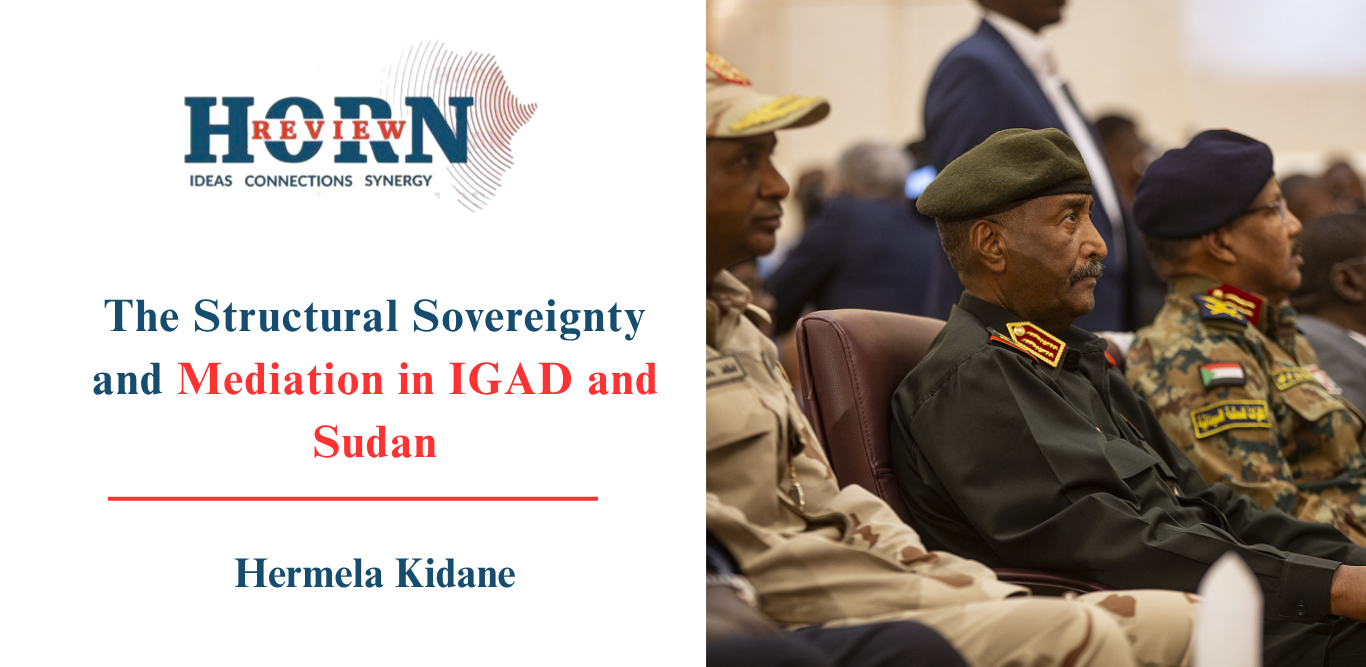
Meta Title: IGAD’s Sudan Mediation Paradox: Sovereignty vs. Inclusivity in Regional Diplomacy
Meta Description: Explore the structural tension in IGAD’s mediation of the Sudan conflict, analyzing the cycle of suspension and return driven by the clash between state sovereignty claims and the necessity of inclusive dialogue with the RSF.
Focus Keyword: IGAD Sudan mediation
Slug: /igad-sudan-mediation-sovereignty-inclusivity-paradox
The Structural Paradox of IGAD’s Sudan Mediation
The Intergovernmental Authority on Development (IGAD) faces a defining structural dilemma in its attempt to mediate the conflict in Sudan. As a regional bloc, IGAD operates under a dual imperative: it must facilitate inclusive dialogue to end the war, yet its legal authority derives entirely from the consent of sovereign member states. This contradiction creates a persistent paradox: to build a workable mediation framework, IGAD must engage the de facto holders of military power—specifically the Rapid Support Forces (RSF)—but that very engagement triggers fierce sovereignty objections from the Sudanese government in Port Sudan.
The cycle of Sudan’s suspension from IGAD in 2024 and its formal return in 2026 did not resolve this tension. Rather, it recalibrated the balance of power in response to shifting battlefield dynamics and diplomatic language. Understanding this dynamic is essential for analyzing the future of regional conflict resolution in the Horn of Africa.
The 2024 Suspension: Sovereignty as a Shield
In January 2024, the Government of Sudan, led by General Abdel Fattah al-Burhan and the Sovereignty Council, suspended its membership in IGAD. The immediate catalyst was IGAD’s invitation to RSF Commander Mohamed Hamdan Dagalo (“Hemedti”) to attend an extraordinary summit in Uganda.
Khartoum argued that the invitation disregarded and violated Sudan’s sovereignty. This accusation was not merely rhetorical; it drew directly on IGAD’s founding treaty, which enshrines the sovereign equality of member states, non-interference in internal affairs, and the peaceful settlement of disputes.
From the perspective of the Sudanese Armed Forces (SAF) leadership, the logic is internally consistent. Their position is not a categorical refusal to negotiate, but a rejection of any diplomatic architecture that places the national army and a paramilitary force on equal presentational footing. Seating the RSF as a co-equal interlocutor, in this view, dilutes the exclusive authority of the state to speak for itself. However, from the standpoint of mediation practice, excluding the RSF— which controls substantial territory and combat capacity—renders any peace process structurally incomplete. This creates a deadlock where inclusivity activates the sovereignty defense, and exclusion guarantees mediation failure.
The 2026 Return: A Discursive and Battlefield Recalibration
Sudan’s formal resumption of full membership on February 9, 2026, announced via an official IGAD Secretariat statement, marked a new phase in this paradox. The return was not precipitated by an abandonment of Sudan’s sovereignty stance, but by an observable adjustment in IGAD’s public posture.
In late January 2026, following consultations between the IGAD Executive Secretary and Sudan’s Prime Minister, the organization issued a statement that condemned violations by the Rapid Support Forces and reaffirmed full support for the unity, sovereignty, and existing national institutions of the Republic of Sudan. The specific reference to “existing institutions” was pivotal; it aligned the bloc’s language with the legitimacy claim advanced by the SAF-dominated structure, effectively neutralizing the core objection that drove the 2024 walkout.
Battlefield Dynamics Driving Diplomacy
This discursive shift coincided with significant changes on the ground. The Sudan Armed Forces registered measurable advances, including the restoration of activity at Khartoum International Airport and offensives in the Kordofan region that degraded RSF presence in North Kordofan, pushing elements westward toward Darfur.
These developments altered the calculus among IGAD member states. The balance shifted toward an actor controlling the capital, major transport nodes, and core state institutions, versus a political-military force retaining presence in Darfur but lacking international recognition. The SAF’s military momentum strengthened its bargaining position, allowing battlefield advantage to be converted into diplomatic leverage within the regional bloc.
Three Dimensions of Sudan’s Strategic Return
The decision to re-engage can be analyzed through three linked dimensions—normative, instrumental, and battlefield—none of which are mutually exclusive.
1. Normative Alignment
IGAD’s renewed emphasis on sovereignty and the legitimacy of “existing institutions” supplied the precise diplomatic language Khartoum required. The bloc effectively signaled that mediation would not proceed on terms that equated the government with the insurgency.
2. Instrumental Necessity
Absence carried a high opportunity cost. Outside IGAD, Sudan lost the capacity to shape the regional agenda or challenge narratives advanced by other member states—some of whom maintain open channels with the RSF. Return restored the discursive weight of a founding member, allowing Port Sudan to veto or steer resolutions from inside the room rather than protesting from the outside.
3. Battlefield Leverage Conversion
Reported SAF gains strengthened the government’s hand. However, the instrumental rationale deserves particular scrutiny. It is possible Sudan returned not out of confidence in a decisive military victory, but because continued exclusion offered no viable alternative for influencing the regional conversation. This distinction matters: it suggests re-engagement is driven as much by the costs of diplomatic isolation as by expectations of imminent military resolution.
The Unresolved Core: The Envoys Forum and the Inclusivity Trap
Despite the recalibration, the underlying structural tension remains intact. At the Third IGAD Meeting of Special Envoys on Sudan in July 2026, the bloc continued to stress the coordination of regional and international mediation efforts and the need for an inclusive political process.
Meanwhile, SAF leadership has maintained that the RSF will have no role in a post-war Sudanese state. Effective mediation, therefore, still requires an operational balance between the sovereignty claim (exclusion) and the practical necessity of inclusivity (engagement). Until this gap is bridged—either through a decisive military outcome or a novel political formula—the mediation process remains structurally fragile.
Wider Implications for African Regional Security Architecture
The IGAD-Sudan case carries profound significance for the African Peace and Security Architecture (APSA). Regional organizations across the continent draw legitimacy from the consent of sovereign members, yet the internal conflicts they are mandated to address frequently require forms of engagement—talking to rebels, inviting non-state actors, imposing sanctions—that strain that consent.
A clear pattern emerges:
- When the recognized government strengthens: The sovereignty norm gains weight; the organization aligns with the state.
- When conflict is evenly contested or state authority fragments: The imperative of inclusivity reasserts itself; the organization pushes for broad-based talks.
Legitimacy and effectiveness often stand in inverse relation. Greater emphasis on sovereignty preserves member state confidence but limits leverage over non-state armed groups. Greater pursuit of inclusive mediation risks activating defensive sovereignty claims, leading to withdrawal or non-cooperation.
Sudan’s suspension and return exemplify—rather than resolve—this structural predicament. Whether the current equilibrium can be translated into a durable mediation framework, or whether it will recur as a cycle of withdrawal and re-engagement, remains the open question for IGAD and for comparable regional bodies confronting complex internal wars.
Key Takeaways for Policy Observers
| Dimension | 2024 Suspension Phase | 2026 Return Phase |
|---|---|---|
| Trigger | RSF invitation to IGAD Summit (Uganda) | IGAD statement condemning RSF; endorsing “existing institutions” |
| Sovereignty Claim | Absolute: Equal seating = violation of sovereignty | Conditional: Sovereignty respected via linguistic alignment |
| Battlefield Context | Stalemate / RSF holding Khartoum | SAF advancing (Khartoum Airport, Kordofan) |
| Strategic Logic | Protest / Norm enforcement | Influence / Agenda control / Leverage conversion |
| Remaining Hurdle | How to talk to RSF without recognizing them | How to implement “inclusive process” SAF rejects |
Frequently Asked Questions (FAQ)
Why did Sudan suspend its IGAD membership in 2024? Sudan suspended its membership in January 2024 after IGAD invited RSF Commander Mohamed Hamdan Dagalo to a summit in Uganda. Khartoum viewed this as a violation of its sovereignty and the principle of non-interference, arguing it equated the national army with a paramilitary militia.
What changed to allow Sudan’s return to IGAD in 2026? Two factors aligned: IGAD adjusted its public rhetoric to explicitly condemn RSF violations and endorse Sudan’s “existing national institutions,” and the SAF made significant battlefield gains (recapturing Khartoum Airport, advances in Kordofan), shifting the diplomatic leverage in the government’s favor.
Does Sudan’s return mean it agrees to negotiate directly with the RSF? No. The SAF leadership maintains the RSF will have no role in a post-war state. IGAD continues to call for an “inclusive political process,” creating a persistent gap between the mediation framework’s requirements and the government’s red lines.
What does this mean for other African regional bodies (ECOWAS, EAC, SADC)? It highlights a systemic vulnerability: regional blocs rely on state consent for legitimacy but need inclusivity for effective mediation. The Sudan case demonstrates how battlefield momentum dictates the diplomatic space available to these organizations, often forcing a choice between relevance (inclusivity) and unity (sovereignty).
Author: Hermela Kidane, Research, Horn Review
Published: [Current Date]
Tags: #SudanConflict #IGAD #HornOfAfrica #AfricanDiplomacy #Mediation #Sovereignty #RSF #SAF
