




Meta Title: Somalia’s Geopolitical Shift: Term Extensions, AUSSOM Collapse & Rising Regional Tensions
Meta Description: Analysis of Somalia’s deepening political crisis under Hassan Sheikh Mohamud, the collapse of AUSSOM funding, rising Eritrean and Egyptian influence in the SNA, and the strategic implications for Ethiopia and the Horn of Africa.
Focus Keyword: Somalia geopolitical crisis
Slug: somalia-geopolitical-crisis-hassan-sheikh-aussom-ethiopia-eritrea-egypt
Somalia’s Deepening Geopolitical Crisis: Power Struggles, Foreign Rivalries, and the AUSSOM Collapse
The Horn of Africa is witnessing a dangerous realignment of power centered on Somalia. Since returning to Villa Somalia in 2022, President Hassan Sheikh Mohamud has pursued a centralization strategy that has extended his mandate, fractured federal relations, and invited competing foreign militaries into the country’s security architecture. With the African Union mission teetering on financial collapse and historical irredentist rhetoric resurfacing, the region faces a volatile new chapter.
Constitutional Crisis and the Fractured Federal System
Term Extension and the One-Person-One-Vote Pivot
President Hassan Sheikh’s official term ended in May 2026, but he remains in office following controversial constitutional amendments approved by the Federal Parliament. The government cites the implementation of a one-person-one-vote system—replacing the decades-old clan-based indirect suffrage—as the legal justification for the extension.
However, this move has deepened political fractures. Regional leaders and former presidents continue to dispute his legitimacy, arguing the mandate lacks consensus. The standoff has paralyzed intergovernmental cooperation, weakening the federal framework essential for national stability.
The Somaliland Factor
Compounding Mogadishu’s legitimacy crisis is the Somaliland question. While Somalia claims sovereignty over the breakaway region, Somaliland secured its first formal recognition from Israel in late 2025. This diplomatic breakthrough bolsters Hargeisa’s quest for statehood and directly undermines Mogadishu’s territorial integrity narrative, creating a parallel diplomatic track that Villa Somalia cannot control.
The AUSSOM Collapse: A Security Vacuum Looms
US Funding Withdrawal and UN Pullback
The most immediate threat to Somalia’s security is the impending collapse of the African Union Support and Stabilization Mission in Somalia (AUSSOM). In July 2026, the United States decided to pull its funding for the mission, channeled through the UN Support Office in Somalia (UNSOS). Consequently, UNSOS has begun withdrawing assets and personnel, auctioning off equipment and laying off staff.
This follows a pattern of instability for the mission. Since 2007, AU peacekeepers have been the primary bulwark preventing an al-Shabaab takeover of Mogadishu. Without a funded mandate, that bulwark is disappearing.
The Ethiopia Fallout
The crisis was exacerbated by Mogadishu’s diplomatic offensive against Addis Ababa. In December 2024, President Hassan Sheikh initially removed Ethiopia—historically the largest troop-contributing country (TCC) and a frontline counter-terrorism partner—from the mission. This was a direct retaliation for the Memorandum of Understanding (MoU) between Ethiopia and Somaliland, widely viewed as a recognition-for-port-access deal.
Although Ethiopia was later readmitted with a drastically reduced troop ceiling, the damage was done. By August 2026, Ethiopia handed over the strategic Burhakaba base in the Bay region—a position held for over a decade—to the Somali National Army (SNA), signaling a forced disengagement.
The Militarization Gambit: Eritrean Influence in the SNA
Leadership Appointments and the “Eritrea” Connection
As AUSSOM falters, Mogadishu’s strategy has shifted toward rapid militarization and self-reliance. A pivotal moment came with the appointment of Abdirisak Mahamud Haji, nicknamed “Eritrea,” as Chief of the Air Force.
- Background: Haji has deep roots in the Ogaden National Liberation Front (ONLF), a former secessionist movement in Ethiopia’s Somali Region.
- Eritrean Ties: He spent years in Eritrea, maintaining ties to the Eritrean National Security apparatus.
- Pipeline: Haji facilitated the training and return of ~5,000 Somali troops from Eritrea in 2019/2022, creating a loyalist cohort within the SNA.
Historical Context: Eritrea’s Shadow War
This influence is not new. During the 2000s and early 2010s, while Ethiopian forces battled al-Shabaab, Eritrea cultivated Somali opposition networks, backing both the ONLF and al-Shabaab to undermine the Addis-backed federal government. Today, those networks have migrated into the state security apparatus.
Expansion and Ethnic Recruitment
In mid-August 2026, Somalia graduated 3,000 new troops—the largest batch since the 1991 collapse of Siad Barre. Critics highlight the timing: the graduation occurs under a disputed mandate while Puntland forces violently contest Mogadishu’s centralization (e.g., the seizure of a base in Galkayo).
Furthermore, SNA Ground Forces Commander General Sahal Abdullahi Omar shares ONLF roots with Haji. Reports indicate the rapid expansion is drawing ethnic Somali-Ethiopians into the ranks, blurring the lines between Somali national defense and irredentist mobilization.
The Resurrection of “Greater Somalia” Irredentism
The most alarming signal for regional neighbors came in June 2026, when President Hassan Sheikh publicly invoked “Greater Somalia” rhetoric. He described Ethiopian territory (specifically the Somali Region), alongside parts of Kenya and Djibouti, as the “missing parts” of Somalia.
This echoes the ideology that drove Siad Barre’s disastrous 1977 invasion of Ethiopia. While the ONLF signed a peace deal with Addis Ababa in 2018 and its military capacity is degraded, its institutional entrenchment within the new SNA officer corps revitalizes the irredentist threat from within the state structure.
The Middle Eastern Proxy War: Turkey, Egypt, Israel, and the UAE
Turkey’s Deepening Footprint
Turkiye has emerged as Mogadishu’s primary backer, expanding a massive security footprint including training, equipment, and naval base construction. While Ankara maintains ties with Addis Ababa, its near-total dominance of Somalia’s security sector creates a dependency that limits Mogadishu’s strategic autonomy and alarms rivals.
The Red Sea Rivalry Arrives
Turkiye’s dominance has triggered a counter-mobilization by regional rivals:
- Israel & UAE: Motivated by rivalry with Ankara and a desire for Red Sea/Gulf of Aden footholds, Israel recognized Somaliland. Reports indicate a discreet UAE/Israeli military base construction in Somaliland, bringing Middle Eastern geopolitical fault lines directly to Ethiopia’s border.
- Egypt: Cairo has become Mogadishu’s newest major military partner. Despite AUSSOM’s uncertain future, Egypt deployed over 1,000 troops to Mogadishu in January 2026 as a bilateral TCC, supplementing weapons deliveries with “boots on the ground.”
Strategic Implications for Ethiopia: A Three-Front Dilemma
Ethiopia now faces a converging set of threats on its eastern flank:
| Threat Vector | Description | Risk Level |
|---|---|---|
| Security Vacuum | AUSSOM collapse + Ethiopian withdrawal = al-Shabaab resurgence crossing into Ethiopian Somali Region. | Critical |
| Irredentist SNA | ONLF-aligned officers leading a rapidly expanding SNA preaching “Greater Somalia” rhetoric. | High |
| Anti-Ethiopia Alliance | Eritrea (covert influence) + Egypt (overt troops) + Somaliland/Israel/UAE (diplomatic/military foothold) forming a de facto encirclement. | Strategic |
The Leadership Disconnect
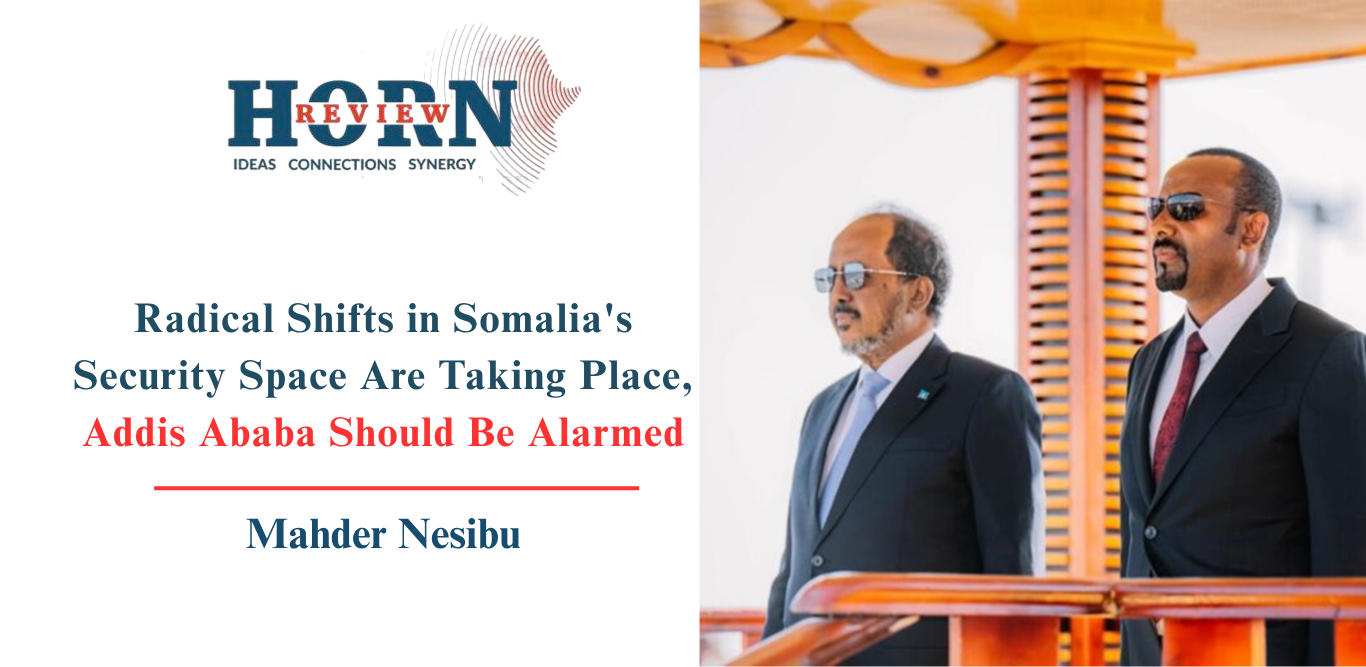
Paradoxically, Prime Minister Abiy Ahmed and President Hassan Sheikh maintain warm bilateral relations, having managed the post-MoU fallout diplomatically. However, the operational reality on the ground—Eritrean-linked commanders, Egyptian bases, irredentist rhetoric, and a collapsing AU mission—renders high-level diplomacy insufficient.
Conclusion: A Region on the Precipice
Somalia is no longer just a fragile state; it is becoming an arena for multi-polar competition. The convergence of a domestic legitimacy crisis, the evaporation of the AU security guarantee, the institutionalization of Eritrean networks within the SNA, and the militarization of the Red Sea rivalry (Turkey vs. Egypt/UAE/Israel) creates a perfect storm.
For Ethiopia, the “Eastern Front” has reopened—not just as a counter-terrorism theater, but as a theater of conventional irredentism and great power proxy conflict. Addis Ababa can no longer afford to treat Somalia as a secondary theater while managing crises in the north (Eritrea) and west (Sudan). The structural transformation of the Somali state demands an immediate, comprehensive recalibration of Ethiopian foreign and security policy.
Key Takeaways (FAQ Schema Ready)
- Why did Hassan Sheikh extend his term? To implement a one-person-one-vote electoral system, though opponents view it as a power grab.
- Why is AUSSOM collapsing? The US cut funding via UNSOS in July 2026, forcing a UN logistical withdrawal.
- Who is Abdirisak “Eritrea” Mahamud Haji? The new Somali Air Force Chief with deep ONLF and Eritrean intelligence ties.
- Why is Egypt deploying troops to Somalia? To counter Ethiopian/Turkish influence and secure leverage over Nile/Red Sea geopolitics.
- What is the “Greater Somalia” claim? An irredentist ideology claiming Somali-inhabited lands in Ethiopia, Kenya, and Djibouti, recently invoked by President Hassan Sheikh.
External References & Further Reading:
- CNBC Africa: Somali Parliament Approves Constitution Change
- New York Times: Somalia Mogadishu Fighting & Legitimacy Disputes
- Amani Africa: US Plan to Unplug UNSOS
- Somali Guardian: UNSOS Layoffs & AUSSOM Endgame
- The Reporter Ethiopia: Hassan Sheikh Removes Ethiopia from AUSSOM
- Addis Standard: Ethiopia Hands Over Burhakaba Base
- Horn Review: Who is Abdirisak Eritrea?
- Africanews: Somali Soldiers Return from Eritrea
- Somali Guardian: SNA Graduates 3000 Troops
- Al Jazeera: Puntland Seizes Base in Galkayo
- Somali Guardian: President on “Missing Parts” of Greater Somalia
- ADF Magazine: Turkiye Builds Ties Through Training
- Le Monde: UAE Builds Base in Somaliland for US/Israel
- DW: Why is Egypt Bolstering Ties with Somalia?
