




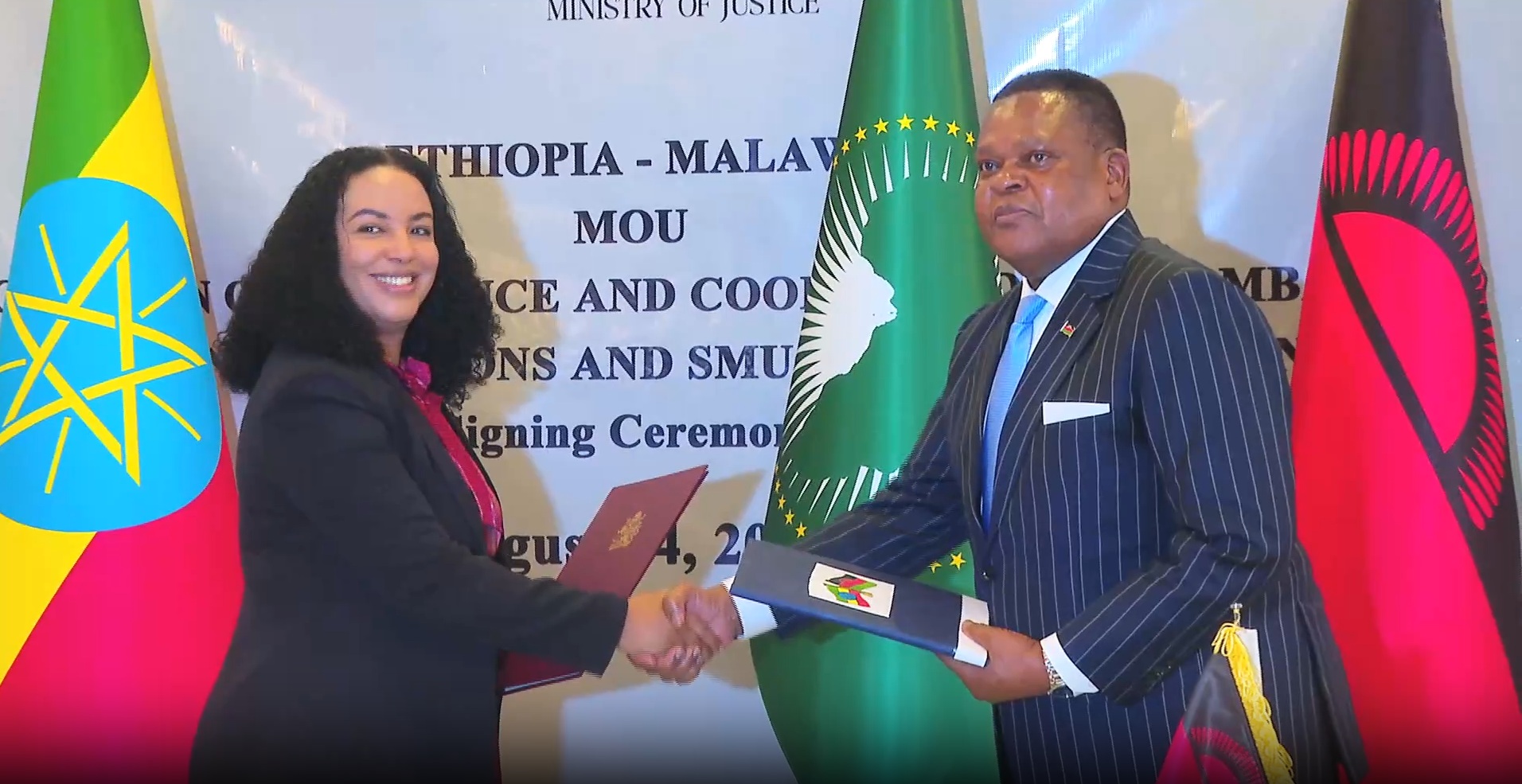
Ethiopia and Malawi Sign MOU to Combat Human Trafficking on Southern Migration Route
ADDIS ABABA, August 14, 2026 (ENA) — Ethiopia and Malawi have officially signed a Memorandum of Understanding (MOU) aimed at strengthening bilateral cooperation in migration governance and intensifying the fight against human trafficking and migrant smuggling along the Southern Route to South Africa.
The agreement, formalized in Addis Ababa on Friday, establishes a comprehensive framework for joint action centered on four strategic pillars: prevention, protection, prosecution, and partnership. It places a specific emphasis on safeguarding vulnerable migrants and dismantling the transnational criminal networks that exploit them.
Strategic Partnership Targets Southern Route Vulnerabilities
The Southern Migration Route—stretching from the Horn of Africa through Kenya, Tanzania, Malawi, Zambia, and Mozambique toward South Africa—remains one of the continent’s most perilous corridors for irregular migration. According to the International Organization for Migration (IOM), thousands of migrants, predominantly Ethiopians, traverse this route annually, facing extreme risks of abandonment, extortion, physical abuse, and death at the hands of smuggling syndicates.
Speaking at the signing ceremony, Ergoge Tesfaye, Ethiopia’s Minister of Women and Social Affairs, underscored the urgency of the accord.
“Migration is a natural phenomenon, but if we fail to manage it properly, we know it poses a significant danger,”
Minister Ergoge stated. She highlighted that the MOU provides a legal and operational backbone for protecting migrants’ human rights, ensuring access to humanitarian assistance, and facilitating dignified voluntary return processes for stranded nationals.
Four-Pillar Framework: Prevention, Protection, Prosecution, Partnership
The signed MOU moves beyond rhetorical commitment by codifying cooperation across the globally recognized “4Ps” framework endorsed by the United Nations Office on Drugs and Crime (UNODC) and the Global Compact for Safe, Orderly and Regular Migration (GCM):
- Prevention: Joint awareness campaigns targeting source communities in Ethiopia and transit communities in Malawi to counter misinformation spread by smugglers.
- Protection: Standardized operating procedures (SOPs) for the identification, referral, and assistance of victims of trafficking (VoTs), ensuring gender-sensitive and child-friendly approaches.
- Prosecution: Harmonized legal frameworks and mutual legal assistance (MLA) to ensure traffickers cannot exploit jurisdictional gaps to evade justice.
- Partnership: Institutionalized information sharing between the Ethiopian Federal Police and the Malawi Police Service, alongside social affairs ministries.
Leadership Voices: Closing Gaps Exploited by Criminal Networks
Peter Mukhito, Malawi’s Minister of Homeland Security, framed the agreement as a pivotal shift from reactive measures to proactive intelligence-led policing.
“Today, Malawi and Ethiopia are doing more than signing a Memorandum of Understanding. We are strengthening trust, closing the spaces criminals exploit,”
Minister Mukhito declared. He stressed that the “real test” lies in implementation, calling for accelerated communication channels, efficient real-time intelligence exchange, and enhanced capacity building for frontline law enforcement officers in both nations.
Mukhito further emphasized the human cost of trafficking, urging both governments to prioritize victim-centered approaches—ensuring survivors receive psychosocial support, legal aid, and safe reintegration—while guaranteeing that perpetrators face the full force of the law regardless of the border they cross.
Proven Track Record: 300+ Victims Rescued, Traffickers Apprehended
The MOU formalizes an already productive operational relationship. Minister Ergoge revealed that prior joint operations between the Malawian Police and the Ethiopian Federal Police have successfully dismantled a major trafficking network responsible for victimizing over 300 Ethiopian citizens.
This track record demonstrates the tangible impact of cross-border police cooperation. By institutionalizing these ad-hoc successes into a permanent legal framework, the MOU aims to replicate and scale these outcomes, ensuring sustainable disruption of criminal business models.
Legal Foundation Set for Deeper Bilateral Action
Belayihun Yirga, Ethiopia’s State Minister of Justice, affirmed that the agreement provides the necessary legal foundation for future cooperation.
“We will use this as a foundation to move directly into implementation,”
State Minister Yirga noted, signaling an immediate transition from diplomatic signing to operational deployment. The Ministry of Justice is expected to lead the harmonization of legal statutes concerning the definition of trafficking in persons (TIP) and smuggling of migrants (SOM) to align with the UN Protocol to Prevent, Suppress and Punish Trafficking in Persons (Palermo Protocol) and the Protocol against the Smuggling of Migrants.
Regional Implications for African Migration Governance
Both ministers acknowledged that the bilateral accord carries wider significance for the African Union (AU) Agenda 2063 and the Migration Policy Framework for Africa (MPFA). Human trafficking, migrant smuggling, and transnational organized crime are shared continental challenges requiring a collective response.
By operationalizing a model of South-South cooperation rooted in trust, shared intelligence, and mutual legal assistance, Ethiopia and Malawi are setting a precedent for other member states along the Southern Route—including Tanzania, Zambia, Mozambique, and South Africa—to pursue similar binding arrangements.
Next Steps: From Signature to Operational Reality
The immediate focus shifts to the Technical Working Groups from both nations, tasked with:
- Drafting the Standard Operating Procedures (SOPs) for victim referral and repatriation.
- Establishing a Secure Information Exchange Platform for law enforcement.
- Scheduling joint capacity-building workshops for prosecutors, judges, and investigators.
- Coordinating with IOM Malawi and IOM Ethiopia for assisted voluntary return and reintegration (AVRR) logistics.
As the ink dries on the Memorandum, the message from Addis Ababa is clear: managing migration humanely and securely requires moving beyond national silos. For the hundreds of thousands of migrants navigating the Southern Route, this Ethiopia-Malawi partnership represents a critical step toward turning a corridor of danger into a pathway of protection.
