




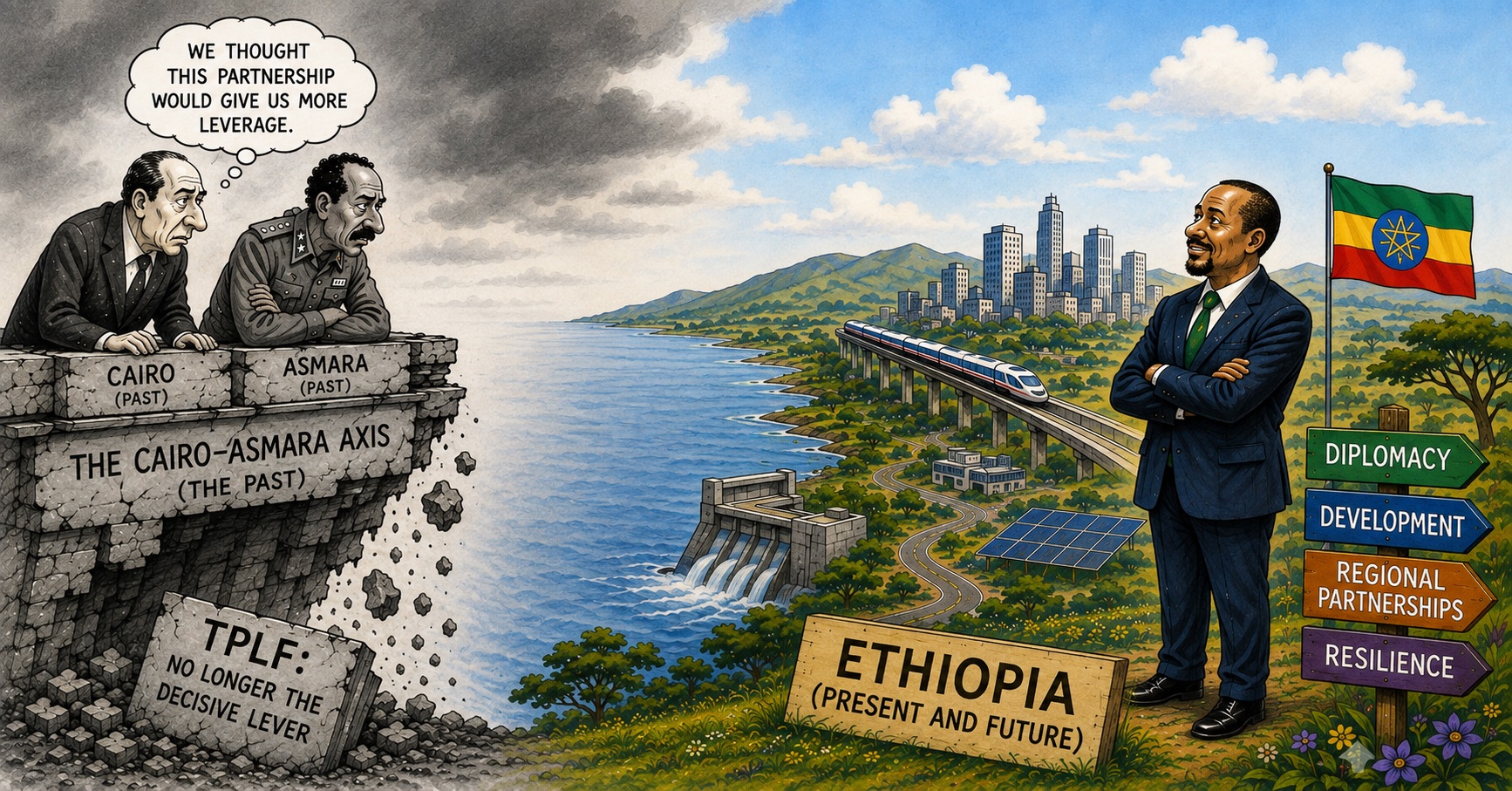
For much of the past decade, the partnership between Cairo and Asmara stood at the center of the Horn of Africa’s geopolitical competition. Egypt viewed Ethiopia’s rise primarily through the lens of the Grand Ethiopian Renaissance Dam and Nile water security. Eritrea approached the relationship from the perspective of regime security, regional balance of power, and its rivalry with Addis Ababa.
The expectation was that sustained pressure on Ethiopia’s internal vulnerabilities would constrain its regional ambitions. Instead, the strategic landscape has evolved in ways that increasingly limit the effectiveness of that approach.
From Containment to Strategic Stagnation
The Cairo Asmara alignment emerged during a period when Ethiopia faced simultaneous military, diplomatic, and political crises. The Tigray war, tensions with Sudan, disputes over the GERD, and deteriorating Ethiopia Eritrea relations created an environment in which coordinated pressure appeared capable of reshaping the regional balance.
The turning point was the Pretoria Agreement.
Although implementation remains incomplete and political disputes persist, the agreement ended the large scale war between the federal government and the TPLF and fundamentally changed the military balance in northern Ethiopia. The agreement also exposed growing differences between Addis Ababa and Asmara because Eritrea was excluded from the negotiations and opposed important aspects of the post war settlement. Rift Valley Institute report on Ethiopia Eritrea relations since 2018
The alliance that proved effective during the Tigray war increasingly became an alliance with diverging interests rather than converging objectives. According to the Rift Valley Institute, the Ethiopia Eritrea military partnership from 2018 to 2022 was largely opportunistic, and the structural differences between the two governments have become more pronounced since Pretoria. (Rift Valley Institute)
The Limits of Proxy Competition
Regional competition in the Horn has rarely been confined to diplomacy. Governments have repeatedly accused one another of cultivating relationships with armed movements to increase strategic leverage.
Ethiopian officials have repeatedly alleged that Eritrea has provided various forms of support to armed actors operating inside Ethiopia, including sanctuary, logistics, and training. Eritrea has consistently rejected those allegations. Earlier this year Ethiopia formally accused Eritrea of backing armed groups inside Ethiopian territory, while Eritrea denied the claims. Reuters report on Ethiopia’s accusations against Eritrea (Investing.com)
At the same time, Egypt has significantly expanded its strategic relationship with Eritrea. High level summits involving Egypt, Eritrea, and Somalia have focused on security cooperation, Red Sea stability, and regional coordination at a time of heightened tensions with Ethiopia. Reuters report on the Egypt Eritrea Somalia summit (Reuters)
Whether these regional alignments have translated into meaningful strategic gains is a different question.
The TPLF no longer occupies the central position it once held in regional calculations. The Oromo Liberation Army continues its insurgency in parts of Oromia, while Fano remains engaged in conflict in Amhara. Each movement continues to challenge the Ethiopian state, but none has fundamentally altered Ethiopia’s position as the dominant military and political actor in the Horn.
If the objective of sustained regional pressure was to fundamentally weaken Ethiopia’s strategic position, the results have so far been limited.
War Fatigue Has Become a Strategic Variable
Military campaigns do not occur in isolation from public sentiment. Years of conflict have left communities across Tigray, Amhara, Oromia, Afar, and other regions exhausted by displacement, economic disruption, and humanitarian suffering. Political grievances remain unresolved, but there is also growing pressure for stability, reconstruction, and economic recovery.
This war fatigue has become an important strategic variable. Armed movements depend not only on battlefield performance but also on sustained social and political support. As the costs of prolonged conflict accumulate, maintaining momentum becomes increasingly difficult regardless of military capability.
Ethiopia Has Recovered Diplomatic Space
During the height of the Tigray war, Ethiopia faced substantial diplomatic pressure. Since then Addis Ababa has rebuilt relationships across Africa, the Gulf, and Asia while emphasizing sovereignty, territorial integrity, and non interference in its diplomatic messaging. Ethiopia remains central to discussions concerning Red Sea security, continental trade, and regional integration despite continuing domestic security challenges.
At the same time, the Horn itself has become increasingly crowded with outside powers. Reuters has reported that Egypt, Eritrea, and Somalia have strengthened security coordination, while wider competition involving Gulf states continues to reshape regional alignments. (Reuters)
Eritrea’s Strategic Constraints
Eritrea remains geopolitically important because of its position along the Red Sea. However, geography alone cannot compensate for structural constraints. The country faces long term economic limitations, demographic pressures, environmental challenges, and uncertainty surrounding political succession after decades under the same leadership. These realities constrain Eritrea’s capacity to sustain an expansive regional strategy over time.
Relations with Ethiopia have also become increasingly shaped by competing visions of the region’s future. Ethiopia’s renewed emphasis on maritime access, including public discussion surrounding Assab, has intensified Eritrean security concerns while reinforcing longstanding mistrust on both sides. (Rift Valley Institute)
Historical memory continues to influence political thinking inside Ethiopia as well. For many Ethiopians, the loss of direct Red Sea access remains a major strategic issue, while Eritrea regards its sovereignty as non negotiable.
A More Multipolar Red Sea
The Red Sea is no longer defined by one bilateral rivalry. Saudi Arabia, the United Arab Emirates, Türkiye, Qatar, and other external powers have significantly expanded their political, economic, and security engagement throughout the region. Reuters has reported that rivalry among Gulf powers is increasingly reshaping alliances across Ethiopia, Eritrea, Somalia, and Sudan. (Reuters)
This emerging regional order leaves less room for any single geopolitical axis to dominate events. Egypt continues to prioritize the GERD dispute, but it must simultaneously manage security challenges across North Africa, Gaza, the Eastern Mediterranean, and the Red Sea.
Against that backdrop, the Cairo Asmara partnership remains strategically relevant. The more important analytical question, however, is whether it retains the capacity to shape Ethiopia’s trajectory in the way many anticipated during the height of the Tigray conflict.
Current regional trends suggest that Ethiopia’s resilience, diplomatic recovery, and the emergence of a more multipolar Red Sea security architecture have narrowed the strategic space within which the Cairo Asmara partnership can operate.
