




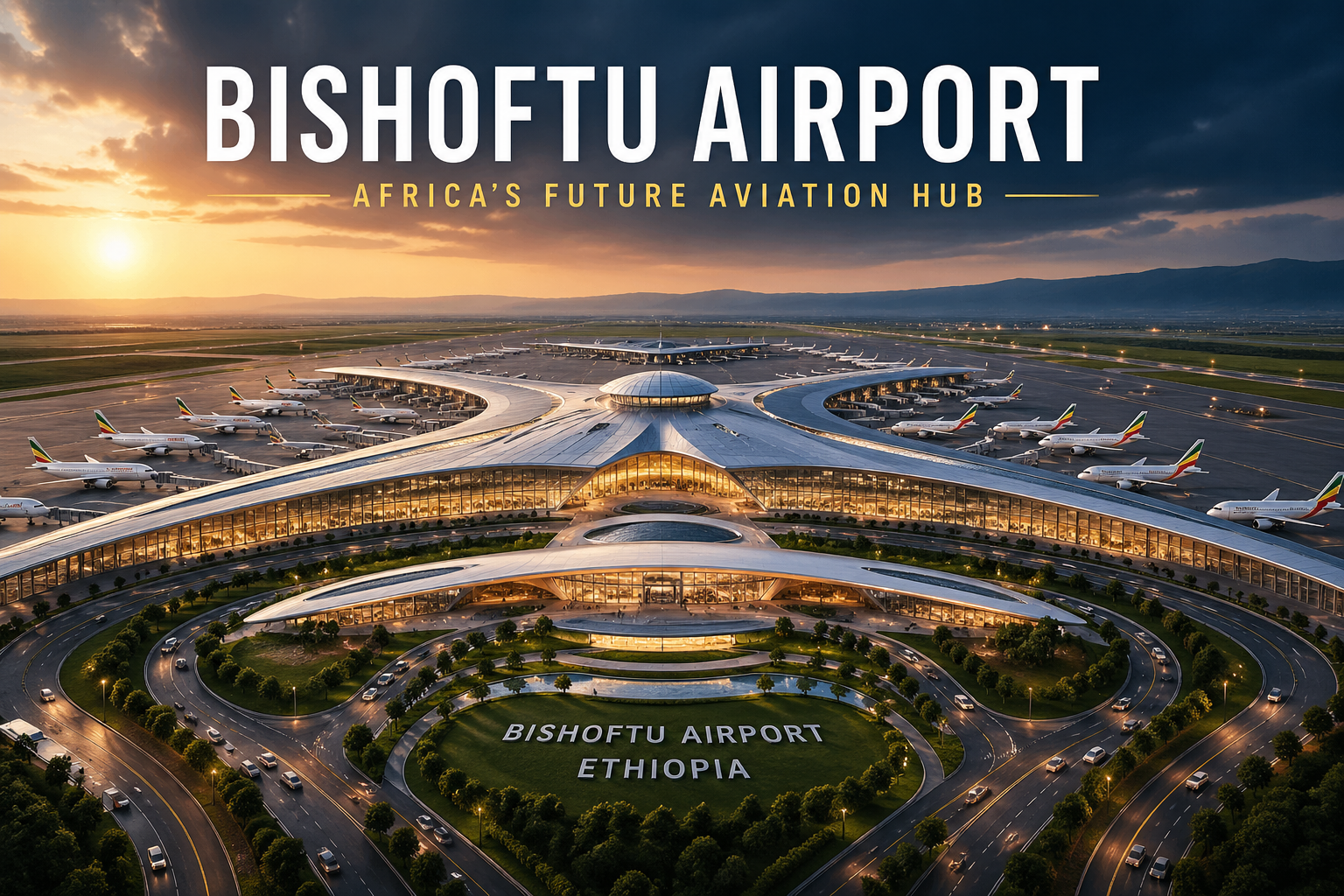
America’s development financiers do not typically dabble in grandiose aviation schemes abroad. Yet their recent enthusiasm for Ethiopia’s proposed Bishoftu airport suggests something more strategic is afoot. Both the Export-Import Bank of the United States (EXIM) and the U.S. International Development Finance Corporation (DFC) have signalled their readiness to fully finance the project—an unusually strong vote of confidence in a country better known in recent years for macroeconomic strain than megaproject ambition.
The planned airport, to be built near Bishoftu, is envisioned as the largest in Africa and among the most modern globally. Its scale is not merely architectural bravado. It is tightly bound to the expansion strategy of Ethiopian Airlines, Africa’s most successful carrier, which has placed large orders with Boeing and continues to broaden its long-haul network. Executives at the American aerospace giant have been quick to frame the airport as critical infrastructure—less a vanity project than a necessary node in what they see as Africa’s next phase of aviation growth.
The financing model itself is telling. By underwriting American firms—whether as prime contractors or subcontractors—EXIM and DFC are not simply backing Ethiopia’s ambitions; they are advancing U.S. commercial interests. In effect, Washington is signalling that it sees Ethiopia as a viable destination for large-scale capital deployment again, after years in which political risk often deterred Western investors. The project thus doubles as industrial policy: a means of supporting U.S. exporters while deepening economic ties with a pivotal African market.
That message was reinforced during a recent visit to Washington by Ethiopia’s finance minister, Ahmed Shide. Leading a high-level delegation, he embarked on a diplomatic tour of federal agencies and international financial institutions, including the World Bank and the International Monetary Fund. His pitch was straightforward: Ethiopia, having embarked on a programme of macroeconomic reforms, is open for business.
Those reforms—ranging from currency liberalisation to efforts at improving the investment climate—are intended to unlock opportunities across sectors. Mr Shide reportedly highlighted mining, high-end healthcare tourism, artificial intelligence and broader capacity-building as areas ripe for foreign participation. For American policymakers, such sectors align neatly with both commercial and developmental priorities, offering the prospect of returns alongside geopolitical influence.
A business forum hosted at the Ethiopian Embassy in Washington added a more practical dimension to the visit. Bringing together investors, policymakers and corporate representatives, the event underscored the breadth of interest in Ethiopia’s economic reorientation. A question-and-answer session, by accounts both candid and detailed, allowed participants to probe regulatory risks, financing structures and sector-specific opportunities. The embassy, keen to position itself as a bridge between Ethiopian ambitions and American capital, appears to have curated a notably engaged audience.
For Ethiopia, the stakes are high. The Bishoftu airport is not merely an infrastructure project; it is a bet on sustained growth in air travel, trade and investment. For the United States, the calculus is equally clear. By backing such ventures, it secures commercial footholds for its firms while reinforcing ties with one of Africa’s most consequential economies.
Whether this convergence of interests translates into lasting success will depend on execution—always the Achilles’ heel of megaprojects. But for now, the alignment between Addis Ababa’s ambitions and Washington’s financial muscle marks a notable shift. After years of hesitation, American capital appears ready to take Ethiopia’s prospects seriously again.America Backs Ethiopia’s Aviation Ambitions
