




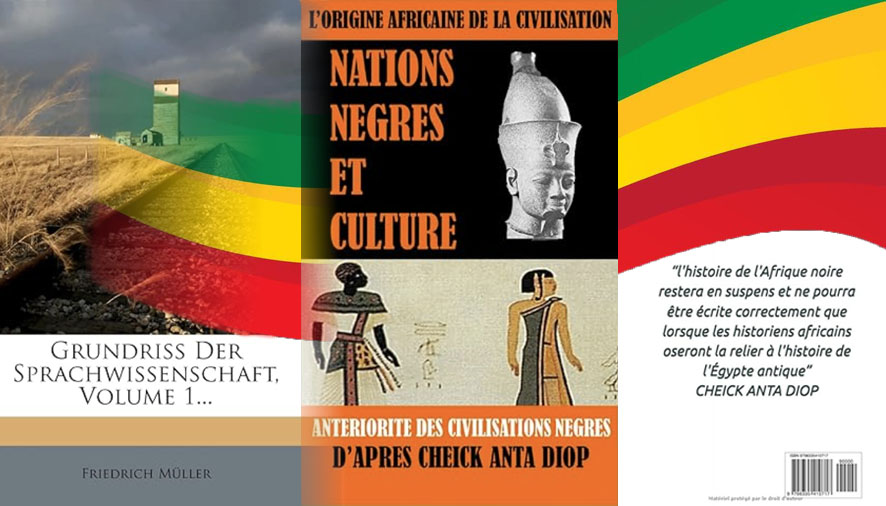
The maps drawn in 19th-century Europe never stopped at borders; they extended into language, faith, and even time itself. In Vienna and Berlin, men with microscopes and Bibles tried to fit humanity into genealogies, tracing every tribe back to Shem, Ham, or Japheth. In that intellectual climate, Friedrich Müller, an Austrian linguist, coined a term that would shape how Africa was read for over a century: Cushitic. To him, it was the linguistic echo of a biblical Cush, son of Ham, brother of Mizraim, ancestor of dark-skinned peoples said to dwell beyond the Nile.
What began as a European experiment in classification would leave scars far beyond the academy. The Cushitic and Semitic labels, conceived in the echo chambers of imperial theology, would trickle down through colonial administration and, later, local politics. In Ethiopia, those borrowed categories have resurfaced in the rhetoric of identity and grievance, turning linguistic heritage into a weapon of suspicion. Today, extremist ethnocentric factions wield those terms as moral boundaries, implying civilizational rank where there should be only cultural kinship. The result is a tragic paradox: a hierarchy once used to justify domination abroad now recycled within Africa’s own discourse.
The project sounded scientific but was framed through the interpretive lens of scripture as understood in 19th-century Europe. Müller’s comparative philology, developed in the 1870s and 1880s, drew authority as much from Biblical genealogy as from emerging linguistic science. In an era when theology served empire, he read sacred texts through the prism of racial hierarchy, imagining the descent of languages. And by extension, civilizations from a divinely ordained center in the Middle East and Europe toward what were viewed as lesser peripheries. His synthesis lent a moral vocabulary to colonial expansion: a way to clothe hierarchy in the language of destiny.
At the time, this hierarchy mirrored Europe’s worldview. Linguistics became a cartography of power: to name a language was to assign its place in humanity’s supposed ascent from primitive to civilized. Müller’s taxonomies echoed the moral geography of empire, where the Nile’s sources became not just geographical but genealogical boundaries separating Africa from the Near East. Few scholars questioned whether the division was arbitrary; they were too busy drawing lines to prove it.
By the early 20th century, Joseph Greenberg and others would reorganize these linguistic families under what we now call Afroasiatic, a more technical label but still bound to the old assumption that Africa’s richest tongues carried Asiatic ancestry. The implication lingered: African civilization was remarkable, perhaps, but derivative. The damage, meanwhile, was done. In Ethiopia, the categories hardened into identities. What had been linguistic description morphed into political myth.
Across the 20th century, as Ethiopia navigated modernity, revolution, and reform, these imported linguistic markers quietly seeped into narratives of belonging. Cushitic came to signify indigeneity, Semitic to imply proximity to civilization. Such distortions, born in colonial libraries, now haunt the politics of ethnicity, justifying rivalry where kinship once thrived. The European habit of dividing to classify has been localised into dividing to govern, and, at times, dividing to hate.
Yet history rarely stands still. A century later, another scholar, Senegalese, multilingual, impatient with inherited narratives would turn Müller’s world upside down. His name was Cheikh Anta Diop, and his project was not to classify but to reclaim.
Reclaiming the Source
By the 1950s, as newly independent African states wrestled with their political futures, Diop confronted their intellectual pasts. Trained in physics, anthropology, and history, he approached language not as taxonomy but as testimony. He rejected the tripartite Biblical descent Shem, Ham, and Japheth, as a myth that had quietly structured Western science. To Diop, the “Hamito-Semitic” theory that split African languages into Near Eastern and African halves was less a discovery than a justification for colonial logic: that civilization, like light, had to come from the East.
Diop’s response was as radical as it was rigorous. Drawing on comparative linguistics, archaeology, and early genetic studies, he demonstrated that the so-called Semitic languages and peoples were not outsiders to Africa but branches of an African trunk. Ancient Egypt Kemet, was not an Asiatic bridge but an African civilization through and through, linguistically and biologically linked to its southern neighbors. His work drew direct correspondences between Ancient Egyptian and modern African languages such as Wolof, showing shared roots in grammar, structure, and even idiomatic expression.
For Diop, these were not mere linguistic curiosities. They were proofs of continuity, of a civilizational fabric stretching from the Sahel to the Nile, long before external contact blurred its colors. He called it the African cultural unity, a hypothesis that unsettled Western academia precisely because it placed Africa at the origin, not the margin, of world history.
The Clash of Frameworks
If Müller’s world was one of descent, Diop’s was one of return. The Austrian linguist worked within a system that arranged knowledge vertically: language descended from purity to mixture, from center to periphery. Diop thought horizontally: languages evolve, cross, and influence one another within a living ecology. Where Müller saw taxonomy, Diop saw kinship.
That distinction remains essential for understanding today’s Ethiopia, and by extension, Africa’s intellectual moment. For the Horn of Africa, the region most burdened by these classifications, the debate is not academic. It shapes how Ethiopians, Eritreans, and Somalis see themselves in relation to both Africa and the Middle East. Is Amharic a Semiticlanguage because it shares morphology with Arabic, or is Arabic itself an offshoot of an older African root system? Does Geʽez, the liturgical language of the Ethiopian Church speak with an echo from Jerusalem, or is it the other way around?
Modern linguistics can trace sound shifts and syntax; it cannot yet trace pride. But Diop’s work made it possible to ask: who benefits from describing Africa as a derivative continent?
The Return of Africa’s Voice
A new generation of African and diaspora scholars is asking those same questions, now with the tools Müller never imagined, from genetic mapping to computational linguistics. Their findings, while nuanced, continue to tilt the evidence toward Africa as the cradle of linguistic and cultural innovation. The migration of language families, once imagined as an exodus from the Levant into Africa, now appears bidirectional, with strong evidence that proto-Afroasiatic languages evolved in northeast Africa before radiating outward.
In this, Ethiopia becomes not a recipient of influence but one of its sources. The country’s linguistic diversity, from Oromo to Tigrinya to Afar, is less a mosaic of borrowings than a palimpsest of original expressions, layered across millennia of contact and adaptation. The same soil that preserved Lucy, humanity’s oldest ancestor, also preserved some of the world’s earliest syntactic innovations.
For many young Africans, this shift is not only about academic correction; it’s about identity. Across campuses in Addis Ababa, Dakar, and Nairobi, Diop’s challenge is finding a new audience, a generation less interested in revisiting Europe’s classification of Africa than in narrating Africa’s own continuity with the world. They quote his warning that “to restore the past of the African is to restore the future of humanity.”
The Generational Turn
That generational dimension matters. Friedrich Müller’s heirs once defined Africa through the vocabulary of absence: lacking writing, lacking history, lacking origin. Diop’s intellectual descendants now define it through the language of presence, of continuity, resilience, and authorship.
To them, reclaiming linguistic ancestry is inseparable from reclaiming political and cultural agency. The same logic that once turned African tongues into “offshoots” of Asiatic ones underpinned the notion that African societies required external guidance. Correcting one helps unravel the other.
This is why Ethiopia’s current generation of thinkers, artists, and policymakers increasingly frame the nation not as an isolated highland kingdom but as a microcosm of Africa’s evolution, a living proof that complexity and continuity can coexist without colonial mediation. The call that “Africa’s turn has come” is no slogan; it’s an assertion that knowledge, like language, must flow back to its source before it can flow outward again.
From Classification to Connection
What Friedrich Müller began as a project of naming has thus become a project of un-naming, of freeing Africa from the categories that once confined it. The Cushitic and Semitic families remain useful linguistic tools, but their historical baggage demands reckoning. They remind us how scholarship can harden into ideology when curiosity gives way to hierarchy.
Diop’s corrective, half a century later, did more than dismantle those hierarchies; it invited Africa to speak again in its own tongue. His comparative tables, once dismissed as nationalist, now align with genomic data tracing the world’s earliest migrations from northeast Africa. Science, having traveled a long detour through Eurocentric certainty, seems to be catching up with intuition.
Africa’s Turn
In that sense, Ethiopia stands where it has always stood, at the crossroads of memory and renewal. The nation’s linguistic landscape is a metaphor for Africa itself: multilingual yet mutually intelligible, ancient yet alive. As global institutions revisit the narratives that shaped modern anthropology, Africa’s task is not to seek validation but to extend the conversation to insist that the origin of humanity’s languages is not a question of geography but of perspective.
Friedrich Müller’s Europe tried to explain Africa; Cheikh Anta Diop’s Africa now explains humanity. Between those poles lies a story of reclamation, not revenge; a reminder that the languages of the Horn were never echoes of another civilization, but the first voices of one.
References
- Friedrich Müller, Grundriss der Sprachwissenschaft (Vienna, 1876–1880).
- Joseph Greenberg, The Languages of Africa (Bloomington: Indiana University Press, 1963).
- Cheikh Anta Diop, Nations nègres et culture: de l’Antériorité des civilisations nègres, Présence Africaine, 1954; trans. in The African Origin of Civilization: Myth or Reality, Lawrence Hill, 1974.
- Christopher Ehret, The Civilizations of Africa: A History to 1800 (Charlottesville: University Press of Virginia, 2002).
- Molefi Kete Asante, Afrocentricity: The Theory of Social Change (Chicago: African American Images, 1980).
- Gebre-Hiwot Ayalew, Historical Linguistics and the Horn of Africa (Addis Ababa University Press, 2015).
- Kidane Mengisteab, Ethiopia and the Horn: Ethnic Diversity, National Identity, and Linguistic Heritage (Asmara: Red Sea Press, 2004).
