




As Ethiopia approaches its 2026 General Election, two competing stories are unfolding simultaneously.
The first story dominates much of the international conversation. It is a story centered on insecurity, political tensions, governance concerns, opposition grievances, regional and geopolitical rivalries, and uncertainty. This is the story most frequently encountered in international media coverage, policy analysis, diplomatic commentary, and advocacy reports. Readers following Ethiopia through major international outlets are often presented with a country defined primarily by conflict, instability, democratic shortcomings, and humanitarian concerns.
The second story is told not through commentary but through measurable participation.
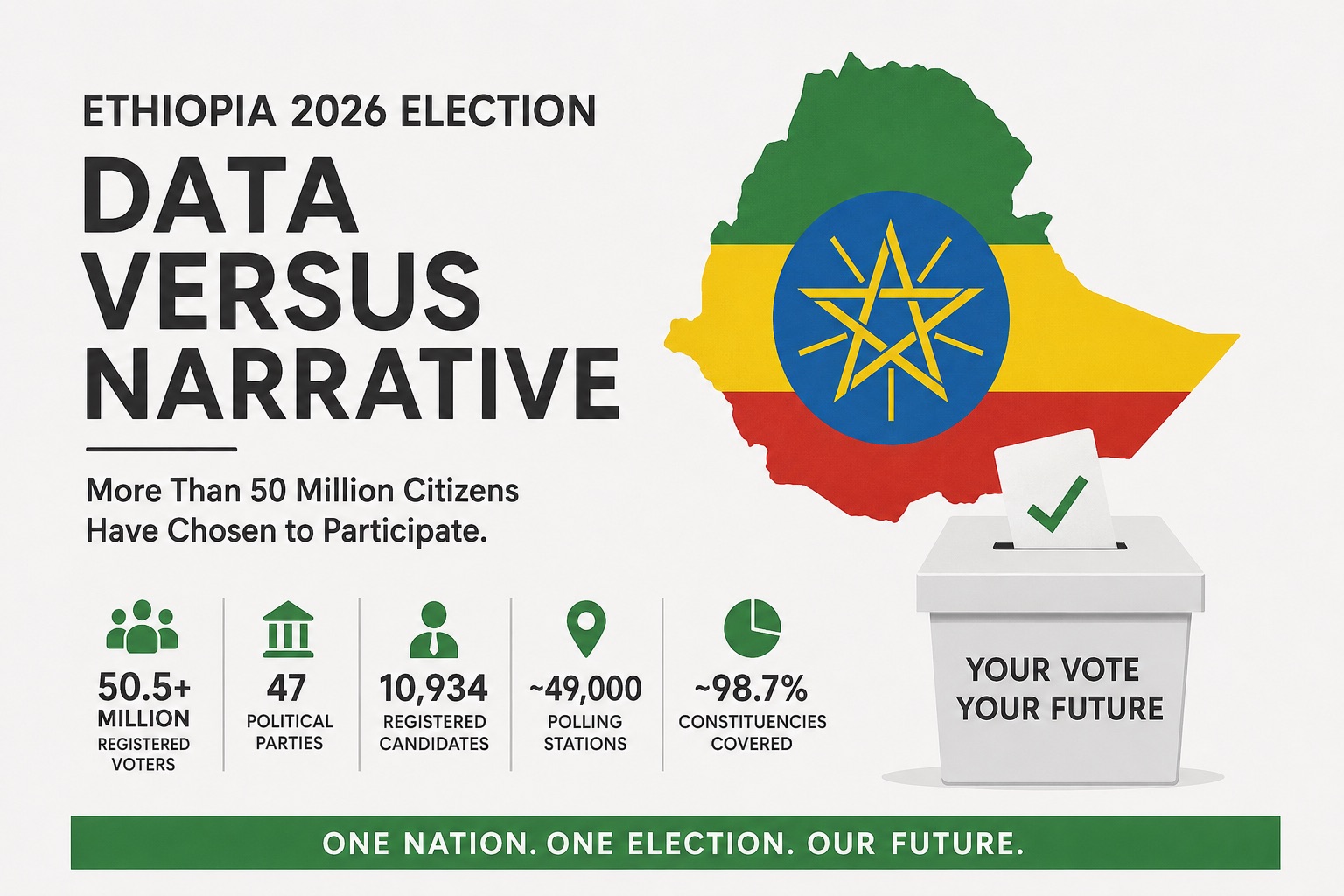
According to figures released by Ethiopia’s National Election Board, more than 50.5 million Ethiopians registered to vote in the country’s seventh general election. Forty seven political parties entered the race. A total of 10,934 candidates registered to compete for federal and regional offices. Nearly 49,000 polling stations were established across the country to facilitate voting. Registration reached approximately 76 percent of Ethiopia’s voting age population, making it one of the largest exercises in democratic participation currently taking place anywhere on the African continent.
The contrast between these two stories lies at the heart of the debate surrounding Ethiopia’s election.
One story is built primarily around interpretation.
The other is built around participation.
Neither should be ignored. Ethiopia faces genuine challenges that deserve scrutiny. Security concerns remain present in parts of the country. Political disagreements remain intense. Democratic development remains a work in progress rather than a completed project.
Yet the central question surrounding Ethiopia’s election is no longer whether criticism exists.
The central question is whether criticism has become so dominant that it obscures one of the largest democratic exercises on the African continent.
If Ethiopia were experiencing the widespread political disengagement often implied by international commentary, it would be difficult to explain why more than fifty million citizens voluntarily registered to vote.
If confidence in political participation had collapsed, it would be difficult to explain why forty seven political parties chose to compete.
If public faith in political engagement had disappeared, it would be difficult to explain why more than ten thousand candidates entered the race.
The participation of forty seven political parties is particularly significant because it challenges portrayals of the election as a purely one sided political exercise. Regardless of how observers evaluate the competitiveness of the process, the presence of dozens of political organizations and thousands of candidates demonstrates that the election involves political contestation rather than the absence of opposition participation.
The scale of registration becomes even more striking when viewed in comparative perspective. More Ethiopians registered to vote than the entire population of many African countries and more than the population of numerous sovereign states around the world. Registration at this scale is not a minor administrative achievement. It represents one of the largest expressions of electoral participation anywhere in Africa.
The significance of these figures becomes even more apparent when considering the country’s security environment. International coverage frequently highlights insecurity in parts of Amhara and Tigray, often creating the impression that electoral activity has been fundamentally disrupted nationwide. Yet even accepting reports that voting is not taking place in eight parliamentary constituencies because of security conditions, approximately 606 of Ethiopia’s 614 constituencies remain covered by the electoral process. In practical terms, roughly 98.7 percent of parliamentary constituencies continue to participate in election preparations.
This is not the profile of a country abandoning democratic participation.
It is the profile of a country attempting to conduct a national election despite localized security challenges.
Many countries routinely described as democratic conduct elections with lower voter registration rates, fewer competing parties, and lower levels of participation. Yet discussions surrounding Ethiopia frequently begin with assumptions of democratic deficiency rather than democratic engagement. The contrast suggests that perceptions of Ethiopia are often shaped not only by electoral realities but also by preexisting narratives.
The election is also taking place under substantial international observation. Foreign diplomats, election specialists, observer delegations, representatives of international organizations, and diplomatic missions have followed the process closely. International observers have engaged with election officials, political parties, civil society organizations, and government representatives throughout the election period. Whatever conclusions they ultimately reach, the election is occurring under a level of scrutiny that many countries would consider extensive.
This reality complicates suggestions that the election is taking place beyond international oversight.
Yet despite this level of attention, a broader geopolitical dimension often remains underappreciated.
Over the last decade, Ethiopia has emerged as one of the most strategically important countries on the African continent. It is the second most populous nation in Africa. It hosts the headquarters of the African Union. It is completing the Grand Ethiopian Renaissance Dam, the largest hydroelectric project in Africa. It seeks expanded maritime access to global trade routes. It possesses one of the largest economies and military establishments in the Horn of Africa.
For many observers, the significance of Ethiopia extends beyond elections. A country of more than 120 million people, possessing Africa’s largest hydroelectric project, one of the continent’s largest military establishments, the headquarters of the African Union, and ambitions for greater maritime connectivity has the potential to emerge as a dominant economic and strategic power in the Horn of Africa.
Much of the debate surrounding Ethiopia today reflects not only concern about current events but uncertainty regarding what a stronger Ethiopia would mean for the future regional order.
The discussion surrounding Ethiopia is therefore not simply about elections.
It is increasingly about the future balance of power in the Horn of Africa.
It is about who will shape the future of the Nile Basin.
It is about who will influence the Red Sea corridor.
It is about whether Ethiopia’s demographic, economic, and energy advantages will translate into greater regional influence.
These questions generate both opportunities and anxieties throughout the region.
Egypt’s opposition to the Grand Ethiopian Renaissance Dam has become one of Africa’s most consequential strategic disputes. Cairo has consistently argued that the dam threatens its water security, while Ethiopia has maintained that the project represents a sovereign development initiative designed to provide electricity and economic opportunity for millions of citizens.
More recently, Egypt opposed Ethiopia’s efforts to secure direct maritime access through Somaliland. The Arab League aligned itself with Somalia’s objections to the agreement, reflecting broader concerns regarding sovereignty, regional stability, and changing power dynamics within the Horn of Africa and the Red Sea region.
These disputes are often framed in legal, diplomatic, and security terms.
They also reflect a deeper strategic reality.
A stable, economically expanding, energy exporting Ethiopia with enhanced regional connectivity would reshape existing regional relationships. Such a transformation would inevitably affect long standing balances of power.
Public records show that Egypt has invested substantial resources over many years in lobbying, strategic communications, public relations, and diplomatic outreach efforts in major Western capitals. Such activities are common instruments of statecraft employed by governments throughout the world to advance national interests and shape international perceptions.
There is no evidence that Egypt controls major international media organizations.
Influence, however, rarely depends upon direct control.
Modern information ecosystems are shaped through networks of experts, think tanks, advocacy organizations, academic specialists, diplomatic institutions, lobbying firms, and media sourcing practices that collectively influence how events are interpreted and discussed.
Egypt’s role in shaping the regional information environment therefore deserves attention. Public professional profiles identify Amr El Qazaz, Director and Head of Strategy at Al Jazeera’s SANAD Media Verification Hub, as an Egyptian media professional. This fact alone does not prove editorial bias or institutional control. However, it illustrates a broader reality that information ecosystems are shaped by people, institutions, professional networks, and geopolitical assumptions.
The issue is therefore not whether every negative article is directed by Egypt.
The more relevant question is whether diplomatic, lobbying, expert, and media influence networks contribute to an international environment in which Ethiopia is more frequently discussed through the language of instability, risk, and regional tension than through the data of participation, development, and democratic engagement.
The contrast between data and narrative becomes particularly visible when examining who is generating much of the discussion surrounding Ethiopia.
The overwhelming majority of influential commentary originates outside Ethiopia itself. Foreign journalists, international advocacy organizations, policy institutions, think tanks, diplomatic actors, external analysts, diaspora activists, and regional observers dominate much of the global conversation.
Meanwhile, the most significant measurable response from inside Ethiopia has not been commentary but participation.
While commentators debate legitimacy, citizens register.
While analysts discuss democratic shortcomings, political parties organize campaigns.
While headlines focus on instability, millions prepare to vote.
A widely circulated analysis on X by Addis Kidan claimed that more than 65 percent of visible local election related voices were supportive of participation in the election process, while much of the negative framing originated from non local actors. This observation should be treated as a social media based assessment rather than an independently verified statistic. Nevertheless, it reflects a broader pattern already visible in the available electoral data itself.
The strongest measurable evidence from within Ethiopia is participation.
The loudest criticism often comes from outside it.
This does not invalidate criticism.
Nor does it imply that all criticism is politically motivated.
It simply highlights a distinction between those participating in the election and those defining it internationally.
The question is not whether criticism of Ethiopia is legitimate.
The more important question is which actors benefit when Ethiopia is viewed primarily through the lens of instability.
As Ethiopia expands energy production through the GERD, seeks greater maritime access, strengthens regional connectivity, and increases its geopolitical influence, narratives surrounding the country’s stability increasingly intersect with broader strategic interests.
This reality does not invalidate criticism.
It does suggest that political narratives and geopolitical interests often coexist.
Perhaps the most important principle at stake is one that transcends governments, opposition movements, geopolitical rivalries, and media debates.
It is the principle of respecting democratic participation itself.
Democracy is not measured solely by whether international observers approve of a particular government, nor is it determined exclusively by the opinions of commentators, analysts, advocacy organizations, or foreign policy institutions.
At its foundation, democracy depends upon citizens choosing to participate in determining the future of their country.
More than fifty million Ethiopians have made that choice.
Some support the government.
Others support opposition parties.
Many likely support neither.
What unites them is their decision to engage rather than withdraw.
For that reason, respect for democracy requires respect for the citizens who participate in it. Legitimate criticism of institutions, policies, and procedures should never obscure the significance of mass civic participation. When millions of people register, organize, campaign, debate, and vote despite conflict, economic hardship, and political disagreement, their commitment to the democratic process deserves recognition.
History will ultimately remember two competing stories.
One was the story told about Ethiopia.
The other was the story told by Ethiopians themselves.
One focused primarily on crisis.
The other was expressed through the actions of more than fifty million citizens who chose participation over disengagement.
More than fifty million Ethiopians registered to vote.
Forty seven parties entered the race.
More than ten thousand candidates sought office.
Approximately 98.7 percent of constituencies remain covered by the electoral process.
These facts do not eliminate criticism.
They do challenge narratives that reduce Ethiopia to a story of crisis alone.
In the contest between data and narrative, the data deserves a more prominent place in the conversation.
Whatever political conclusions observers ultimately reach, the participation of more than fifty million citizens remains one of the largest expressions of democratic agency on the African continent today.
