




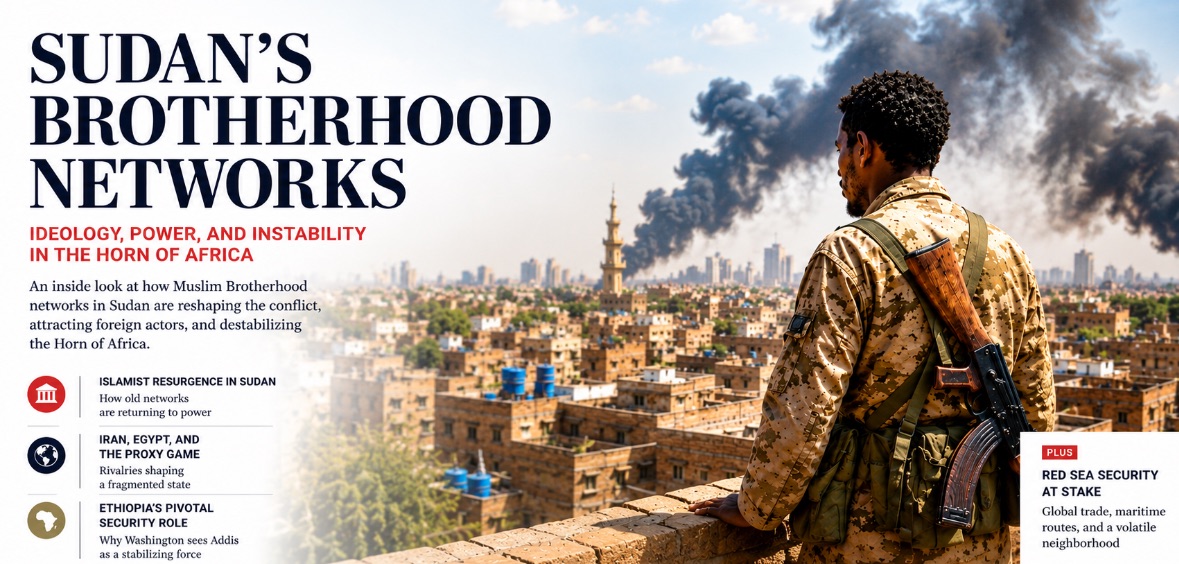
Sudan has long occupied one of the most strategically important and politically fragile positions in Africa and the Middle East. Stretching from the Sahel to the Red Sea and bordering seven countries, Sudan sits at the intersection of Arab politics, African security, Islamic movements, and international trade routes. For decades, the country has been shaped by the rise of political Islam and the influence of the Muslim Brotherhood, movements that gradually transformed Sudan from a struggling postcolonial state into one of the most influential centers of Islamist political ideology in Africa. The consequences of that transformation extended far beyond Sudan itself. Sudan became a sanctuary for extremist networks, a center for ideological mobilization, and a platform from which transnational militant organizations expanded their reach across East Africa and the wider world. Today, as Sudan descends deeper into civil war and institutional collapse, many regional and international observers fear that the country is once again becoming fertile ground for extremist resurgence, foreign proxy competition, and geopolitical destabilization that threatens the entire Horn of Africa and the Red Sea corridor.
The roots of Sudan’s Islamist transformation trace back to the spread of the Muslim Brotherhood from Egypt into Sudan during the middle of the twentieth century. Founded in Egypt in 1928 by Hassan al Banna, the Muslim Brotherhood promoted the belief that Islam should govern every aspect of public and private life, including politics, economics, education, and the legal system. The movement rapidly evolved into one of the most influential Islamist organizations in the modern Middle East, inspiring generations of political activists and religious ideologues throughout the Arab world and Africa. In Sudan, the movement eventually gained influence within universities, mosques, intellectual circles, and sections of the political elite. Over time, Islamist activists built networks capable of influencing not only public debate but also state institutions themselves.
The central figure in Sudan’s Islamist evolution was Hassan al Turabi, a lawyer, intellectual, and political strategist who transformed Sudanese Islamism into a highly organized political force. Turabi was not merely a religious thinker. He envisioned a revolutionary Islamist state capable of reshaping Sudanese society through ideological governance and institutional control. Turabi became one of the most influential Islamist thinkers in Africa and eventually built the National Islamic Front into one of Sudan’s most powerful political movements. Under Turabi’s leadership, Islamist networks infiltrated universities, military structures, intelligence agencies, and government bureaucracy. This strategy allowed political Islam to move from the margins of Sudanese politics directly into the center of state power.
That transformation accelerated dramatically in 1989 when Omar al Bashir seized power in a military coup backed by Islamist forces aligned with Turabi. Bashir’s rise marked a turning point not only for Sudan but for the entire region. The new regime fused authoritarian military rule with Islamist ideology, embedding loyalists within the armed forces, judiciary, intelligence services, educational institutions, and media networks. Sudan became increasingly isolated internationally as accusations mounted regarding repression, extremism, terrorism sponsorship, and human rights abuses. According to Human Rights Watch Report, “Bashir’s regime presided over decades of violent conflict, authoritarian governance, and widespread repression that devastated Sudan’s political institutions and social fabric”.
From Safe Haven to Global Threat
The Islamist transformation of Sudan had global consequences because the Bashir and Turabi government chose not merely to promote political Islam domestically but also to provide sanctuary for extremist organizations from across the region. The clearest and most dangerous example was Sudan’s hosting of Osama bin Laden and al Qaeda during the nineteen nineties. Between 1991 and 1996, bin Laden lived openly in Sudan under the protection of the Islamist government while building al Qaeda’s logistical infrastructure, financial networks, militant recruitment systems, and international operational capabilities. According to History.com’s account of Bin Laden leaving Sudan, Sudan provided bin Laden with a secure environment where he invested in construction, agriculture, transportation, and businesses while simultaneously strengthening extremist networks that would later carry out international terrorist operations. Sudan effectively became one of al Qaeda’s earliest external headquarters and a launching point for transnational jihadist expansion.
The consequences of that decision became tragically clear in August 1998 when al Qaeda bombed the United States embassies in Nairobi, Kenya, and Dar es Salaam, Tanzania. More than two hundred people were killed and thousands injured in attacks that shocked the international community and demonstrated the dangers posed by extremist organizations operating from fragile states. According to the Federal Bureau of Investigation archive on the East African embassy bombings, investigators later connected the attacks to al Qaeda’s East African infrastructure that had been strengthened during the organization’s years operating from Sudan. Sudan’s role during this period transformed the country into a symbol of how ideological extremism combined with weak institutions and authoritarian governance can evolve into a direct international security threat.
Sudan’s Islamist trajectory also cannot be separated from developments in Egypt, where the Muslim Brotherhood originated. Following the Arab Spring uprisings, Egypt briefly experienced Brotherhood rule through the election of Mohamed Morsi in 2012. However, Morsi’s presidency quickly became deeply polarizing as tensions escalated between Islamist factions, secular political groups, military institutions, and regional powers. According to Britannica’s biography of Mohamed Morsi, Egypt’s experiment with Brotherhood rule intensified fears throughout the region that political Islam could weaken state institutions and destabilize national political systems. In 2013, Egypt’s military removed Morsi from power after mass protests. The events in Egypt reshaped regional politics and intensified opposition toward Brotherhood aligned movements throughout Africa and the Middle East.
Sudan’s War and Islamist Resurgence
Today, Sudan once again stands at the center of a widening regional crisis. Since 2023, the country has descended into civil war between the Sudanese Armed Forces led by General Abdel Fattah al Burhan and the Rapid Support Forces. What initially appeared to be a struggle for military control has increasingly evolved into a broader geopolitical conflict involving Islamist factions, regional rivalries, foreign proxy networks, militia alliances, and ideological movements. As Sudan’s institutions continue collapsing, analysts increasingly warn that Islamist organizations linked to the former Bashir regime are reemerging inside Sudan’s political and military structures. This time more battle hardened and more linked with international terror networks. According to Reuters reporting on Sudan’s Islamists seeking political return, factions associated with the former Islamist establishment have repositioned themselves alongside elements within the Sudanese Armed Forces.
As the war intensified and the Sudanese Armed Forces suffered battlefield pressure, reports increasingly suggested that Islamist factions linked to the Bashir era became operationally useful to the military establishment. Former National Congress Party networks, Islamist brigades, and ideological mobilizers reportedly reemerged as part of wartime recruitment efforts. This development alarmed regional governments and Western policymakers who feared that Sudan’s military conflict was gradually becoming intertwined with the revival of the same Islamist political structures that once hosted al Qaeda and transformed Sudan into a center for extremist activity.
Iran’s growing involvement in Sudan has intensified these fears. After restoring diplomatic relations with Sudan, Tehran reportedly expanded military cooperation with Sudanese factions during the conflict. Reports linking Iranian made drones to battlefield operations in Sudan alarmed regional governments and Western policymakers concerned that Sudan could become part of a wider Iranian strategic network stretching from the Middle East into East Africa. According to Reuters reporting on Iranian drones in Sudan, Iranian support reportedly helped alter battlefield dynamics during parts of the conflict. For Washington and its allies, the danger lies not simply in foreign weapons transfers but in the convergence of Islamist networks, collapsing state institutions, militia fragmentation, and foreign proxy influence inside one of the world’s most strategically sensitive regions.
The humanitarian consequences of Sudan’s collapse have also become catastrophic. Millions of civilians have been displaced internally or forced to flee into neighboring countries including Chad, Egypt, South Sudan, and Ethiopia. According to UNHCR’s Sudan emergency overview, Sudan now faces one of the world’s largest displacement crises. Humanitarian collapse creates fertile conditions for radicalization, criminal trafficking, militia recruitment, and long term instability. History repeatedly shows that extremist organizations thrive where governance disappears, economies collapse, and populations become desperate.
Ethiopia and Red Sea Security
Sudan’s instability directly threatens Ethiopia and the wider Horn of Africa. Ethiopia already faces major pressures related to refugee flows, insurgencies, arms trafficking, and tensions surrounding the Grand Ethiopian Renaissance Dam. If extremist movements regain operational depth inside Sudan, Ethiopia could face increased militant infiltration and proxy pressure along its western frontier. According to the Council on Foreign Relations conflict tracker on Ethiopia, the Horn of Africa already suffers from overlapping crises involving armed insurgencies, political fragmentation, and regional rivalries. Sudan’s deterioration risks intensifying all of these pressures simultaneously.
At the same time, Ethiopia has emerged as a central strategic actor in Washington’s evolving Red Sea and Horn of Africa security calculations. The United States increasingly views the Red Sea corridor as one of the world’s most important geopolitical and economic theaters because it connects Europe, Asia, Africa, and the Middle East through vital maritime shipping routes. Instability across the Red Sea threatens global commerce, energy transportation, military logistics, and international security operations. According to Council on Foreign Relations analysis of Red Sea attacks and global shipping, growing instability across the region has already disrupted major international trade routes and intensified geopolitical competition.
American diplomatic and security engagement with Ethiopia has increasingly focused on counterterrorism cooperation, maritime security, and regional stabilization. According to Horn Review’s analysis of Ethiopia and United States security dialogue, Washington increasingly views Ethiopia as one of the few states in the Horn of Africa with the demographic scale, geographic position, institutional capacity, and military strength capable of helping stabilize the region. Ethiopia’s importance has grown as concerns intensify regarding extremist expansion, Red Sea insecurity, and state collapse across neighboring countries.
Accusations, Denials, and Information Warfare
Sudan’s accusations against Ethiopia have therefore become particularly sensitive. Following drone strikes inside Sudan, Sudanese officials accused Ethiopia of allowing attacks to originate from Ethiopian territory. Ethiopia strongly denied the allegations and warned against attempts to regionalize Sudan’s internal conflict. Shortly afterward, regional media channels and widely circulated social media posts claimed that American intelligence assessments had rejected Sudan’s accusations and concluded that the attacks originated from inside Sudan itself. One such narrative circulated widely through Sudanese media aligned social media accounts. However, no official public CIA statement has yet been independently verified through direct United States government publication or major international reporting. What the episode clearly demonstrates is the growing information warfare surrounding Sudan’s conflict, where military confrontation increasingly overlaps with propaganda campaigns, diplomatic accusations, and regional political manipulation.
From Ethiopia’s perspective, the accusations reflect broader efforts to politically pressure Addis Ababa at a moment when Ethiopia is increasingly viewed by Washington as a critical regional security actor. Ethiopian officials fear that Sudan’s military leadership, with quiet support from Egyptian strategic interests tied to Nile Basin politics and the Grand Ethiopian Renaissance Dam dispute, may seek to drag Ethiopia into Sudan’s war or weaken Ethiopia diplomatically. Ethiopia has repeatedly insisted that Sudan’s conflict must remain internal and that attempts to externalize the war risk destabilizing the entire region.
The broader danger is that Sudan’s civil war increasingly resembles a convergence point for multiple unresolved geopolitical struggles. Political Islam, Nile Basin tensions, Red Sea militarization, foreign proxy networks, militia fragmentation, ethnic conflict, humanitarian collapse, and extremist resurgence are now intersecting within a single collapsing state. Few regions in the world currently combine so many overlapping security threats simultaneously.
Conclusion
Sudan’s experience offers one of the clearest modern lessons about the dangers of ideological extremism operating inside fragile political systems. Political Islam in Sudan did not merely influence elections or religious discourse. It gradually reshaped state institutions, empowered extremist actors, weakened democratic structures, and contributed to the emergence of transnational militant networks whose impact extended across continents. The consequences of those decisions continue reverberating today.
The current conflict now threatens to reopen many of the same pathways that once allowed extremist organizations to establish themselves inside Sudan. The collapse of governance, the return of Islamist factions, the growing involvement of foreign powers, the militarization of the Red Sea corridor, and the fragmentation of regional alliances all point toward an increasingly dangerous future unless regional stabilization efforts succeed.
For the United States and its allies, the stakes extend far beyond Sudan itself. The future of Red Sea security, maritime commerce, regional counterterrorism operations, and Horn of Africa stability may increasingly depend on preventing Sudan from once again becoming a sanctuary for extremist and proxy networks. In this evolving geopolitical environment, Ethiopia is increasingly viewed in Washington as a central pillar for regional stabilization and security management.
What happens in Sudan will not remain in Sudan. The country now sits at the intersection of political Islam, Red Sea militarization, global shipping insecurity, and the fragmentation of the Horn of Africa. If Sudan collapses further into ideological warfare and proxy conflict, the consequences will extend far beyond East Africa and reshape one of the world’s most strategically important regions.
