




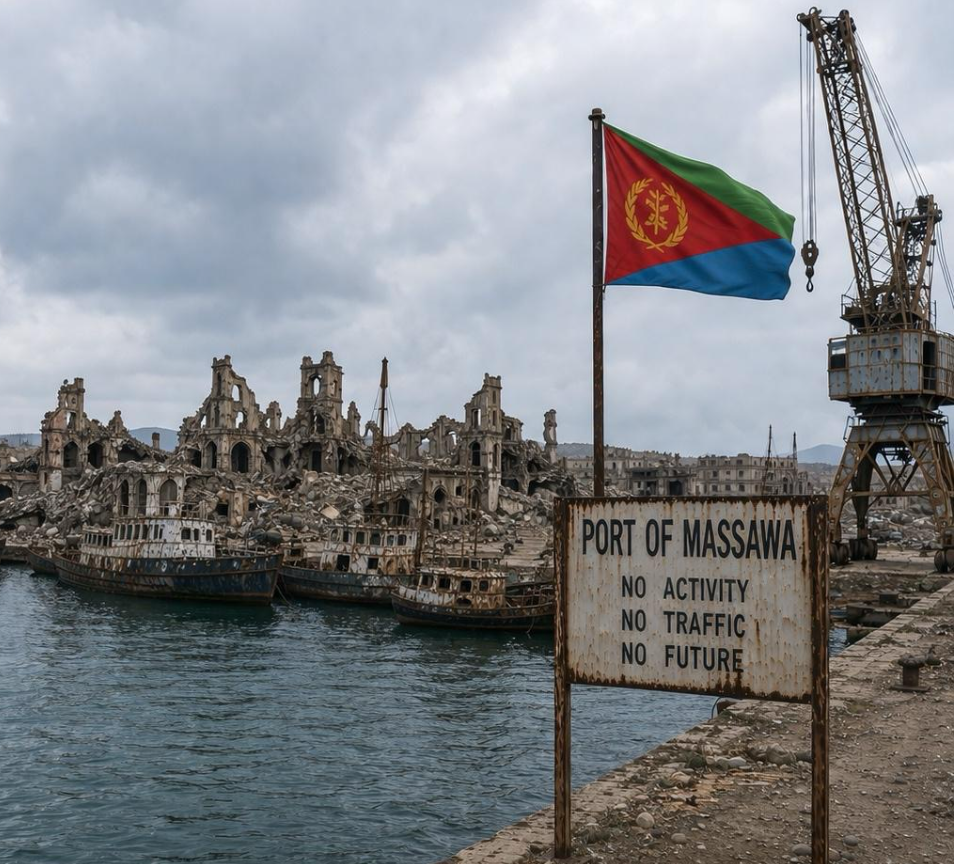
A foreign policy paper on the structural limits of Eritrean maritime power
On a map, Eritrea appears positioned for maritime relevance. Its Red Sea ports, Massawa and Assab, sit near one of the world’s most important shipping corridors linking Africa, the Middle East, Europe, and Asia. Yet geography alone does not produce maritime power. Ports derive value from the systems behind them: demand, capital, electricity, technology, institutions, security, law, labor, and trust.
Eritrea’s condition is best understood as one of economic lock. It is not simply poor or underdeveloped. It is structurally constrained from the flows of trade, finance, expertise, and confidence that make modern port economies viable.
An Economy Without Scale or Verifiability
A viable port economy requires a large and measurable economic base. Eritrea lacks both. The World Bank’s Eritrea data shows the country’s last widely available GDP figure at about 2.07 billion dollars in 2011, with no recent comparable GDP series available. The IMF has also stated that Eritrea’s economic information base has deteriorated and that data and capacity constraints limit understanding of the country’s macroeconomic situation.
This matters because port finance depends on measurable risk. Investors need credible GDP figures, trade volumes, sector data, import patterns, export capacity, and revenue projections. Without reliable data, capital becomes cautious. In infrastructure finance, uncertainty is priced before money moves.
Eritrea also lacks a diversified export base. It has no major manufacturing platform, no large reexport economy, no major industrial cluster, and no anchor industries capable of producing consistent cargo flows. A port cannot sustain itself if the economy behind it does not produce or consume at scale.
Demand, Path Dependency, and Regional Exclusion
The decisive constraint is demand. Eritrea’s ports historically mattered because they served Ethiopia, the only nearby economy large enough to generate major cargo volume. That market is gone due to long running mistrust and conflict between the two states.
Ethiopia has built its trade system around Djibouti. World Bank project documents describe the Ethiopia Djibouti corridor as the dominant gateway for Ethiopia, carrying more than ninety five percent of the country’s imports and exports. A more recent World Bank document also states that Modjo Dry Port handles more than eighty percent of incoming trade into Ethiopia and is central to the Ethiopia Djibouti corridor.
This is not a temporary arrangement. It is a case of path dependency. Railways, roads, dry ports, customs systems, contracts, and commercial habits all reinforce the Djibouti route. Once trade infrastructure is built around one corridor, changing direction becomes costly.
Eritrea is therefore not merely competing from behind. It is outside the system that already carries the region’s most important cargo flows. Without Ethiopian cargo, Eritrea has no anchor demand. Without anchor demand, there is no throughput. Without throughput, there is no revenue model.
Network Effects and Economies of Scale
Modern ports operate through network effects. Shipping lines prefer ports where other shipping lines already operate. Freight forwarders cluster around established hubs. Warehouses, insurers, customs brokers, repair firms, banks, and trucking companies follow cargo volume.
Volume attracts more volume. Scale lowers the cost per container. Lower cost attracts more shipping routes. More routes attract more cargo.
Eritrea lacks this cycle. It has low domestic cargo, no major hinterland market, no established liner route inclusion, no large shipping line partnerships, no global port operator partnerships, and no economies of scale. Its economically locked condition is reinforced by the fact that maritime networks reward countries that are already inside the network.
The Cost Barrier and Capital Exclusion
Modern ports require deep water berths, container yards, cranes, scanners, digital customs platforms, storage facilities, power systems, roads, rail links, security systems, and maintenance capacity. These investments often cost hundreds of millions or billions of dollars.
For a country whose last widely reported GDP figure is only a few billion dollars, domestic financing capacity is extremely limited. External capital is also difficult to attract because investors look for predictable cargo, credible data, legal protection, policy stability, and trusted institutions.
Eritrea struggles on each of these fronts. The result is capital exclusion. The country lacks domestic financing, faces limited international finance, carries high perceived borrowing risk, and would likely face elevated insurance costs due to political, legal, and operational uncertainty.
Technology and Operational Capability
A modern port is not merely a dock. It is a digital operating system. Containers are tracked electronically. Customs clearance is automated. Security depends on scanners, databases, surveillance systems, and chain of custody records.
Eritrea lacks the technological ecosystem required for this kind of port economy. It has weak ICT capacity, limited integration into global logistics platforms, no advanced port automation base, and no major technology partnerships. Without automation and digital logistics systems, operational efficiency remains weak.
Technology is not a luxury in port competition. It is the entry fee.
Human Capital and Institutional Knowledge
Ports require specialized expertise. They need experienced port operators, logistics professionals, customs officials, maritime lawyers, security managers, crane technicians, warehouse operators, freight forwarders, insurers, compliance officers, and maintenance teams.
Eritrea lacks a deep professional base in these fields. Human Rights Watch reports that Eritrea continues to rely on indefinite military and national service, which contributes to emigration and affects the labor force.
This creates a shortage of skilled workers and a shortage of institutional memory. The issue is not only labor quantity. It is the absence of accumulated experience in complex commercial port management.
Infrastructure Constraints
Ports depend on reliable electricity and inland transport. Eritrea faces major constraints in both.
World Bank electricity data shows that access to electricity in Eritrea remains limited. Modern port operations require continuous power for cranes, lighting, cold storage, scanners, customs platforms, security systems, and communications.
Eritrea also lacks an integrated rail system connecting its ports to major inland markets. Road infrastructure is limited, logistics connectivity is weak, and industrial infrastructure is underdeveloped. A port without reliable electricity, roads, rail, and inland logistics is not a gateway. It is a dead end.
Security, Chain of Custody, and Risk Pricing
Security is central to maritime commerce. A port is a custody system. Cargo owners, insurers, shipping lines, and importers must trust that containers will be protected from theft, tampering, smuggling, corruption, arbitrary seizure, and unexplained delay.
This requires clear chain of custody procedures, predictable customs security, accountable enforcement, and credible compensation mechanisms when cargo is lost or damaged.
Eritrea’s weak transparency raises difficult questions. Who guarantees container protection? Who investigates cargo loss? Who compensates owners? Who ensures that customs procedures are not arbitrary? Who gives insurers and shipping lines confidence that cargo will be handled predictably?
In global shipping, risk is priced before cargo moves. If risk appears unclear, insurers charge more, shipping lines hesitate, and cargo owners choose safer corridors.
Political Structure and Predictability
Eritrea has not held national elections since independence. Human Rights Watch states that President Isaias Afewerki has ruled for decades, that the 1997 constitution has not been implemented, and that no legislature has met since 2010. Freedom House describes Eritrea as a militarized authoritarian state with no national elections since independence.
This matters because port projects require long term predictability. Investors need transparent regulation, enforceable contracts, stable policy, and credible institutions. Eritrea’s prolonged transitional governance, lack of elections, weak regulatory clarity, and limited policy predictability all raise investor risk.
The issue is not only political openness. It is whether the rules of investment can be trusted for decades.
Financial and Legal Isolation
Eritrea’s financial system is underdeveloped. The United States Investment Climate Statement says Eritrea’s investment climate is not conducive to United States investment and points to sanctions, lack of a commercial code, and disconnection from international financial systems.
This supports several structural constraints: weak banking capacity, limited access to global finance, weak currency convertibility, underdeveloped capital markets, and difficulty repatriating profits.
Legal risk compounds the financial problem. Large port projects require contract enforcement, dispute resolution, investor protection, arbitration credibility, and compensation mechanisms for damaged or lost cargo. Weak legal institutions raise borrowing costs, increase insurance premiums, and discourage long term infrastructure commitments.
Absence of a Commercial Ecosystem
A port requires a surrounding commercial ecosystem. This includes freight forwarders, customs brokers, warehousing networks, trucking firms, maintenance companies, banks, insurers, repair yards, industrial zones, and free zones.
Eritrea lacks this ecosystem. Its private sector is weak, its logistics sector is thin, its integration into global supply chains is limited, and it has no major free zone or industrial cluster comparable to successful port economies.
Without this commercial ecosystem, even a renovated port would remain isolated infrastructure.
Competition, Shipping Networks, and Late Entry
Eritrea is a late entrant into a regional system that has already consolidated. Djibouti dominates Ethiopia’s trade corridor, and World Bank documents identify Djibouti as Ethiopia’s dominant port gateway. Other regional ports have foreign investment, established shipping relationships, and stronger logistics systems.
Eritrea lacks a cost advantage, a demand advantage, major shipping line partnerships, global port operator partnerships, economies of scale, and strong liner route inclusion. Shipping routes are already optimized around existing hubs. Once carriers, insurers, importers, and freight forwarders trust a corridor, they do not shift without a strong commercial reason.
Eritrea does not currently offer that reason.
Administrative, Urban, and Environmental Constraints
Administrative inefficiency further weakens competitiveness. Inefficient customs, bureaucratic delays, lack of procedural transparency, and high transaction costs all undermine port reliability.
Urban capacity is also limited. Port cities require housing, water systems, public services, roads, health services, and workforce support. Weak urban services reduce the ability to host large scale port operations.
Environmental conditions add another burden. Coastal heat, salt, corrosion, and climate related infrastructure stress increase maintenance costs. Ports require constant upkeep. In a weak financial and technical environment, maintenance becomes a structural challenge.
Trade, Diplomacy, and Strategic Orientation
Eritrea also faces trade and diplomatic constraints. Limited trade agreements, weak global trade integration, limited economic diplomacy, and historically strained regional relations reduce the country’s ability to build port based partnerships.
State priorities have long emphasized security and control over commercial openness. This means ports are often treated more as strategic assets than commercial hubs. That orientation limits private participation, foreign operator involvement, and integration into global trade systems.
Security prioritized over economic development may preserve state control, but it weakens maritime competitiveness.
Execution Risk
Port development requires more than ambition. It requires the proven ability to deliver large infrastructure projects on time, within budget, and at commercial standard.
Eritrea faces a high perceived execution risk. Investors would question whether major projects could be completed efficiently, maintained properly, and integrated into global logistics systems. Weak project delivery history, possible delays, and perceived inefficiency further reduce investor confidence.
Conclusion
Eritrea’s coastline provides geographic potential, but not maritime power.
The country is economically locked. It lacks verifiable economic data, demand, capital, technology, expertise, electricity, infrastructure, legal certainty, container security assurance, investor trust, commercial networks, shipping partnerships, and regional integration.
Ports do not create economies. Economies create ports.
Eritrea has access to the sea. It does not have access to the systems that make that access meaningful.

2 Comments
A very insightful down-to-Earth analysis. What Eritrea lacked as listed in your analysis can be compensated by working closely with Ethiopia. Eritreans should stop seeing Ethiopia as an enemy or a competitor but a country with which they should work in collaboration in order to realize the economic opportunities their ports present. They have to learn that both countries complement each other, obviously from which Eritrea benefits more
Eritrea Is Not Economically Locked — It Is Strategically Positioned
The article “Economically Locked: Eritrea Is a Maritime Dead End” by Selam Tesfaye presents a familiar argument that has circulated for years in certain Ethiopian political circles: that Eritrea’s ports are economically meaningless unless Ethiopia depends on them.
This narrative oversimplifies both Eritrea’s history and the strategic realities of the Red Sea region.
More importantly, it ignores the central reason why Eritrea’s maritime infrastructure did not become aggressively commercialized during the past two decades. Eritrea spent much of its post-independence history defending its sovereignty against repeated political, military, and economic pressure originating from successive Ethiopian governments and their international allies.
For over twenty years, Eritrea operated under constant security threats, regional instability, sanctions, diplomatic isolation, and the possibility of renewed war. Under such circumstances, expecting Eritrea to prioritize large-scale port expansion above national survival was unrealistic.
The Eritrean government and people instead focused on building resilience.
National priorities became food security, healthcare, education, self-reliance, and national defense — ensuring the country could withstand external pressure and remain sovereign despite continuous attempts to weaken it politically and economically.
That was not a sign of failure. It was a strategic necessity.
Security and Stability Were the Foundation
While critics measured Eritrea’s success only through port traffic and foreign investment figures, Eritrea focused on securing its coastline and stabilizing its internal systems.
Today, Eritrea possesses one of the most secure maritime environments in the Horn of Africa.
This matters far more than many observers acknowledge.
The Red Sea and Bab-el-Mandeb corridor remain among the most strategically important shipping routes in the world, linking Europe, Asia, the Gulf, and Africa. Global trade flows through these waters every day, making maritime security increasingly valuable in an unstable region.
In recent years, instability across surrounding areas has only reinforced the strategic importance of secure coastlines and reliable maritime access.
Ports are not valuable only because of current cargo volume.
They are valuable because of location, security, long-term potential, and geopolitical importance.
Eritrea possesses all four.
Eritrea’s Ports Were Never Meant Only for Ethiopia
The assumption that Eritrean ports have value only if Ethiopia uses them reflects a narrow understanding of modern maritime economies.
Ports today are not simply gateways for neighboring countries. They are economic ecosystems connected to energy, logistics, fisheries, transportation, tourism, shipping services, and global trade networks.
Eritrea’s long Red Sea coastline gives it opportunities that extend far beyond Ethiopian transit trade.
Fisheries and the Blue Economy
Eritrea controls one of the least exploited fishing zones in the Red Sea.
Its coastline and island networks create enormous opportunities for:
• commercial fishing
• seafood exports
• fish processing industries
• aquaculture
• marine conservation and eco-tourism
Unlike many heavily exploited coastal regions, Eritrea’s waters remain relatively preserved. As global seafood demand continues rising, this could become one of Eritrea’s strongest long-term economic sectors.
Fuel Depots and Maritime Services
Thousands of commercial vessels pass through the Red Sea shipping corridor every year.
This creates major opportunities for Eritrea to develop:
• fuel depots for international shipping
• ship maintenance and repair facilities
• dry docks
• cargo servicing centers
• maritime logistics hubs
• maritime security and support services
Assab’s geographic location alone gives Eritrea strategic importance near one of the busiest maritime corridors on earth.
A port does not need to become another Dubai overnight to generate major economic value.
Oil and Natural Gas Potential
The Red Sea basin remains underexplored compared to many global energy regions.
Future offshore oil and natural gas exploration could significantly increase Eritrea’s economic relevance in the years ahead. Combined with secure ports and maritime infrastructure, Eritrea could eventually emerge as both an energy producer and a strategic energy transit location.
Mineral Exports and Industrial Growth
Eritrea already possesses valuable mineral resources including gold, copper, zinc, and potash potential.
As mining production expands, Eritrea’s ports can support:
• mineral exports
• industrial processing
• manufacturing zones
• logistics and shipping industries
Rather than depending entirely on neighboring countries, Eritrea can increasingly connect directly to international markets through its own coastline.
Tourism and Red Sea Development
Eritrea’s coastline remains one of the least commercialized and least overdeveloped coastal regions in the world.
Massawa itself is a historic Red Sea port city with enormous cultural and architectural significance.
With long-term investment and stability, Eritrea could eventually expand into:
• Red Sea tourism
• diving tourism
• eco-tourism
• island tourism
• luxury coastal development
Few countries still possess such relatively untouched coastal assets.
Eritrea’s Strategic Position Between Africa and the Middle East
Another overlooked reality is Eritrea’s geographic position between Africa, the Gulf, and Southern Europe.
In the future, Eritrea could also develop into:
• a regional cargo transit hub
• a maritime-air logistics center
• an aviation connection point between Africa and the Middle East
• a strategic trade and transport corridor
As African trade integration expands, Eritrea’s geographic importance will likely continue increasing.
Sovereignty Before Dependency
Critics often portray Eritrea’s slower economic development as proof that the country failed.
But Eritrea chose a different path from many externally dependent states.
Rather than sacrificing sovereignty for short-term economic gains, Eritrea prioritized national resilience, food security, internal stability, and independence during one of the Horn of Africa’s most volatile periods.
That decision carried economic costs. But it also preserved Eritrea’s strategic autonomy.
Now, as the geopolitical importance of the Red Sea grows once again, Eritrea is entering a new phase where opportunities delayed by years of conflict and pressure can finally begin to materialize.
The future of Eritrea’s ports will not be determined solely by Ethiopia.
It will be determined by Eritrea’s ability to leverage its geography, secure coastline, natural resources, maritime stability, and strategic position along one of the world’s most important trade corridors.
Eritrea is not a maritime dead end. It is a strategic maritime frontier whose full potential is only beginning to emerge.