




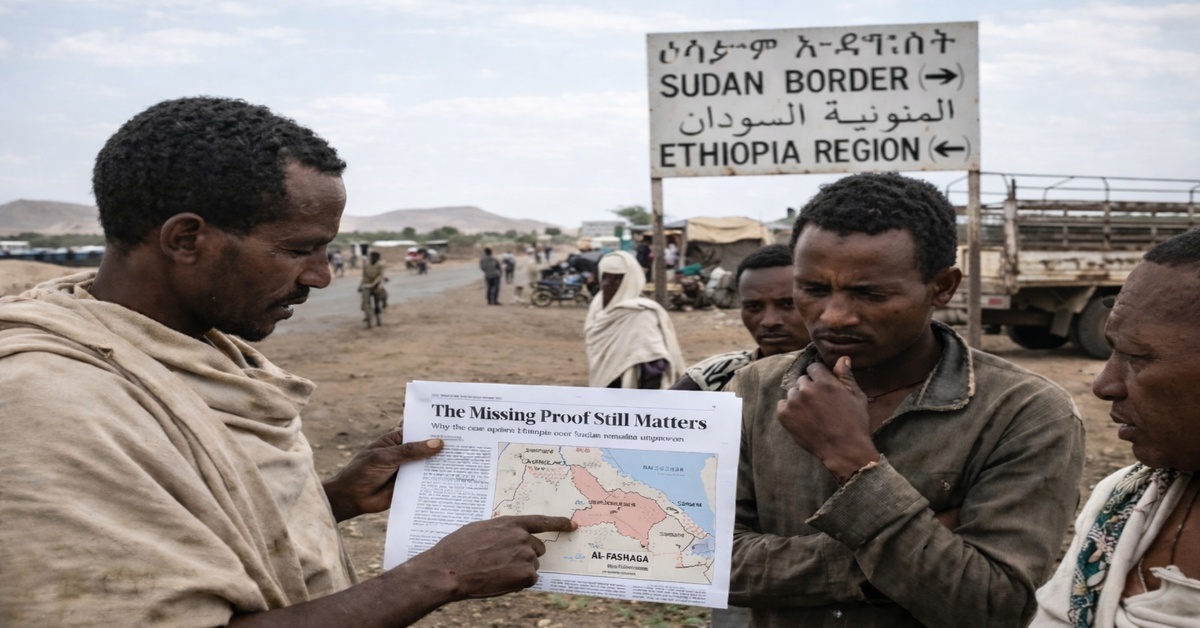
Accusation against Ethiopia over Sudan’s internal war remains unproven despite a growing campaign to present it as settled fact
Follow up analysis
This article follows The Missing Proof Behind Claims of Ethiopian Support for the RSF of Sudan . Its purpose is not merely to urge caution. It is to challenge the attempt to turn the Reuters and Bloomberg line into an established fact pattern before the evidence can bear that weight.
There is a difference between allegation and proof. In the campaign to portray Ethiopia as a confirmed backer of the Rapid Support Forces in Sudan, that difference has been steadily erased. A disputed site, anonymous sourcing, contested interpretation of imagery, and a flood of social media amplification have been pushed as though they amount to a settled case. They do not. That is not rigorous foreign policy analysis. It is a rush to verdict in the middle of a war.
The central problem is simple. The strongest public reporting used to build this case, above all the widely cited Reuters investigation , did not actually close the matter. It escalated it. Reuters advanced serious allegations, but it also contained important caveats and verification limits. Bloomberg helped widen the narrative, but wider circulation is not the same as stronger proof. In that sense, the Reuters Bloomberg line has not been established. It has been challenged, and it remains unproven.
That matters because the accusation is not minor. To claim that Ethiopia is directly aiding one side in Sudan’s civil war is to allege a major regional escalation. A claim of that magnitude requires independently verifiable evidence linking a specific site, specific personnel, and a clear operational chain to the alleged activity. On the public record, that threshold still has not been met.
That is why the earlier Abren article remains important. It did not argue that every allegation against Ethiopia was impossible. It argued that the leap from ambiguous observation to categorical conclusion was not justified by the evidence available. That remains the central flaw in the current narrative. A location can be observed. Construction can be observed. Trucks can be observed. What cannot be established from such material alone is the full identity, mission, and chain of command of everyone present.
There is also a basic strategic logic problem that has never been answered. If Ethiopia were to involve itself directly in Sudan’s war, it would not be risking a marginal tactical move. It would be risking higher order national interests, above all its room for maneuver around the Nile dispute and the already charged politics surrounding the Grand Ethiopian Renaissance Dam. It is difficult to believe Addis Ababa would knowingly create a fresh opening for diplomatic, military, and informational escalation against itself at the very moment it has every reason to avoid new vulnerability on the GERD file. A state under pressure does not normally respond by handing its principal rival an even stronger case against it.
The specific claim that Ethiopia would host RSF elements inside or beside an ENDF linked camp is even harder to sustain. From a basic security standpoint, that would create obvious force protection, counterintelligence, and sovereignty risks. No serious state lightly inserts a foreign non state armed actor into sensitive military infrastructure on its own territory during an active regional conflict. Such a move would expose Ethiopia to infiltration, deniability costs, internal security liabilities, and political blowback for little obvious gain. Even if one assumes some form of involvement in theory, it is still difficult to explain why Ethiopia would choose the most politically costly and operationally reckless method available. If Ethiopia were involved at all, it would be illogical for it to fold the RSF into ENDF infrastructure for basic state security reasons.
The geographic logic is no stronger. If there were truly a covert camp in the area being discussed, it would be an extraordinarily naive place to put one if the surrounding zone is, as critics have argued, already crowded by outside actors, mining related activity, commercial presence, multiple mining sites, and foreign entities operating in the vicinity. A setting like that is not ideal for covert military work. It is ideal for observation, rumor, analytical confusion, misidentification, and competing narratives. Rather than preserving secrecy, it would magnify exposure. That is one reason the counterclaim that the site is more plausibly a mining related installation than an army base has resonated so strongly in online rebuttals, including this post.
Whether every counterclaim is correct is a separate question. The point is that the geography itself does not naturally support the certainty with which the accusation is being made.
The allegation becomes still less convincing when placed in the wider regional setting. If Egyptian, Eritrean, and TDF linked or Sudan based anti Ethiopian actors are already operating openly or semi openly on Sudanese territory, then Sudan itself already provides the more plausible arena for covert interaction among forces hostile to Ethiopia. Under those conditions, it would make little strategic sense for Ethiopia to import that risk onto its own soil and transform an external war into a direct domestic liability. The accusation asks the reader to believe not only that Ethiopia was involved, but that it chose the least disciplined, least secure, and most self damaging way to be involved.
This matters even more because far less attention has been paid to foreign involvement on the other side of the war. Egypt’s role is not a matter of conjecture. It is documented. At the start of the war, Reuters reported that the RSF circulated video showing Egyptian troops in custody at Merowe, while Egypt acknowledged that its forces were in Sudan for joint exercises with the Sudanese army. A few days later, Reuters also reported that 177 Egyptian troops had returned to Cairo and that 27 Egyptian air force personnel had been detained after the fighting around Merowe air base. Egypt’s physical presence on Sudanese soil at the start of the war is therefore established fact.
That role appears to have deepened. In February 2026, Reuters reported that Egypt had provided logistical and technical support to the SAF and that satellite imagery showed a Bayraktar Akinci drone at East Oweinat near the Sudan border. Reuters described that deployment as a significant escalation. That does not prove every battlefield rumor circulating online, but it does establish something much more important. Egypt is not a distant commentator on Sudan’s war. It is a proven supporter of the SAF.
More recent reporting points in the same direction. Africa Intelligence reported in March 2026 that Brigadier General Ahmed Samir Abdel Wahab Noor Al Din was killed in connection with a Sudan mission, reportedly alongside other Egyptian personnel. Reports surrounding that case have presented his death as evidence of deeper Egyptian involvement, including reported assistance to the SAF in drone related activity around Kosti. The existence of the death report matters. The precise mission profile should still be described carefully as reported rather than conclusively established unless supported by additional primary confirmation. But the broader pattern is difficult to deny. Egyptian exposure in the theater is real and growing.
Sudan’s war is also being narrated selectively. Far less attention has been paid to claims and reporting involving TDF linked remnants, Army 70 elements, and She’abia or Eritrea aligned insurgent networks operating from or through Sudanese territory and, according to these claims, fighting alongside or otherwise intersecting with SAF aligned military dynamics. Whether every operational detail can be independently verified is a separate question. The broader point is that Sudanese territory has not only been used as the setting for accusations against Ethiopia. It has also reportedly served as a space in which anti Ethiopian armed and political networks, including TDF associated and Eritrea linked actors, have regrouped, maneuvered, or aligned in ways hostile to Ethiopia. That asymmetry matters because weakly substantiated allegations against Ethiopia are often elevated to near certainty while hostile armed activity on Sudanese territory is treated as secondary.
This broader context is essential because the claims against Ethiopia are not emerging in a vacuum. They are being made in an environment where Egypt’s support to the SAF is documented, where Eritrean linked activity is part of the wider regional picture, and where narratives about Ethiopia are being pushed through an increasingly aggressive online campaign.
The cited posts are valuable not because they independently prove every operational claim, but because they illustrate the structure of the information war itself. Some point to the broader anti Ethiopian military and political environment in Sudan. Threads such as these below matter because they reflect an argument that after the war in Ethiopia began in 2020, some TDF linked remnants, including references to Army 70, moved through or into Sudan and became part of a broader anti Ethiopian landscape intersecting with Eritrean and Egyptian interests. Whether each individual detail in those posts is independently verifiable is a separate question. What matters here is that they complicate the simplistic story in which Ethiopia alone is cast as the covert destabilizer while activity by anti Ethiopian elements on Sudanese territory is treated as peripheral or ignored.
Other posts are important because they reveal a different layer of the campaign. The account FaisalElsheikh presents itself in the register of OSINT analysis, yet much of the material circulated around that account has been challenged as unverified, overstated, or contradicted.
The same concern applies to accounts such as AfrimeOSINT, which has been criticized as part of a stream of repeated and unfounded accusations directed at Ethiopia while presenting itself through anonymous or highly stylized branding, including what critics describe as AI generated profile imagery. Whether that characterization is correct in every detail is less important than the larger pattern. The pattern is the repeated transformation of weakly substantiated claims into a posture of certainty.
That is why the rebuttal material matters. Posts such as this one from Yousrael Bagir https://x.com/yousraelbagir/status/1998989180160917891?s=46 and this one from hkzuk https://x.com/hkzuk/status/1999027233575338152?s=46 are relevant because they push back against the certainty being manufactured around the alleged base narrative. The wider chain of posts, including this (https://x.com/faisalelsheikh/status/2003165521316053060?s=46), this (https://x.com/faisalelsheikh/status/2003165492937437549?s=46), this (https://x.com/faisalelsheikh/status/2003165497475629395?s=46), this (https://x.com/faisalelsheikh/status/2003165502118719792?s=46), this (https://x.com/faisalelsheikh/status/2003165506975527218?s=46), this (https://x.com/faisalelsheikh/status/2003165511132282903?s=46), this (https://x.com/faisalelsheikh/status/2003165515586629710?s=46), and this (https://x.com/faisalelsheikh/status/2003165529780158891?s=46), helps demonstrate the ecosystem through which contested or weakly verified claims are repeated until they begin to look like established truth.
That ecosystem did not appear overnight. The larger anti Ethiopian narrative field has long included aggressive messaging streams, including older examples such as this one (https://x.com/eekadfacts/status/1427582160744194049?s=46). More recent posts such as this post by EthiopiansOne (https://x.com/ethiopiansone/status/1749112558148030523?s=46), this post by Nate Jone (https://x.com/nate_jone/status/1950904093364342814?s=46), and this post by Walad Kosti (https://x.com/waladkosti/status/1844139149407944879?s=46) are useful in the same way. They may tell us something about agenda, repetition, framing, and perception shaping. They do not, by themselves, establish the truth of the underlying allegation. In a war saturated by propaganda, that distinction is not optional. It is fundamental.
The historical backdrop matters too. The Tigray war began in 2020. Current attempts to connect TPLF or TDF remnants, Army 70, Sudan based actors, Eritrean involvement, Egyptian support, and alleged Ethiopian backing for the RSF all draw on that post 2020 landscape of fragmentation and proxy competition. Some fragments may be real. But fragments do not automatically prove the larger structure activists, partisan commentators, and self styled investigators are trying to build around them.
The wider regional alignments further complicate any simple narrative. The United States is not aligned with the SAF leadership or with Sudanese Islamist currents linked to the Muslim Brotherhood. The US Treasury sanctioned Abdel Fattah al Burhan in January 2025 (https://home.treasury.gov/news/press-releases/jy2789), and later sanctioned Sudanese Islamist actors including the Al Baraa Bin Malik Brigade (https://home.treasury.gov/news/press-releases/sb0246). That matters because it shows that Washington’s position is adverse both to the SAF command and to Islamist militia networks fighting in its orbit. Washington, in other words, is adverse to both Burhan and the Islamist militia ecosystem around the SAF. The Muslim Brotherhood issue is therefore not rhetorical background. It is part of the actual policy map shaping how external actors assess legitimacy, threat, and alignment in Sudan’s war.
Instead, the alignment picture is fractured. Egypt is a documented supporter of the SAF. Eritrean linked actors have been reported on the SAF side of the conflict environment. Iran has been linked in reporting to support for the Sudanese army. The UAE has long been accused of backing the RSF. The result is not a simple binary but a crowded regional contest in which rival powers back different actors for different strategic reasons. Any analysis that foregrounds allegations against Ethiopia while muting these wider alignments produces a distorted account of the war. A serious foreign policy reading of the available record therefore points to three conclusions.
First, there is still no independently verified public proof that an Ethiopian run RSF base or a proven Ethiopian military base in Sudan has been established beyond doubt. The most serious allegations remain unproven. Much of what has been offered publicly remains a chain of claims, inference, and repetition, including claims marked by serious evidentiary gaps.
Second, there is substantial evidence that Sudan’s war has become a theater for multiple outside actors, and Egypt in particular is a documented supporter of the SAF rather than a neutral bystander.
Third, the campaign to frame Ethiopia as a confirmed belligerent has become more confident than the available evidence warrants, in large part because social media repetition, geopolitical hostility, and weakly substantiated accusations have been allowed to substitute for proper verification.
The proper conclusion is therefore not that every allegation against Ethiopia is impossible. It is that the strongest allegations remain unproven. In the absence of independent verification, they cannot honestly be presented as settled fact. They should be treated for what they presently are: claims advanced in the fog of war, useful to some actors, loudly amplified by others, but still unproven.
Proof is not whatever survives repetition. Proof is what survives scrutiny. On that standard, the case against Ethiopia still does not hold.
