




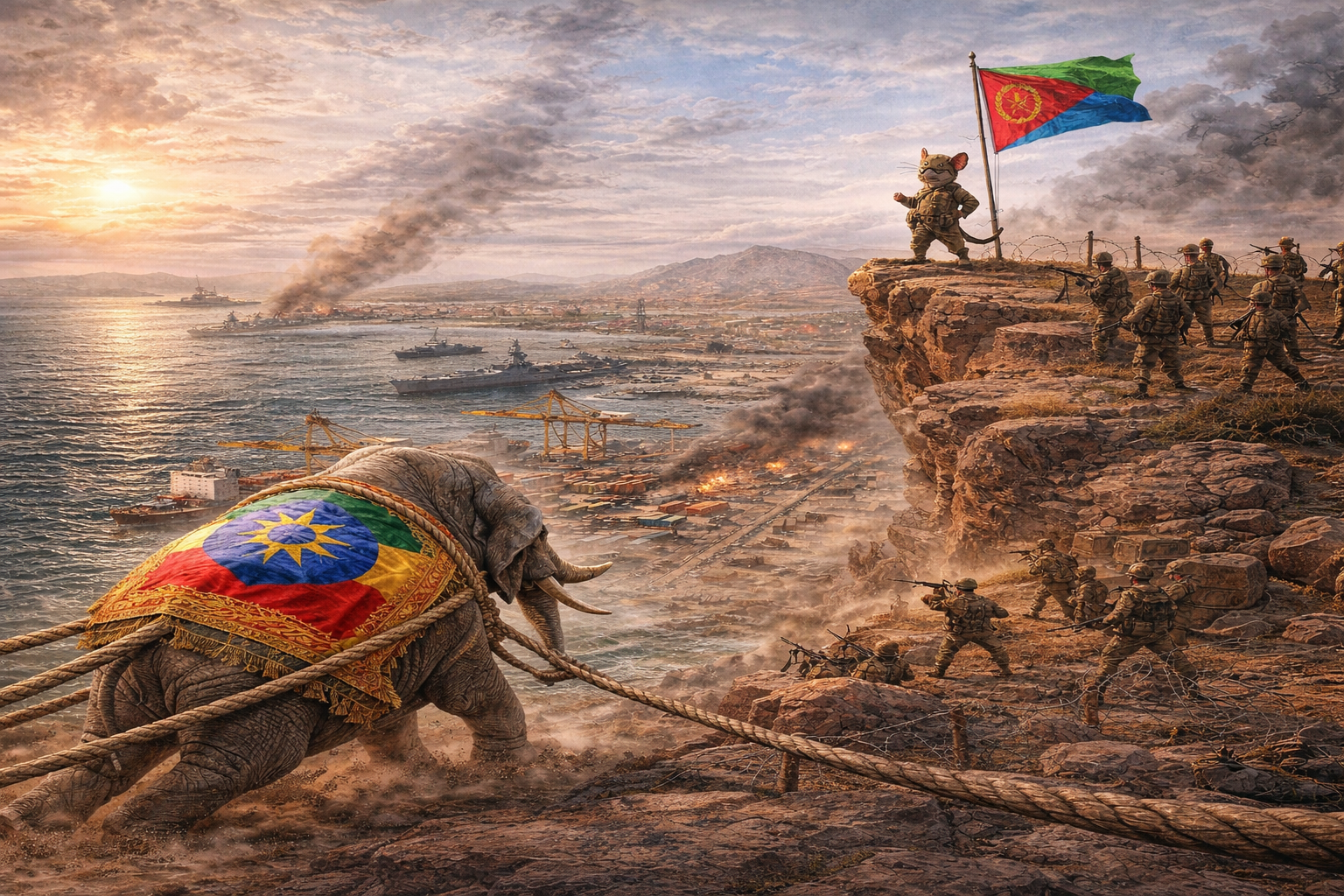
In the Horn of Africa, geography has produced a confrontation that is no longer merely diplomatic but structural. The relationship between Eritrea and Ethiopia reflects a widening divergence between stagnation and inevitability. One country, small, rigid, and economically dormant, sits on strategic coastal assets it has yet to meaningfully develop. The other, vast and demographically dynamic, continues to expand despite internal and external pressures, constrained not by lack of ambition but by lack of access. The imbalance is striking not simply because of size, but because of trajectory. Eritrea projects defiance disproportionate to its economic weight, while Ethiopia, far larger and more complex, finds itself in the unusual position of negotiating for the basic infrastructure required to sustain its growth. The contrast resembles a familiar metaphor: the mouse that roars and the elephant that is no longer willing to pay simply to breathe.
Eritrea’s economic model has produced remarkably little change over time. Its cities and ports, including Assab, occupy a prime position along one of the world’s most critical maritime corridors, yet remain underutilized and largely disconnected from global trade. In an era where connectivity determines competitiveness, idle infrastructure does not confer leverage. It reflects lost opportunity and saps confidence. A coastline that could anchor regional commerce, attract investment, and integrate supply chains instead sits dormant, constrained by a system that prioritizes control over growth. This stagnation is not imposed from outside. It is the product of deliberate policy choices that have favoured isolation over participation in the global economy.
Ethiopia, by contrast, continues to move forward with a sense of urgency shaped by both ambition and necessity. Its economy, while uneven and periodically disrupted by internal conflict, has expanded through large scale investments in infrastructure, energy, and industrial capacity. Its population, one of the largest and youngest in Africa, generates constant pressure for job creation and economic expansion. Growth is not a policy preference but a structural requirement. A country of such scale cannot afford prolonged stagnation without risking instability. As a result, Ethiopia’s posture remains outward looking, even when doing so exposes it to new vulnerabilities.
Those vulnerabilities are most evident in Ethiopia’s lack of direct access to the sea. Its landlocked status imposes costs that are both economic and strategic, forcing reliance on external corridors and exposing trade flows to political and logistical risk. For years, this dependency has translated into substantial payments for port access, an arrangement that was tolerated when alternatives were limited and regional dynamics relatively stable. That context is now changing. The global environment has become more uncertain, and the risks associated with concentrated supply routes have increased significantly.
The Strait of Hormuz remains a persistent flashpoint, where any disruption could reverberate across global energy and trade networks. At the same time, instability along the Red Sea, including attacks linked to the Houthi movement, has demonstrated how quickly maritime corridors can become contested. Shipping delays, rising insurance costs, and security risks are no longer hypothetical concerns. In such a context, dependence on a narrow set of access points is not merely inefficient. It is increasingly untenable for a country of Ethiopia’s size and trajectory.
Against this backdrop, Ethiopia’s push for alternative arrangements, whether through shared ownership, long term investment, or diversified access points, reflects a shift from economic convenience to strategic necessity. The question is no longer whether Ethiopia should pay for access, but whether it should remain structurally dependent on others for a lifeline it cannot do without. No major economy willingly sustains such a position indefinitely. The logic of securing more stable and autonomous access to maritime trade is therefore not aggressive. It is predictable.
Complicating this already fragile situation is a deteriorating regional security environment marked by overlapping conflicts and shifting alliances. Even The Economist has warned that tensions between Ethiopia and Eritrea are “reconfiguring alliances across the Horn of Africa” and pushing the region closer to renewed conflict. Reports from multiple sources indicate a growing web of proxy dynamics, in which state and non state actors interact in ways that blur the line between domestic and regional conflict. Ethiopia has formally accused Eritrea of supporting armed groups and engaging in military activity along contested borders, while analysts point to evidence of shifting alignments involving actors such as the Tigray People’s Liberation Front. These claims remain contested in detail, but the broader pattern of entanglement is widely acknowledged.
Historical precedent reinforces these concerns. Eritrea has, at various points, been linked to support for insurgent movements within Ethiopia, including factions associated with the Oromo Liberation Army and the Fano, though such allegations are often disputed and difficult to independently verify. More recent reporting also points to Eritrean involvement in the aftermath of the Tigray conflict, including the continued presence of its forces in border areas within the Tigray Region. Taken together, these dynamics contribute to a regional environment in which tensions are not contained but layered, increasing the risk of escalation.
In such a scenario, Eritrea’s economic posture carries not only opportunity costs but also strategic risk. A port that remains underdeveloped and disconnected from regional trade networks lacks the protective buffer that economic integration can provide. In the event of renewed conflict, infrastructure such as Assab would no longer be passive assets but potential focal points of confrontation. Analysts have already warned that the Horn of Africa is approaching a tipping point, with military buildups and political rhetoric indicating a growing likelihood of escalation. In that context, the assumption that unused infrastructure will remain insulated from conflict appears increasingly optimistic.
The contradiction at the heart of Eritrea’s position is therefore difficult to ignore. It avoids economic integration while remaining deeply embedded in regional security tensions. It leaves valuable assets idle while exposing them to geopolitical risk. It resists cooperation even as the surrounding environment becomes more volatile. This is not simply a conservative strategy. It is a form of isolation that carries increasing costs.
Ethiopia, by contrast, operates under a different set of constraints. Its economy will continue to expand, driven by demographic pressure and structural necessity. Its need for reliable access to global markets will intensify rather than diminish. And its tolerance for dependency, particularly in an era of rising geopolitical uncertainty, is likely to decline. These are not policy choices that can be easily reversed. They are structural forces that shape behaviour over time.
There remains, at least in theory, an alternative path. Shared investment, joint ownership of port infrastructure, and deeper economic integration could align incentives and reduce the risk of conflict. Eritrea could transform its coastline into a driver of growth, while Ethiopia could secure access without relying on perpetual external payments. Such an arrangement would not eliminate tension, but it could mitigate it by embedding both countries within a framework of mutual interest.
Yet the window for such cooperation appears to be narrowing. As pressures build, both economic and strategic, the cost of inaction rises. In a region already described as edging closer to war, the consequences of unresolved tensions are unlikely to remain confined to economics.
The mouse may continue to roar.
But the elephant is no longer willing to suffocate.
