




In the evolving information battles surrounding Ethiopia’s internal conflicts, a sophisticated and increasingly transnational ecosystem of digital actors has emerged in shaping perception. These social media accounts frequently present themselves as Ethiopian, adopting local names, symbols, and linguistic patterns, yet their output reflects technical precision, geopolitical awareness, and narrative coordination that suggests something more structured than organic discourse. Their posts do not simply report developments. They construct them. Through selective framing, repetition, and the growing use of artificial intelligence imaging tools, these actors have built a parallel narrative environment in which armed groups such as Fano are consistently portrayed as more capable, more coordinated, and more technologically advanced than independently verifiable evidence supports.
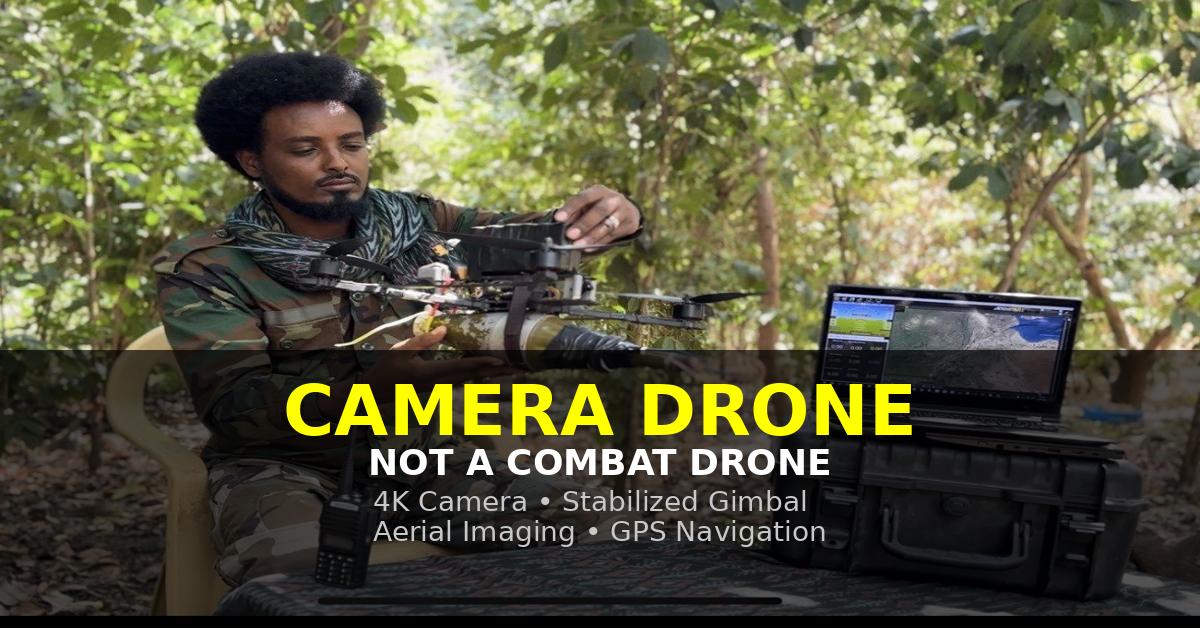
A striking example of this narrative construction lies in the widespread circulation of imagery showing what is, in reality, a commercially available camera drone. Across multiple accounts, including @hammerofwar, @NotWoofers, and @zeyede1264, such imagery has been framed as evidence of advanced battlefield drone capability attributed to Fano. The implication is deliberate. By drawing visual parallels with the Ethiopian National Defense Force, these posts suggest parity in technological sophistication. Yet the drone itself is not a military system. It is a consumer grade device widely used for photography and videography. The gap between what is shown and what is implied illustrates the mechanics of narrative inflation, where perception is engineered not through fabrication alone but through selective contextual distortion.
Amplification does not rely on a single tactic. It operates through layered networks of reinforcement. Accounts such as @Hoaaffairs, while not associated with the circulation of this specific drone imagery, play a significant role in elevating broader Fano related narratives. With a following approaching 50 thousand and a profile listing Addis Ababa as its location, the account consistently promotes content portraying Fano as a highly capable and organized force, reinforcing the same perception through scale and repetition. Other accounts, including @Tsiond11 and @nebyg_G, have been flagged by observers as potentially aligned with Eritrean information networks, while @hammerofwar5and @NotWooferscontinue to publish highly technical battlefield analysis from outside the region, often with a level of specificity uncommon in grassroots reporting.
The account @zeyede1264 further contributes to this environment through posts such as the widely circulated clip
which shows what is described as a Fano leader communicating via walkie talkie in Arabic. Regardless of the full context of the clip, its circulation serves a clear narrative function. It introduces the suggestion of external coordination, reinforcing the broader theme that the conflict is not purely domestic but shaped by actors operating beyond Ethiopia’s borders.
This ecosystem is reinforced by media aligned amplification. One of the most visible examples is the Egypt linked platform operating under Daily News Egypt’s Africa vertical, which has repeatedly amplified and, in some cases, lionized Fano narratives, including here
This amplification becomes particularly significant when viewed alongside U.S. government security framing. The Immigration and Customs Enforcement reference to a Tier III terrorism related classification framework, which includes mention of Fano within a broader legal context, is documented here
Tier III classification does not function as a formal designation. It is a legal standard used in immigration and national security contexts to identify groups associated with terrorist activity. Its invocation in relation to Fano introduces a central contradiction. While the group is referenced within a terrorism related framework, it is simultaneously being amplified across transnational digital networks as a capable and increasingly sophisticated military force. This dual framing is not incidental. It reflects a strategic information environment in which the same actor can be vilified or elevated depending on the interests of those shaping the narrative.
Eritrea’s role must be understood within a longer history of proxy engagement and indirect conflict. Ethiopian officials have accused Eritrea of arming and supplying Fano through cross border logistical channels. Eritrea has denied these allegations, but the historical pattern is well established. Eritrea has presistantly hosted, trained, and supported Ethiopian insurgent movements as part of its strategy to erode the Ethiopian state. Contemporary analysis continues to point to the possibility of logistical pathways facilitating material support, while digital narratives reinforce the perception of a strengthened and externally connected armed group, which contributes to a wider narrative environment linking Eritrea to evolving conflict dynamics in Sudan and across the Horn of Africa.
Turkey’s position intersects with these developments through its alignment with Somalia and its clear opposition to the recognition of Somaliland. Ethiopia’s memorandum of understanding with Somaliland directly challenges this alignment, particularly in relation to Red Sea access and regional trade routes. In this context, narratives portraying Ethiopia as unstable or internally divided serve a strategic function. They weaken Ethiopia’s negotiating leverage while reinforcing the positions of Turkey and Somalia. Somalia itself has a direct stake in this narrative environment, as any perception of Ethiopian instability strengthens Mogadishu’s argument against Somaliland’s recognition and reinforces its claims over territorial integrity.
Sudan introduces an additional layer of complexity, both through its internal conflict and through overlapping narrative frameworks. Claims alleging Ethiopian involvement in Sudan, including assertions of drone strikes and military bases, have circulated widely despite being disputed or debunked, including cases where alleged military installations were later identified as civilian or commercial sites. At the same time, ideological narratives have been amplified, including the circulation of this video, which shows Abdel Fattah al Burhan referencing Islamist aligned battalions. The broader context includes U.S. State Department sanctions targeting certain Muslim Brotherhood linked entities and Sudan’s historical association with Islamist networks under Omar al Bashir. While the extent of current institutional ties remains contested, the narrative itself has become a strategic instrument shaping external interpretation of the conflict.
Egypt’s role is perhaps the most structurally embedded. The Grand Ethiopian Renaissance Dam remains central to Cairo’s national security concerns, and Ethiopia’s internal stability is directly tied to its negotiating leverage over Nile waters. An Ethiopia portrayed as fragmented, unable to control internal armed actors, or facing expanding insurgency is an Ethiopia with diminished diplomatic weight. Within this framework, Egyptian media ecosystems, including Daily News Egypt and its Africa focused platforms, contribute to shaping regional discourse. Their repeated focus on Ethiopian conflict narratives, combined with amplification of groups such as Fano, aligns with a broader strategic objective of influencing perception in a way that indirectly strengthens Egypt’s negotiating position in GERD related negotiations.
The convergence of these dynamics raises a fundamental question. Why is a localized armed group receiving disproportionate international amplification, sustained analytical attention, and detailed military framing from accounts operating across multiple continents. If Fano is simultaneously referenced within a terrorism related framework while being elevated as a capable and technologically advancing force, the contradiction is not incidental. It reflects a layered information environment in which perception is actively constructed to serve strategic ends.
Across Eritrea, Egypt, Sudan, Turkey, and Somalia, a consistent pattern emerges. Each actor has a stake in Ethiopia’s internal trajectory, whether through security concerns, territorial disputes, economic interests, or geopolitical positioning. Digital narratives that exaggerate conflict, elevate armed groups, and introduce ambiguity are not neutral artifacts of online discourse. They are instruments of influence. They shape negotiations, alter alliances, and redefine how both regional and international audiences understand power in the Horn of Africa.
In this environment, the central question is not whether individual claims are true or false in isolation, but what function they serve collectively. Increasingly, the answer points beyond Ethiopia itself. The amplification of Fano, the framing of conflict, and the projection of instability do not align with Ethiopia’s strategic interests. They align with the interests of those seeking to shape outcomes in the Horn of Africa from the outside.
