




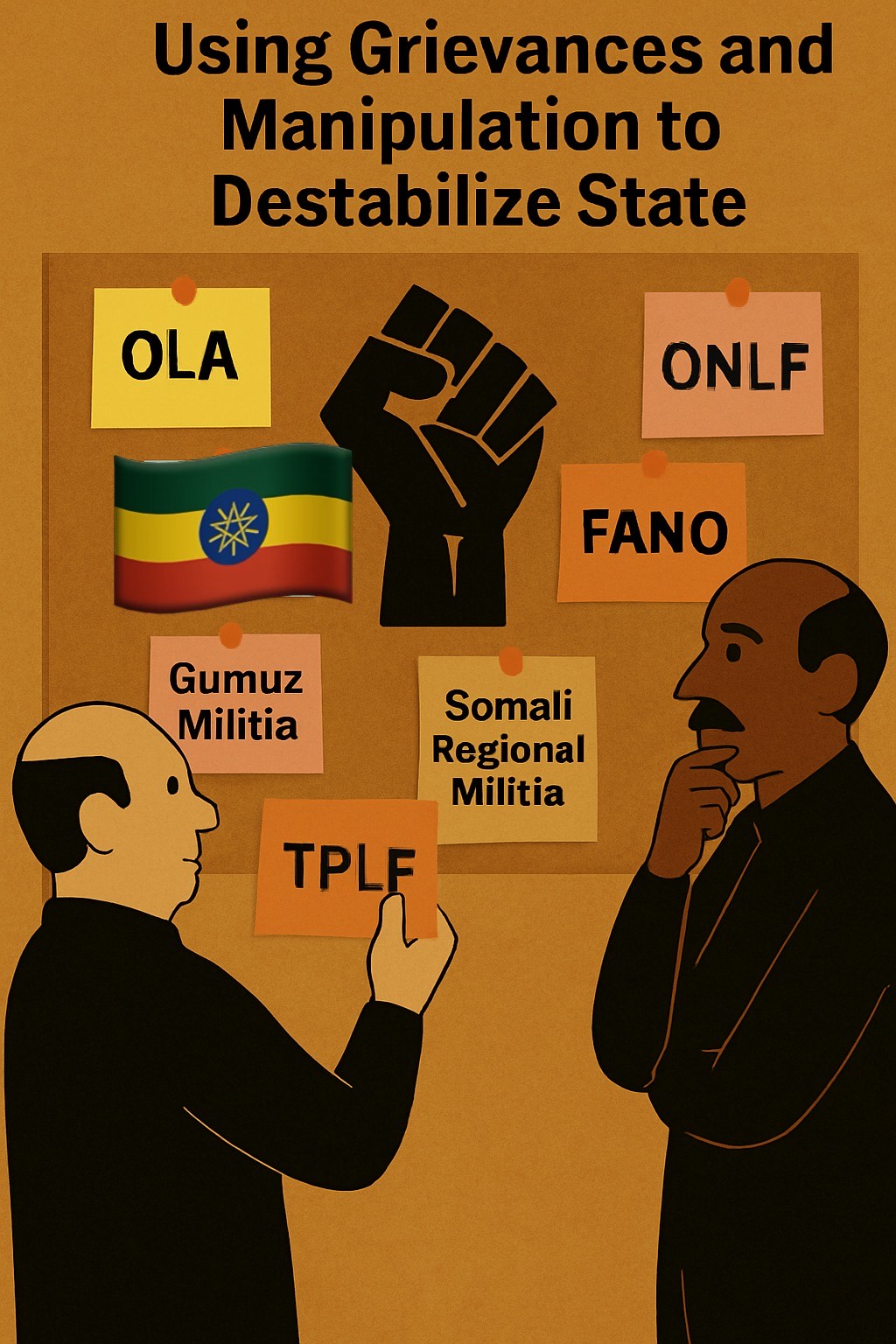
Throughout modern history there has been a recognizable pattern in how certain states are weakened from within. The tactic relies on exploiting ethnic grievances, turning diversity into division and frustration into political chaos. It is a strategy designed not to reform governments but to render them ungovernable.
A clear hallmark of such destabilization campaigns is their repetition of imagery and message. Across nations, slogans, colors, and symbols are recycled to create an illusion of spontaneous uprising. These efforts are often coordinated not necessarily by armies but by information networks, activist groups, and foreign sponsors who amplify small movements into global causes.
At first the movements exploit real discontent such as economic inequality, ethnic favoritism, or corruption, but soon escalate toward violence. Protesters provoke security responses that are quickly labeled tyrannical, while social media floods with outrage, images of clashes, and calls for international condemnation.
The aim is to delegitimize the state, fracture the population, and attract outside sympathy. Although the participants often represent a small minority, they are portrayed as the voice of the nation. Once governments are pressured to yield, these same movements silence dissent, control the media, and often fail to govern effectively, leaving behind fragile institutions and deep resentment.
Ethiopia’s experience illustrates how such a process unfolds through ethnic polarization, external manipulation, and media distortion.
External Interference and Armed Groups: A Chronological Record
Over the past decade numerous investigations have described Eritrea’s involvement with armed groups operating in or around Ethiopia.
2012: A UN Monitoring Group report documented evidence that Eritrea provided training and funding to opposition movements such as the ONLF, OLF, TPDM (Demhit), Ginbot 7, and ARDUF.
2013: A leaked Egyptian parliamentary discussion captured senior politicians talking about supporting Ethiopian rebels to weaken the country over the Grand Ethiopian Renaissance Dam (GERD). Al Jazeera and AP reported the footage widely.
2016–2018: Some exiled Ethiopian groups closed Eritrean bases following the peace accord between Prime Minister Abiy Ahmed and President Isaias Afwerki.
2020–2022: During the Tigray war, Eritrean troops fought inside Ethiopia, as confirmed by reports from the United Nations Office for the Coordination of Humanitarian Affairs.
2023–2025: The Economist and other analysts noted Eritrea’s strategic interest in a fragmented Ethiopia, suggesting support for Fano militias destabilizing the Amhara region.
This timeline shows that external actors have repeatedly exploited Ethiopian divisions, first by backing armed groups and later by nurturing disinformation that deepens mistrust and violence.
The Media and Personalities Shaping the Narrative
Alongside physical warfare runs an equally influential information war. Several foreign commentators have shaped international perceptions of Ethiopia’s conflicts, often portraying themselves as defenders of the Amhara cause or champions of justice.
They first made their names by opposing gun wielding insurgents such as the Tigray People’s Liberation Front (TPLF) and the Oromo Liberation Army (OLA), whose attacks killed ENDF soldiers and aimed to destabilize the government and seize Addis Ababa. In doing so they earned public trust among Ethiopians who felt misunderstood by Western outlets.
Figures like Jeff Pearce, Jemal Countess, and Graham Peebles became prominent voices, their work challenging narratives that sympathized with insurgents. Yet over time many of these same voices changed tone, now presenting the government in Addis Ababa as the aggressor and militias like Fano as defenders of the people.
On X (formerly Twitter) and through independent blogs they share emotive photos and commentaries that frame the conflict as an Oromo government versus Amhara population, turning social grievances into moral crusades. But this portrayal distorts reality.
Prime Minister Abiy Ahmed was born to an Oromo father and Amhara mother, married to an Amhara woman, and his children are majority Amhara by heritage. His cabinet is multiethnic, and the Prosperity Party unites representatives from all major regions. Ethiopia’s leadership is therefore national, not ethnic.
Labeling the administration as an Oromo government is a false narrative, a deliberate simplification meant to mobilize anger. It functions as a fake humanitarian scream shielded as war enthusiasm, masking political motives behind calls for justice.
Equally revealing is what these commentators omit. They speak at length about alleged government abuses but remain silent on the Eritrean regime’s long standing repression. Organizations like Amnesty International and Human Rights Watch consistently describe Eritrea as a police state with indefinite conscription and no free press. Yet such realities rarely appear in the humanitarian storytelling of those now advocating for Fano.
This selectivity raises an obvious question. Why do commentators who are not from the continent express outrage only toward Ethiopia while avoiding criticism of Eritrea The imbalance mirrors the communication strategy of Shabia, Eritrea’s ruling party, which benefits from deflecting attention toward Ethiopian divisions.
Understanding this bias is vital. It reveals how storytelling can be weaponized, how empathy can be turned into propaganda, and how foreign voices can influence domestic polarization without accountability.
The Path Forward
Ethiopia’s resilience has always come from its diversity and shared sense of destiny. To survive the storm of ethnic manipulation and foreign interference, it must reject opportunistic politics and reaffirm national unity.
The country needs independent media committed to truth rather than partisanship, civic education that emphasizes shared history over identity politics, and diplomacy that protects sovereignty from regional exploitation.
Ethiopia’s challenge is not merely political, it is existential. The battle is not between Oromo and Amhara, north or south, but between truth and distortion. Only through dialogue, integrity, and solidarity can the nation protect its sovereignty and complete the vision symbolized by the Grand Ethiopian Renaissance Dam, a project of self-reliance and unity that must stand as a beacon, not a wedge.
