




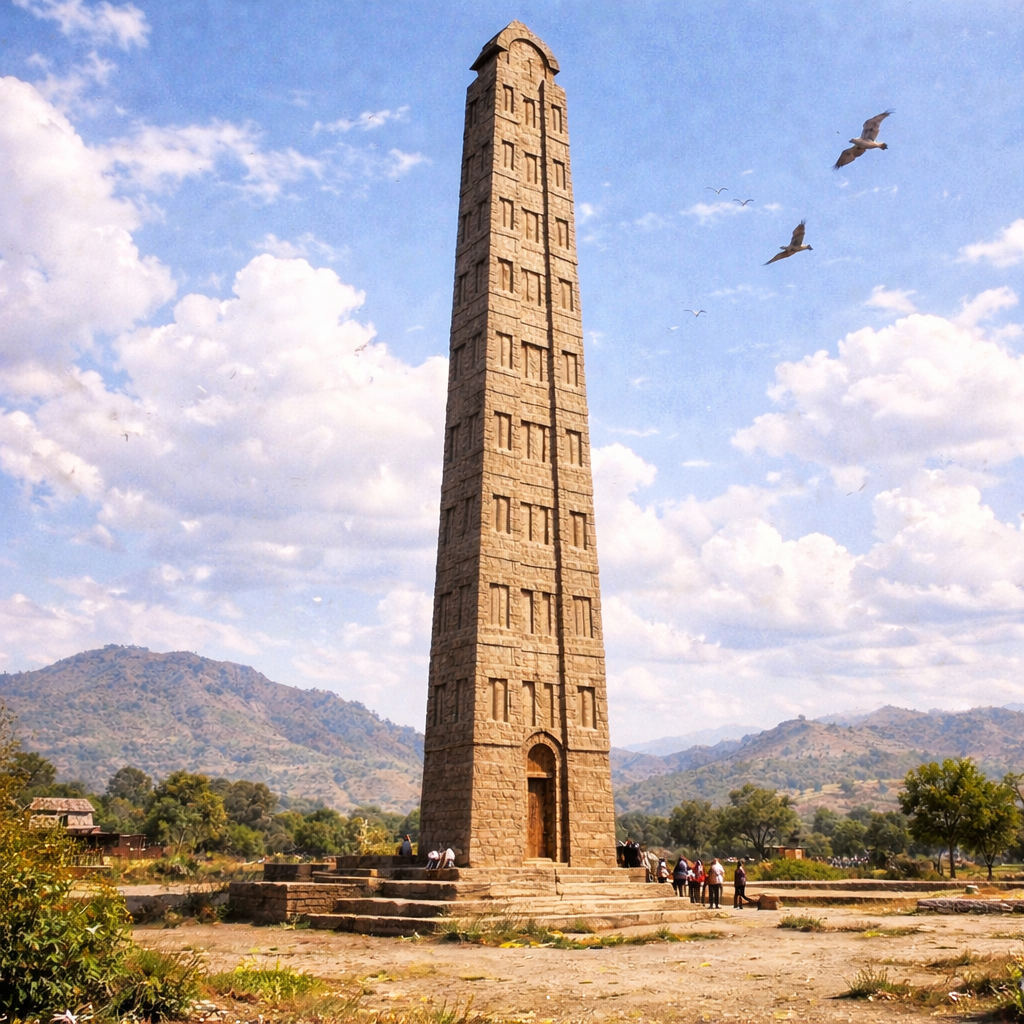
Each year, the Axum Massacre is ceremoniously commemorated by Tigrayan nationalists and others around the world. But what actually happened back then in late November 2020? This is an adapted excerpt from the book “Getting Ethiopia Dead Wrong”.
Both sides committed war crimes. This is the only point of near-universal agreement about the so-called Tigray War, which raged across the northern half of Ethiopia from November 3, 2020, to November 2, 2022. Probably the most iconic of these war crimes became known as the Axum massacre, dated to the early days of the war, when Eritrean and Ethiopian soldiers had just entered Tigray, struggling to suppress the insurgency of the rulers-turned-rebels, namely the Tigray People’s Liberation Front (TPLF), the ethnically exclusive party which had dominated the national government from 1991 to 2018.
As of today, the short answer to the question posed in the headline is no, we do not know what happened in Axum. And we ought to find out. If just a fraction of what has been claimed is true, it cries out for justice. However, as we shall see in this longread, after the first horror story turned out to be blatant disinformation, the media instantly forgave and moved on to another, still unproven version of events. Thus, not only mispredictions and misreporting from the front, but also thoroughly debunked atrocity testimonies, have been loudly spread and then quietly abandoned without the slightest follow-up, let alone accountability. This has been symptomatic of the war coverage, which makes the Axum massacre worth zooming in on.
It all exploded on January 9, 2021 by means of a tweet by journalist Martin Plaut.
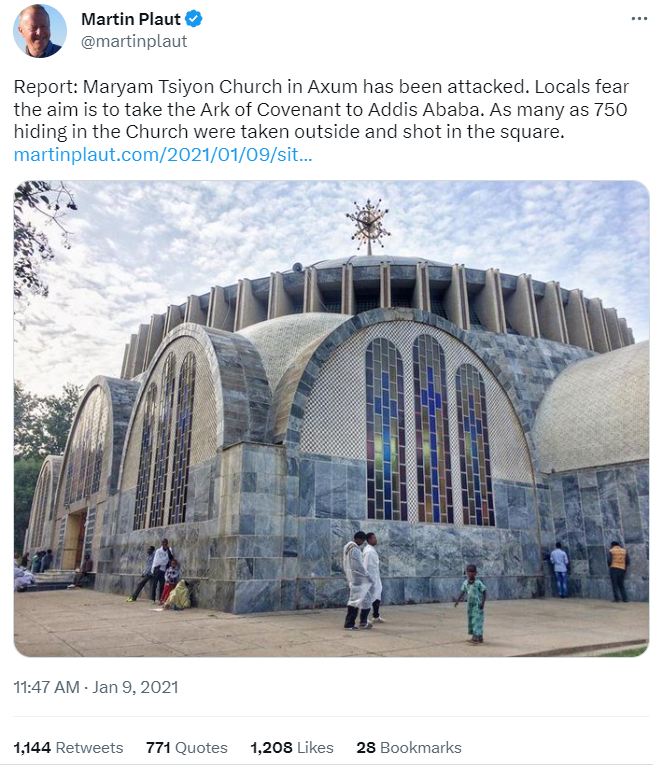
Axum is the cradle of Ethiopian Orthodox Christianity, famous for its ancient obelisks and stones with inscriptions in classical languages. The holiest of holy relics, the Ark of the Covenant, containing the original tablets of the Ten Commandments, is believed to be kept in the city’s Church of Our Lady Mary of Zion (‘Maryam Tsiyon’), shown in the picture.
At first, the gruesome martyrdom of 750 church-goers was divulged by a list of mainly Christian news outlets.[1] At this early stage, the misdeed was attributed to “Ethiopian federal troops and Amhara militia” and dated December 15, 2020.[2] This was put out, for instance, on January 11, 2021, on the website of British Lord David Alton, with Martin Plaut as the source. The Polish government issued a condemnation, but stopped short of placing the guilt.[3] Noticeably, one analyst in the Jesuit America Magazine let the accused side get in a word. He remarked on the lack of material evidence, and asked for withholding judgement.[4] In January 2021, the only big newspaper to mention the point-blank slaughter of the 750 seems to be The Guardian in two articles, one of which was more concerned with the danger to religious artefacts, such as the fabled ark, while the other took this precaution: “The report has not been independently verified.”[5]
The Guardian should have dug deeper into the original source, It was, as per Martin Plaut’s original tweet and article, a report by EEPA.[6] This acronym stands for the official-sounding Europe External Programme with Africa and also for Europe External Policy Advisors, two closely related Belgian-based NGOs, whose joint website had recently removed the names of those behind the outfit. Other pages, however, still revealed, as confirmed in the da[7]tabase of deleted internet pages,[8] that its founder and leader is Mirjam van Reisen. She is mentioned in the EU transparency register as director and legally responsible in 2020, although a few months into the war, her position was officially taken over by the Irishman Paddy Maguinness.
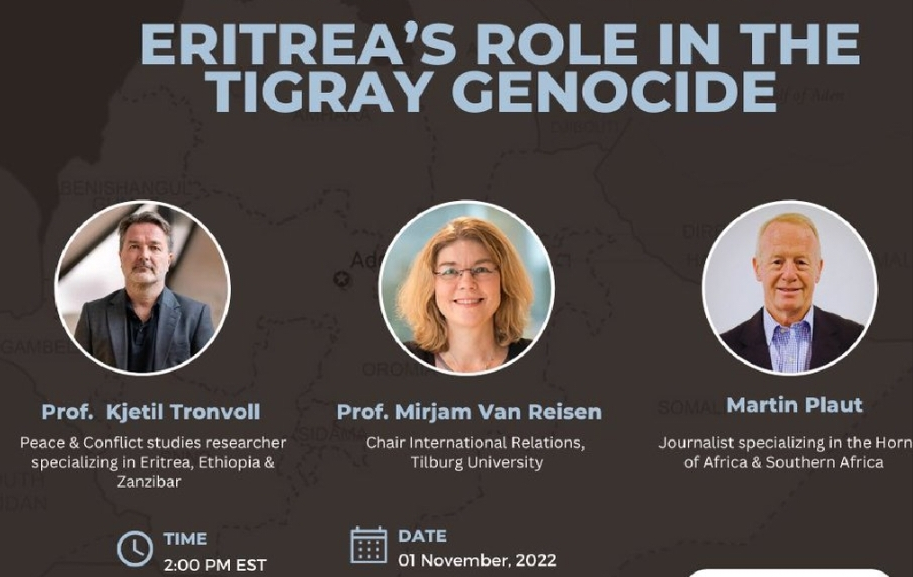
A lineup of like-minded speakers who mainly blamed Ethiopia’s federal government for the war.
The Dutch university professor Mirjam van Reisen has long been known for activism alongside the Eritrean exile community, a small part of which, and her more than anyone, saw the war through the lens of ‘my enemy’s enemy is my friend’. Thus, she spent the war churning out pro-rebel disinformation, including on Twitter for others to retweet. Here are some examples, which have since been deleted.
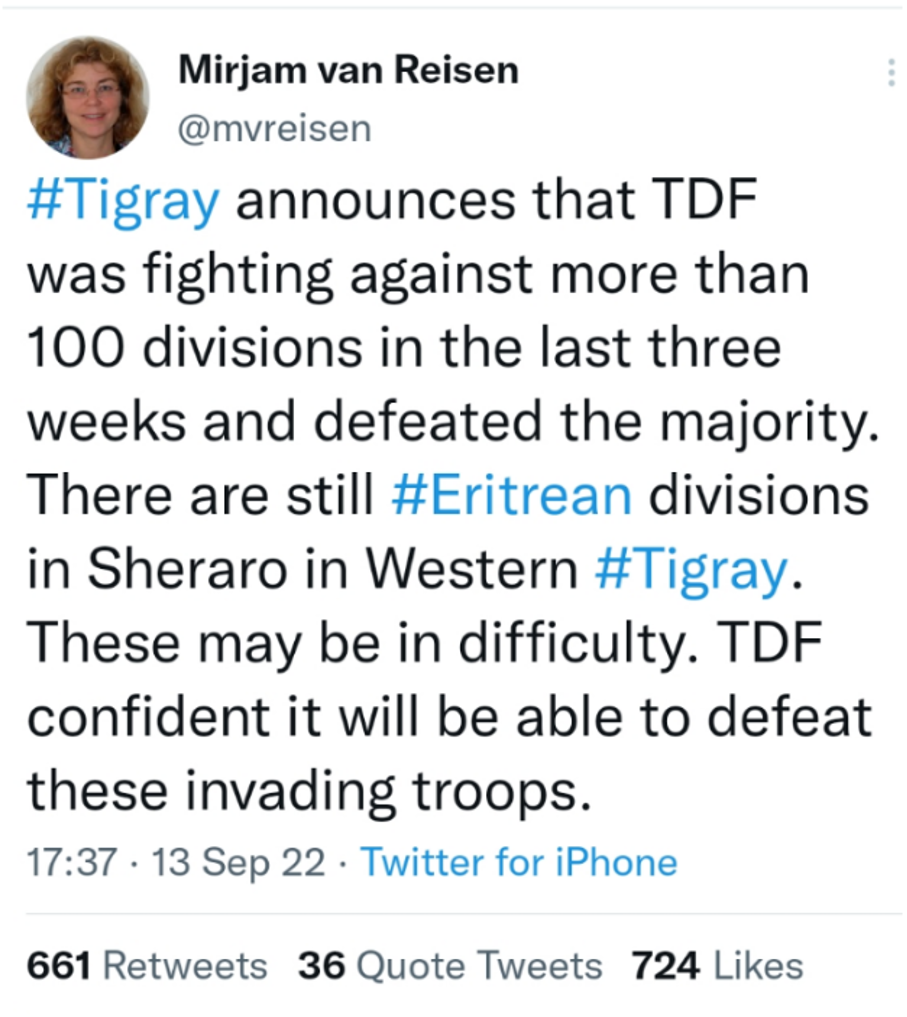
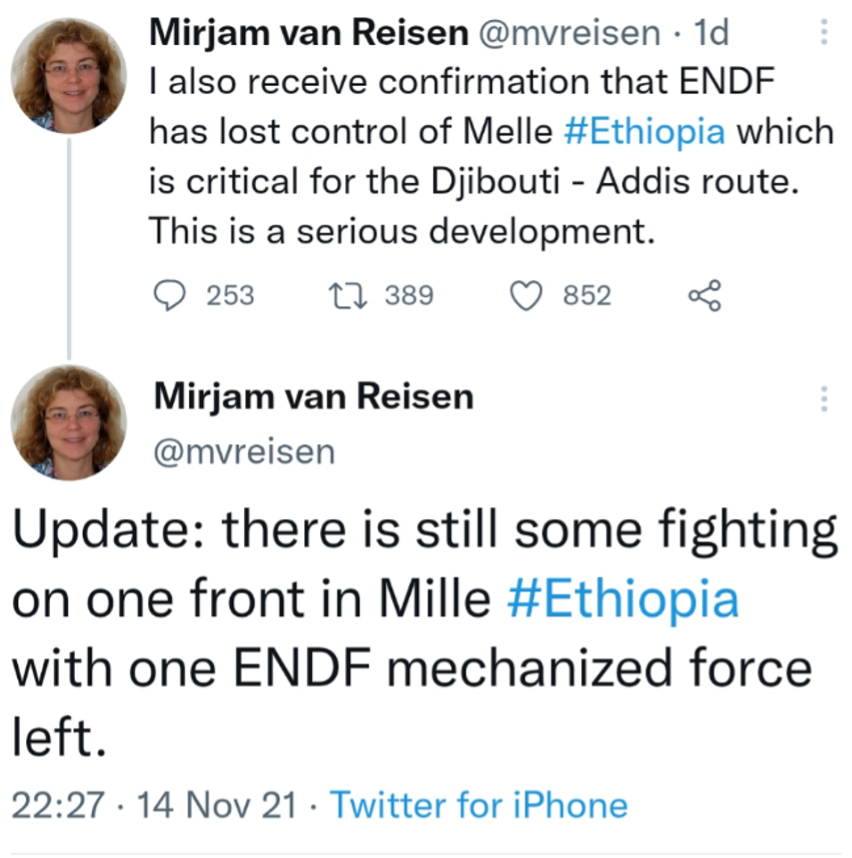
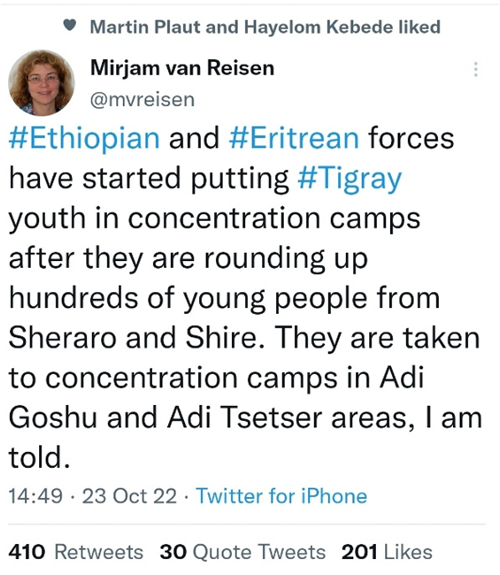
Sensible observers, whether or not they knew about Mirjam van Reisen being behind EEPA, or were aware of Martin Plaut’s penchant for fanning the flames, dismissed the initial report, seeing it as an attempt to stir religious emotions.
A fabrication and a fig leaf
Then, on February 18, 2021, an outlet as big and reputed as Associated Press took the bait with the article headlined “‘Horrible’: witnesses recall massacre in Ethiopian holy city”. Reporting all the way from Nairobi, Kenya, correspondent Cara Anna started out: “Bodies with gunshot wounds lay in the street for days in Ethiopia’s holiest city. At night, residents listened in horror as hyenas fed on the corpses of people they knew.” Apart from changing the perpetrators from Ethiopians to Eritreans and the date from December 15 to “late November”, Cara Anna confirmed Martin Plaut’s and EEPA’s version of the bloodbath in the central square by quoting the deacon, “who spoke on the condition of anonymity” about “soldiers bursting into the church, cornering and dragging out worshippers and shooting at those who fled”, with a death toll of “some 800”. When this was published, the federal government was tenuously in control of Axum, where it had restored the communications network. This had enabled Cara Anna to conduct phone interviews with various unidentified people from the city. She concluded that: “Ethiopia’s narrative, however, has crumbled as witnesses like the deacon emerge”. It was later discovered that Alula Solomon, a prominent figure in the TPLF propaganda apparatus, had tweeted in Tigrinya about Cara Anna reaching out to him for sources on the Axum massacre.
Such a prestigious news agency lending its credibility to the story opened the floodgates. The tabloids went wild,[9]and several others followed,[10] usually referring to Associated Press or to its sources, showcasing either the hyenas[11]or how it happened in a place that is to Ethiopian orthodoxy what Saint Peter’s Basilica is to Roman Catholicism.[12]Some continued to describe the perpetrators as Ethiopian troops.[13]
The story was drawing massive attention, so the world-renowned human-rights organization Amnesty International launched an investigation. On February 26, it published its report “Ethiopia: The Massacre in Axum”. It contained enough horrors for Martin Plaut to boast about being vindicated,[14] which testifies to how little he cares for accuracy, because it was about bloodshed that had been spread out all across Axum, with absolutely nothing about any church congregation being dragged out and gunned down.
That initial version of the Axum story was not only a fabrication, but also a poor one that could not be sustained over time. There is no precedent of 750-800 people being murdered in one go in the most central open space of a relatively modern city, and remaining a secret for over a month. There are plenty of cameras, and many people had been travelling in and out of this urban area of about 67,000 people. The new claim about a citywide killing spree, by contrast, could make a case for plausibility.
According to the Amnesty report, after causing random casualties by “indiscriminately shelling the city”, Eritrean and Ethiopian soldiers entered Axum together on November 19, 2020. Witnesses say that Eritrean forces then committed extrajudicial executions, as well as widespread looting. On Saturday morning, November 28, a group as small as 50-80 TPLF fighters attacked an Eritrean position at a nearby mountain, and were joined by local youths “with improvised weapons, such as knives, sticks and stones”. This was as suicidal as it sounds, and the response of the Eritrean soldiers, still according to the Amnesty report, was to go on a revenge rampage inside the city, killing “hundreds of civilians” during a 24-hour period on November 28-29. As a side note not mentioned in the Amnesty report, early on Sunday, November 29, TPLF leader Debretsion Gebremichael texted to Reuters that his forces had retaken Axum,[15] but presumably this was just more fog of war. What the Amnesty report describes going on at that time is a frenzy of house-to-house searches for teenage and adult men, who are summarily executed. This was reminiscent of Tigrayan militiamen’s massacre two and a half weeks earlier in Mai-Kadra.
So how did Amnesty gather this information? With the war still raging, there was no question of travelling to Axum. Instead, eleven days were spent talking to “41 witnesses and survivors of the massacre”, who could not be named “given security concerns”. Testimonies were either delivered face-to-face in a refugee camp of Tigrayans in Sudan, or by means of “numerous phone interviews with witnesses in Axum”. Crucially, it says nothing about how these 41 persons were identified or by whom, which obviously raises suspicion that they were selected and coached by the TPLF.
The first part of the Amnesty report mostly reproduces the testimonies verbatim. Then it tends towards its own narration of the witnesses’ accounts, tacitly assuming that all 41 speak the truth, albeit still garnished with quotes, such as this from a man who said he saw six men killed through his window on 29 November: “They lined them up and shot them in the back from behind”, he says. This must be the inspiration for a leader in The Economist on October 9, 2021. It states as fact, without indicating any source, that: “Late last year in the city of Axum, for instance, Eritrean troops fighting alongside Ethiopian forces murdered hundreds of civilians, mostly men and boys. Some were lined up and shot in the back.” In the Amnesty report, the same witness goes on to say that the soldiers killed three people with one bullet. “They were lined up perfectly”, he explains.
Amnesty makes no mention of hyenas, but says that, on Sunday morning, November 29, Eritrean soldiers were still preventing residents from picking up the bodies. Then: “On the request of local elders, Ethiopian soldiers gave permission for people to bury the dead in the late afternoon on 29 November. Most of the dead bodies appear to have been buried on 30 November, but witnesses said that people found many additional bodies in the days that followed. (…) The bodies were brought to the Arba’etu Ensessa Church (next to the Axum Tsion St Mary Church), as well as [various other churches].” One witness said up to ten bodies at a time were piled onto carts. Another “estimated that he saw 400 bodies on 30 November alone”.
The conclusion is: “Amnesty International was unable to calculate the massacre’s precise death toll, but estimates that hundreds of people were killed”.
The Amnesty report includes two satellite images with three places of recently “disturbed earth” consistent with mass graves. But this is a moot point. Nobody denies that there was a war going on at the time with a high death count. And no other photographic material was even mentioned. Ethiopian city dwellers do have smartphones. The power grid might have been down for days, but this is so frequent that many have generators, power banks and solar chargers. It stretches belief that the people attacked a fortified position of a professional army, but nobody took sneak photos or videos of piles of dead bodies spread all over the streets for days.
Human Rights Watch did indeed present five videos one week later, as part of its Axum massacre report, which was even shorter than Amnesty’s and based on 28 witness statements. The first is of Brana Hotel hit by artillery on November 25. The other four were accompanied by bold claims, but showed absolutely nothing, even supposing that they were authentic, correctly dated and without soundtrack alterations. Anyone can examine them.[16] The toughest image to watch is that of a group of people carrying a dead body on a stretcher, though only the hand is visible.
Returning to the mass burials as recounted in the Amnesty report: “30 November marked the anniversary of St Mary, a major celebration in Axum, which on another year would have drawn the faithful from across Ethiopia and tourists from around the world. In light of the exceptional circumstances, the celebrations were canceled.”
This is demonstrably false, because the religious festival was held. Fana Television, a state-owned channel, had a crew in Axum to cover it. A clip was soon after uploaded to YouTube,[17] and later translated from Amharic into Englishby the Eritrean foreign service.[18] It shows 100-200 people dressed up for the occasion. An Ethiopian flag can be glanced in the background. The faithful interviewed on screen lament the war and the consequent poor turnout for the event, but say that things are now peaceful. There has been no expression of regret by Amnesty International over this clear and grave error in such a serious report.
It is not completely impossible, albeit hard to imagine, that simultaneously, just across the square from these celebrations, carts were being pushed around with up to ten bodies each, while others were lying around decomposing, and hundreds of victims were being laid to rest, none of which was photographed by any of the thousands of smartphones in the city. At least this is what we should now believe, according to the numerous respectable media and personalities invoking the Amnesty report.
But nobody ever tried to contend that the festival was held where 750-800 worshippers had just been sprayed with bullets and eaten by hyenas. That incendiary version with religious overtones had to be definitively abandoned. Yet it had been propagated by the EEPA report, amplified by Martin Plaut, and then given so much credence by Cara Anna from Associated Press that it was splashed on headlines across the world.
So how did the world’s media, big and small, face up to having run way too fast with a fabrication? Did they do a mea culpa? Did they learn a lesson about sharpening their critical faculties so as to give the public a reason to trust them again?
Not at all. They quietly ditched the church massacre and loudly adopted Amnesty’s completely different story. And they did so instantly and uncritically, so as to forget and dissipate accountability for a month and a half of spreading a barefaced lie. There was not a hint of regret or retraction. In fact, Cara Anna had the jaw-dropping chutzpah to write: “The new [Amnesty] report echoed the findings of an Associated Press story last week”.[19] And a few days later, she went on: “The Associated Press and Amnesty International have separately documented a massacre of several hundred people.”[20] She actually insisted that she had “documented” something! These were the truth contortions with which she wiggled out of avidly endorsing a macabre false testimony, which had sent shockwaves around the globe. The Amnesty report served as a fig leaf. It was an ill-fitting one for sure, but good enough for other big media to go along with the pretense that the Associated Press article and the Amnesty report had sort of shown the same thing, as if all the hair-
raising specifics had been just a little innocent adornment.[21]
On the same day that the Amnesty report came out and prompted every news outlet, including the Associated Press, to quietly ditch Cara Anna’s insanely incendiary story from Axum, Associated Press awarded her the “Best of the Week”, gushing that: “Anna’s exclusive reporting not only scooped all other media, she was ahead of human rights groups who had been investigating what happened in Axum.” But no other investigation made findings that conferred any credibility on Cara Anna’s “determined source work”.
Thus, Cara Anna could carry on producing vaguely-sourced reports of insane cruelty against Tigrayans, winning accolades[22] and being paraded before the next generation of journalists as an idol and an inspiration.[23] However, I went undercover online as a young man pretending to have scripted a student movie based on her version of the Axum massacre. She took the bait, and a not unamusing exchange ensued, reproduced in its entirety with my comments in an annex to my book, and also available here. Wary of incriminating herself from an Associated Press email account, she could neither admit her story had been false nor stand by its veracity.
Though other media took Cara Anna’s church-massacre story to be true for only a week, it lives on in the realm of myth. It continues to pop up, usually with a touch of ambiguity. For instance, speaking in the British House of Lords, shortly after the Pretoria Peace Agreement of November 2, 2022, Lord David Alton conjured up Cara Anna’s anonymous deacon saying “800 civilians had been executed”, albeit this time without specifying the location or the perpetrators. He added the Amnesty version on top.[24]
Other investigations
As soon as the security situation allowed, the Ethiopian Human Rights Commission (EHRC) dispatched a rapid investigation mission from February 27 to March 5, 2021.[25] It also relied mainly on eye witnesses, who could have been coached to lie, given the TPLF’s tight control of the population. But at least they were interviewed face-to-face and comprised a large and diverse group of people in Axum. They talk of Eritrean soldiers committing extrajudicial executions, identical or similar to those in the Amnesty report, albeit without any claim to have seen hundreds of dead bodies, or to have carted ten at a time. There are also testimonies about looting both by Eritreans and by locals who took advantage of the breakdown in law and order. While the Amnesty report often summarizes its sources, as if they had spoken with one voice that could be distilled into an indisputable finding, the EHRC report contains more individual and often differing accounts. This makes for fewer conclusions, but also comes across as more credible. While the locals decry the inaction of the ENDF (federal army), they recount that “on December 23, an attempt by Eritrean soldiers to enter Aksum Tsion Church to loot it was foiled by the combined efforts of ENDF and residents.” The EHRC report suggests a more moderate estimated death toll of “over a hundred civilians”. When this came out, once again, Martin Plaut expressed a sense of vindication, blithely passing over his previous claims.[26]
The EHRC hits a compromise note as regards the festival: “Although the November 30 Aksum Tsion holiday was marked within the Church’s compound, they [residents of Axum] have been saddened that the media did not report the state of grief the city was in.”
Finally, Ethiopia’s Attorney General sent a team of criminal investigators to Axum who spoke to 95 witnesses and gathered “documentary evidences” up until May 3, 2021.[27] They gave a completely different account of what caused the deaths. The Ethiopian army had withdrawn from Axum on November 27 to fight elsewhere, leaving a small number of Eritrean troops “stationed in the mountainous area of the city”. They were attacked, not by 50-80 TPLF soldiers, as claimed in the Amnesty report, but by 1,500 local youths, who had been trained and armed by the TPLF. Heavy fighting ensued, resulting in a death toll of 93.
The Attorney General also received 116 denunciations of rape, and identified some perpetrators as members of the federal army and police, transferring the prosecution of these cases to the military courts. The investigation blamed the TPLF for some of the increase in crime due to its “release of tens of thousands of notorious criminals from prison and attiring them with ENDF’s and Eritrean military uniforms”.
Again, I make no claim to know what happened in Axum. The point is that finding out calls for hard-nosed investigators on the ground. What they must look for is not the stories that will grab the attention of the international community, but the kind of evidence that will hold up in court. Even the EHRC’s effort falls short of that. It is fair to dispute the impartiality of the EHRC and the Attorney General. But nor will it do for activism-oriented human-rights organizations to draw exclusively on anonymous witness accounts from one side.
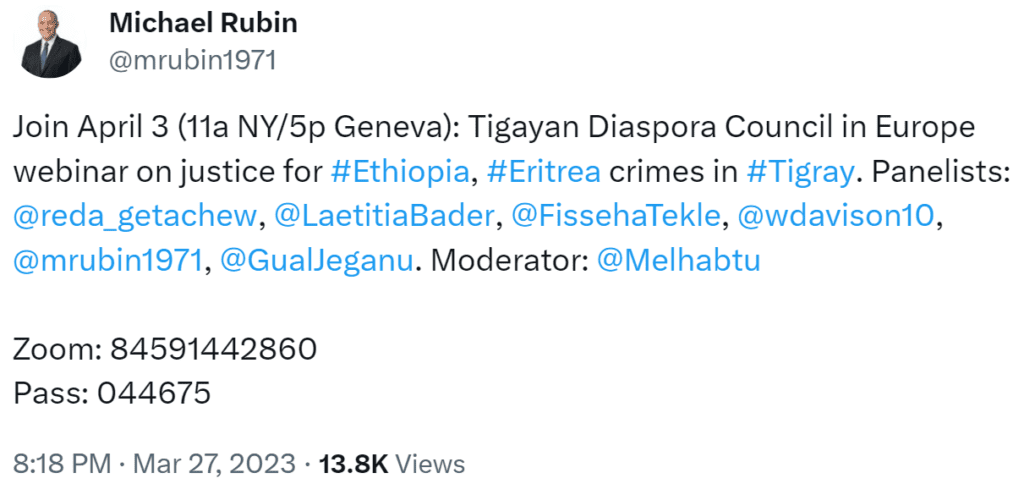
On April 3, 2023, Human Rights Watch (HRW) Director for the Horn of Africa, Laetitia Bader, and Amnesty International (AI) Researcher for Ethiopia, Fisseha Tekle, were invited by a fiercely pro-TPLF organization to discuss “justice for war crimes”. Fellow panelists included Getachew Reda, who led the TPLF war effort at the time, Michael Rubin, the one journalist who advocated for the West to arm the TPLF, and Millette Birhanemaskel, a prominent champion of the TPLF insurgency. The debate was moderated by Melat Habtu, yet another ardent pro-TPLF activist. Although HRW and AI have also denounced TPLF’s war crimes, there is no example of their representatives attending similarly partisan events with the other side in the war.
There is nothing about Amnesty International today that justifies accepting its claims so readily. Over the past decade, this worldwide entity, with a vast contingent of volunteers and some pampered executives,[28] has expanded its founding focus on prisoners of conscience to every issue under the sun, advocating for sex work to be legalized, demanding medicalization of trans children, campaigning for a far-left constitution in Chile, fighting for a feminist internet. As a result, its saintly aura has worn off, as it is being increasingly treated with the same suspicion as any other big player with an ideological agenda. For instance, in August 2022, after it accused Ukraine of violating international humanitarian law, it was blasted for lack of professionalism, thanks to its arguments being carefully dissected and fiercely challenged.
Alas, there was no chance of its work on Ethiopia being subjected to such scrutiny. With the notable exception of Francesca Ronchin reporting for Italy’s Panorama magazine[29], established media gave Ethiopian and Eritreanobjections short shrift. The framing of the war within the single story about Africa laid the groundwork for believing the worst. No matter how flimsy the evidence, news editors’ backs would be adequately covered by pointing to a Western-based organization as the source. Thus, Amnesty International basked in the glory of yore, when its moral authority went unquestioned on all things human rights. Only a big war in Africa could have provided such an opportunity. Inability to meet basic standards of proof was not going to get in the way.
[1] I have dug up six examples, namely, Church Times on January 15, 2021: “Massacre ‘of 750’ reported in Axum church complex”, by Rebecca Paveley. Christian Broadcasting Network (CBN) on January 22, 2021: “750 People Massacred at Ethiopian Church, Alleged Hiding Place of Ark of the Covenant”, by Steve Warren. Coptic Solidarity on January 23, 2021: “Hundreds reportedly dead after massacre at orthodox church in Ethiopia”, by the Catholic News Agency, CNA. Independent Catholic News (ICN) on January 23, 2021: “Ethiopia: massacre at historic church + update”, by Fionn Shiner. Metro Voice on January 27, 2021: “750 Christians killed at Ethiopian church that is said to house Ark of the Covenant”, also by Steve Warren from the Christian Broadcasting Network. Christians United for Israel (CUFI) on January 29, 2021: “750 people massacred at Ethiopian church that claims to hide the Ark of the Covenant”, author not indicated.
[2] Situation Report EEPA HORN No. 53, January 12, 2021.
[3] Ministry of Foreign Affairs, Republic of Poland on January 22, 2021: “Statement regarding the massacre in front of the Church of Our Lady Mary of Zion in Axum in the Tigray Region”.
[4] America magazine, the Jesuit Review on January 29, 2021 (with several updates since then): “Were Orthodox Christians Massacred in Ethiopia?”, by Kevin Clarke.
[5] The Guardian on January 24, 2021: “Fabled Ark could be among ancient treasures in danger in Ethiopia’s deadly war”, by Harriet Sherwood, and also on January 24, 2021, “Ethiopia’s leader must answer for the high cost of the hidden war in Tigray”, by Simon Tisdall.
[6] Situation Report EEPA HORN No. 53, January 12, 2021.
[8] https://web.archive.org/web/20180504233623/https:/www.eepa.be/?page_id=119
[9] For example, The New York Post on February 20, 2021: “At least 800 Ethiopians killed after defending ‘Ark of the Covenant’”, by Elizabeth Elizalde.
[10] For example, The Sun on February 21, 2021: “Sacred Treasure: At least 800 worshippers die defending the ‘Ark of the Covenant’ from looters amid ethnic massacre in Ethiopia”, by Katie Davis.
[11] The hyenas were headlined in The Times on February 19: “Tigray: Hyenas pick over the unburied dead of Ethiopian war”, by Jane Flanagan.
[12] The religious aspect was played up in The Daily Mail on February 20, 2021: “Defenders of the lost ark: Hundreds of worshippers protected Ark of the Covenant as Ethiopian rebels and soldiers battled near church where it is secured, it was revealed”, by Harry Howard for Mail Online. And in a follow-up article in The New York Post on February 23: “Christians in Ethiopia never saw ‘Ark of the Covenant’ they died for”, by Lee Brown.
[13] The New York Post on February 20, 2021 wrote: “The battle between Ethiopian soldiers and rebel fighters happened in the fall, The Sunday Times reported, but it is only being reported now.”
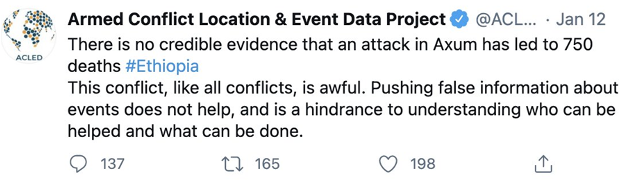
[14] On February 26, 2021, Martin Plaut tweeted: “Now that the Amnesty International report has been published, is @ACLED going to publish a reassessment of its assertion that there was “no credible evidence” of the attack on Axum leading to hundreds of deaths?” In fact, what ACLED had called into question was Martin Plaut’s claim about a church segregation being dragged out and gunned down by Ethiopian soldiers on December 15, 2020, none of which was borne out by Amnesty International’s report.
[15] According to Reuters: “In text messages on Sunday [November 29, 2020], he [Debretsion Gebremichael] said that his forces had shot down an Ethiopian military plane and captured the pilot, and had also retaken the town of Axum. From the article “Tigray forces claim to have shot down Ethiopian plane, taken town”, published on November 30, 2020, at 10.16am local time.
[16] At the time of publication, the link is: https://www.hrw.org/news/2021/03/05/ethiopia-eritrean-forces-massacre-tigray-civilians
[17] https://www.youtube.com/watch?v=fIaBCMPuQ4U
[18] https://www.youtube.com/watch?v=PXyhikpFmJU
[19] Associated Press News on February 28, 2021: “Amnesty Report describes Axum massacre in Ethiopia’s Tigray”, by Cara Anna.
[20] Associated Press News on March 3, 2021: “Ethiopia now calls Axum massacre allegations ‘credible’”, by Cara Anna. In this article, the Ethiopian authorities’ decision to investigate what happened in Axum is spun by Cara Anna as a semi-confession. She also writes that “alarm grows over the fate of the region’s [Tigray’s] 6 million people”, thus echoing the TPLF’s line that the alternative to its insurgency is a full-fledged genocide.
[21] For example, The Telegraph wrote on April 7, 2021: “In February, AP and Amnesty published accounts of several hundred people being killed by Eritrean soldiers in Tigray’s holy city of Axum”, giving the false impression that these completely different accounts confirmed one another. From the article “’Their bodies were torn into pieces’: Ethiopian and Eritrean troops accused of massacre in Tigray”, by Lucy Kassa.
[22] The Pulitzer Center boasts of funding her and her Associated Press team’s coverage of Ethiopia’s Tigray conflict, which won the AP’s “top journalism award” in 2021.
[23] According to Elon University’s website on November 15, 2022: “Pulitzer Center grantee Cara Anna visits communications classes” by Tommy Kopetskie, which says: “The Associated Press correspondent visited campus as part of Elon’s partnership in the Pulitzer Center’s Campus Consortium, speaking with nine classes and dozens of students. (…) Anna’s important and insightful work led to the Ethiopian government barring her from the country. (…) Accompanying Anna during her visit was Mikaela Schmitt, program coordinator for Outreach and Campus Consortium for the Pulitzer Center.”
[24] https://www.youtube.com/watch?v=3I_p06a6CoE&t=132s
[25] The Ethiopian Human Rights Commission in March 2021: “Investigation into Grave Human Rights Violations in Aksum City, Report on Preliminary Findings.”
[26] Martin Plaut tweets on March 24, 2021: “Good to see the Ethiopian Human Rights Commission report on Axum, which broadly backs the earlier findings by Amnesty International and Human Rights Watch. Eritrean troops “killed over 100 civilians”. Final figure likely to be much higher.”
[27] Reported in English by Fana Broadcasting Corporate on May 10, 2021: “AG [Attorney General] Unveils Report Concerning Criminal Investigation On Crimes Committed In Axum City”.
[28] The high salaries and massive payoff packages to its senior figures Irene Khan and Kate Gilmore caused some scandal in March 2011.
[29] Panorama on March 25, 2021: “Axum: il massacro denunciato dalle ong”, by Francesca Ronchin.
