




Why counter-terrorism in Ethiopia now depends on counter-narrative
For much of the past three decades, Ethiopia has been described abroad in terms that bear little resemblance to the realities experienced by its citizens. Foreign think-tanks rely on outdated templates, advocacy groups supply pre-packaged interpretations, and media outlets recycle a set of familiar tropes: authoritarian drift, sectarian tension, looming catastrophe. These narratives shift in detail but not in function. They are designed to produce urgency, moral clarity and pressure on policymakers. Accuracy is optional.
The results have been predictable. External readings of Ethiopia increasingly diverge from what is occurring inside the country. The gap between perception and reality widens, producing a distortion effect that now shapes policy, investment and security analysis. In the Horn of Africa, where instability spreads quickly across borders, this is more than a reputational problem. It risks undermining counter-terrorism efforts and weakening already strained national institutions. In Ethiopia, narrative misinterpretation has become a security issue in its own right.
This article examines how those distortions arise, who benefits from them, and why a credible counter-narrative has become essential not only for Ethiopia’s political stability but for regional security.
A Familiar Script with New Voices
Narratives about Ethiopia tend to follow a recognisable pattern. Reports circulate before verification. Conceptual frames appear before facts. Claims about atrocities or persecution receive global distribution even when local actors struggle to recognise the situations being described. Advocacy organisations provide language calibrated for maximum alarm; analysts, short on ground access but long on confidence, fill the gaps with conjecture.
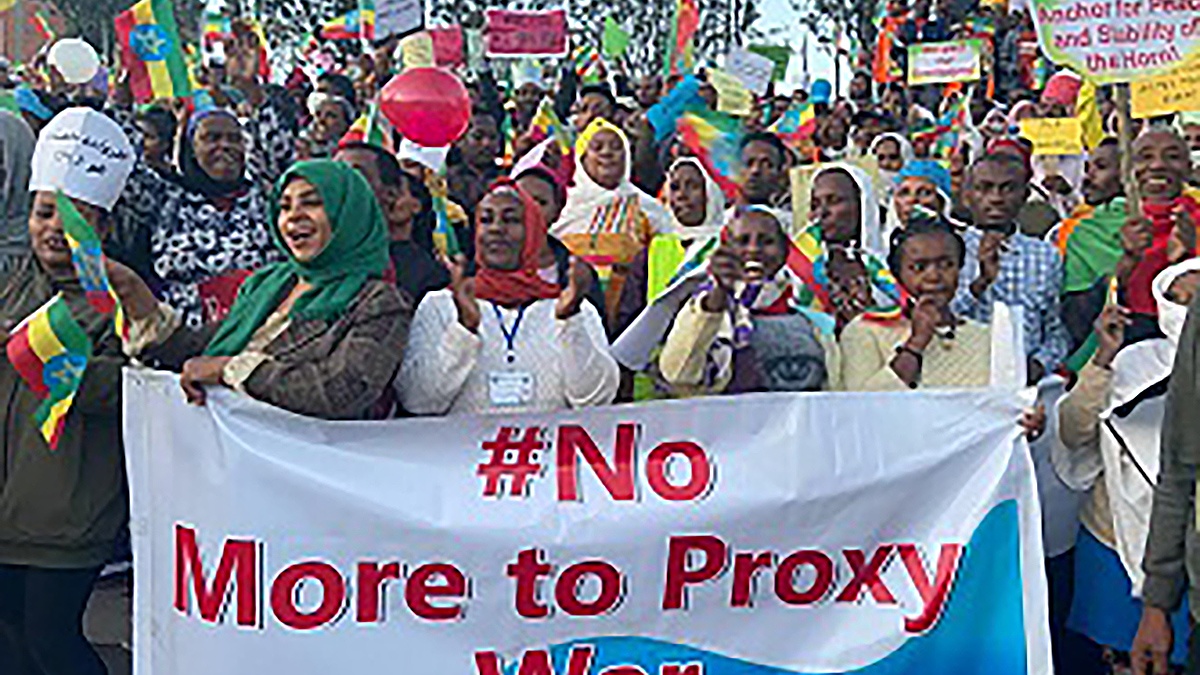
The ecosystem creating these narratives has expanded. Diaspora groups, political entrepreneurs, lobbying outfits and foreign institutions all feed into the same loop. Many operate with a certainty that exceeds their knowledge. Others treat Ethiopia as a proxy through which to wage domestic political battles at home. A handful view the country as the last remaining arena where Cold War reflexes can still be exercised under new terminology.
The effect is cumulative. Instead of refining earlier misunderstandings, new reports reinforce them. Policymakers abroad find themselves addressing crises that Ethiopians do not recognise. In Washington, Brussels and European capitals, urgency is often manufactured upstream while those on the ground are left to deal with consequences downstream.
The question is not whether Ethiopia has serious challenges. It does. The question is why the international reading of those challenges is so frequently incorrect.
Containment Never Ended – It Only Changed Vocabulary
Much of the misreading stems from an older architecture. During the Cold War, Ethiopia was treated not as a sovereign actor but as a node in a global contest. Domestic problems were interpreted through ideological filters. Internal disputes were recast as threats to the regional balance of power. Western support or hostility depended less on local facts than on global alignment.
The end of the Cold War did not end this reflex. It simply replaced ideological terminology with humanitarian and security language. The logic of containment persisted. The lens remained external.
After 9/11, Ethiopia was reclassified again, this time as a frontline counter-terrorism partner. The policy environment was shaped by fears of jihadist expansion from Somalia and the wider region. Ethiopian stability was valued, but not fully understood. The country became simultaneously indispensable and misunderstood.
That pattern endures today. Legislatures and foreign ministries still view the Horn of Africa through inherited frameworks. The political actors most fluent in those frameworks, usually diaspora lobbyists and advocacy organisations, gain disproportionate influence over how Ethiopia is portrayed. Local context seldom appears in the conversation. Instead, Ethiopia becomes part of a set script: crisis, authoritarianism, persecution, intervention.
In this environment, nuance becomes suspect. Complexity becomes an obstacle. And Ethiopia becomes a stage upon which external anxieties are projected.
Parallel Markets and Asymmetric Sovereignty
One of the most striking omissions in foreign commentary is the asymmetric dynamic between Ethiopia and Eritrea, an imbalance that has shaped economic flows, border pressures and political calculations for decades. The external reading often ignores this entirely, preferring a simplified model that treats both countries as equal participants in a shared dispute. Ethiopians know otherwise.
For years, cross-border trade operated in a semi-formal zone where Eritrean networks benefited disproportionately. Ethiopian goods, particularly high-value commodities, leaked outward through informal corridors while hard currency moved in the opposite direction. The flows were significant enough to shape Ethiopia’s macroeconomic position. Eritrea’s security doctrine, built on perpetual mobilisation and regional pressure, allowed these practices to continue with minimal transparency.
In Ethiopia, this was understood as an asymmetric arrangement: one state claiming absolute sovereignty while leveraging Ethiopia’s openness for its own economic and political advantage. Abroad, the pattern rarely entered analysis. Eritrea’s role, whether in smuggling networks or regional destabilisation, was often excluded from the narrative altogether. International reports treated instability as an Ethiopian phenomenon, ignoring cross-border pressures that shaped local security environments.
This selective reading matters. Counter-terrorism efforts require an accurate map of networks, incentives and actors. When foreign institutions omit entire components of the regional landscape, their conclusions lose utility, and their recommendations become harmful.
The Diaspora’s Double Shock
Diaspora communities occupy an outsized place in shaping perceptions of Ethiopia abroad. They are diverse, often passionate, and sometimes deeply divided. Their engagement is important, but their narratives frequently reflect another form of misreading: a double culture shock.
For many, Ethiopia freezes at the moment they leave. The country that exists in memory becomes a benchmark against which all present developments are judged. When the reality diverges, frustration turns into political activism. In the West, a second shock occurs as diaspora members face cultural dislocation, identity pressure and political marginalisation. The combination produces a potent mixture: nostalgia mixed with grievance, activism mixed with personal projection.
In these conditions, some diaspora voices become louder than those inside Ethiopia. Positions harden. Nuance evaporates. Conflicts are interpreted as moral absolutes. Lobbying efforts accelerate, often targeting foreign legislators who rely on diaspora constituencies for interpretation.
The trouble is not that diaspora views are illegitimate. It is that the loudest voices are not always the most informed. Their influence on foreign policy is considerable, while their exposure to conditions on the ground may be limited. The result is a policy environment shaped by distance, emotional, geographical and political.
When Narrative Becomes Policy
The transition from misinterpretation to material harm is swift. In foreign ministries and legislative chambers, narrative signals often precede official assessments. Once enough pressure accumulates, a familiar pattern emerges: First the alarm. Then the resolution. Then the policy shift. Finally the unintended consequences. Investors retreat. Humanitarian agencies recalibrate. Government legitimacy is questioned abroad, emboldening internal opponents and complicating peace efforts. Sanction proposals emerge, sometimes targeting institutions essential for stabilisation. Local actors, sensing opportunity, amplify whichever narrative suits their aims.
This is not hypothetical. Ethiopia has experienced each stage of this pattern over the past five years. And each time, the effects have been felt most acutely by ordinary citizens rather than political elites.
When institutions are delegitimised, extremists gain room to manoeuvre. When narratives exaggerate instability, communities experience real economic destabilisation. When foreign actors misinterpret local dynamics, they risk inflaming tensions rather than easing them.
The cost of misreading is paid by people who did not create the narrative but live with its consequences.
Why Counter-Narrative Is Now a Security Instrument
Counter-terrorism depends on intelligence, coordination and credible institutions. But it also depends on narrative accuracy. Extremist groups thrive in environments where institutional confidence is low, where political actors are portrayed as illegitimate, and where external pressure exacerbates domestic fault lines.
Correcting false narratives is not public relations. It is preventive security.
A reliable counter-narrative provides:
A correct mapping of actors and incentives.
Clarity about the distinction between local conflicts and transnational threats.
A shield against politicised advocacy masquerading as evidence.
Protection for communities at risk of stigmatisation.
A mechanism for resisting foreign policy built on misleading assumptions.
Ethiopia’s internal challenges, ethnic tension, economic pressures, institutional reform, require sober analysis. They do not benefit from narratives that treat every disturbance as a prelude to collapse.
In regions where perception guides response, accuracy is as essential as deterrence.
The Institutions Driving the Misreading
Several groups play recurring roles in the narrative distortion cycle:
Think-tanks that rely on recycled frameworks rather than current field data.
Advocacy organisations that substitute activism for analysis.
Foreign legislatures influenced by diaspora pressure and outdated assumptions.
Media outlets that favour dramatic claims over contextual reporting.
Policy entrepreneurs who convert Ethiopia’s complexity into attention-grabbing narratives.
Digital influencers whose incentives are tied to engagement rather than accuracy.
None operate with malicious intent as a starting premise. Yet the cumulative effect is harmful. Ethiopia becomes a case study in everything except what it is.
Listening to Those on the Ground
One of the most striking features of the current landscape is the absence of Ethiopian voices in international discussions about the country. Analysts abroad cite each other more readily than they cite local experts, academics or institutions. International commentary often treats Ethiopian perspectives as secondary sources, useful for colour but not authoritative.
This imbalance shapes outcomes. Peace efforts are questioned based on interpretations that do not match local realities. Government actions are evaluated according to frameworks that ignore Ethiopia’s political history. Community grievances are filtered through external narratives that reduce complexity to single-issue activism.
A credible counter-narrative begins with the obvious: listening to the people who live inside the country affected by the policy.
A New Framework for Ethical Engagement
For Ethiopia, the path forward requires a different model of international engagement, one that prioritises accuracy, local knowledge and shared security. The elements are straightforward
Verification before amplification.
Distinction between advocacy and evidence.
Engagement with institutions rather than assumptions.
Recognition of Ethiopia’s sovereignty without romanticism or suspicion.
A shift away from containment reflexes and towards regional stability.
Acknowledgment of cross-border drivers, including asymmetric pressures.
Support for institutional resilience instead of punitive theatrics.
This approach does not absolve Ethiopian actors of responsibility. It merely corrects a starting point that has long been distorted.
Stability Requires Truth
The Horn of Africa is entering a period in which information, not ideology, will determine security outcomes. Counter-terrorism requires accurate assessments. Peace efforts require credible intermediaries. Economic recovery requires investor confidence. None of these are compatible with the misreading that currently dominates West’s engagement with Ethiopia.
The human cost of bad narratives is visible in lost opportunities, damaged institutions, polarized communities and weakened security. The people paying that cost are the least responsible for the misconceptions driving foreign policy.
Ethiopia does not need flattery. It does not need silence. It needs clarity, accuracy and a narrative grounded in reality. Anything less risks turning foreign engagement into a destabilizing force rather than a constructive one.
Counter-terrorism requires counter-narrative. Stability requires truth. And Ethiopia, more than ever, requires the world to listen before it decides.
