




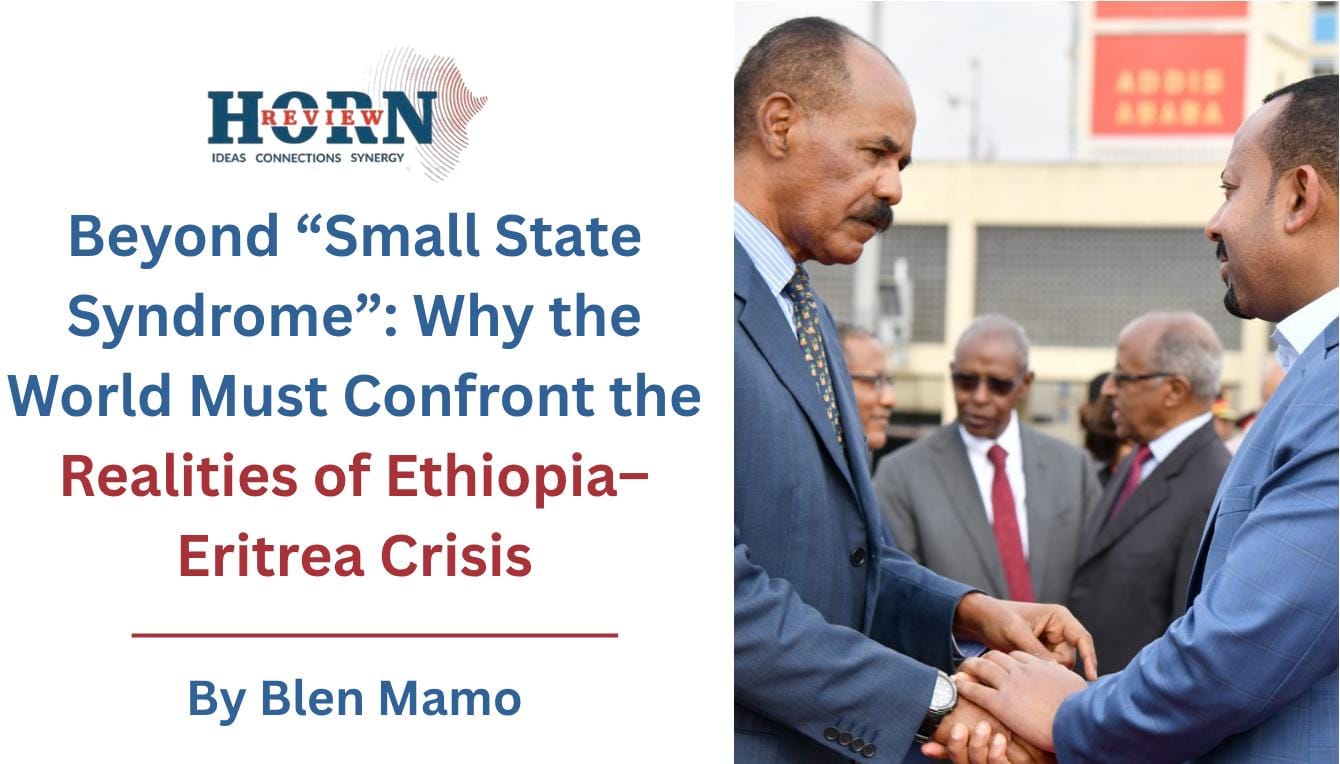
Rethinking the Ethiopia–Eritrea Relationship: A Call for Strategic Clarity
Understanding the Ethiopia–Eritrea Dynamics
For years, the international community has approached the relationship between Ethiopia and Eritrea through an oversimplified lens. This perspective captures Eritrea as a small, vulnerable state and Ethiopia as the presumptive aggressor, primarily because of its larger size. Such a skewed interpretation—often termed the “small state syndrome”—has not only distorted diplomatic engagement but also allowed unsubstantiated narratives to shape international policies toward the two nations.
The Inherent Asymmetry in Relations
The ongoing tensions between Ethiopia and Eritrea are far from being a mere dispute over territory or ports. Instead, they reveal a deeper, systemic issue rooted in ideological, historical, and structural realities. Eritrea operates under a paradigm characterized by insecurity and militarization, which has informed its national identity. This approach remains steadfast despite various attempts by Ethiopia to engage in diplomatic reconciliation.
Historical Context of Eritrea’s Insecurity
Eritrean leaders, exemplified by President Isaias Afwerki, have fostered a worldview suggesting that Eritrea’s survival hinges on keeping Ethiopia in a weakened state. This perspective prioritizes militarization over economic development, complicating any prospects for genuine peace and stability in the Horn of Africa.
Ethiopia’s Restraint in the Face of Aggression
Despite Eritrea’s provocations—such as the active occupation of Ethiopian territory and efforts to instigate insurgencies—Ethiopia has consistently exercised restraint. In similar circumstances, many nations would likely invoke Article 51 of the UN Charter. Historical precedents demonstrate that even minor provocations have led to significant global conflicts. Ethiopia’s situation, involving overt violations from Eritrea, underscores the disparity in international responses.
The Dissonance in Global Reactions
Notably, Egypt has leveraged expansive claims over the Nile River to justify aggressive diplomatic maneuvers and military threats against Ethiopia, drawing condemnation for actions less provocative than Eritrea’s ongoing hostilities. This inconsistency raises questions about the international community’s understanding of Ethiopia’s position and its capacity for self-defense.
Misunderstanding Eritrea: A Deep-Seated Doctrine
A critical miscalculation among external observers is the assumption that smaller nations like Eritrea inherently adopt defensive postures. In reality, Eritrea’s actions stem from the “Isaias Doctrine,” which intentionally destabilizes and interferes in the internal affairs of surrounding countries. This fundamentally aggressive stance has been obscured by a narrative that portrays Eritrea as a victim, rather than acknowledging its historical role in regional turmoil.
The Role of Propaganda
Eritrea’s government utilizes propaganda to invert narratives and cast Ethiopia as the antagonist. Public statements often employ rhetorical deflection to avoid acknowledging their complicity in escalating tensions. Ethiopia’s efforts for peaceful negotiation regarding maritime access, for instance, are framed by Eritrea as irredentist ambitions, despite clear intentions focused on mutual economic development.
Rethinking International Approaches
The international community must shift its analytical frameworks away from simplistic narratives that depict small states as innocent and large states as culpable. Instead, a comprehensive understanding of the historical, ideological, and structural factors that have destabilized the region is essential.
Tools for Conflict Prevention
To foster lasting peace, external actors should not resort to pressure-based frameworks but should rather apply targeted diplomatic pressure on those obstructing de-escalation. Recognizing the inviolability of territorial integrity and supporting early-stage dialogue could avert tragedy.
The Path Toward Stability in the Horn of Africa
Ethiopia has repeatedly demonstrated its commitment to peace and stability, not as an indictment of weakness but rather as a sign of strategic maturity. Sustainable peace will only be achieved if the international community acknowledges these dynamics and recalibrates its approach to align with the realities on the ground.
Conclusion: A Call for Action
Now is the time for a paradigm shift in how the international community addresses the Ethiopia–Eritrea issues. Avoiding convenient illusions in favor of a more analytically rigorous and historically grounded approach will pave the way for stability and prosperity in the Horn of Africa.
For deeper insights, explore resources on the historical contexts of Ethiopia and Eritrea, as well as current movements toward peace in the region. Consider visiting United Nations – Peace and Security or Council on Foreign Relations for further information.
