




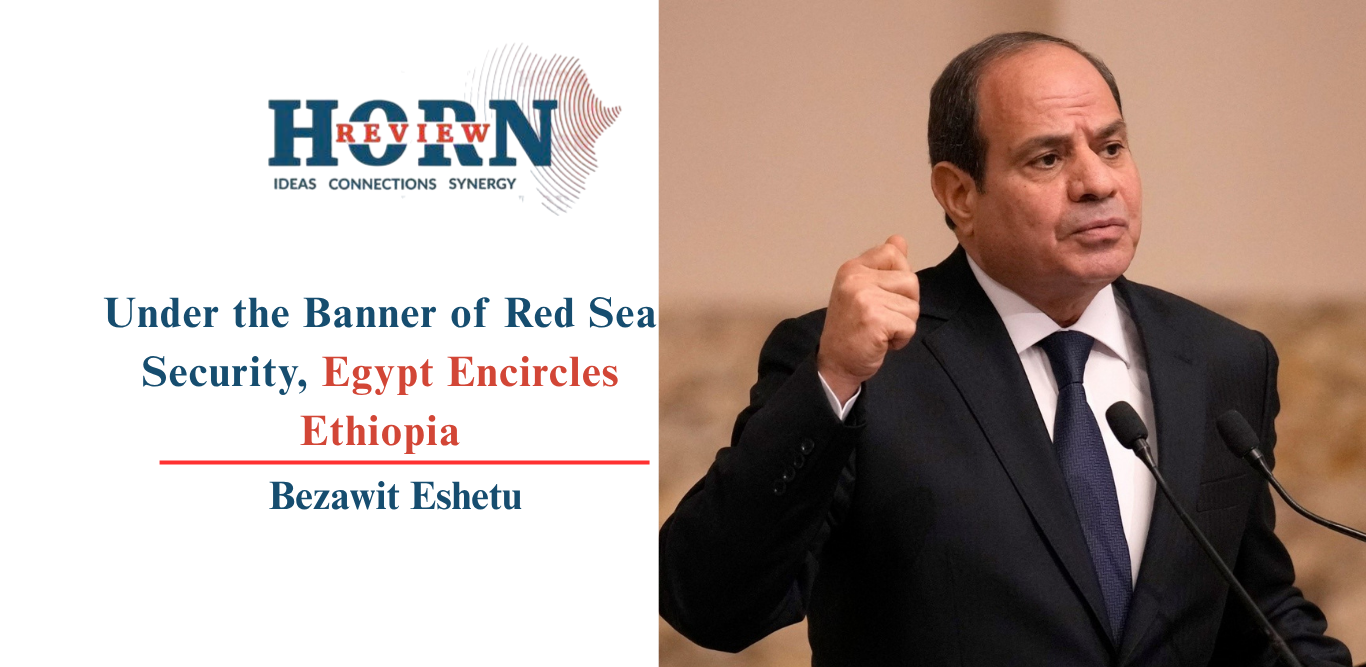
Meta Title: Egypt’s Red Sea Strategy: Naval Expansion, Regional Alliances, and the Strategic Encirclement of Ethiopia
Meta Description: Analyzing Egypt’s 2024–2026 military-diplomatic offensive in the Red Sea—from Berenice Base to the Alamein Declaration—and how naval deployments, port agreements, and security pacts with Somalia, Sudan, and Eritrea are reshaping Ethiopia’s strategic environment.
Focus Keyphrase: Egypt Red Sea strategy Ethiopia encirclement
Slug: egypt-red-sea-strategy-ethiopia-strategic-encirclement
Egypt’s Red Sea Strategy: Naval Expansion, Regional Alliances, and the Strategic Encirclement of Ethiopia
Reports of Egyptian naval movements toward the southern Red Sea in August 2026—amid renewed Houthi threats to shipping and the aftermath of a drone strike at Damietta—have brought a broader strategic question into sharp focus. While Cairo frames these deployments as responses to immediate maritime insecurity, a deeper analysis reveals a coordinated, multi-vector campaign. Since 2024, Egypt has systematically combined naval power projection, port infrastructure agreements, bilateral military pacts, and diplomatic institutionalization to establish a persistent presence around the Horn of Africa.
For Ethiopia—a landlocked nation dependent on the Bab el-Mandeb corridor for over 90% of its foreign trade—this architecture represents a fundamental shift in the regional balance of power. The following analysis breaks down the components, vectors, and implications of Egypt’s evolving Red Sea doctrine.
1. The Catalyst: Damietta, the Saudi Coalition, and the Mandate for Forward Presence
The current phase of escalation traces back to July 30, 2026, when Egypt confirmed a drone strike caused fires aboard two vessels at Damietta port. No group claimed responsibility, but the incident coincided with Riyadh’s announcement of a Saudi-led maritime defence alliance to secure the Red Sea, Bab el-Mandeb, and the Gulf of Aden. Egypt’s immediate integration into this coalition provided a legitimate security mandate for forward naval deployments.
This mandate was reinforced on October 5, 2026, when the Saudi-backed Yemeni government launched a major offensive against Houthi forces. The operation underscored the strategic premium on controlling the Bab el-Mandeb strait. Egyptian naval movements toward the southeastern Red Sea shortly thereafter signaled an intent to convert a temporary coalition role into a permanent forward operating posture.
Strategic Implication: A sustained presence grants Egypt persistent surveillance over Ethiopia’s trade routes, deepens intelligence ties with littoral states, and positions Cairo as the primary arbiter of maritime security governance in the southern Red Sea.
2. The Architecture of Access: Ports, Bases, and Legal Frameworks
Egypt’s reach is not abstract; it is anchored in concrete infrastructure agreements and legal arrangements reported throughout late 2025 and 2026.
A. Assab and Doraleh: The Logistics Chain
In December 2025, Cairo-based sources reported agreements governing the Eritrean port of Assab and the Doraleh multipurpose port in Djibouti. These arrangements reportedly include:
- Naval berthing and refueling rights.
- Deployment of small Egyptian contingents.
- Integration into the coalition’s escort, inspection, and interdiction mission profile.
These facilities extend Egypt’s operational radius from its home waters to the very mouth of the Bab el-Mandeb, creating a logistics chain that supports continuous patrol cycles.
B. Berenice Base: The Southern Hub
Inaugurated by President Sisi on January 15, 2020, Berenice Naval Base (approx. 90km north of the Hala’ib Triangle) serves as the linchpin. Designed as a joint naval, air, and air-defense complex, its stated mandate—protecting the southern coast, economic resources, and the Suez axis—provides cover for power projection toward Sudan, Eritrea, and the strait.
C. The “Coastal State” Governance Model
Egypt has aggressively institutionalized a littoral-state exclusivity doctrine to legitimize this architecture while excluding non-coastal actors—specifically Ethiopia.
- Jan 2020: Founding of the Council of Arab and African States Bordering the Red Sea and Gulf of Aden (Ethiopia excluded).
- Jan 11, 2025: FM Badr Abdelatty rejects naval presence by non-littoral states.
- Oct 31, 2025: Abdelatty declares Ethiopia has no right to participate in Red Sea governance.
- June 8, 2026: President Sisi reiterates exclusivity to Eritrean President Isaias Afwerki in Cairo.
3. The Somali Vector: Depth, Legitimacy, and the Gedo Flashpoint
Somalia represents the most developed military partnership in Egypt’s southern flank strategy.
The Partnership Timeline
- Aug 14, 2024: Military Cooperation Protocol signed.
- Jan 23, 2025: Relations elevated to Strategic Partnership; Cairo commits to training, armament, and counterterrorism support for the Somali National Army (SNA).
- Early 2026: ~1,100 Egyptian troops readied for the AUSSOM mission (AU Support and Stabilization Mission in Somalia).
The Dual-Use Nature of Counterterrorism
While framed around al-Shabaab, this presence yields strategic byproducts directly affecting Ethiopia:
- Institutional Influence: Training programs embed Egyptian doctrine and liaison networks within the SNA federal command structure.
- Infrastructure Dual-Use: Airfields and logistics hubs built for counterterrorism serve equally well for power projection.
- The Gedo Complication: Ethiopia views Gedo region (Beled Hawo, Doolow) as its “outer security perimeter.” Egyptian support for federal units pushing into Gedo—where Jubaland and Ethiopian interests intersect—places a hostile patron on the border of Ethiopia’s Somali Regional State. An Egyptian presence in Gedo converts Ethiopia’s strategic depth into a forward Egyptian defense line.
4. The Sudanese Vector: Conflict-Enabled Leverage and the Al Fashaga Precedent
Sudan offers Egypt a landward vector into Ethiopia’s western flank, amplified by the ongoing civil war.
Precedent and Rhetoric
- Dec 2020: Sudanese forces moved into Al Fashaga while Ethiopia was committed to the Tigray war.
- Dec 2025: SAF Chief Abdel Fattah al-Burhan threatened cross-border action against “mobilizers,” accusing Ethiopia of supporting the RSF (Rapid Support Forces) without credible public evidence.
The Egypt-SAF Alignment
- Allegations: RSF and other sources allege Egyptian K-8 aircraft, ammunition, intelligence, and training support for the SAF. Cairo officially denies direct military intervention but pledges political backing.
- Diplomatic Payoff: Cairo lobbies for SAF recognition as Sudan’s sole legitimate authority.
- Strategic Return: A SAF dependent on Egyptian supplies and diplomacy offers Cairo territory, airspace, and political influence to pressure Ethiopia’s western frontier (Benishangul-Gumuz, Al Fashaga).
The “Conflict Dividend”
Even without direct Egyptian intent, a prolonged Sudanese war benefits Cairo strategically: it absorbs Ethiopian military bandwidth, delays the Ethiopia-Sudan economic corridor, justifies Egyptian deployments on its own southern border, and deepens SAF dependence.
5. Historical Proof of Concept: The 1973 Bab el-Mandeb Blockade
Egypt’s current doctrine has a validated historical precedent. On the first day of the October 1973 War, Egyptian destroyers and submarines—staging from Aden (South Yemen)—interdicted Israeli shipping at Bab el-Mandeb, nearly 2,000 km from home waters.
- Lesson Learned: A state with sufficient reach and host-nation access can control the southern gateway without owning coastline there.
- Doctrinal Continuity: In 2016, Egypt’s Navy Commander explicitly placed the origin of Egyptian national security at Bab el-Mandeb, confirming the institutional memory driving current deployments.
6. Diplomatic Consolidation: The Alamein Declaration and the Asmara Axis
The Asmara Summit (Oct 2024) created a trilateral committee (Egypt, Eritrea, Somalia) covering Sudan, Somalia, and Red Sea security. Throughout 2025, this evolved into a coordinated framework:
- Egypt assumes command of Combined Task Force 153 (April 2025).
- AUSSOM contingent preparation accelerates.
- Eritrean alignment deepens (port access, intelligence sharing).
The Alamein Declaration (Oct 4, 2026)
Signed by Egypt, Sudan, Eritrea, and Somalia, this declaration formalized the bloc.
- Core Principle: Red Sea governance reserved for littoral states.
- The Somalia Paradox: Somalia’s inclusion (justified by its Gulf of Aden coastline and Bab el-Mandeb corridor access) exposes the selectivity of the “geography-only” argument. Ethiopia depends on the exact same corridor for survival but is excluded by definition.
- Issue Linkage: The declaration binds Nile water security, opposition to Somaliland recognition, and Red Sea governance into a single package, aligning Egypt’s core existential concerns with its regional military expansion.
7. The Winter 2025–2026 Convergence: Diplomacy, Access, and Kinetic Signaling
The months between October 2025 and January 2026 demonstrate the “coupling” of the diplomatic and military tracks:
| Date | Diplomatic / Political Track | Military / Access Track |
|---|---|---|
| Oct 31, 2025 | Abdelatty denies Ethiopia Red Sea role; Isaias Afwerki begins 5-day Cairo visit. | Eritrea-Egypt military coordination deepens. |
| Dec 2025 | Port agreements at Assab & Doraleh reported. | Cairo reinforces political/military alignment with SAF (Port Sudan). |
| Dec 27, 2025 | Egyptian Presidency warns on Sudanese security. | Burhan threatens cross-border strikes. |
| Jan 9, 2026 | — | Reports of air strike from southern airbase (potentially Berenice/East Oweinat). |
This synchronization creates a “strategic geometry” where diplomatic rules narrow Ethiopia’s legal space, military partnerships expand Egypt’s physical reach, and security narratives provide perpetual justification.
8. Strategic Geometry: The Encirclement Vectors
Read vector-by-vector, the architecture applies pressure on every Ethiopian approach:
- Northwest (Sudan/SAF): Al Fashaga precedent + SAF dependence on Cairo = Pressure on Tigray/Amhara borders & Benishangul-Gumuz routes.
- West (East Oweinat / Sudanese East): Akinci UAV deployment at East Oweinat (Egypt) + Sudanese military establishment = Surveillance/strike capability over western Ethiopia.
- South/Southeast (Somalia/Gedo): SNA/AUSSOM partnership + Gedo access = Presence on the border of Somali Regional State, negating Ethiopia’s strategic depth.
- Maritime (Bab el-Mandeb / Assab / Doraleh): Naval presence + Interdiction rights = Chokehold on Ethiopian import/export (via Djibouti).
- Diplomatic (Arab/African Forums): Coastal State Doctrine + Alamein Framework = Institutional exclusion of Ethiopian interests; any Ethiopian counter-move framed as “spoiler” behavior.
9. The Coercive Character of Geometry
The potency of this architecture lies in its persistence and deniability.
- Defensible Mandates: Every deployment answers a legitimate request (counterterrorism, sovereignty support, maritime security, border defense).
- Host Nation Consent: Egypt operates by invitation, insulating it from accusations of aggression.
- Conversion Readiness: The infrastructure (Berenice, Assab, Doraleh, Mogadishu airfields, East Oweinat) and legal mandates (CTF-153, AUSSOM, Bilateral Pacts, Alamein Declaration) are already in place.
- Timing Control: Cairo holds the escalation dial. It can shift from “maritime security” to “interdiction of Ethiopian-linked shipping,” or from “counterterrorism training” to “border security operations in Gedo,” without deploying new assets—only re-tasking existing ones.
Conclusion: A Strategic Environment Redefined
Egypt’s Red Sea strategy has moved beyond reactive threat response. It has constructed a self-reinforcing system of access, legitimacy, and partnership that physically and diplomatically surrounds the Ethiopian highlands.
For Addis Ababa, the “pursuit of peaceful access to the sea” articulated by PM Abiy Ahmed in 2024 now confronts a fait accompli: a governance framework that defines Ethiopia out of the region’s decision-making, a military perimeter that monitors its trade and frontiers, and a network of partners incentivized to align with Cairo’s strategic preferences.
The question for 2026 and beyond is not whether Egypt intends to use this leverage, but whether the structure itself—built on valid mandates and sovereign invitations—has already altered the cost-calculus of Ethiopian statecraft irreversibly. The geometry is set; the initiative lies with the architect in Cairo.
Key Entities & Concepts Index (For Schema Markup / Entity SEO)
- Organizations: Egyptian Navy, Saudi-led Maritime Coalition, African Union (AUSSOM), Combined Task Force 153 (CTF-153), Rapid Support Forces (RSF), Sudanese Armed Forces (SAF), Somali National Army (SNA), Council of Arab and African States Bordering the Red Sea and Gulf of Aden.
- Locations: Bab el-Mandeb, Damietta, Berenice Naval Base, Assab Port, Doraleh Port, Hala’ib Triangle, East Oweinat, Al Fashaga, Gedo Region (Beled Hawo, Doolow), Eritrea, Djibouti, Somalia, Sudan.
- Personalities: Abdel Fattah el-Sisi, Badr Abdelatty, Abiy Ahmed, Isaias Afwerki, Abdel Fattah al-Burhan.
- Events/Doctrines: 1973 Bab el-Mandeb Blockade, Coastal State Exclusivity Doctrine, Alamein Declaration (2026), Asmara Summit (2024).
Further Reading & Sources:
