




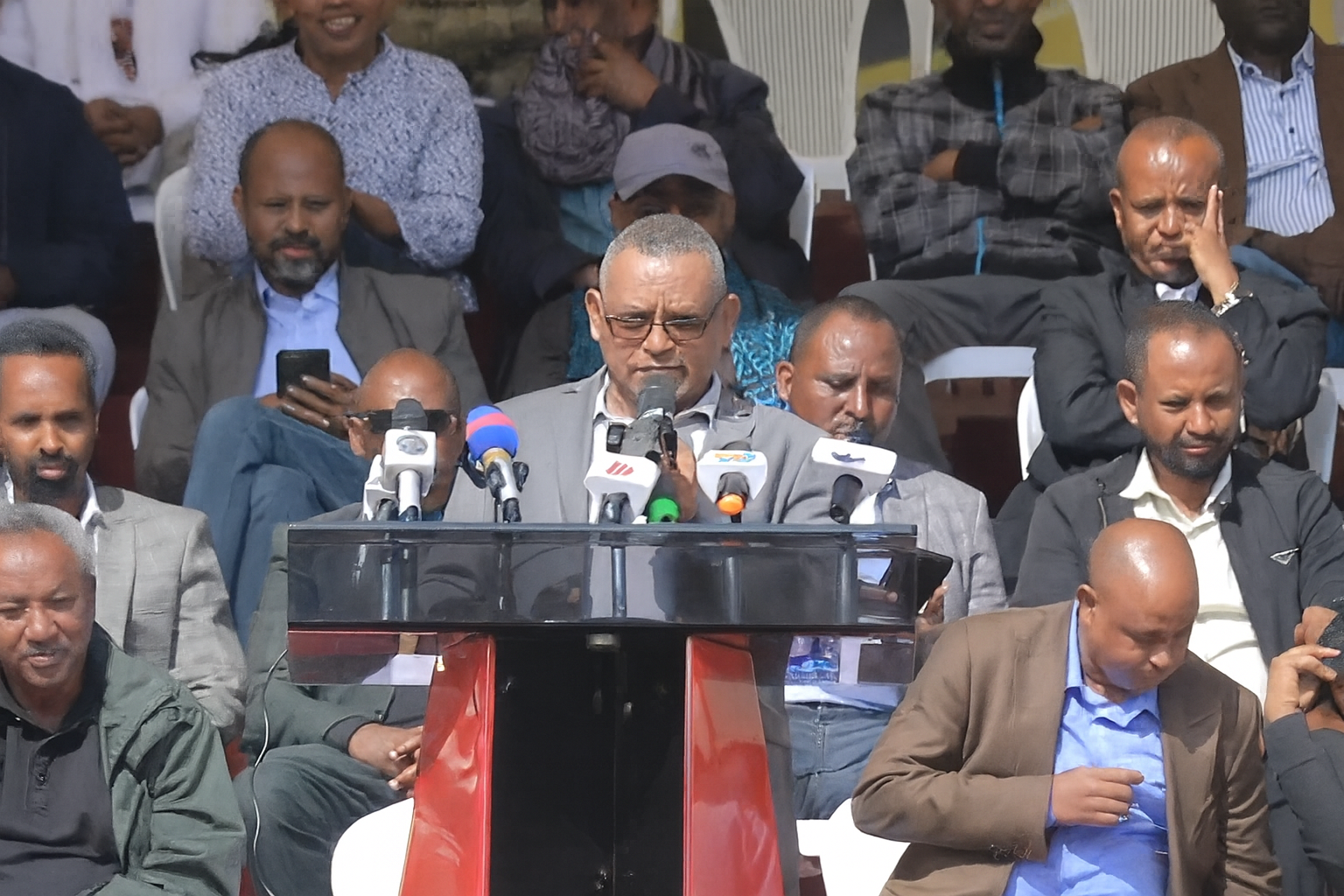
In remarks today, Debretsion Gebremichael, chairman of the Tigray People’s Liberation Front (TPLF) confirmed young people are leaving the Tigray region for other parts of Ethiopia — a clear sign of deep war fatigue. After years of devastation, few appear willing to risk their lives for another cycle of war.
He also acknowledged Eritrean troop infiltration into Tigray — in tacit coordination with the TPLF leadership — raising serious questions about Ethiopia’s sovereignty, territorial integrity, and the myopic political judgment of the region’s leaders.
As migration accelerates, reliance on external backing from Asmara appears to be increasing. That dependence may prove strategically costly, further entangling Eritrea in Tigray’s internal crisis.
Any attempt to reverse course now could carry significant risks for Asmara, including violent backlash by a population reeling from atrocities committed by Eritrean troop during the conflict between 2020 and 2022. What is unfolding looks less like leverage and more like a deepening regional quagmire.
Why Talk of Renewed War in Tigray Is Misplaced
Recent claims that the federal government of Ethiopia intends to reignite conflict against the Tigray region are categorically incorrect. Despite the partially implemented Pretoria Peace Agreement and ongoing tensions, a repeat of the 2020–2022 war in Tigray is not in the federal government’s interest.
This is true even though the hardliners of the Tigray People’s Liberation Front (TPLF) seek to leverage the threat of insurgency and its proxy activity—now enabled through a newly formed, though unwieldy, tactical alliance with the Eritrean regime—to extract concessions from Addis Ababa. For the federal government, another Ethiopian civil war would not serve strategic interests; on the contrary, it would advance the agendas of regional adversaries such as Egypt and Eritrea.
From a long-term perspective, unhindered access to the sea is far more critical to Ethiopia than another internal conflict with Tigray’s recalcitrant rebel leaders. Getting bogged down in Tigray would contradict the strategic calculus of Ethiopia’s armed forces.
Secession Fears and Political Reality
The threat of Tigray secession is overstated. Historically, Tigray has been an integral part of Ethiopia, and despite social media narratives and elite posturing, the population overwhelmingly opposes separation. Geopolitical conditions and internal boundary disputes further discourage secession, and any move toward independence would exacerbate the divisions in the region.
Tigray has deep historical roots within the Ethiopian state, and while political polarization is real, broad-based public appetite for outright independence appears limited. Secession would introduce complex border, economic and security questions that few actors — internal or external — seem prepared to manage.
That said, Eritrea seeks to extend its influence within Tigray, acting as a conduit for Egypt. With a small population and limited resources, Eritrea cannot afford to confront Ethiopia directly, particularly on its own territory. As far as Asmara is concerned any conflict it pursues must occur in Tigray, Amhara, or Afar regions of northern Ethiopia, thus minimizing the impact on Eritrea itself. Eritrea therefore relies on ethnic-based rebels and militants in Ethiopia to secure “strategic depth,” with Egypt providing financial and logistical support.
A federal response that involves full-scale combat in Tigray would escalate Ethiopia’s internal violence and offer little strategic gain. Instead, operations should target the external sources of instability, particularly the destabilizing regime in Eritrea.
Strategic Priorities Beyond Tigray
Ethiopia’s long-term strategic focus lies elsewhere. As a landlocked state of more than 120 million people, access to maritime trade routes remains a central national concern. Any prolonged re-entanglement in Tigray would divert military and political capital from broader regional objectives — including negotiations and positioning related to Red Sea access.
From this vantage point, a renewed war in Tigray offers limited upside and considerable downside. It would absorb military resources, deepen humanitarian strain, and likely draw international scrutiny at a moment when Ethiopia seeks greater economic integration and foreign investment.
Addis Ababa would rather redirect attention toward Ethiopia’s strategic maritime interests, raising patriotic sentiment, and diminishes the advantage currently enjoyed by external adversaries who seek to manipulate Ethiopia’s internal ethnic boundaries.
It would be more fruitful to manage internal conflicts politically and diplomatically, using public relations as a tool. Limited and targeted military operations can neutralize imminent threats when needed, but a large-scale war would entangle Addis Ababa in a costly quagmire. Strategic restraint, rather than escalation, remains the most prudent course. So far this seems to be the path followed by Ethiopia’s federal government, but one cannot discount forces that seek to insnare Ethiopia into another round of devastating civil war. In this regard we’ve noted a series of media misrepresentations and sensationalist claims designed to goad Ethiopian authorities into war. Not least of these is the recent false claim by Reuters of an RSF military training based in Western Ethiopia.
Strategic patience, political prudence, diplomatic pivoting, public relations, combined with military deterrence are needed to skillfully navigate the many trapping laid on the path to Ethiopia’s development and prosperity.
